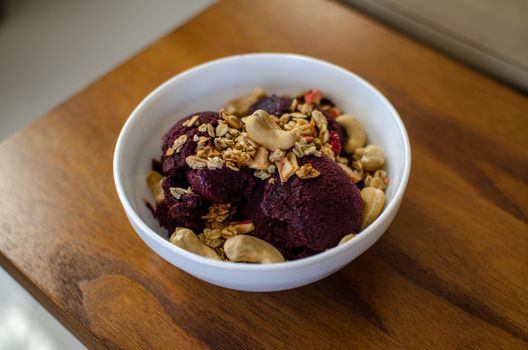
Photo: MESSALA CIULLA / Pexels
The diets react (see scores below)
Common Ingredients
- açaí pulp
- banana
- granola
- strawberries
- blueberries
- honey
- coconut flakes
Specific recipes may vary.
Incompatible with 6 of 11 diets
Diet Ratings
An açaí bowl is one of the most keto-incompatible breakfasts possible. Nearly every ingredient is a significant source of net carbs or added sugar. Banana alone contains ~27g net carbs; granola adds ~30-40g of grain-based carbs; honey is pure sugar (~17g per tablespoon); blueberries and strawberries contribute additional fruit sugars. Even the açaí pulp, while lower in sugar than most fruits, is typically served as a sweetened puree adding more carbs. A standard bowl easily exceeds 80-120g net carbs — multiple times the entire daily keto allowance — before any toppings. Coconut flakes are the only ingredient that could be considered keto-friendly. This dish is fundamentally a high-carb, sugar-dense meal by design.
The açaí bowl is almost entirely plant-based, featuring whole fruits (açaí, banana, strawberries, blueberries), coconut flakes, and granola. However, it includes honey, which the Vegan Society and most major vegan organizations classify as an animal product derived from bees. This single ingredient pushes the dish from a clear 'approve' into contested territory. Without honey, this would be a high-scoring whole-food plant-based meal. The granola could also contain honey or dairy depending on the brand, but evaluating the listed ingredients as stated, honey is the primary concern.
A minority of plant-based eaters and some whole-food plant-based advocates argue that honey from ethically managed local beekeeping does not cause animal suffering and is therefore acceptable. They distinguish between industrial animal agriculture and small-scale beekeeping, viewing honey as compatible with a plant-based lifestyle even if not strictly vegan by organizational definitions.
The açaí bowl is disqualified primarily by granola, which is a grain-based ingredient (typically oats, often with added sugars and seed oils) and a clear paleo violation. Without granola, the dish would be a caution-level bowl due to the natural sugar load from honey, banana, and fruit — but the presence of granola makes this an avoid. The remaining ingredients (açaí pulp, banana, strawberries, blueberries, coconut flakes) are individually paleo-compatible, and honey is a debated-but-accepted natural sweetener in most paleo frameworks. However, granola's grain base is a hard exclusion with high consensus across all major paleo authorities.
An açaí bowl contains several Mediterranean-friendly elements — fresh berries (strawberries, blueberries), banana, and açaí pulp are all whole fruits rich in antioxidants and fiber. However, this dish diverges from Mediterranean diet principles in a few notable ways. Açaí is not a traditional Mediterranean ingredient, and the combination of granola (often made with refined oats, added sugars, and oils), honey (added sugar), and coconut flakes (saturated fat not typical of Mediterranean eating) pushes the dish toward a high-sugar, higher-calorie profile. The granola in particular is frequently a processed product with refined grains and significant added sugar. While the fruit components are excellent, the overall dish as typically constructed is more of an American health-trend food than a Mediterranean staple, and the sugar load from honey, granola, and banana together warrants moderation.
Some Mediterranean diet interpretations would view this bowl more favorably, noting that its core components — diverse fresh fruits and berries — align well with the diet's emphasis on plant-forward eating. If granola is replaced with whole-grain oats or nuts and honey is minimized, the dish moves closer to Mediterranean principles. Traditional Mediterranean breakfasts in Greece and southern Italy often feature fresh fruit prominently.
An Açaí Bowl is entirely plant-derived with zero animal products. Every single ingredient — açaí pulp, banana, granola (grains), strawberries, blueberries, honey, and coconut flakes — is excluded on a carnivore diet. This dish is essentially a concentrated collection of everything the carnivore diet eliminates: fruits, grains, and plant-based toppings. Even honey, which some animal-based practitioners allow, does not redeem a dish that is otherwise 100% plant matter. There is no animal protein, no animal fat, and no carnivore-compatible component whatsoever.
This açaí bowl contains multiple excluded ingredients that make it clearly non-compliant with Whole30. Granola is a grain-based product (typically oats, sometimes wheat or corn), which are entirely excluded from the program. Honey is an added sugar — Whole30 prohibits all added sugars, whether real or artificial, with no exceptions for 'natural' sweeteners like honey, maple syrup, or agave. The remaining ingredients — açaí pulp, banana, strawberries, blueberries, and coconut flakes — are individually Whole30-compatible, but the presence of granola and honey alone are sufficient to disqualify the dish entirely.
This açaí bowl contains multiple high-FODMAP ingredients that make it unsuitable during the elimination phase. Banana is high-FODMAP even at moderate portions (low-FODMAP only at under-ripe, 1/3 medium banana — a full banana is high in fructans and polyols). Honey is high-FODMAP due to excess fructose and should be avoided entirely during elimination. Granola typically contains wheat, honey, or dried fruit, making it high-FODMAP at standard servings. Blueberries become high-FODMAP above 1/4 cup (40g) due to excess fructose and polyols, and açaí bowls typically include generous portions. Açaí pulp itself is not well-tested by Monash but contains polyols. Standard açaí bowl servings are large, meaning even the individually borderline ingredients (blueberries, coconut flakes) will exceed safe thresholds. The combination of banana + honey + likely-wheat granola alone makes this a high-FODMAP dish at any realistic serving size.
An açaí bowl contains several DASH-friendly ingredients — fresh berries (strawberries, blueberries), banana, and açaí pulp are all excellent sources of potassium, fiber, and antioxidants that align well with DASH principles. However, two ingredients introduce concern: coconut flakes contain saturated fat from a tropical oil source, which DASH explicitly limits, and honey adds free/added sugars that DASH discourages. Granola is also a variable ingredient — commercial granola is often high in added sugars, saturated fat, and calories, though a low-sugar whole-grain granola would be more DASH-compatible. The dish lacks lean protein or low-fat dairy, reducing its nutritional completeness as a DASH meal. Sodium is low, which is a positive. Overall, this dish sits in the 'caution' zone: the fruit base is excellent, but the coconut flakes, honey, and typical commercial granola introduce enough DASH-limiting components to prevent a full approval. Substituting unsweetened granola, omitting or minimizing coconut flakes, and replacing honey with a small amount of fresh fruit would move this closer to an 'approve' rating.
NIH DASH guidelines explicitly limit saturated fat and added sugars, which coconut flakes and honey contribute; however, some updated DASH-aligned nutritionists argue that small amounts of whole-food saturated fat sources like coconut and natural sweeteners like honey have a minimal cardiovascular impact when consumed in modest portions within an otherwise nutrient-dense, fruit-heavy meal.
The açaí bowl as constructed is a Zone Diet nightmare in terms of macro balance. It is almost entirely carbohydrate-dominant with virtually no protein and insufficient quality fat to achieve any semblance of the 40/30/30 ratio. The ingredient list compounds the problem by stacking multiple unfavorable or high-glycemic carb sources: banana (explicitly unfavorable in Zone — high glycemic, high sugar fruit), honey (essentially pure sugar, one of the worst Zone offenders), and granola (processed, high-glycemic grain product). Even the more Zone-friendly ingredients — açaí pulp (rich in polyphenols and omega-9 fats, which Sears would approve of in isolation), strawberries, and blueberries (favorable low-glycemic fruits) — are overwhelmed by the surrounding high-glycemic load. Coconut flakes add saturated fat rather than preferred monounsaturated fat. Critically, there is no protein source whatsoever, making it structurally impossible to achieve any Zone block balance without a complete overhaul of the dish. A typical açaí bowl delivers 60-80g of carbohydrates, 5-8g of protein, and 10-15g of fat — the polar opposite of Zone ratios. While Zone is ratio-based rather than exclusion-based, this dish is so far out of balance that it cannot reasonably be incorporated into a Zone meal without being fundamentally reconstructed. It is functionally equivalent to a high-sugar dessert masquerading as a health food.
An açaí bowl has a genuinely mixed anti-inflammatory profile. On the positive side, açaí pulp is exceptionally rich in anthocyanins and polyphenols — among the highest antioxidant-density foods measured by ORAC — and has been associated with reduced inflammatory markers in studies. Blueberries and strawberries are cornerstone anti-inflammatory fruits, packed with flavonoids, vitamin C, and resveratrol. Banana contributes potassium and prebiotic fiber. These components collectively make a strong anti-inflammatory case. However, the dish as commonly served raises several concerns: (1) Honey adds free sugars, and when used generously the glycemic load increases substantially — blood sugar spikes can promote short-term inflammatory responses. (2) Granola is typically made with refined oats, added sugars, and often seed oils (sunflower, canola), making it a mildly pro-inflammatory component. (3) Coconut flakes contribute saturated fat (lauric acid), which is debated but generally falls in the 'limit' category under anti-inflammatory principles. (4) The overall sugar load — açaí pulp (often sweetened in commercial packs), banana, honey, and granola combined — can be significant, potentially offsetting the polyphenol benefits. The dish lands at 'caution' rather than 'approve' because, while the fruit base is excellent, the granola and honey push it into mixed territory. A modified version with unsweetened açaí, minimal honey, low-sugar granola or seeds, and no coconut flakes would score 8-9.
Many anti-inflammatory practitioners and popular media present açaí bowls as a superfood breakfast with little qualification, emphasizing açaí's polyphenol content and the berry mix as strongly anti-inflammatory. However, registered dietitians and nutrition researchers critical of the trend (including pieces in outlets like Healthline and nutrition journals) point out that restaurant and commercial versions routinely deliver 60–80g of sugar per bowl — comparable to a can of soda — which can trigger insulin spikes and inflammatory cascades that negate the antioxidant benefits. Context and portion size matter considerably here.
An açaí bowl as typically constructed is a poor fit for GLP-1 patients despite its health halo. The primary concerns are the near-absence of protein (açaí pulp, banana, berries, honey, and coconut flakes contribute virtually none), a high sugar load from banana, honey, and fruit in combination, and moderate-to-high fat from açaí pulp and coconut flakes. Granola adds refined carbohydrates and is calorie-dense in small volumes — a particular problem when appetite is suppressed and every calorie must work nutritionally. The berries and fruit do provide meaningful fiber and antioxidants, and the water content of the fruit supports hydration, but these positives are outweighed by the sugar density and protein gap. For a GLP-1 patient eating significantly fewer calories, a breakfast with negligible protein fails the #1 dietary priority and will not prevent muscle loss or sustain satiety effectively. This dish would need substantial modification — adding a protein source such as Greek yogurt base, protein powder, or cottage cheese, reducing honey and banana, swapping granola for hemp seeds or chia seeds — to become appropriate.
Some GLP-1-focused dietitians accept modified açaí bowls as an occasional breakfast when protein is added via Greek yogurt or protein powder, arguing the antioxidant and fiber value of berries has merit. However, the standard commercial or homemade version as described here, with no protein source, is broadly discouraged by obesity medicine RDs due to the sugar load and failure to meet protein targets at a meal where calories are already limited.
*See how scores were generated at our methodology page.
Nutritional profile
Six traits that cut across every diet.
Fiber & Plants
How much whole-plant food and fiber it delivers.
Healthy Fats
The quality of its fats (unsaturated, omega-3).
Whole / Unprocessed
How close it is to its natural, unprocessed form.
Gut Gentle
How easy it is on digestion (low FODMAP, few irritants).
Low Glycemic
How little it spikes your blood sugar.
Protein Density
How much protein it packs per calorie.
Controversy Index
Higher controversy = more disagreement between diets.
Diet-Specific Tips
 Vegan — 6/10
View tips
- Honey is classified as an animal product by the Vegan Society and PETA, making this dish non-compliant for most vegans
- All other ingredients — açaí, banana, granola, strawberries, blueberries, coconut flakes — are fully plant-based
- Without honey (or substituting agave/maple syrup), this dish would score 9/10 as a whole-food plant-based meal
- Granola should be checked for dairy or honey as a hidden ingredient depending on brand
- High nutrient density from whole fruits and plant fats makes this otherwise an excellent vegan option
 Mediterranean — 5/10
View tips
- Açaí, strawberries, and blueberries are antioxidant-rich whole fruits — a Mediterranean positive
- Granola is typically a processed product with refined grains and added sugars — a Mediterranean negative
- Honey adds significant free sugars, which Mediterranean guidelines minimize
- Coconut flakes introduce saturated fat atypical of Mediterranean fat sources (olive oil preferred)
- Banana adds natural fruit but also contributes to a high glycemic load when combined with granola and honey
- No olive oil, legumes, or other Mediterranean staples present
- Not a traditional Mediterranean dish — American health-trend origin
 DASH — 5/10
View tips
- Açaí, banana, strawberries, and blueberries are DASH-approved fruits rich in potassium and fiber
- Coconut flakes are a tropical oil source high in saturated fat, explicitly limited by DASH
- Honey adds free/added sugars, which DASH discourages
- Granola is frequently high in added sugars and saturated fat in commercial forms; whole-grain low-sugar versions are preferable
- Dish is very low in sodium, which is a DASH positive
- No lean protein or low-fat dairy included, limiting DASH nutritional completeness
 Anti-Inflammatory — 6/10
View tips
- Açaí pulp: very high in anthocyanins and polyphenols — strongly anti-inflammatory
- Blueberries and strawberries: flavonoid-rich, well-supported by anti-inflammatory research
- Banana: beneficial fiber and micronutrients, moderate glycemic contribution
- Honey: adds free sugars; glycemic impact can promote transient inflammation
- Granola: often contains added sugars and seed oils — mildly pro-inflammatory component
- Coconut flakes: high in saturated fat (lauric acid) — falls in 'limit' category
- Combined sugar load from sweetened açaí packs + banana + honey + granola can be substantial
 GLP-1 Friendly — 5/10
View tips
- Negligible protein — fails the 15-30g per meal protein target entirely
- High sugar load from banana, honey, and combined fruit volume
- Granola is calorie-dense with low protein density, poor fit for reduced-appetite eating
- Açaí pulp and coconut flakes contribute saturated fat
- Berries provide some fiber and antioxidants — a partial positive
- Fruit water content modestly supports hydration
- Would require significant reformulation to be GLP-1 appropriate