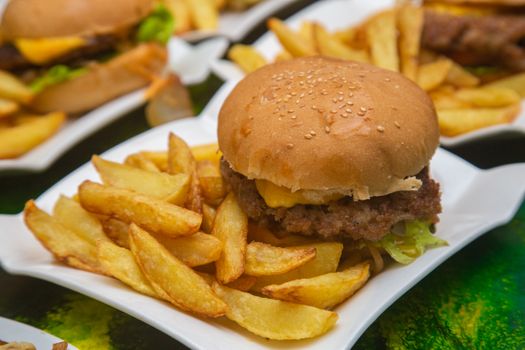
Photo: Audy of Course / Pexels
American
Beef Burger with Fries
The diets react (see scores below)
Common Ingredients
- ground beef
- hamburger bun
- lettuce
- tomato
- onion
- cheese
- ketchup
- french fries
Specific recipes may vary.
Incompatible with 11 of 11 diets
Diet Ratings
A classic beef burger with fries is heavily incompatible with ketogenic eating in its standard form. The hamburger bun alone contributes roughly 25-30g of net carbs, the french fries add another 40-50g, and ketchup adds additional sugar. Together, these three components alone can exceed an entire day's keto carb budget multiple times over. While the ground beef and cheese are keto-friendly, and lettuce/tomato/onion are manageable in small amounts, the core structural components (bun and fries) make this dish a clear avoid. The only keto-compatible version would require removing the bun entirely (lettuce wrap), eliminating the fries, and replacing ketchup with mustard — which would be an entirely different dish.
A beef burger with cheese contains multiple animal products that are unambiguously excluded from a vegan diet. Ground beef is animal flesh, and cheese is a dairy product derived from animal milk. Both are core violations of vegan principles. The remaining ingredients — hamburger bun, lettuce, tomato, onion, ketchup, and french fries — are typically plant-based, but the presence of beef and cheese makes this dish entirely incompatible with veganism.
This dish contains multiple paleo-excluded ingredients. The hamburger bun is made from wheat (a grain), which is strictly forbidden in all paleo frameworks. Cheese is dairy, also excluded. Ketchup is a processed condiment typically containing refined sugar and additives. French fries, while made from potatoes, are almost universally deep-fried in seed oils (canola, soybean, or vegetable oil) and heavily salted, making them non-compliant. While the core ingredients — ground beef, lettuce, tomato, and onion — are paleo-approved, the dish as traditionally constructed is dominated by non-paleo components. A paleo adaptation (lettuce wrap, no cheese, no ketchup, oven-baked fries in avocado oil) could shift the rating, but the standard dish as presented is clearly non-compliant.
A beef burger with fries is a near-perfect inversion of Mediterranean diet principles. Ground beef is red meat, which the Mediterranean diet restricts to a few times per month. The hamburger bun is a refined grain with little nutritional value. French fries are deep-fried in non-olive oils and represent highly processed, calorie-dense starchy food. Ketchup adds sugar and sodium. Cheese in this context contributes saturated fat beyond moderate dairy guidelines. While lettuce, tomato, and onion are positive elements, they are overwhelmed by the problematic components. This dish is a hallmark of Western fast food culture, which stands in direct contrast to the traditional Mediterranean dietary pattern.
While the ground beef patty itself is carnivore-approved, this dish is overwhelmingly non-carnivore. The hamburger bun is a grain-based processed food, french fries are plant-based starch, and the toppings — lettuce, tomato, onion — are all excluded vegetables. Ketchup contains sugar and tomato paste. Even the cheese is debated on strict carnivore. The dish as served is fundamentally incompatible with the carnivore diet; only the beef patty could be salvaged by eating it in isolation.
This dish contains multiple Whole30-excluded ingredients. The hamburger bun is a grain-based bread product, which is excluded both as a grain and as a recreated baked good/bread item. Cheese is dairy, which is excluded. Ketchup typically contains added sugar. French fries, while potatoes themselves are Whole30-compliant, are explicitly listed as a excluded 'junk food' recreation (tots/fries). The ground beef, lettuce, tomato, and onion are compliant, but the overall dish has too many non-compliant components to salvage without a complete rebuild.
This dish contains multiple high-FODMAP ingredients that make it unsuitable during the elimination phase. The hamburger bun is made from wheat flour, which is high in fructans — a major FODMAP trigger. Onion is one of the highest-FODMAP foods tested by Monash University, containing significant fructans even in small amounts. Cheese in a standard burger is typically a processed or soft cheese (e.g., American, cheddar slices) — while hard cheddar is low-FODMAP, processed cheese slices may contain additives. Ketchup often contains high-fructose corn syrup or excess fructose, and is high-FODMAP at typical serving sizes (>13g). The ground beef patty, lettuce, tomato, and french fries (plain, potato-based) are themselves low-FODMAP, but the combination of the wheat bun, raw onion, and ketchup makes the overall dish high-FODMAP with no realistic way to consume it in a standard form during elimination.
A beef burger with fries is highly problematic for the DASH diet on multiple fronts. Ground beef (especially standard 80/20 blend) is high in saturated fat, which DASH explicitly limits. The dish as a whole — with cheese, ketchup, a refined-flour bun, and deep-fried french fries — combines high sodium, high saturated fat, refined carbohydrates, and added sugars. A typical fast-food or restaurant beef burger with fries can exceed 1,500–2,000mg of sodium in a single meal, approaching or surpassing the entire day's sodium allotment under the standard DASH plan (2,300mg) and well exceeding the low-sodium DASH limit (1,500mg). Red meat is explicitly limited on DASH, full-fat cheese adds saturated fat and sodium, and french fries are a fried, high-sodium processed food with no meaningful nutritional benefit for DASH goals. The only DASH-friendly elements are the lettuce, tomato, and onion, which are negligible in the context of this dish's overall nutritional profile.
A classic beef burger with fries is one of the most Zone-unfavorable combinations possible. The dish fails on nearly every macronutrient dimension simultaneously. The french fries are extremely high-glycemic (potatoes are explicitly listed as 'unfavorable' carbs in Sears' writings), and the hamburger bun adds refined, high-glycemic carbohydrates on top of that — creating a massive carbohydrate overload that would spike insulin dramatically. The ground beef is typically high in saturated fat rather than monounsaturated fat, and the cheese compounds the saturated fat load. The ketchup adds sugar-based carbohydrates. The 40/30/30 ratio is essentially impossible to achieve with this combination as served: carbohydrates are far above 40% of calories from two high-glycemic sources, fat skews heavily saturated, and the protein-to-carb ratio is wildly imbalanced. While Zone is ratio-based rather than exclusionary, this dish presents multiple simultaneous violations — high-glycemic carbs, saturated fat dominance, processed ingredients, no low-GI vegetables contributing meaningfully to the macro balance — making it genuinely very difficult to incorporate. The only Zone-favorable elements are the lettuce, tomato, and onion, which are minimal. A heavily modified version (lettuce wrap, no fries, leaner beef) could score much higher, but as presented this is a near-canonical example of a Zone-unfavorable meal.
A classic beef burger with fries is a prototypical pro-inflammatory meal across virtually every anti-inflammatory framework. Ground beef is high in saturated fat and arachidonic acid, both of which promote inflammatory signaling (elevated CRP, IL-6, NF-κB activation). The hamburger bun is a refined carbohydrate with a high glycemic load, spiking blood sugar and triggering inflammatory cascades. Cheese adds additional saturated fat. Ketchup typically contains high-fructose corn syrup and added sugars. French fries are deep-fried in seed/vegetable oils (typically high-omega-6 corn, soybean, or sunflower oil), and the high-heat frying process generates advanced glycation end-products (AGEs) and potentially acrylamide — both potent pro-inflammatory compounds. The only redeeming ingredients are lettuce, tomato, and onion, which provide modest antioxidants and polyphenols (quercetin in onion, lycopene in tomato), but these are far outweighed by the inflammatory load of the rest of the dish. This meal hits nearly every 'limit' and 'avoid' category simultaneously: red meat, refined carbs, saturated fat, added sugar, and high-omega-6 fried oils.
A standard beef burger with fries is a poor fit for GLP-1 patients on nearly every relevant dimension. Ground beef (especially at typical 80/20 fat ratios) is high in saturated fat, which worsens nausea, bloating, and reflux — already elevated side effects on GLP-1 medications. The hamburger bun is a refined carbohydrate with minimal fiber or protein contribution. French fries are deep-fried, high in fat, and nutritionally empty per calorie — one of the clearest avoid foods in this dietary framework. Cheese adds additional saturated fat. Ketchup contributes added sugar. The combination of high fat, fried food, refined carbs, and large portion size creates a compounding GI risk for GLP-1 patients. While the meal does contain some protein from the beef patty, the fat-to-protein ratio and overall nutritional profile make it a poor vehicle for that protein. Small modifications (leaner patty, lettuce wrap, no fries) could substantially improve the rating, but as typically prepared and served, this dish is not appropriate.
*See how scores were generated at our methodology page.
Nutritional profile
Six traits that cut across every diet.
Fiber & Plants
How much whole-plant food and fiber it delivers.
Healthy Fats
The quality of its fats (unsaturated, omega-3).
Whole / Unprocessed
How close it is to its natural, unprocessed form.
Gut Gentle
How easy it is on digestion (low FODMAP, few irritants).
Low Glycemic
How little it spikes your blood sugar.
Protein Density
How much protein it packs per calorie.
Controversy Index
Higher controversy = more disagreement between diets.