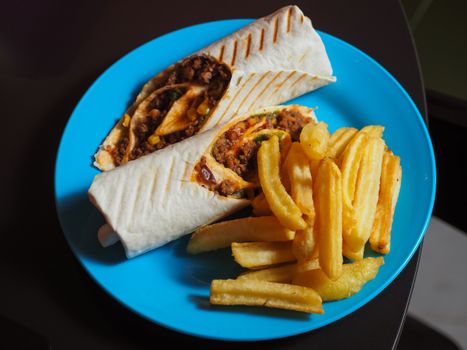
Mexican
Beef Burrito
The diets react (see scores below)

That’s a heavy plate — want to see the leaner version?
Common Ingredients
- flour tortillaWhole wheat tortilla+0.5
Whole wheat tortilla replaces refined flour with whole-grain wheat: fiber rises from ~3.5g to ~9.8g per 100g and the high-glycemic refined-grain penalty cited by zone, glp-1, anti-inflammatory and mediterranean falls correspondingly. Sodium and total carbs sit lower; the wrap form factor is unchanged.
- ground beefGround turkey+1.0
Ground turkey roughly halves the saturated fat content (~3g vs ~7g per 4oz cooked serving) and meaningfully lowers the cholesterol load. Protein and overall caloric profile stay similar, so the dish stays a ground-meat dish; the red-meat / saturated-fat penalty cited by DASH, mediterranean, and anti-inflammatory frameworks is substantially reduced.
- refried beans
- Mexican riceBrown rice+0.5
Brown rice swaps a refined-white starchy base (Mexican rice is white rice with oil and salt) for whole-grain rice with ~4× the fiber and no added cooking oil or sodium. Zone and glp-1 both flag the glycemic profile; brown rice lowers that meaningfully without changing the cuisine.
- cheddar cheese
- salsa
- sour cream
- onion
Specific recipes may vary.
Incompatible with 9 of 11 diets
Diet Ratings
A beef burrito is fundamentally incompatible with ketogenic eating. The flour tortilla alone contributes approximately 35-45g of net carbs, instantly approaching or exceeding the entire daily keto carb budget. Compounding this, refried beans add another 20-25g net carbs and Mexican rice contributes an additional 35-45g net carbs. Combined, this dish easily delivers 90-120g+ of net carbs in a single serving — three to six times the daily keto limit. While individual components like ground beef, cheddar cheese, sour cream, and salsa are keto-friendly in isolation, the structural carbohydrate load from the tortilla, beans, and rice makes this dish completely incompatible with ketosis in its standard form.
The Beef Burrito contains multiple animal-derived ingredients that are strictly prohibited on a vegan diet. Ground beef is slaughtered animal flesh, cheddar cheese is a dairy product derived from cow's milk, and sour cream is also a dairy product. These three ingredients alone make this dish unequivocally non-vegan. There is no ambiguity or debate within the vegan community regarding any of these ingredients.
The Beef Burrito is overwhelmingly non-paleo. The flour tortilla is a grain-based product (wheat), which is explicitly excluded from the paleo diet. Refried beans are a legume, also strictly prohibited. Mexican rice is another grain violation. Cheddar cheese and sour cream are dairy products, excluded under paleo rules. The only paleo-compliant ingredients in this dish are the ground beef, salsa (depending on preparation), and onion. With five out of eight ingredients being clear paleo violations — including grains, legumes, and dairy — this dish cannot be considered paleo in any interpretation.
The Beef Burrito is a poor fit for the Mediterranean diet on multiple fronts. Ground beef is a red meat that the Mediterranean diet restricts to a few times per month, making it a problematic primary protein. The flour tortilla is a refined grain, which the diet discourages in favor of whole grains. Refried beans, while beans themselves are a Mediterranean staple, are often prepared with lard or excess saturated fat. Mexican rice is typically made with refined white rice and added oils. Cheddar cheese and sour cream add significant saturated fat from dairy beyond moderate levels. The overall dish is calorie-dense, saturated fat-heavy, and built around refined carbohydrates — contradicting core Mediterranean principles. The only redeeming elements are the salsa and onion (vegetables) and the legume base of the refried beans.
A beef burrito is almost entirely incompatible with the carnivore diet. While ground beef is the one carnivore-approved ingredient, it is surrounded by a cascade of excluded plant-based foods: a flour tortilla (grain-based carbohydrate), refried beans (legumes), Mexican rice (grain), salsa (vegetables/fruit), and onion (vegetable). Cheddar cheese and sour cream are dairy and debated within the community, but they are irrelevant here given the overwhelming volume of strictly forbidden plant foods. This dish is a textbook example of a mixed, plant-dominant meal that violates nearly every core carnivore principle. There is no meaningful way to adapt a burrito for carnivore eating without deconstructing it entirely and discarding most of its components.
A Beef Burrito contains multiple excluded ingredients that make it clearly non-compliant with Whole30. The flour tortilla is made from wheat (a grain) and is also explicitly listed as a prohibited 'wrap' under the no-recreating-junk-food rule. Refried beans are legumes, which are excluded. Mexican rice contains rice, a prohibited grain. Cheddar cheese and sour cream are dairy products, both excluded. This dish fails on at least five separate Whole30 rules simultaneously, making it one of the most non-compliant dishes possible.
This beef burrito contains multiple high-FODMAP ingredients that make it clearly unsuitable during the elimination phase. Flour tortilla is made from wheat and is high in fructans. Refried beans are high in GOS (galacto-oligosaccharides) and fructans. Onion is one of the highest-FODMAP foods known, rich in fructans. Mexican rice often contains onion and garlic in its preparation. Salsa typically contains onion and garlic. Even in small amounts, fructans from the tortilla and onion alone would make this dish high-FODMAP. The combination of wheat-based tortilla, legumes, and alliums creates a triple-FODMAP threat with no realistic way to consume a standard serving within safe limits. Ground beef and cheddar cheese are low-FODMAP, but they are the minority of problematic ingredients here.
A beef burrito as commonly prepared is problematic for DASH diet adherence on multiple fronts. Ground beef (especially standard 80/20) is high in saturated fat, which DASH explicitly limits. The flour tortilla is a refined grain, not a whole grain. Refried beans, while a legume source, are typically made with lard and high sodium. Cheddar cheese is full-fat dairy, contrary to DASH's low-fat dairy emphasis. Sour cream adds saturated fat. Mexican restaurant-style rice is typically made with white rice, oil, and sodium. Salsa can be a reasonable vegetable component but often adds sodium. Together, a typical beef burrito can easily contain 1,000–1,500mg of sodium and 15–25g of saturated fat in a single serving — far exceeding DASH targets for a single meal. Red meat is specifically called out as a food to limit under DASH guidelines. The overall nutritional profile is the antithesis of a DASH-aligned meal.
A beef burrito as typically constructed presents multiple Zone Diet challenges. The flour tortilla is a high-glycemic refined carbohydrate — an 'unfavorable' carb in Zone terminology that causes rapid insulin spikes. Mexican rice compounds this with another high-glycemic starch. Together, these two ingredients alone likely exceed a full meal's carbohydrate block allotment while being the wrong *type* of carbs. Ground beef, while a workable protein source, is fattier than Zone-preferred lean proteins (skinless chicken, fish), adding excess saturated fat. Refried beans offer some redeeming value as a lower-glycemic protein/carb combo with fiber, but are often prepared with lard. Cheddar cheese and sour cream add significant saturated fat, throwing the fat ratio toward unfavorable sources rather than monounsaturated fats. Salsa and onion are Zone-favorable (low-glycemic polyphenol-rich vegetables). The macro ratio of a standard burrito skews heavily toward carbohydrates (60%+) with fat dominated by saturated sources — essentially the inverse of Zone ideals. While the Zone is ratio-based and not exclusionary, a standard restaurant or home burrito is very difficult to balance into Zone ratios without fundamental reconstruction (low-carb tortilla, lean beef or chicken, eliminating rice, adding avocado for fat, doubling vegetables).
The beef burrito presents multiple pro-inflammatory concerns that accumulate across its ingredient list. Ground beef is a red meat high in saturated fat and arachidonic acid, both of which are associated with elevated inflammatory markers (CRP, IL-6) when consumed regularly. The flour tortilla is a refined carbohydrate with a high glycemic index, contributing to insulin spikes and downstream inflammatory signaling. Mexican rice is typically made with white rice, another refined carb. Cheddar cheese and sour cream are full-fat dairy products high in saturated fat — both in the 'limit' category. Refried beans are a genuinely anti-inflammatory ingredient (legumes are emphasized in the framework), and salsa and onion provide polyphenols and antioxidants. However, the positives are substantially outweighed by the combination of red meat, refined carbohydrates, and full-fat dairy. The dish as a whole represents a convergence of the anti-inflammatory diet's primary 'limit' and 'avoid' categories, making it a poor fit for this dietary framework as typically composed.
A standard beef burrito presents a mixed nutritional profile for GLP-1 patients. Ground beef and refried beans together provide meaningful protein (roughly 25-35g depending on portion), and beans add fiber. However, the combination of a large flour tortilla (refined carbs, low fiber), Mexican rice (more refined carbs), cheddar cheese, and sour cream significantly raises the fat and calorie load — particularly saturated fat — which worsens GLP-1 side effects like nausea, bloating, and reflux. The overall volume and caloric density of a full burrito also conflicts with the small-portion requirement. Slowed gastric emptying means this heavy, dense meal will sit in the stomach longer, increasing discomfort. Refried beans and onion may additionally contribute to gas and bloating. A deconstructed or modified version — e.g., a burrito bowl with lean ground beef, black beans, salsa, and vegetables over a small portion of rice, skipping the tortilla, cheese, and sour cream — would rate considerably higher.
Some GLP-1-focused dietitians note that the refried beans and ground beef combination delivers a reasonable protein-and-fiber pairing that satisfies in a small portion, and may recommend a half-portion burrito as an acceptable occasional meal. Others counter that the saturated fat load from cheese, sour cream, and fattier ground beef cuts is a consistent GI trigger in their patient populations and advise against this dish category entirely.
*See how scores were generated at our methodology page.
Nutritional profile
Six traits that cut across every diet.
Fiber & Plants
How much whole-plant food and fiber it delivers.
Healthy Fats
The quality of its fats (unsaturated, omega-3).
Whole / Unprocessed
How close it is to its natural, unprocessed form.
Gut Gentle
How easy it is on digestion (low FODMAP, few irritants).
Low Glycemic
How little it spikes your blood sugar.
Protein Density
How much protein it packs per calorie.
Controversy Index
Higher controversy = more disagreement between diets.
Diet-Specific Tips
 Zone — 4/10
View tips
- Flour tortilla is a high-glycemic 'unfavorable' carb — drives insulin spike and dominates carb blocks with poor nutrient density
- Mexican rice adds a second high-glycemic starch, pushing total carbs far beyond Zone 40% target
- Ground beef has higher saturated fat than Zone-preferred lean proteins; portion would need to be modest (~2 oz) to fit protein blocks
- Refried beans partially redeem the carb profile (lower GI, added fiber reduces net carbs) but often contain lard
- Cheddar and sour cream add saturated fat, not the monounsaturated fat Zone prioritizes
- Salsa and onion are Zone-favorable low-glycemic polyphenol-rich ingredients
- Overall macro ratio of a standard burrito (~60% carbs, high saturated fat) is nearly opposite to Zone 40/30/30 target
- Could theoretically be adapted (smaller low-carb tortilla, lean beef or chicken, no rice, avocado instead of sour cream) but as served is difficult to Zone-balance
 GLP-1 Friendly — 4/10
View tips
- Ground beef and refried beans provide ~25-35g protein — meets per-meal protein target
- Refined flour tortilla and Mexican rice add carbohydrate volume with minimal fiber
- Cheddar cheese and sour cream add significant saturated fat — known GLP-1 side effect trigger
- High overall caloric density and large portion size conflict with small-meal requirement
- Refried beans and onion may worsen bloating due to slowed gastric emptying
- Salsa is a positive — low calorie, adds micronutrients and hydration
- Dish is highly modifiable — removing tortilla, cheese, and sour cream substantially improves rating