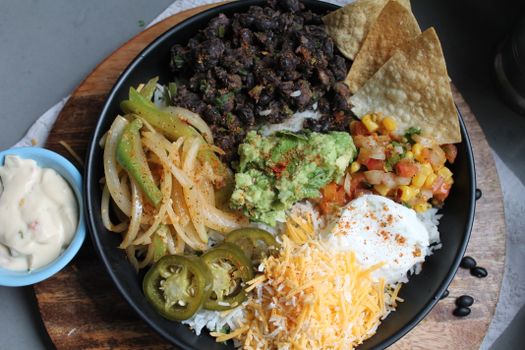
Photo: Nourishment DECODED / Pexels
Mexican
Beef Burrito Bowl
The diets react (see scores below)
Common Ingredients
- seasoned ground beef
- cilantro lime rice
- black beans
- salsa
- cheddar cheese
- sour cream
- corn
- lettuce
Specific recipes may vary.
Incompatible with 7 of 11 diets
Diet Ratings
The Beef Burrito Bowl is heavily incompatible with ketogenic eating due to multiple high-carb ingredients. Cilantro lime rice is a grain-based starch delivering roughly 40-45g net carbs per standard serving alone — enough to break ketosis by itself. Black beans add another 20-25g net carbs, corn contributes an additional 15-20g, and salsa adds minor carbs on top. Together, these three ingredients easily push a single bowl to 80-100g+ net carbs, far exceeding the entire daily keto limit of 20-50g. The seasoned ground beef, cheddar cheese, and sour cream are keto-friendly elements, and lettuce is benign, but these positives are completely overwhelmed by the carbohydrate load of the rice, beans, and corn. This dish as traditionally composed is fundamentally incompatible with ketosis.
The Beef Burrito Bowl contains multiple animal products that are strictly excluded from a vegan diet. Seasoned ground beef is animal flesh, cheddar cheese is a dairy product, and sour cream is also dairy-derived. Any single one of these ingredients would be sufficient to disqualify this dish; the combination of three distinct animal-derived components makes this unambiguously non-vegan. The remaining ingredients — cilantro lime rice, black beans, salsa, corn, and lettuce — are fully plant-based, but they cannot offset the presence of meat and dairy.
The Beef Burrito Bowl contains multiple non-paleo ingredients that are clear violations by all major paleo authorities. Cilantro lime rice is a grain (rice), which is explicitly excluded. Black beans are a legume, also clearly excluded. Corn is a grain and excluded. Cheddar cheese and sour cream are both dairy products, excluded under paleo rules. The only paleo-compliant ingredients in this dish are the seasoned ground beef (assuming no added salt or non-paleo seasonings), salsa (if made without additives), and lettuce. With five out of eight ingredient categories being non-paleo violations — grains, legumes, dairy (×2), and corn — this dish is fundamentally incompatible with a paleo diet.
The Beef Burrito Bowl is centered on seasoned ground beef as its primary protein, which directly conflicts with Mediterranean diet principles that limit red meat to only a few times per month. The dish also includes refined white rice (cilantro lime rice), sour cream, and cheddar cheese, adding saturated fat from dairy sources. While some ingredients — black beans, corn, lettuce, and salsa — are plant-forward and Mediterranean-friendly, the overall composition is dominated by red meat and high-fat dairy, making this dish a poor fit. The absence of olive oil, whole grains, fish, or any distinctly Mediterranean elements further distances it from the dietary pattern.
The Beef Burrito Bowl is almost entirely incompatible with the carnivore diet. While the seasoned ground beef is the one animal-derived component, it is surrounded by a majority of plant-based ingredients that are strictly excluded: cilantro lime rice (grain), black beans (legume), salsa (plant-based), corn (grain/vegetable), and lettuce (vegetable). The cheddar cheese and sour cream are dairy and would be debated, but they are minor factors here. The dish as a whole is a plant-heavy Mexican bowl that fundamentally contradicts carnivore principles. Even the ground beef is 'seasoned,' implying plant-based spices or additives. This dish cannot be modified into a carnivore meal without replacing virtually every component.
This dish contains multiple excluded ingredients: rice (a grain), black beans (legumes), cheddar cheese (dairy), sour cream (dairy), and corn (a grain). With five distinct Whole30 violations, this dish is firmly off-limits in its current form.
This Beef Burrito Bowl contains multiple high-FODMAP ingredients that make it unsuitable during the elimination phase. Black beans are high in GOS (galacto-oligosaccharides) and are high-FODMAP even in small servings — a standard burrito bowl portion would far exceed any safe threshold. Seasoned ground beef is a significant concern: commercial taco/burrito seasoning blends almost universally contain garlic and onion powder, which are among the highest-FODMAP ingredients possible (fructans). Sour cream contains lactose and is high-FODMAP at typical serving sizes (>2 tbsp). Cheddar cheese is low-FODMAP (aged, hard cheese with minimal lactose). Rice is low-FODMAP. Salsa typically contains onion and garlic, making it high-FODMAP. Corn is low-FODMAP at ~38g (half a cob equivalent) but could be borderline at larger portions. Lettuce and cilantro are low-FODMAP. The combination of black beans, seasoned beef (garlic/onion powder), salsa with onion/garlic, and sour cream creates a dish with at least three independent high-FODMAP sources, making avoidance necessary during elimination.
The Beef Burrito Bowl is a mixed dish with both DASH-friendly and DASH-problematic components. On the positive side, black beans are an excellent DASH food (high in fiber, potassium, magnesium, and plant protein), corn and lettuce add vegetables, and salsa contributes vegetables with minimal calories. However, the dish has several DASH concerns: ground beef is a red meat that DASH limits due to saturated fat content; cheddar cheese is full-fat dairy, which DASH discourages in favor of low-fat dairy; sour cream is a full-fat dairy product high in saturated fat; and seasoned ground beef typically carries significant sodium from seasoning blends. The cilantro lime rice, while acceptable, is likely made from white rice rather than whole grains, missing a DASH whole-grain opportunity. The combination of red meat, full-fat dairy (cheese + sour cream), and high-sodium seasoning makes this a food that requires substantial modification to align with DASH principles. Swapping ground beef for grilled chicken or fish, using low-fat or no cheese, replacing sour cream with plain low-fat Greek yogurt, using brown rice, and choosing low-sodium seasoning would significantly improve DASH compatibility.
A Beef Burrito Bowl contains several Zone-compatible elements alongside multiple problematic ones, making it a mixed bag that requires significant modification rather than outright avoidance. On the positive side: black beans provide a decent low-glycemic carb and protein combo, salsa is a polyphenol-rich low-calorie carb block, and lettuce adds favorable fibrous vegetable volume. However, the dish has several Zone concerns: (1) Ground beef is acceptable protein but typically carries more saturated fat than Zone-preferred lean proteins like skinless chicken or fish — lean ground beef (90%+) would be needed. (2) Cilantro lime rice is a white-rice-based carb, which is high-glycemic and unfavorable in Zone terminology. (3) Corn is a starchy, higher-glycemic vegetable that Sears classifies as unfavorable. (4) Cheddar cheese adds saturated fat and dairy protein without being a preferred fat or protein source. (5) Sour cream adds saturated fat with minimal Zone nutritional value. The 40/30/30 ratio is achievable with careful portioning — reduce rice significantly, eliminate or minimize corn, replace sour cream with avocado or guacamole for monounsaturated fat, use lean beef, and lean on the black beans and salsa. As assembled in a typical restaurant or home serving, the bowl skews high-carb and high-saturated fat, disrupting Zone balance.
Some Zone practitioners and Sears' later writings (particularly around the anti-inflammatory Zone) place less strict emphasis on eliminating white rice entirely, viewing small portions as manageable within blocks. Additionally, black beans' combined carb+protein profile means the bowl's protein-to-carb ratio may be more forgiving than it first appears. A Zone-informed practitioner might approve a modified version of this bowl — halved rice, guacamole instead of sour cream and cheese, and lean beef — as a workable 3-block Zone meal.
This burrito bowl presents a mixed anti-inflammatory profile. On the positive side, black beans are an excellent anti-inflammatory food — high in fiber, polyphenols, and plant protein. Salsa typically contains tomatoes, onions, and chili peppers, all of which carry antioxidants and anti-inflammatory compounds (lycopene, quercetin, capsaicin). Corn offers some fiber and carotenoids (lutein, zeaxanthin). Lettuce adds modest antioxidants. Cilantro is a mild anti-inflammatory herb. The rice is likely white rice, which is a refined carbohydrate with minimal anti-inflammatory benefit — a neutral-to-slightly-negative component. The central concern is the primary protein: ground beef is red meat, which anti-inflammatory frameworks recommend limiting due to saturated fat content and pro-inflammatory arachidonic acid. Cheddar cheese and sour cream add full-fat dairy, which is in the 'limit' category — contributing saturated fat that can modestly elevate inflammatory markers like CRP. The dish is not disqualifying — the beans, salsa, and vegetables provide meaningful anti-inflammatory offset — but the combination of red meat plus full-fat dairy tips the bowl into caution territory. Substituting ground turkey or chicken, using brown rice, reducing or eliminating the sour cream, and adding avocado or extra salsa would meaningfully improve the profile.
Some anti-inflammatory researchers, including those who follow ancestral or paleo-adjacent frameworks, argue that high-quality grass-fed beef has a more favorable omega-6 to omega-3 ratio and is less problematic than conventionally raised beef. Additionally, full-fat dairy proponents (referencing some recent observational studies) argue the saturated fat concern in dairy is overstated. However, mainstream anti-inflammatory guidance (Dr. Weil, IF Rating system) consistently categorizes red meat and full-fat dairy as items to limit rather than emphasize.
The Beef Burrito Bowl has a mixed nutritional profile for GLP-1 patients. On the positive side, it contains meaningful protein from ground beef and black beans, fiber from black beans, corn, and lettuce, and nutrient-dense ingredients like salsa and cilantro lime rice. However, ground beef is a fatty red meat — depending on the grind (80/20 is common in restaurant-style bowls), saturated fat per serving can be high, which worsens GLP-1 side effects like nausea and reflux. Cheddar cheese and sour cream add additional saturated fat and calories with limited protein payoff per bite. Cilantro lime rice is a refined or semi-refined grain — it contributes carbohydrates but limited fiber and protein. The overall dish can easily tip into high-fat, high-calorie territory depending on portion size and ingredient ratios. With modifications — leaner beef (93/7 or swapped for chicken or shrimp), reduced or eliminated sour cream and cheese, and increased black beans and vegetables — this bowl moves toward approve territory. As served with standard ingredients, it sits firmly in caution.
Some GLP-1-focused RDs view burrito bowls as a practical high-protein template that patients can customize, and would approve a modified version without flagging the base dish. Others are more cautious about ground beef categorically due to saturated fat load and GI side effect risk, and would rate any version with full toppings as closer to avoid.
*See how scores were generated at our methodology page.
Nutritional profile
Six traits that cut across every diet.
Fiber & Plants
How much whole-plant food and fiber it delivers.
Healthy Fats
The quality of its fats (unsaturated, omega-3).
Whole / Unprocessed
How close it is to its natural, unprocessed form.
Gut Gentle
How easy it is on digestion (low FODMAP, few irritants).
Low Glycemic
How little it spikes your blood sugar.
Protein Density
How much protein it packs per calorie.
Controversy Index
Higher controversy = more disagreement between diets.
Diet-Specific Tips
 DASH — 4/10
View tips
- Ground beef is a red meat DASH limits due to saturated fat
- Cheddar cheese is full-fat dairy, not aligned with DASH low-fat dairy guidance
- Sour cream adds additional saturated fat from full-fat dairy
- Seasoned ground beef likely high in sodium from spice blends and seasonings
- Black beans are a strong DASH-positive ingredient (fiber, potassium, magnesium)
- Salsa and corn contribute DASH-friendly vegetables and nutrients
- Rice is likely white, missing whole-grain DASH benefit
- Dish can be modified toward DASH compliance with lean protein and low-fat dairy swaps
 Zone — 5/10
View tips
- Ground beef is higher in saturated fat than Zone-preferred lean proteins; 90%+ lean required
- Cilantro lime rice (white rice base) is a high-glycemic unfavorable carb in Zone
- Corn is a starchy, unfavorable high-glycemic vegetable per Zone guidelines
- Sour cream and cheddar cheese add saturated fat, not Zone-preferred monounsaturated fat
- Black beans are a favorable Zone carb with protein bonus and good fiber
- Salsa is an excellent low-calorie Zone carb block rich in polyphenols
- Lettuce adds favorable fibrous vegetable volume
- Swapping sour cream for guacamole/avocado would significantly improve Zone compatibility
 Anti-Inflammatory — 5/10
View tips
- Ground beef is red meat — anti-inflammatory frameworks recommend limiting red meat due to saturated fat and arachidonic acid content
- Black beans are a strong anti-inflammatory ingredient — high in fiber, polyphenols, and plant protein
- Cheddar cheese and sour cream are full-fat dairy — in the 'limit' category due to saturated fat
- Salsa contributes lycopene (tomatoes), capsaicin (chili), and quercetin (onions) — all anti-inflammatory
- White rice (cilantro lime rice) is a refined carbohydrate with minimal anti-inflammatory benefit
- Corn adds some fiber and carotenoids (lutein, zeaxanthin) — modestly positive
- Cilantro is a mild anti-inflammatory herb
- Overall balance: meaningful anti-inflammatory components offset by red meat and full-fat dairy — net neutral to mildly pro-inflammatory
 GLP-1 Friendly — 5/10
View tips
- Ground beef is high in saturated fat, especially at common 80/20 grind — worsens nausea and reflux on GLP-1 medications
- Black beans provide meaningful fiber and plant protein — a strong positive for GLP-1 patients
- Cheddar cheese and sour cream add saturated fat and calories with low protein density per calorie
- Cilantro lime rice is a refined carbohydrate with limited fiber contribution
- Salsa, corn, and lettuce are nutrient-positive, low-calorie additions
- Portion size is critical — this dish can easily exceed appropriate serving size for GLP-1 patients with reduced gastric capacity
- Highly modifiable: swapping beef for chicken or shrimp, removing sour cream, reducing cheese significantly improves the rating