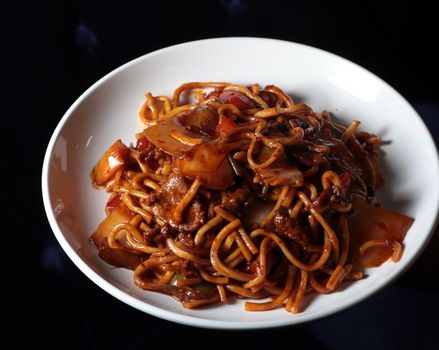
Photo: Merkhat Amangeldinov / Pexels
Chinese
Beef Chow Fun
The diets react (see scores below)
Common Ingredients
- wide rice noodles
- flank steak
- bean sprouts
- scallions
- dark soy sauce
- Shaoxing wine
- ginger
- garlic
Specific recipes may vary.
Incompatible with 8 of 11 diets
Diet Ratings
Beef Chow Fun is fundamentally incompatible with a ketogenic diet. The primary ingredient — wide rice noodles — is a high-glycemic, high-carb grain product that alone can contain 40-60g of net carbs per standard serving, instantly exceeding or maxing out the entire daily keto carb budget. Shaoxing wine adds additional sugars and carbs. While the flank steak, bean sprouts, ginger, garlic, and scallions are keto-friendly in isolation, the dish is architecturally built around the noodles, which cannot be reduced to a token portion without fundamentally changing the dish. There is no realistic portion size of this dish that maintains ketosis.
Beef Chow Fun contains flank steak, which is a direct animal product (beef). This is an unambiguous violation of vegan dietary principles. No plant-based substitution is present in this dish as described. The remaining ingredients — wide rice noodles, bean sprouts, scallions, dark soy sauce, Shaoxing wine, ginger, and garlic — are all plant-based, but the inclusion of beef makes the dish entirely non-vegan.
Beef Chow Fun is fundamentally incompatible with the paleo diet. The dish's base is wide rice noodles, a grain-derived processed food that is explicitly excluded under paleo rules. Dark soy sauce contains wheat and soy (both grains and legumes), and Shaoxing wine is a processed grain-based alcohol. Bean sprouts, while technically a vegetable, come from mung beans which are legumes. The only paleo-compliant ingredients in this dish are the flank steak, scallions, ginger, and garlic. The foundational components — noodles, soy sauce, and Shaoxing wine — make this dish entirely non-paleo with no straightforward substitution that would preserve the dish's identity.
Beef Chow Fun is fundamentally at odds with Mediterranean diet principles on multiple fronts. The primary protein is beef (red meat), which should be limited to only a few times per month. The base is wide rice noodles, a refined grain with no fiber benefit compared to whole grains. The dish is cooked with dark soy sauce (high sodium, processed condiment) and Shaoxing wine rather than olive oil as the fat/flavor base. While some ingredients like bean sprouts, scallions, ginger, and garlic are plant-based positives, they are minor components. The overall profile — red meat dominant, refined grain base, no olive oil, processed sauces — contradicts nearly every core Mediterranean dietary principle.
Beef Chow Fun is almost entirely incompatible with the carnivore diet. While flank steak is a carnivore-approved protein, it is overwhelmed by multiple disqualifying ingredients. Wide rice noodles are a grain-based carbohydrate and a core plant food to be excluded. Bean sprouts and scallions are plant vegetables. Dark soy sauce is a fermented soy (legume) product. Shaoxing wine is a plant-derived alcohol. Ginger and garlic are plant-based spices/aromatics. The dish is fundamentally a grain-and-vegetable stir-fry with a small amount of beef — the opposite of carnivore eating. There is complete consensus across all carnivore camps that this dish should be avoided.
Beef Chow Fun contains multiple Whole30-excluded ingredients. Wide rice noodles are made from rice, which is an excluded grain. Shaoxing wine is an alcoholic ingredient (rice wine), which is excluded both as alcohol and as a grain derivative. Dark soy sauce contains soy, an excluded legume, and typically also contains wheat (an excluded grain). These are fundamental, non-negotiable exclusions under the Whole30 program, making this dish clearly incompatible regardless of the other compliant ingredients (flank steak, bean sprouts, scallions, ginger, garlic).
Beef Chow Fun contains two significant high-FODMAP ingredients that make it unsuitable during the elimination phase. Garlic is one of the highest-FODMAP foods tested by Monash University, containing dense fructans even in very small quantities — it cannot be reduced to a safe portion in a standard dish preparation. Scallions (green onions) also contain fructans in their white bulb portion, though the green tops are low-FODMAP. In a typical restaurant or home preparation of Beef Chow Fun, whole scallions including white parts are used. Shaoxing wine, while used in small quantities, is a rice wine that is generally considered low-FODMAP in culinary amounts. The base ingredients — wide rice noodles, flank steak, bean sprouts, dark soy sauce, and ginger — are all low-FODMAP. However, garlic alone disqualifies this dish during the strict elimination phase regardless of portion size.
Beef Chow Fun is poorly aligned with DASH diet principles on multiple fronts. Dark soy sauce is extremely high in sodium, easily contributing 800–1,500mg or more per serving, pushing this dish close to or beyond the entire daily DASH sodium limit in a single meal. Flank steak is a red meat, which DASH explicitly limits due to saturated fat and its association with cardiovascular risk. Wide rice noodles are refined carbohydrates with negligible fiber, not aligned with DASH's emphasis on whole grains. While bean sprouts, scallions, ginger, and garlic are DASH-friendly vegetables, they do not offset the significant sodium load from soy sauce and the red meat component. Restaurant versions of this dish are typically wok-fried with additional oil, further increasing total fat content. This dish represents the convergence of three major DASH concerns: high sodium, red meat, and refined grains.
Beef Chow Fun presents significant Zone Diet challenges primarily due to its foundation of wide rice noodles, which are a high-glycemic refined carbohydrate — exactly the type of 'unfavorable' carb Dr. Sears warns against. A typical serving delivers a large, rapid-digesting carbohydrate load that would dramatically skew the 40/30/30 ratio and spike insulin. The flank steak is a moderately lean cut of beef — acceptable in Zone in controlled portions but not ideal compared to skinless chicken or fish. Bean sprouts and scallions are Zone-favorable low-glycemic vegetables, and ginger, garlic, and Shaoxing wine contribute negligible macros. Dark soy sauce adds sodium but minimal macros. The dish's core problem is structural: rice noodles dominate the carb block count and are high-GI, making it very hard to achieve Zone balance without drastically reducing the noodle portion (to perhaps 1/3 of the dish). With aggressive portion control — a small serving of noodles, larger proportion of protein and vegetables — a Zone practitioner could technically incorporate this dish, which prevents it from scoring lower. However, as traditionally served, it falls well outside Zone ratios and carbohydrate quality guidelines.
Beef Chow Fun presents a mixed anti-inflammatory profile. On the positive side, ginger and garlic are well-established anti-inflammatory spices with meaningful polyphenol and sulfur compound content. Bean sprouts contribute some antioxidants and fiber, and scallions add flavonoids. Shaoxing wine in cooking quantities is minimal concern. However, the dish has several limiting factors: flank steak is red meat, which anti-inflammatory guidelines consistently recommend limiting due to saturated fat content and arachidonic acid, even though it is a leaner cut compared to fattier beef options. Wide rice noodles are refined carbohydrates with a high glycemic index and negligible fiber, which can promote postprandial inflammation and insulin spikes. Dark soy sauce, while used in moderate culinary quantities, is a processed condiment with high sodium content. In restaurant preparation, this dish is almost always cooked with high-heat wok techniques using significant amounts of oil — typically a neutral seed oil (soybean or vegetable oil) — which would add pro-inflammatory omega-6 fatty acids; this review rates the listed ingredients, but this is a relevant real-world consideration. The dish lacks the high-antioxidant vegetables, omega-3 sources, or legumes that would elevate it. Overall it falls into a neutral-to-mildly-cautionary zone: occasional consumption is acceptable, but it should not be a regular feature of an anti-inflammatory eating pattern.
Some anti-inflammatory practitioners would rate this more favorably, noting that lean red meat like flank steak in modest portions provides zinc, selenium, and B12 without excessive saturated fat, and that ginger and garlic offer meaningful anti-inflammatory phytonutrients — Dr. Weil's framework does not prohibit lean red meat entirely, only recommends limiting it. Conversely, stricter anti-inflammatory and autoimmune protocols would score this lower, flagging refined rice noodles as a glycemic load concern and processed soy sauce as a potential gut irritant.
Beef Chow Fun is a mixed profile dish for GLP-1 patients. On the positive side, flank steak is a relatively lean cut of beef providing meaningful protein, and bean sprouts add hydration and light fiber. Scallions, ginger, and garlic are GLP-1-friendly aromatics. However, the dish has significant drawbacks: wide rice noodles are refined, low-fiber, high-glycemic carbohydrates with little nutritional density per calorie — a poor fit given the premium placed on every calorie counting. The dish is traditionally cooked using 'wok hei' technique requiring very high heat and a substantial amount of oil, which elevates fat content considerably and can worsen nausea, bloating, and reflux. Dark soy sauce adds sodium. Shaoxing wine contributes a small amount of alcohol. The overall protein-to-carb ratio is unfavorable for GLP-1 patients, and the oily preparation makes it a risky choice for those experiencing GI side effects. Acceptable occasionally in a small portion if prepared with minimal oil, but not a recommended regular meal choice.
Some GLP-1-focused dietitians would rate this more leniently if home-prepared with reduced oil and a larger proportion of flank steak to noodles, arguing the lean beef protein and low-calorie vegetables partially redeem the dish. Others would push this toward avoid territory specifically because the refined rice noodle base and oil-heavy wok cooking combine two of the most problematic elements — low nutrient density and high fat per serving — simultaneously.
*See how scores were generated at our methodology page.
Nutritional profile
Six traits that cut across every diet.
Fiber & Plants
How much whole-plant food and fiber it delivers.
Healthy Fats
The quality of its fats (unsaturated, omega-3).
Whole / Unprocessed
How close it is to its natural, unprocessed form.
Gut Gentle
How easy it is on digestion (low FODMAP, few irritants).
Low Glycemic
How little it spikes your blood sugar.
Protein Density
How much protein it packs per calorie.
Controversy Index
Higher controversy = more disagreement between diets.
Diet-Specific Tips
 Zone — 4/10
View tips
- Wide rice noodles are high-glycemic refined carbs — classified as 'unfavorable' in Zone terminology
- Flank steak is moderately lean but not ideal Zone protein; contributes saturated fat
- Bean sprouts and scallions are Zone-favorable low-GI vegetables that offset some concerns
- Typical restaurant serving is noodle-heavy, making 40/30/30 ratio nearly impossible to achieve
- Could be incorporated in Zone with extreme portion reduction of noodles and increased vegetable ratio
- No added oils listed, limiting the saturated/omega-6 fat concern somewhat
 Anti-Inflammatory — 4/10
View tips
- Red meat (flank steak) — limited per anti-inflammatory guidelines due to saturated fat and arachidonic acid
- Refined rice noodles — high glycemic index, low fiber, pro-inflammatory carbohydrate source
- Ginger and garlic — well-documented anti-inflammatory spices (gingerols, allicin)
- Bean sprouts and scallions — modest antioxidant and flavonoid contribution
- Dark soy sauce — processed, high sodium
- Likely high-heat seed oil in preparation — adds omega-6 burden not reflected in listed ingredients
- No omega-3 sources, colorful vegetables, legumes, or whole grains present
 GLP-1 Friendly — 4/10
View tips
- Wide rice noodles are refined, low-fiber, high-glycemic carbohydrates with poor nutrient density per calorie
- Traditional wok preparation uses significant oil, elevating fat content and GI side effect risk
- Flank steak provides moderate lean protein but overall protein-to-carb ratio is unfavorable
- Bean sprouts add some hydration and fiber benefit but volume is typically small
- Dark soy sauce contributes high sodium
- Shaoxing wine adds trace alcohol
- Ginger may mildly support digestion and nausea relief
- Small-portion tolerance varies significantly — wok-fried oily textures are a common GLP-1 nausea trigger