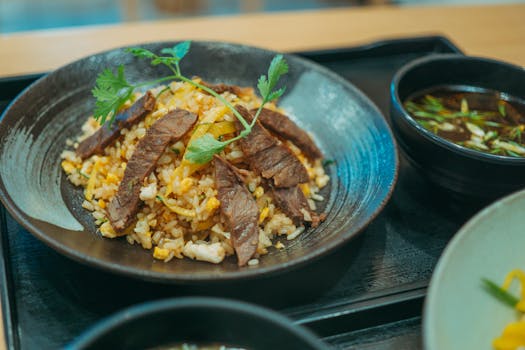
Photo: FOX ^.ᆽ.^= ∫ / Pexels
Chinese
Beef Fried Rice
The diets react (see scores below)
Common Ingredients
- jasmine rice
- flank steak
- eggs
- peas
- carrots
- scallions
- soy sauce
- sesame oil
Specific recipes may vary.
Incompatible with 7 of 11 diets
Diet Ratings
Beef Fried Rice is fundamentally incompatible with ketogenic diet due to jasmine rice as its primary base ingredient. A single cup of cooked jasmine rice contains approximately 45g of net carbs, which alone exceeds or nearly exhausts the entire daily carb allowance on keto. The dish also includes peas and carrots, both starchy/higher-carb vegetables that add additional net carbs. While flank steak, eggs, scallions, soy sauce, and sesame oil are individually keto-compatible or low-carb, the rice base makes this dish a non-starter for ketosis. No reasonable portion size would bring this within keto-safe carb limits.
Beef Fried Rice contains multiple animal products that are strictly excluded from a vegan diet. Flank steak is red meat (animal flesh), and eggs are an animal product. Both are unambiguous violations of vegan dietary principles. The remaining ingredients — jasmine rice, peas, carrots, scallions, soy sauce, and sesame oil — are plant-based, but the presence of beef and eggs makes this dish entirely incompatible with a vegan diet.
Beef Fried Rice contains multiple hard-banned paleo ingredients. Jasmine rice is a grain, strictly excluded by all major paleo authorities. Soy sauce contains both soy (a legume) and wheat (a grain), making it doubly non-compliant. Sesame oil is a seed oil, excluded under paleo guidelines. Peas are legumes. While flank steak, eggs, carrots, and scallions are individually paleo-approved, the foundational ingredients of this dish — rice, soy sauce, sesame oil, and peas — are all clear violations with no meaningful debate within the paleo community.
Beef Fried Rice conflicts with Mediterranean diet principles on multiple fronts. The primary protein is beef (red meat), which is limited to only a few times per month in the Mediterranean diet. The base is jasmine rice, a refined white grain rather than a whole grain. Soy sauce is a highly processed, high-sodium condiment not part of Mediterranean culinary traditions. Sesame oil, while a plant fat, is not the canonical Mediterranean fat (extra virgin olive oil). The dish lacks the plant-forward, olive oil-based, whole grain foundation central to the Mediterranean dietary pattern. The only redeeming elements are the eggs and vegetables (peas, carrots, scallions), which are modest contributors in an otherwise non-compatible dish.
Beef Fried Rice is fundamentally incompatible with the carnivore diet. The dish is built around jasmine rice, a grain that is strictly excluded from all tiers of carnivore eating. Beyond the rice, it contains multiple plant-based ingredients: peas and carrots (vegetables/legumes), scallions (allium vegetable), soy sauce (fermented soy — a legume-based condiment containing plant proteins and often wheat), and sesame oil (a plant-derived oil). While flank steak and eggs are carnivore-approved ingredients, they are minor components of a dish that is overwhelmingly plant-based in structure and flavoring. No variation of carnivore — from the broadest 'animal-based' approach to the strictest Lion Diet — would permit this dish as prepared.
Beef Fried Rice contains two clearly excluded ingredients: jasmine rice (a grain, explicitly banned on Whole30) and soy sauce (a soy-based product, also explicitly banned). Either of these alone would disqualify the dish. Additionally, peas are legumes — while green beans, sugar snap peas, and snow peas are explicitly excepted, standard green peas are not among the legume exceptions and are excluded. This dish cannot be made Whole30-compliant as described without fundamentally changing its character.
Beef fried rice contains several ingredients that are individually manageable but collectively require careful portion control. Jasmine rice is low-FODMAP and safe. Flank steak and eggs are low-FODMAP proteins. Sesame oil is low-FODMAP (FODMAPs are water-soluble). The problematic ingredients are: (1) Scallions/green onions — the green tops are low-FODMAP, but if the white bulb portions are used, they contain fructans and become high-FODMAP; this is a common preparation variable. (2) Peas — green peas are moderate-FODMAP; Monash rates 1/4 cup (35g) as low-FODMAP, but larger amounts (common in fried rice) become high-FODMAP due to GOS and fructans. (3) Soy sauce — regular soy sauce contains wheat and is technically high-FODMAP per Monash due to fructans, though the small amounts used in cooking create debate about clinical significance. (4) Carrots are low-FODMAP and safe. The dish as typically prepared has multiple FODMAP risk points that stack together, making it borderline rather than clearly safe or clearly problematic.
Monash University rates small amounts of soy sauce (2 tablespoons) as low-FODMAP in practice due to dilution during fermentation, and many FODMAP-trained dietitians permit it in cooking quantities; however, strict elimination phase protocols often recommend tamari (gluten-free soy sauce) as a safer substitute. Similarly, pea portions in a standard restaurant serving of fried rice often exceed the 35g low-FODMAP threshold, but a home cook can control this by limiting peas to 1/4 cup total across the dish.
Beef Fried Rice as commonly prepared is problematic for DASH compliance on multiple fronts. Soy sauce is the primary concern — a single tablespoon contains roughly 900–1,000mg of sodium, and fried rice recipes typically use several tablespoons, easily pushing one serving well beyond the DASH daily sodium limit of 2,300mg (or 1,500mg for low-sodium DASH). Flank steak, while a leaner cut of beef, is still red meat, which DASH explicitly limits. Jasmine rice is a refined white grain rather than a DASH-preferred whole grain. Sesame oil adds fat, and the overall dish is a high-calorie, sodium-dense preparation. The vegetables (peas, carrots, scallions) and eggs offer some nutritional value, but they do not offset the sodium and red meat concerns. This dish as commonly served at restaurants is particularly problematic due to even higher sodium loads and added oils.
Beef Fried Rice presents significant Zone Diet challenges primarily due to jasmine rice, which is a high-glycemic carbohydrate that Sears explicitly classifies as 'unfavorable.' Jasmine rice in particular has a high glycemic index, causing rapid insulin spikes that work against the Zone's central goal of controlling eicosanoid balance through stable blood sugar. The dish is structurally carbohydrate-dominant, with rice comprising the majority of volume and calories, making it very difficult to achieve a 40/30/30 macro ratio without radical portion manipulation. On the positive side, flank steak is a reasonably lean cut of beef (favorable protein, though not as lean as chicken or fish), eggs add quality protein, and peas and carrots contribute some favorable low-glycemic vegetable carbs and fiber. Sesame oil is omega-6-heavy seed oil that Sears discourages from an anti-inflammatory standpoint, though the quantity used is typically small. Soy sauce adds sodium but negligible macros. A Zone-adapted version would dramatically reduce rice (to perhaps a garnish amount — half a cup or less), increase the flank steak and egg portions, and add more vegetables to shift the carb load toward favorable sources. As traditionally served, however, the rice-to-protein ratio is far too skewed toward high-glycemic carbs to fit comfortably in Zone parameters.
Beef fried rice presents a mixed anti-inflammatory profile. On the positive side, eggs provide choline and some anti-inflammatory nutrients, peas and carrots contribute antioxidants and fiber, scallions offer quercetin and allicin, and sesame oil contains sesamin and sesamol — lignans with modest anti-inflammatory properties. However, several concerns weigh it down: red meat (flank steak) is in the 'limit' category due to saturated fat and arachidonic acid content, which can promote inflammatory signaling when consumed regularly. Jasmine rice is a refined white rice with a high glycemic index, meaning it lacks the fiber and phytonutrients of whole grains and can spike blood glucose — a known driver of inflammatory markers like CRP. Soy sauce, while fermented (which has some benefit), is high in sodium, and most commercial soy sauces contain additives and wheat. The dish is also typically made with high heat and potentially seed-based cooking oils not listed (a common restaurant reality). Overall, this is a moderate-to-mildly inflammatory dish: not a dietary disaster, but not a food that earns anti-inflammatory credentials. Occasional consumption is acceptable; regular meals built around white rice and red meat are inconsistent with anti-inflammatory principles.
Some anti-inflammatory practitioners would score this lower, arguing that red meat — even lean cuts — regularly elevates arachidonic acid and saturated fat intake in ways that meaningfully increase inflammatory load; from that perspective this dish edges toward 'avoid' territory. Conversely, a more lenient reading (closer to Dr. Weil's generally pragmatic approach) notes that flank steak is relatively lean, the vegetable content adds real antioxidant value, and a moderate portion eaten infrequently poses little inflammatory risk for a healthy individual.
Beef fried rice presents a mixed nutritional profile for GLP-1 patients. The combination of flank steak and eggs provides a meaningful protein contribution, and peas and carrots add modest fiber and micronutrients. However, the dish is dominated by jasmine rice — a refined, high-glycemic carbohydrate with low fiber density — which competes with protein and fiber for limited stomach capacity. Sesame oil and the fat from flank steak add up quickly, and the high-heat stir-fry preparation (with oil) raises overall fat per serving. Soy sauce contributes significant sodium, which can worsen water retention and bloating. Gastric emptying is already slowed on GLP-1 medications, and a dense, mixed rice dish can sit heavily and trigger nausea or reflux. Portion sensitivity is high — a restaurant serving is typically 2-3x what a GLP-1 patient should eat in one sitting. A home-modified version using cauliflower rice, reduced sesame oil, and a higher egg-to-rice ratio could push this toward an approve.
Some GLP-1-focused RDs accept small portions of mixed rice dishes because the protein from eggs and lean beef partially offsets the refined carbohydrate load, and real-world adherence matters — overly restricting familiar cultural foods can undermine long-term compliance. Others flag any refined-grain-dominant dish as counterproductive given reduced caloric budget, arguing every bite must carry higher nutritional density than fried rice typically delivers.
*See how scores were generated at our methodology page.
Nutritional profile
Six traits that cut across every diet.
Fiber & Plants
How much whole-plant food and fiber it delivers.
Healthy Fats
The quality of its fats (unsaturated, omega-3).
Whole / Unprocessed
How close it is to its natural, unprocessed form.
Gut Gentle
How easy it is on digestion (low FODMAP, few irritants).
Low Glycemic
How little it spikes your blood sugar.
Protein Density
How much protein it packs per calorie.
Controversy Index
Higher controversy = more disagreement between diets.
Diet-Specific Tips
 Low-FODMAP — 5/10
View tips
- Jasmine rice: low-FODMAP, safe at standard servings
- Flank steak: low-FODMAP, no FODMAP concerns
- Eggs: low-FODMAP, no FODMAP concerns
- Sesame oil: low-FODMAP (FODMAPs are water-soluble, not fat-soluble)
- Scallions: green tops only are low-FODMAP — white bulb portions contain fructans and must be avoided
- Peas: low-FODMAP only at ≤35g (1/4 cup); standard fried rice portions likely exceed this threshold
- Soy sauce: contains wheat (fructans); tamari is the low-FODMAP substitute; small culinary amounts debated
- Carrots: low-FODMAP, no concerns
- FODMAP stacking risk: multiple moderate-FODMAP ingredients in one dish can cumulatively trigger symptoms
 Zone — 4/10
View tips
- Jasmine rice is a high-glycemic, unfavorable carbohydrate explicitly discouraged in Zone methodology
- Dish is structurally carb-dominant, making 40/30/30 ratio very difficult to achieve at normal serving sizes
- Flank steak is a moderately lean protein — acceptable but not ideal compared to poultry or fish
- Eggs provide quality Zone-friendly protein
- Peas and carrots are favorable low-glycemic carb contributors but are minority ingredients here
- Sesame oil is an omega-6 seed oil inconsistent with Zone's anti-inflammatory fat priorities
- Could be Zone-adapted by drastically reducing rice and increasing vegetable and protein components
 Anti-Inflammatory — 4/10
View tips
- Red meat (flank steak) is in the 'limit' category — associated with elevated arachidonic acid and saturated fat
- Jasmine white rice is a refined, high-glycemic carbohydrate — lacks fiber and polyphenols of whole grains
- Eggs contribute choline and selenium — nutritionally mixed but acceptable in moderation
- Peas and carrots provide fiber, carotenoids, and antioxidants — positive contributions
- Scallions offer quercetin and allicin — mild anti-inflammatory benefit
- Sesame oil contains sesamin/sesamol lignans — modest anti-inflammatory effect, but omega-6 ratio is a consideration
- Soy sauce is high in sodium and often contains additives — minor negative
- Dish is typically prepared at high heat, which can oxidize oils and reduce antioxidant content
 GLP-1 Friendly — 4/10
View tips
- Refined jasmine rice is the dominant ingredient — low fiber, high glycemic, crowds out more nutrient-dense foods in limited stomach capacity
- Flank steak and eggs provide protein but total protein per standard serving may fall short of the 15–30g per meal target depending on portion
- Sesame oil and beef fat increase total fat per serving, raising risk of nausea and reflux on GLP-1 medications
- High sodium from soy sauce may contribute to bloating and water retention
- Dense mixed dish may sit heavily due to slowed gastric emptying — portion control is critical
- Peas and carrots add minor fiber and micronutrients but not enough to offset refined carbohydrate base
- Home preparation allows meaningful upgrades: cauliflower rice substitution, reduced oil, extra egg whites