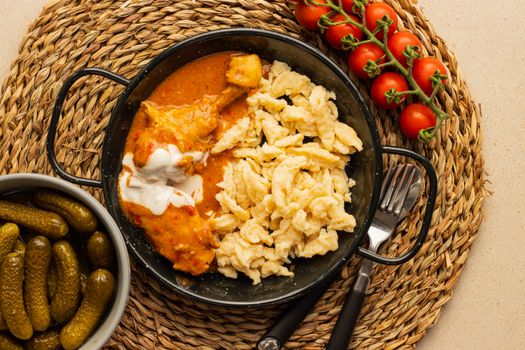
Photo: Istvan Szabo / Pexels
Eastern-European
Hungarian Beef Goulash
The diets react (see scores below)
Common Ingredients
- beef chuck
- onion
- Hungarian paprika
- bell peppers
- tomatoes
- caraway seeds
- garlic
- beef stock
Specific recipes may vary.
Incompatible with 4 of 11 diets
Diet Ratings
Hungarian Beef Goulash is built around fatty beef chuck, which is an excellent keto protein and fat source. However, the combination of onions, bell peppers, and tomatoes adds meaningful net carbs — a standard serving could easily contain 10-15g net carbs depending on portion size and ratios. Traditional goulash also sometimes includes a small amount of flour as thickener (not listed here, so not penalized), but even without it the vegetable load is moderate. A reasonable portion (1-1.5 cups) can fit within a 20-50g daily net carb budget, but it requires tracking and careful portioning alongside very low-carb choices for the rest of the day. The dish has no added sugars or grains as listed, and the fat profile from beef chuck is favorable.
Stricter keto practitioners would flag the onion, tomatoes, and bell peppers as too carb-dense to include regularly, arguing that even a moderate serving can consume a significant share of the daily carb allowance, leaving little room for other vegetables. Some carnivore-adjacent keto followers would simplify the dish to beef, fat, salt, and paprika only.
Hungarian Beef Goulash contains multiple animal products that are strictly excluded from a vegan diet. Beef chuck is mammalian muscle tissue, and beef stock is derived from animal bones and connective tissue. There is no ambiguity here — this dish is fundamentally built around animal ingredients and is entirely incompatible with veganism in its traditional form.
Hungarian Beef Goulash as described here is an excellent paleo dish. Every ingredient aligns cleanly with paleo principles: beef chuck is an unprocessed, nutrient-dense animal protein; onion, bell peppers, tomatoes, and garlic are whole vegetables available to hunter-gatherers; Hungarian paprika and caraway seeds are natural spices; and a pure beef stock (without additives or salt) is a traditional whole-food base. There are no grains, legumes, dairy, seed oils, refined sugars, or processed ingredients present. The dish is essentially a slow-cooked meat and vegetable stew — one of the most ancestrally consistent meal formats possible. The only minor consideration is commercial beef stock, which sometimes contains added salt or preservatives, but assuming homemade or a clean-label stock, this dish is fully paleo-compliant.
Hungarian Beef Goulash is centered on beef chuck, a red meat high in saturated fat, which directly contradicts Mediterranean diet principles that limit red meat to a few times per month. While the dish does include several Mediterranean-friendly ingredients — onions, bell peppers, tomatoes, and garlic — these vegetables serve as aromatics and supporting elements rather than the dietary foundation. The beef chuck is the dominant caloric and protein source. The dish uses beef stock rather than olive oil as the primary fat/liquid base, further diverging from Mediterranean principles. The Eastern European culinary tradition this dish belongs to is not aligned with Mediterranean dietary patterns. Occasional consumption as a rare treat might be tolerable, but this is not a dish compatible with regular Mediterranean eating.
Hungarian Beef Goulash is fundamentally incompatible with the carnivore diet despite containing beef as the primary protein. The dish is built around multiple plant-based ingredients that are strictly excluded: onion, Hungarian paprika, bell peppers, tomatoes, caraway seeds, and garlic. These are not incidental garnishes — they are structural components of the dish that define its flavor profile and bulk. Beef chuck and beef stock are the only carnivore-compliant ingredients. The paprika, bell peppers, and tomatoes are particularly problematic as nightshades, which many carnivore practitioners specifically avoid even in transitional phases. This dish cannot be modified into a carnivore-compatible version without ceasing to be goulash entirely.
Hungarian Beef Goulash as described contains entirely Whole30-compliant ingredients. Beef chuck is an approved protein, onions, bell peppers, tomatoes, and garlic are all compliant vegetables, Hungarian paprika and caraway seeds are approved spices, and beef stock (assuming no added sugar, gluten, or non-compliant additives) is generally compatible. There are no grains, legumes, dairy, added sugars, or other excluded ingredients in this dish. This is a classic whole-food, meat-and-vegetable stew that fits well within the Whole30 framework.
Hungarian Beef Goulash contains multiple high-FODMAP ingredients that make it unsuitable during the elimination phase. Onion is one of the highest-fructan foods tested by Monash University and is problematic even in small amounts, especially when cooked into a dish where fructans leach into the liquid. Garlic cloves are similarly extremely high in fructans and are a common trigger for IBS symptoms. These two ingredients alone make this dish a clear avoid. Caraway seeds also contain moderate fructans. The beef chuck, Hungarian paprika, bell peppers, tomatoes, and plain beef stock are generally low-FODMAP, but the combination of onion and garlic throughout the recipe — both cooked into the broth — means FODMAPs are distributed throughout the entire dish and cannot be removed by picking around them.
Hungarian Beef Goulash presents a mixed DASH profile. The dish contains several DASH-friendly ingredients — onion, bell peppers, tomatoes, garlic, and spices like paprika and caraway seeds are all vegetables/herbs that align well with DASH principles, providing potassium, fiber, and antioxidants. However, the primary protein is beef chuck, which is a higher-fat cut of red meat. DASH guidelines explicitly limit red meat consumption (recommending no more than a few servings per week) and emphasize lean proteins. Beef chuck contains meaningful amounts of saturated fat, which DASH restricts. The use of beef stock also raises sodium concerns — commercial beef stock can be high in sodium, potentially pushing a single serving toward a significant portion of the 2,300mg daily DASH sodium limit. The dish is not inherently disqualifying: it lacks added sugars, tropical oils, or processed ingredients, and the vegetable content is genuinely beneficial. With lean beef substitution (e.g., round or sirloin), low-sodium stock, and moderate portion sizes, this dish can fit within DASH. As commonly prepared with chuck and standard stock, it earns a caution rating.
NIH DASH guidelines categorically limit red meat due to saturated fat and recommend lean poultry or fish as preferred proteins. However, updated clinical interpretations note that unprocessed lean red meat in controlled portions (2–3 servings/week) is not explicitly prohibited and that the overall dietary pattern matters more than individual foods — some DASH-oriented dietitians would permit this dish with portion control and low-sodium stock.
Hungarian Beef Goulash presents a mixed Zone profile. The vegetable base — bell peppers, tomatoes, onion, and garlic — is excellent from a Zone standpoint, providing low-glycemic carbohydrates rich in polyphenols and antioxidants. Hungarian paprika adds anti-inflammatory compounds aligned with Sears' polyphenol emphasis. However, the primary protein source, beef chuck, is a fatty cut with significant saturated fat content, which the Zone Diet discourages in favor of leaner proteins like skinless chicken, fish, or lean beef cuts (sirloin, tenderloin). The dish lacks a balanced fat component — the fat comes predominantly from the chuck rather than monounsaturated sources. Additionally, traditional goulash is often served over egg noodles or with bread dumplings (not listed here), which would push it firmly into 'caution' territory. As written, without starchy accompaniments, the carb-to-protein-to-fat ratio can be managed with proper portioning, but the saturated fat load from chuck requires restraint. A Zone-conscious adaptation would substitute leaner beef cuts and pair with a non-starchy vegetable side. The dish can fit within Zone blocks but requires deliberate modification to approach the 40/30/30 target.
In Sears' later works (particularly 'The Anti-Inflammation Zone' and 'Toxic Fat'), he softened somewhat on saturated fat, acknowledging it is less problematic than omega-6-heavy vegetable oils when consumed in the context of an otherwise anti-inflammatory diet. Some Zone practitioners would argue that beef chuck in moderate portion (3 oz cooked) within a polyphenol-rich vegetable stew is acceptable, especially if the meal is balanced with additional monounsaturated fat. The rich paprika and vegetable base could be seen as partially offsetting the saturated fat concern.
Hungarian Beef Goulash presents a mixed anti-inflammatory profile. On the positive side, the dish is rich in anti-inflammatory ingredients: Hungarian paprika and bell peppers are high in carotenoids (beta-carotene, capsanthin) and vitamin C; tomatoes provide lycopene; garlic is a well-established anti-inflammatory allium; caraway seeds offer antioxidant flavonoids; and onions contribute quercetin. These collectively represent a strong vegetable and spice base. However, the primary protein — beef chuck — is a fatty cut of red meat high in saturated fat and arachidonic acid, both associated with pro-inflammatory pathways (elevated CRP, IL-6). Beef chuck is specifically the kind of red meat that anti-inflammatory frameworks recommend limiting. Beef stock is generally neutral. The dish is not processed and contains no refined carbohydrates, trans fats, or added sugars, which is a meaningful positive. Overall, this is a borderline dish: the anti-inflammatory spice and vegetable base partially offsets the pro-inflammatory red meat, landing it squarely in the 'moderate' category. Occasional consumption is acceptable; regular intake is not recommended under strict anti-inflammatory guidelines.
Some anti-inflammatory practitioners, including those influenced by the Mediterranean and Dr. Weil's framework, consider occasional red meat acceptable especially when paired with a rich vegetable and spice base as here — the antioxidant load may partially mitigate red meat's inflammatory effects. However, stricter anti-inflammatory protocols would flag beef chuck as a regular avoid due to saturated fat content and arachidonic acid, and would suggest substituting leaner protein such as chicken or legumes.
Hungarian beef goulash built from beef chuck sits in caution territory for GLP-1 patients. Beef chuck is a moderately fatty cut (roughly 15-20g fat per 3oz cooked serving) with meaningful saturated fat, which can worsen nausea, bloating, and reflux — core GLP-1 side effects. That said, it is a genuine protein source (roughly 20-25g per serving), and the vegetable base of onions, bell peppers, and tomatoes adds fiber, micronutrients, and high water content from the broth, all of which are positives. Hungarian paprika and caraway seeds are generally well-tolerated and bring antioxidants without significant GI irritation. The slow-cooked, stew format improves digestibility compared to grilled or roasted fatty beef — long braising breaks down connective tissue and softens the food matrix, making it easier on a stomach with slowed gastric emptying. The dish is not fried, not ultra-processed, and not high in refined carbohydrates. The primary concern is the fatty cut of beef and the caloric density of the rendered fat in the braising liquid, which may trigger GI discomfort in GLP-1 patients who are sensitive. Portion size is critical here — a small bowl works better than a full entrée serving.
Some obesity medicine dietitians accept beef chuck-based stews for GLP-1 patients when fat is skimmed from the braising liquid, arguing the protein yield and satiety value justify the inclusion, particularly for patients who struggle to meet protein targets. Others recommend substituting lean beef round or sirloin to keep saturated fat low, noting that even moderate fat loads can trigger significant nausea in patients at higher medication doses.
*See how scores were generated at our methodology page.
Nutritional profile
Six traits that cut across every diet.
Fiber & Plants
How much whole-plant food and fiber it delivers.
Healthy Fats
The quality of its fats (unsaturated, omega-3).
Whole / Unprocessed
How close it is to its natural, unprocessed form.
Gut Gentle
How easy it is on digestion (low FODMAP, few irritants).
Low Glycemic
How little it spikes your blood sugar.
Protein Density
How much protein it packs per calorie.
Controversy Index
Higher controversy = more disagreement between diets.
Diet-Specific Tips
 Keto — 5/10
View tips
- Beef chuck is high-fat, high-protein and ideal for keto
- Onions are moderate in carbs and used in volume in goulash — a notable carb contributor
- Bell peppers and tomatoes add 5-10g net carbs per serving collectively
- No added sugars or grains in the listed ingredients
- Caraway seeds and garlic contribute negligible carbs
- Portion control is essential — a large serving could exceed 15g net carbs
- Pairs well with cauliflower rice instead of traditional egg noodles or bread
 Paleo — 9/10
View tips
- Beef chuck is a whole, unprocessed animal protein — strongly paleo-approved
- All vegetables (onion, bell peppers, tomatoes, garlic) are whole and unprocessed
- Paprika and caraway seeds are natural spices with no paleo objection
- No grains, legumes, dairy, or seed oils present
- Beef stock should be homemade or verified additive-free and salt-free for strict compliance
- Slow-cooked stew format mirrors ancestral cooking methods
 Whole30 — 9/10
View tips
- Beef chuck is a fully approved Whole30 protein
- All vegetables (onion, bell pepper, tomatoes, garlic) are compliant
- Hungarian paprika and caraway seeds are approved spices
- Beef stock should be label-checked to ensure no added sugar, gluten, or non-compliant additives
- No grains, dairy, legumes, or added sugars present
- Dish is a traditional whole-food stew, not a 'junk food recreation'
 DASH — 5/10
View tips
- Beef chuck is a fatty cut of red meat — DASH limits red meat and saturated fat
- Beef stock (commercial) is often high in sodium — use low-sodium stock to improve DASH compatibility
- Bell peppers, tomatoes, onion, and garlic are DASH-positive vegetables providing potassium and fiber
- Hungarian paprika and caraway seeds are sodium-free spices consistent with DASH flavor strategy
- No added sugars, tropical oils, or processed ingredients — relatively clean ingredient profile
- Portion size is critical — a modest serving (3–4 oz beef) improves DASH compatibility significantly
- Substituting lean beef (round/sirloin) and low-sodium stock would elevate score to 6–7
 Zone — 5/10
View tips
- Beef chuck is a high-saturated-fat cut — Zone prefers lean protein sources; substituting sirloin or round would improve the score
- Bell peppers, tomatoes, onion, and garlic provide excellent low-glycemic, polyphenol-rich Zone-favorable carbohydrates
- Hungarian paprika is rich in polyphenols and carotenoids, aligned with Sears' anti-inflammatory focus
- No added grains or high-glycemic carbs in the listed ingredients — favorable
- Fat profile is predominantly saturated (from chuck) rather than monounsaturated — a Zone concern
- Protein portion control is essential; a standard restaurant serving may exceed the ~25g per meal Zone target
- Dish lacks omega-3 contribution; a small fish oil supplement or omega-3-rich side would be consistent with Zone protocol
- No trans fats or processed ingredients — base recipe is whole-food focused
 Anti-Inflammatory — 5/10
View tips
- Beef chuck (red meat, high saturated fat) — pro-inflammatory, should be limited
- Hungarian paprika and bell peppers — rich in carotenoids and vitamin C, anti-inflammatory
- Garlic — well-established anti-inflammatory allium
- Tomatoes — lycopene source, antioxidant
- Caraway seeds — antioxidant flavonoids
- Onions — quercetin content, anti-inflammatory
- No refined carbohydrates, trans fats, or added sugars
- No seed oils or processed ingredients
 GLP-1 Friendly — 5/10
View tips
- Beef chuck is a moderately high saturated fat cut — increases nausea and reflux risk on GLP-1 medications
- Protein content is meaningful (~20-25g per serving) and supports the primary GLP-1 dietary priority
- Slow-braised stew format improves digestibility compared to other beef preparations
- Vegetable base (bell peppers, tomatoes, onion) contributes fiber and water content — supportive of GLP-1 needs
- No fried components, refined grains, added sugars, or carbonation — avoids the worst GLP-1 triggers
- Fat skimming the finished stew would meaningfully improve the GLP-1 profile of this dish
- Portion sensitivity is high — a small serving is far better tolerated than a full entrée portion
- Substituting lean beef (round, sirloin) would likely elevate this dish to an approve rating