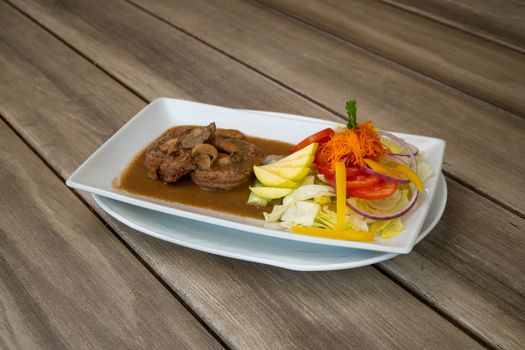
Photo: Allan González / Pexels
Eastern-European
Beef Rouladen
The diets react (see scores below)
Common Ingredients
- beef
- bacon
- Dijon mustard
- onion
- pickles
- red wine
- beef stock
- carrots
Specific recipes may vary.
Incompatible with 5 of 11 diets
Diet Ratings
Beef Rouladen is fundamentally keto-friendly at its core — beef, bacon, Dijon mustard, and pickles are all low-carb ingredients. However, the dish introduces moderate carb concerns from several sources: red wine used in braising adds residual sugars (though much evaporates, some remain), carrots contribute net carbs (~6g per medium carrot), and onions add a modest carb load. Dijon mustard may contain small amounts of sugar depending on the brand. In a standard serving, the cumulative net carbs from carrots, onion, and wine reduction could push toward 8-12g, which is manageable within a daily keto budget but requires awareness. The protein and fat profile from beef and bacon is excellent. With portion control on the vegetables and using minimal wine or a dry red wine substitute, this dish can fit keto well.
Strict keto practitioners may flag red wine entirely (even in cooking) due to residual sugars and potential insulin response, and would argue that carrots should be omitted rather than portioned down, as even small amounts of starchy vegetables are unnecessary on a well-formulated ketogenic diet.
Beef Rouladen is a traditional Eastern European dish built entirely around animal products. The primary ingredient is beef (thinly sliced and rolled), with bacon as a core filling component. Both are unambiguously animal-derived meats. The dish is fundamentally incompatible with a vegan diet and cannot be made vegan without completely replacing its defining ingredients.
Beef Rouladen contains mostly paleo-compatible ingredients — unprocessed beef, onion, carrots, and beef stock are fully approved. Red wine is a gray-area item (alcohol is debated but widely tolerated in moderation). Dijon mustard is borderline: traditional Dijon contains white wine and spices, but commercial versions often include added salt, preservatives, or sugar. Pickles are also problematic in their commercial form due to added salt and vinegar processing. The biggest concern is bacon: while pork belly itself is paleo, commercial bacon is a processed meat cured with added salt, sugar, nitrates, and preservatives — placing it firmly in the 'avoid' category under strict paleo rules. The combination of processed bacon, commercial pickles, and Dijon mustard creates enough non-paleo elements to drop this dish into caution territory, even though the core protein and vegetables are sound.
Some paleo practitioners, including those following Mark Sisson's Primal Blueprint approach, accept uncured, sugar-free bacon and consider small amounts of vinegar-based condiments acceptable, which would push a carefully sourced version of this dish closer to approval.
Beef Rouladen is a quintessential red meat dish that directly contradicts core Mediterranean diet principles. The primary protein is beef, which should be limited to only a few times per month in a Mediterranean eating pattern. Compounding this, the dish includes bacon — a processed, cured red meat high in saturated fat and sodium — as a key ingredient. Together, these two components make this dish fundamentally incompatible with Mediterranean guidelines. While the dish does include some vegetables (onion, carrots, pickles) and red wine, which are Mediterranean-friendly components, these supporting ingredients cannot offset the central problem of a red meat and processed meat combination as the core of the dish. The cooking style and flavor profile are distinctly Eastern European, not Mediterranean, and the saturated fat load from both beef and bacon is high.
Beef Rouladen is heavily non-compliant with the carnivore diet despite its beef and bacon base. The dish contains multiple plant-derived ingredients: Dijon mustard (plant-based condiment with vinegar and seeds), onion, pickles (cucumbers with plant-based brine), red wine (plant-derived alcohol), and carrots. These plant foods are strictly excluded on a carnivore diet. The beef and bacon components are carnivore-approved, but they are outnumbered and marinated/cooked with disqualifying ingredients that permeate the entire dish. This is fundamentally a traditional European preparation designed around plant-based flavoring and braising components, making it incompatible as a carnivore meal.
Beef Rouladen is largely Whole30-compatible in concept — beef, onion, carrots, and beef stock are all straightforwardly allowed. Red wine is permitted as a cooking ingredient (alcohol cooks off and it functions as a flavor component, not a beverage). However, two ingredients require careful label-reading: bacon commonly contains added sugar and/or nitrates (a compliant, sugar-free version must be sourced), and pickles frequently contain added sugar or other non-compliant additives. Dijon mustard also often contains white wine or wine vinegar (generally fine) but some brands sneak in sugar or sulfites — though sulfites are now compliant per the 2024 rule change. If compliant bacon and clean pickles/mustard are used, the dish is fully Whole30-compatible.
Most Whole30 practitioners would approve this dish when made with compliant ingredients, but the reliance on processed items like bacon and commercial pickles means this dish requires diligent label-reading. Official Whole30 guidelines caution against leaning heavily on processed meats like bacon as a dietary staple, even when a compliant version is found.
Beef Rouladen contains multiple high-FODMAP ingredients that make it unsuitable during the elimination phase. Onion is one of the highest-FODMAP foods (rich in fructans) and is a core ingredient that cannot be reduced to a safe serving in this dish. Red wine contributes polyols (sorbitol) and fructose at typical cooking quantities, though small amounts may be tolerable. Dijon mustard often contains onion or garlic powder. Pickles are generally low-FODMAP but commercial varieties may contain garlic. Beef, bacon, carrots, and beef stock (if homemade or certified low-FODMAP) are individually safe, but the onion alone is enough to classify the dish as high-FODMAP. The classic preparation of Rouladen relies structurally on onion as a filling ingredient, making it very difficult to modify without fundamentally altering the dish.
Beef Rouladen is problematic for the DASH diet on multiple fronts. The dish centers on beef (a red meat DASH limits) wrapped with bacon, which is explicitly discouraged — bacon is high in sodium, saturated fat, and processed meat content. Dijon mustard and pickles contribute significant additional sodium, and beef stock (standard versions) adds more. The combination of red meat, processed meat (bacon), and multiple high-sodium condiments/ingredients stacks sodium and saturated fat well beyond DASH targets. While onions, carrots, and red wine are benign or even beneficial, they cannot offset the core concerns. The DASH diet explicitly limits red meat, processed meats, and high-sodium foods — all of which are central to this dish's identity. Even modest portions would likely approach or exceed sodium limits for a single meal.
Beef Rouladen presents a mixed Zone profile. The dish centers on beef (a moderate Zone protein — acceptable but not ideal due to higher saturated fat compared to skinless chicken or fish), wrapped with bacon (adds saturated fat, pushing the fat profile away from the preferred monounsaturated zone). The filling of Dijon mustard, onion, and pickles are low-glycemic and Zone-friendly. The braising liquid of red wine and beef stock adds minimal carbohydrate load. Carrots are a Zone-acceptable vegetable (slightly higher glycemic than leafy greens but still favorable in moderation). The core issue is the combined saturated fat load from both beef and bacon, which conflicts with the Zone's emphasis on monounsaturated fats and anti-inflammatory eating. However, with careful portioning (a modest portion of the rouladen as the protein block, roughly 25g protein), supplemented with additional low-GI vegetables and an olive oil-based fat source to shift the fat ratio toward monounsaturated, this dish can be incorporated. It is not a clean Zone meal out of the box, but it is far from impossible to adapt.
Dr. Sears' earlier Zone writings (Enter the Zone, 1995) were more permissive about red meat in controlled portions, focusing primarily on maintaining the 40/30/30 block ratio. Some Zone practitioners would rate this higher (6-7), arguing that lean cuts of beef with trimmed fat can fit cleanly into Zone blocks and the vegetable-forward filling and braising components support favorable carbohydrate balance. Later Sears anti-inflammatory writing (The Anti-Inflammation Zone, 2005) placed greater emphasis on avoiding saturated fat and omega-6 sources like bacon, which would push this rating lower.
Beef Rouladen presents a mixed anti-inflammatory profile. The dish centers on beef and bacon — both red/processed meats that anti-inflammatory guidelines recommend limiting due to saturated fat content and, in bacon's case, nitrates and sodium. However, the preparation includes several redeeming elements: onions and carrots provide antioxidants and flavonoids; red wine contributes resveratrol and polyphenols; Dijon mustard contains turmeric and anti-inflammatory compounds; and beef stock can offer minerals. The dish is not deep-fried or heavily processed, and the braising method in red wine and stock is a relatively health-conscious preparation technique. Pickles add minimal inflammatory concern. The primary issue is the combination of red meat as the main protein with bacon as an added processed meat — this double hit of saturated fat and processed meat pushes the dish into 'limit' territory per anti-inflammatory guidelines. Occasional consumption in the context of an otherwise anti-inflammatory diet is acceptable, but it cannot be considered a regular staple.
Some anti-inflammatory nutritionists, particularly those following a more ancestral or paleo-aligned framework (e.g., Chris Kresser), would argue that grass-fed beef provides meaningful CLA and omega-3s, making the beef component less concerning than conventionally raised meat. Conversely, strict anti-inflammatory protocols would score this lower due to the processed meat (bacon) and overall saturated fat load, with no mitigating omega-3 source.
Beef Rouladen is a traditional dish where thin slices of beef are rolled around bacon, mustard, onion, and pickles, then braised in red wine and beef stock. The beef itself provides meaningful protein, but the inclusion of bacon adds significant saturated fat, which is a core concern for GLP-1 patients prone to nausea, reflux, and slowed gastric emptying. The braising method (rather than frying) is a point in its favor — it produces a relatively tender, easy-to-chew result and avoids added frying oils. The red wine used in the braise largely cooks off, leaving mostly flavor compounds, but residual alcohol and the heavier sauce may still contribute to GI discomfort. Carrots and onion add modest fiber and nutrient density. The overall fat load per serving — between the fatty beef cuts typically used and the bacon — is the primary concern. Portion size matters significantly here: a small serving with lean beef (e.g., top round) and minimal bacon could be acceptable, while a full traditional portion is likely too heavy for GLP-1 patients. This is a caution rather than an avoid because the braised protein is real and meaningful, and it is not fried.
Some GLP-1-focused dietitians would rate this closer to avoid, arguing that the bacon and fatty beef combination reliably worsens nausea and bloating in GLP-1 patients regardless of cooking method, and that the caloric density per bite is too high for reduced-appetite eating. Others would accept it in small portions with lean beef substitutions, noting that braised dishes are generally easier to digest than grilled or fried preparations and that the protein content supports the medication's muscle-preservation goals.
*See how scores were generated at our methodology page.
Nutritional profile
Six traits that cut across every diet.
Fiber & Plants
How much whole-plant food and fiber it delivers.
Healthy Fats
The quality of its fats (unsaturated, omega-3).
Whole / Unprocessed
How close it is to its natural, unprocessed form.
Gut Gentle
How easy it is on digestion (low FODMAP, few irritants).
Low Glycemic
How little it spikes your blood sugar.
Protein Density
How much protein it packs per calorie.
Controversy Index
Higher controversy = more disagreement between diets.
Diet-Specific Tips
 Keto — 6/10
View tips
- High-quality beef protein and bacon fat are keto-ideal
- Carrots add net carbs (~4-6g per serving depending on quantity)
- Red wine braising introduces residual sugars into the sauce
- Onions contribute moderate net carbs, portion-dependent
- Dijon mustard may contain trace sugars — check label
- Overall net carbs manageable per serving but require tracking
- Dish can be modified by omitting carrots and minimizing wine
 Paleo — 5/10
View tips
- Beef (unprocessed) — fully paleo approved
- Bacon — processed meat with added salt, sugar, and nitrates; strict paleo avoids commercial bacon
- Dijon mustard — commercial versions contain added salt and sometimes sugar; a gray-area ingredient
- Pickles — commercial pickles typically contain added salt and may contain preservatives
- Red wine — alcohol is a debated/caution item in the paleo community
- Onion, carrots, beef stock — paleo approved (watch for additives in store-bought stock)
- Dish can be made more paleo-compliant by substituting uncured pork belly for bacon and using homemade versions of mustard and pickles
 Whole30 — 5/10
View tips
- Bacon commonly contains added sugar — a compliant, sugar-free version is required
- Pickles often contain added sugar or non-compliant preservatives — label check needed
- Dijon mustard may contain sugar — verify label for a compliant version
- Red wine is allowed as a cooking ingredient per Whole30 rules
- Beef, onion, carrots, and beef stock are all fully compliant
- Sulfites (sometimes in wine and mustard) are now compliant per 2024 rule change
 Zone — 5/10
View tips
- Beef provides acceptable Zone protein but carries more saturated fat than preferred lean sources like chicken or fish
- Bacon adds significant saturated fat, conflicting with the Zone's monounsaturated fat preference and anti-inflammatory principles
- Onion, pickles, Dijon mustard, and carrots are low-glycemic Zone-favorable carbohydrate contributors
- Red wine and beef stock braising liquid contribute minimal carbohydrate load and are Zone-neutral
- Dish lacks a monounsaturated fat source — would need olive oil or avocado accompaniment to balance fat blocks
- Portion control is essential: the rouladen roll must be sized to deliver approximately 25g protein per serving
 Anti-Inflammatory — 4/10
View tips
- Red meat (beef) is a 'limit' food in anti-inflammatory guidelines due to saturated fat and pro-inflammatory arachidonic acid
- Bacon is a processed meat — adds saturated fat, sodium, and nitrates, compounding inflammatory concerns
- Red wine in braising contributes polyphenols and resveratrol (a known anti-inflammatory compound)
- Onions and carrots provide quercetin, beta-carotene, and antioxidant support
- No refined carbohydrates, seed oils, or trans fats in the preparation
- Braising technique preserves nutrients and does not add inflammatory fats
- Dijon mustard adds minor anti-inflammatory benefit (turmeric, vinegar)
 GLP-1 Friendly — 4/10
View tips
- Bacon adds saturated fat — a primary GLP-1 side effect trigger
- Braising method preferred over frying — improves digestibility
- Beef cut matters: top round is lean, chuck or brisket is high-fat
- Red wine in braise largely cooks off but may contribute residual GI irritation
- Carrots and onion add modest fiber and micronutrient value
- Portion-sensitive: small serving with lean cuts is materially different from a full traditional portion
- High protein potential if lean beef is used, but partially offset by bacon
- Not a nutrient-dense-per-calorie dish — moderate concern for reduced-appetite patients