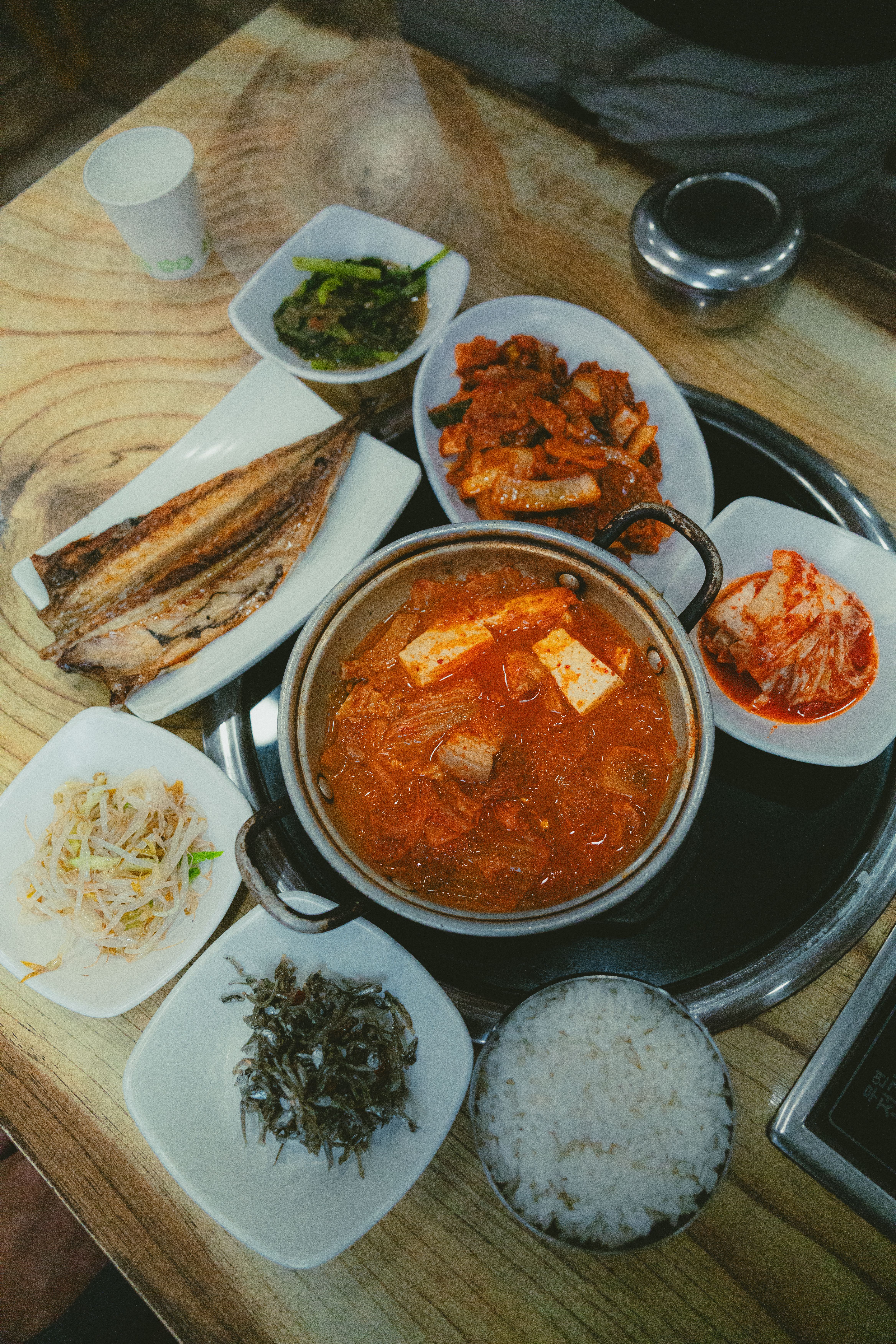
Photo: Theodore Nguyen / Pexels
Korean
Budae Jjigae
The diets react (see scores below)
Common Ingredients
- Spam
- hot dogs
- instant ramen
- kimchi
- tofu
- gochujang
- scallions
- cheese
Specific recipes may vary.
Incompatible with 11 of 11 diets
Diet Ratings
Budae Jjigae is fundamentally incompatible with a ketogenic diet due to its core ingredients. Instant ramen noodles alone contain roughly 50-60g of net carbs per serving, immediately exceeding the daily keto limit. Gochujang paste is a fermented chili paste loaded with added sugar and rice flour, contributing significant carbs. Hot dogs and Spam, while processed meats with some keto tolerance, often contain fillers, starch, and added sugars. Kimchi in small amounts can be keto-friendly, and tofu and cheese are acceptable, but the dish as a whole is built around a high-carb noodle base with a sugary chili paste, making it impossible to fit into ketosis in its traditional form without completely rebuilding the recipe.
Budae Jjigae as described contains multiple animal products that disqualify it entirely from a vegan diet. Spam is a processed pork product, hot dogs typically contain pork and/or beef, and cheese is a dairy product. These three ingredients alone make this dish clearly non-vegan. While some components — kimchi (note: traditional kimchi often contains fish sauce or fermented shrimp, though vegan versions exist), tofu, gochujang, scallions, and instant ramen — can be plant-based, the presence of Spam, hot dogs, and cheese renders the dish as described firmly in the 'avoid' category. There is no meaningful debate within the vegan community about processed pork products or dairy cheese.
Budae Jjigae (Army Base Stew) is one of the most paleo-incompatible dishes imaginable. Nearly every core ingredient violates paleo principles. Spam is a heavily processed pork product loaded with added salt, preservatives, and additives. Hot dogs are processed meats with fillers, nitrates, and artificial additives. Instant ramen noodles are refined wheat-based grains — a foundational paleo exclusion. Tofu is a soy-based legume product, also explicitly excluded. Cheese is dairy, excluded under paleo. Gochujang, while chili-based, is a fermented paste that typically contains rice flour and added sugar. The dish was literally invented from surplus U.S. military processed rations, making it emblematic of modern processed food rather than ancestral eating. Kimchi and scallions are the only ingredients with any paleo compatibility, but they are overwhelmed by the volume and centrality of the non-compliant ingredients.
Budae Jjigae is heavily centered on ultra-processed ingredients that directly contradict Mediterranean diet principles. Spam and hot dogs are processed red/pork meats high in sodium, saturated fat, and preservatives — exactly what the Mediterranean diet minimizes. Instant ramen represents refined, processed grains with poor nutritional profile. Processed cheese adds saturated fat without the benefits of traditional fermented dairy. While kimchi, tofu, scallions, and gochujang offer some plant-based merit, they are overwhelmed by the dominant processed components. This dish is the antithesis of the Mediterranean diet's emphasis on whole, minimally processed foods.
Budae Jjigae is fundamentally incompatible with the carnivore diet. The dish is built around multiple plant-based and processed ingredients that violate core carnivore principles. Instant ramen noodles are a grain-based product, kimchi is fermented vegetables, tofu is a soy-based legume product, gochujang is a fermented chili paste, and scallions are plant matter. Even the animal-derived components are problematic: Spam and hot dogs are heavily processed meats containing sugar, starch fillers, and plant-based additives. The overall dish is a high-carbohydrate, plant-heavy Korean stew with only incidental animal content amid a sea of prohibited ingredients.
Budae Jjigae contains multiple Whole30-excluded ingredients, making it clearly non-compliant. Instant ramen noodles are grains and also fall under the 'no pasta or noodles' rule. Spam is a processed pork product typically containing sugar, starch, and other additives. Hot dogs commonly contain sugar, nitrates, and other non-compliant additives. Cheese is dairy, which is excluded (only ghee and clarified butter are allowed). Tofu is a soy-based product, and soy is a legume — excluded. Gochujang typically contains rice (a grain) and sugar. Even if some ingredients were individually compliant in theory, the combination of grains, dairy, soy, and heavily processed meats makes this dish entirely incompatible with Whole30.
Budae Jjigae contains multiple high-FODMAP ingredients that make it unsuitable during the elimination phase. Kimchi is typically made with garlic and onion (major fructan sources), making it high-FODMAP. Instant ramen noodles are wheat-based, contributing significant fructans. Gochujang (Korean chili paste) contains wheat and often garlic/onion. Hot dogs and Spam frequently contain garlic and onion powder as additives, which are high-FODMAP even in small amounts. Scallion bulbs (white parts) contain fructans, though the green tops are low-FODMAP. Tofu (firm) is generally low-FODMAP. Cheese is typically low-FODMAP (hard/aged cheeses). The dish as a whole is overwhelmingly high-FODMAP due to the combination of wheat-based noodles, kimchi, gochujang, and processed meats with onion/garlic additives — this is not a dish that can be easily modified to be low-FODMAP in its traditional form.
Monash University has tested individual components separately, and some practitioners note that small amounts of kimchi (1 tablespoon) may be tolerable for certain individuals in the reintroduction phase, but during strict elimination the garlic/onion content in kimchi, gochujang, and processed meats makes this dish impractical to approve at any standard serving. The wheat noodles alone would disqualify this dish for most elimination-phase protocols.
Budae Jjigae (Army Base Stew) is heavily incompatible with DASH diet principles. The dish is built around processed, high-sodium ingredients that DASH explicitly limits. Spam alone contains roughly 790mg of sodium per 2oz serving, and a single hot dog adds another 400-500mg. Instant ramen noodles with seasoning packet can contribute 1,500-2,000mg of sodium on their own. Combined, a single serving of this stew can easily exceed the entire daily sodium budget for both standard DASH (2,300mg) and low-sodium DASH (1,500mg) targets. Beyond sodium, Spam and hot dogs are processed meats high in saturated fat and preservatives, which DASH discourages. The American cheese adds saturated fat and sodium. Gochujang and kimchi contribute additional sodium load. While tofu and scallions are DASH-friendly ingredients, they represent a very small fraction of the dish's nutritional impact. The dish's defining character — processed canned meats, instant noodles, and fermented high-sodium condiments — places it squarely in the 'avoid' category with high confidence, as DASH guidelines explicitly flag all of these food types.
Budae Jjigae is a Zone Diet nightmare in its traditional form. The dish is dominated by highly processed, high-sodium, high-saturated-fat proteins (Spam, hot dogs) that are the antithesis of Zone's lean protein guidelines. Instant ramen noodles are a high-glycemic refined carbohydrate that spikes insulin rapidly — exactly what Zone is designed to prevent. The processed cheese adds more saturated fat. While kimchi, tofu, scallions, and gochujang have Zone-friendly properties (kimchi provides polyphenols and fermented benefits, tofu is a legitimate Zone protein block, scallions are favorable low-GI vegetables), these positive elements are overwhelmed by the processed components. Spam and hot dogs are explicitly the type of fatty, processed protein Sears warns against — high in saturated fat, omega-6 fats, nitrates, and sodium, with poor protein-to-fat ratios. The instant ramen noodles represent one of the worst carbohydrate choices possible in Zone methodology. Even aggressive portioning cannot rehabilitate this dish without fundamentally changing its defining ingredients. The ratio cannot be corrected without removing what makes this dish Budae Jjigae.
Budae Jjigae ('Army Stew') is dominated by highly processed, pro-inflammatory ingredients. Spam and hot dogs are ultra-processed meats high in sodium, saturated fat, nitrates/nitrites, and artificial additives — all hallmarks of pro-inflammatory foods. Instant ramen adds refined carbohydrates, inflammatory seed oils, and extreme sodium levels (often 1500-2000mg per packet alone). Processed cheese contributes saturated fat and artificial emulsifiers. The cumulative processed-food load places this dish firmly in 'avoid' territory under any anti-inflammatory framework. There are genuine anti-inflammatory elements present — kimchi provides probiotics and fermented vegetable compounds, tofu supplies soy isoflavones and plant protein, gochujang and scallions offer capsaicin and allicin — but these are minor redemptive factors overwhelmed by the inflammatory core of the dish. The dish exemplifies the category of processed-food-heavy preparations that anti-inflammatory nutrition explicitly warns against, regardless of any beneficial individual components.
Budae Jjigae is a poor fit for GLP-1 patients across nearly every rating criterion. The primary proteins are Spam and hot dogs — ultra-processed, high-sodium, high-saturated-fat meats that are explicitly in the avoid category. Instant ramen noodles are refined carbohydrates with negligible fiber and low nutrient density per calorie. Gochujang and the overall spice profile of the dish can worsen nausea and reflux, which are already common GLP-1 side effects. The cheese adds additional saturated fat. While the dish does contain tofu (a positive) and kimchi (fermented, some fiber and probiotic value), and scallions contribute minor nutrients, these positives are heavily outweighed by the processed meats, refined noodles, high sodium load, and spicy, high-fat profile. The slowed gastric emptying caused by GLP-1 medications makes heavy, fatty, spicy soups like this particularly likely to cause prolonged nausea, bloating, and reflux. The overall dish is low in quality protein relative to its calorie and fat load, low in fiber, high in saturated fat, high in sodium, and high in ingredients that are known to worsen GLP-1 gastrointestinal side effects.
*See how scores were generated at our methodology page.
Nutritional profile
Six traits that cut across every diet.
Fiber & Plants
How much whole-plant food and fiber it delivers.
Healthy Fats
The quality of its fats (unsaturated, omega-3).
Whole / Unprocessed
How close it is to its natural, unprocessed form.
Gut Gentle
How easy it is on digestion (low FODMAP, few irritants).
Low Glycemic
How little it spikes your blood sugar.
Protein Density
How much protein it packs per calorie.
Controversy Index
Higher controversy = more disagreement between diets.