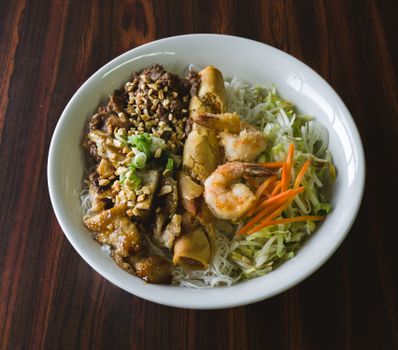
Photo: Alberta Studios / Pexels
Vietnamese
Bun Thit Nuong (Grilled Pork Vermicelli)
The diets react (see scores below)
Common Ingredients
- rice vermicelli
- pork shoulder
- lemongrass
- fish sauce
- peanuts
- mint
- cilantro
- pickled carrots
Specific recipes may vary.
Incompatible with 5 of 11 diets
Diet Ratings
Bun Thit Nuong is fundamentally incompatible with a ketogenic diet due to its primary ingredient: rice vermicelli. A standard serving of rice vermicelli (about 150-200g cooked) contains approximately 40-55g of net carbs on its own, which either meets or exceeds the entire daily keto carb budget in a single dish component. The dish is built around this high-carb noodle base, making it structurally incompatible with ketosis. Secondary concerns include pickled carrots (added sugars in brine, additional carbs) and peanuts (moderate carbs, also a legume debated on keto). The grilled pork itself — marinated with lemongrass and fish sauce — is actually keto-friendly, as is the fresh herb garnish. However, the dish as traditionally prepared cannot be modified slightly to fit keto; the noodle base would need to be entirely removed and substituted, making it a fundamentally different dish.
Bun Thit Nuong contains multiple animal-derived ingredients that disqualify it entirely from a vegan diet. Pork shoulder is a direct animal meat product, and fish sauce is derived from fermented fish — both are clear violations of vegan principles. There is no ambiguity here: this dish is fundamentally built around animal proteins and animal-derived condiments. The plant-based components (rice vermicelli, lemongrass, peanuts, fresh herbs, pickled carrots) are vegan-friendly, but they cannot offset the presence of pork and fish sauce.
Bun Thit Nuong contains multiple paleo-incompatible ingredients. Rice vermicelli is a grain-based noodle (rice is a grain) and forms the foundation of the dish, making it fundamentally non-paleo. Peanuts are legumes, not true nuts, and are explicitly excluded from the paleo diet. Fish sauce, while derived from fish, typically contains added salt and often preservatives, placing it in the avoid or caution range. Pickled carrots may contain added sugar and salt. The remaining ingredients — pork shoulder, lemongrass, mint, and cilantro — are paleo-approved, but the core structural components (rice noodles, peanuts) are clear violations. This dish cannot be considered paleo-compatible in its traditional form.
Bun Thit Nuong presents a mixed Mediterranean diet profile. The dish has several positive elements: abundant fresh herbs (mint, cilantro), peanuts as a legume/nut source, pickled vegetables, and lemongrass — all plant-forward components aligned with Mediterranean principles. However, the primary protein is grilled pork shoulder (red meat), which Mediterranean guidelines restrict to a few times per month. The base is rice vermicelli, a refined grain with no fiber benefit compared to whole grains the diet emphasizes. Fish sauce adds sodium but is a minimally processed condiment used in small quantities. The dish lacks olive oil as a fat source. On balance, the generous herbs, vegetables, and peanuts partially redeem the dish, but the red meat protein and refined grain base pull it into caution territory rather than avoid, since portions of pork are modest and the overall dish is not heavily processed.
Some Mediterranean diet interpreters would score this lower (avoid range) given that pork shoulder is red meat — explicitly limited to once weekly or less — and rice vermicelli is a refined grain, making this a double deviation from core principles. Conversely, the PREDIMED-style emphasis on overall dietary patterns rather than single meals might accept this as an occasional dish given its vegetable and herb density.
Bun Thit Nuong is fundamentally incompatible with the carnivore diet. The dish is built around rice vermicelli, a plant-based grain product that forms the majority of the meal. Beyond the noodles, it contains multiple plant-derived ingredients: lemongrass (herb/spice), peanuts (legume), fresh mint, cilantro, and pickled carrots (vegetables). Fish sauce is carnivore-acceptable, and the grilled pork shoulder is the only component that fits. With only one carnivore-compliant ingredient out of eight, this dish is essentially a plant-forward Vietnamese meal that happens to include some pork.
Bun Thit Nuong contains two clearly excluded ingredients: rice vermicelli (a grain-based noodle made from rice, which is an excluded grain on Whole30) and peanuts (a legume, explicitly excluded). Either of these alone would disqualify the dish. Additionally, pickled carrots may contain added sugar in traditional preparations. Fish sauce is generally compliant, and the remaining ingredients (pork shoulder, lemongrass, mint, cilantro) are all Whole30-friendly, but the foundational components of this dish — the noodles and peanuts — are incompatible with the program.
Bun Thit Nuong is largely low-FODMAP in its base components — rice vermicelli is safe, pork shoulder is FODMAP-free, fresh herbs (mint, cilantro) are low-FODMAP, and fish sauce is low-FODMAP in typical quantities. However, several ingredients introduce meaningful caution. Lemongrass is rated low-FODMAP by Monash at 1 stalk but is commonly used in larger amounts in marinades, and its FODMAP content (fructans) can accumulate. Peanuts are low-FODMAP at a 28g (small handful) serving but become moderate-to-high in GOS at larger amounts, and Vietnamese dishes often include a generous garnish. Pickled carrots are generally low-FODMAP, but if the pickling brine uses large amounts of garlic or onion, this becomes a hidden FODMAP source. The fish sauce-based dipping sauce (nuoc cham) typically accompanies this dish and frequently contains garlic, which is high in fructans even in small amounts. The dish as presented lacks explicit garlic/onion, which is a positive sign, but the real-world preparation of this dish nearly always involves garlic somewhere — in the marinade, the dipping sauce, or both — making it risky in a restaurant or home setting without careful verification.
Monash University rates the individual listed ingredients as manageable with portion control, which could support a higher score. However, clinical FODMAP practitioners would flag that Bun Thit Nuong is almost never prepared without garlic (typically in marinade and nuoc cham dipping sauce), and the dish as described may underrepresent real-world ingredients — making this a borderline 'avoid' in practice for strict elimination phase without explicit recipe confirmation.
Bun Thit Nuong presents a mixed DASH profile. On the positive side, rice vermicelli is a refined carbohydrate but relatively low in sodium, and the dish is rich in DASH-friendly elements: fresh herbs (mint, cilantro), pickled vegetables (carrots), and peanuts (a DASH-approved nut in moderation). However, several factors warrant caution. Pork shoulder is a moderately fatty cut with meaningful saturated fat content — DASH guidelines emphasize lean proteins and limit red meat. Fish sauce is very high in sodium (approximately 1,000–1,400mg per tablespoon), and Vietnamese marinades and dipping sauces (nuoc cham) typically use it generously, making sodium control a significant concern. Pickled carrots also add sodium depending on preparation. The dish is not inherently DASH-incompatible, but as commonly prepared it likely exceeds moderate sodium thresholds and uses a cut of pork that DASH does not emphasize. Modifications — using pork tenderloin instead of shoulder, reducing fish sauce, and requesting low-sodium nuoc cham — would improve the DASH score considerably.
NIH DASH guidelines explicitly limit red and fatty meats and high-sodium condiments like fish sauce, making a 'caution' rating straightforward for this dish as commonly prepared. However, some DASH-oriented dietitians note that when portion-controlled and paired with abundant vegetables and herbs, dishes like Bun Thit Nuong can fit within a DASH pattern — particularly if lean pork cuts are substituted and sodium from sauces is minimized.
Bun Thit Nuong presents a mixed Zone Diet profile. The dish has several favorable elements — grilled pork is a reasonable lean protein source (especially if trimmed), and the fresh herbs (mint, cilantro), pickled carrots, and lemongrass contribute low-glycemic vegetables and polyphenols aligned with Sears' anti-inflammatory emphasis. Peanuts provide monounsaturated fat, though they also carry some omega-6 load. The primary concern is rice vermicelli, a refined, high-glycemic carbohydrate that Sears classifies as an 'unfavorable' carb — it lacks fiber, spikes insulin, and is nutritionally closer to white rice than a favorable Zone carb. Pork shoulder is also fattier than ideal Zone proteins (skinless chicken, fish), adding saturated fat. However, because Zone is ratio-based, this dish can be zone-adjusted: reduce vermicelli portion significantly, increase the herb and vegetable components, and trim the pork well. As typically served in restaurants, the vermicelli portion is large, the pork-to-noodle ratio skews the macros toward carbohydrate-dominant, and the 40/30/30 balance is difficult to achieve without deliberate modification. A home cook controlling portions could bring this closer to Zone compliance.
Some Zone practitioners applying Sears' later anti-inflammatory writing (The OmegaRx Zone, The Mediterranean Zone) would note that this dish's fresh herbs, fermented fish sauce, and pickled vegetables contribute meaningful polyphenols and the overall food quality is far above processed alternatives. They might score it more favorably (6-7) if portion control is applied, arguing that the herb-forward Vietnamese eating style aligns with Sears' Mediterranean Zone evolution. Conversely, strict early-Zone adherents would penalize the rice vermicelli heavily as a high-glycemic unfavorable carb and the pork shoulder for saturated fat, potentially scoring lower (4).
Bun Thit Nuong presents a mixed anti-inflammatory profile. On the positive side, the dish features several strongly anti-inflammatory ingredients: lemongrass contains anti-inflammatory compounds including citral and luteolin; fresh herbs (mint, cilantro) are rich in polyphenols and antioxidants; peanuts provide some anti-inflammatory monounsaturated fats and resveratrol, though they are higher in omega-6 than ideal. Rice vermicelli is a refined carbohydrate that is relatively neutral — not as problematic as wheat-based refined carbs, but provides little anti-inflammatory benefit and moderate glycemic load. The central concern is pork shoulder, a relatively fatty red/processed meat cut that falls into the 'limit' category due to saturated fat content and arachidonic acid, which can promote inflammatory cascades. The fish sauce adds sodium but in typical culinary quantities is not a major concern. Pickled carrots provide some antioxidant carotenoids. Overall, this is a dish with genuine anti-inflammatory highlights (herbs, lemongrass) offset by the pork shoulder and refined carbohydrate base. Suitable in moderation; would score higher with a leaner protein swap (shrimp, tofu) and a whole-grain or lower-GI noodle alternative.
Some anti-inflammatory practitioners, including those aligned with Dr. Weil's broader Mediterranean-Asian dietary approach, may view this dish more favorably given its abundance of fresh herbs, aromatic spices, and relatively light sauce profile compared to Western meat dishes. Conversely, stricter anti-inflammatory protocols would flag both the pork shoulder (saturated fat, arachidonic acid) and the refined rice noodles more harshly, pushing the verdict closer to avoid.
Bun Thit Nuong is a nutritionally mixed dish for GLP-1 patients. On the positive side, grilled pork provides meaningful protein, and the fresh herb garnishes (mint, cilantro), pickled carrots, and light fish sauce dressing make this far more GLP-1-friendly than fried or heavy Vietnamese dishes. The grilling method avoids added fat. However, several factors pull the score down: pork shoulder is a moderately fatty cut with significant saturated fat compared to leaner proteins like chicken breast or pork loin, which can worsen nausea and slow digestion further on top of GLP-1 gastric emptying effects. Rice vermicelli is a refined grain with low fiber and low protein density — it contributes bulk and calories without meaningful nutritional value per bite. Peanuts add healthy unsaturated fat but also caloric density, which is portion-sensitive for GLP-1 patients with reduced appetite. The overall protein-to-calorie ratio of the dish as typically served (vermicelli-heavy) may fall short of the 15-30g protein per meal target unless the pork portion is generous. The dish is easily digestible in texture, which is a positive. Modifying this dish — substituting pork loin or chicken for the shoulder, reducing the vermicelli portion, and going light on peanuts — would significantly improve its GLP-1 suitability.
Some GLP-1-focused dietitians view traditional Vietnamese dishes like this favorably relative to Western alternatives because the overall fat load is still lower than most Western comfort foods and the fresh vegetable components support fiber and hydration goals. Others caution that the refined vermicelli base and fatty pork cut make it a poor choice for patients in early GLP-1 treatment when GI tolerance is lowest and every calorie must be highly nutritious.
*See how scores were generated at our methodology page.
Nutritional profile
Six traits that cut across every diet.
Fiber & Plants
How much whole-plant food and fiber it delivers.
Healthy Fats
The quality of its fats (unsaturated, omega-3).
Whole / Unprocessed
How close it is to its natural, unprocessed form.
Gut Gentle
How easy it is on digestion (low FODMAP, few irritants).
Low Glycemic
How little it spikes your blood sugar.
Protein Density
How much protein it packs per calorie.
Controversy Index
Higher controversy = more disagreement between diets.
Diet-Specific Tips
 Mediterranean — 4/10
View tips
- Pork shoulder is red meat, restricted to a few times per month in Mediterranean guidelines
- Rice vermicelli is a refined grain, not a whole grain
- Abundant fresh herbs (mint, cilantro) and pickled vegetables are Mediterranean-aligned plant foods
- Peanuts provide healthy fats and plant protein consistent with Mediterranean principles
- No olive oil present as the primary fat source
- Dish is minimally processed overall despite non-Mediterranean protein and grain choices
 Low-FODMAP — 5/10
View tips
- Rice vermicelli is low-FODMAP and safe as the base
- Pork shoulder is FODMAP-free as a plain protein
- Lemongrass is low-FODMAP at ≤1 stalk; higher amounts in marinades may contribute fructans
- Peanuts are low-FODMAP at 28g but high-GOS at larger servings common in this dish
- Fish sauce is low-FODMAP at standard quantities (≤2 tbsp)
- Pickled carrots are generally safe unless brined with garlic or onion
- Traditional nuoc cham dipping sauce almost always contains garlic — a major hidden FODMAP risk not listed in ingredients
- Mint and cilantro are both low-FODMAP at typical serving sizes
 DASH — 5/10
View tips
- Pork shoulder has moderate-to-high saturated fat; DASH prefers lean proteins and limits red meat
- Fish sauce is very high in sodium (~1,000–1,400mg/tbsp), posing a significant sodium concern
- Rice vermicelli is refined (not whole grain), though lower in sodium
- Peanuts, fresh herbs, and vegetables are DASH-positive components
- Pickled carrots add additional sodium depending on preparation
- Dish can be DASH-compatible with modifications: lean pork cut, reduced fish sauce, low-sodium dipping sauce
 Zone — 5/10
View tips
- Rice vermicelli is a refined, high-glycemic 'unfavorable' carb in Zone terminology — large portions disrupt the 40/30/30 ratio
- Pork shoulder is fattier than ideal Zone protein sources; leaner cuts like pork tenderloin would improve Zone compatibility
- Fresh herbs (mint, cilantro) and pickled carrots are favorable low-glycemic Zone carb components with polyphenol benefits
- Peanuts provide primarily monounsaturated fat but also carry omega-6 fatty acids — use in moderation
- Fish sauce is a low-calorie flavoring that does not significantly affect macro balance
- Dish as served typically skews carbohydrate-heavy; deliberate portion reduction of noodles and increase of vegetables needed for Zone compliance
- Grilling method is favorable — avoids added cooking fats and reduces overall caloric density
 Anti-Inflammatory — 5/10
View tips
- Pork shoulder is a fatty red meat — falls in the 'limit' category due to saturated fat and arachidonic acid
- Lemongrass is anti-inflammatory (citral, flavonoids)
- Fresh mint and cilantro provide polyphenols and antioxidants
- Peanuts offer some monounsaturated fat but are omega-6 heavy
- Rice vermicelli is a refined carbohydrate with moderate glycemic impact and limited anti-inflammatory benefit
- Fish sauce in culinary quantities is largely neutral
- Pickled carrots contribute carotenoids and modest antioxidant value
- No trans fats, artificial additives, or high-fructose corn syrup
 GLP-1 Friendly — 5/10
View tips
- Pork shoulder is a moderately fatty cut — increases saturated fat load and may worsen GLP-1 nausea and reflux
- Rice vermicelli is a refined grain — low fiber, low protein, contributes empty starch calories
- Grilling method is positive — no added frying fat
- Fresh herbs and pickled carrots contribute micronutrients and mild fiber
- Peanuts add heart-healthy unsaturated fat but are calorie-dense and portion-sensitive
- Protein-to-carbohydrate ratio is unfavorable in typical restaurant servings
- Fish sauce is high sodium but used in small amounts — minor concern
- Overall dish is relatively easy to digest in texture, which suits slowed gastric emptying