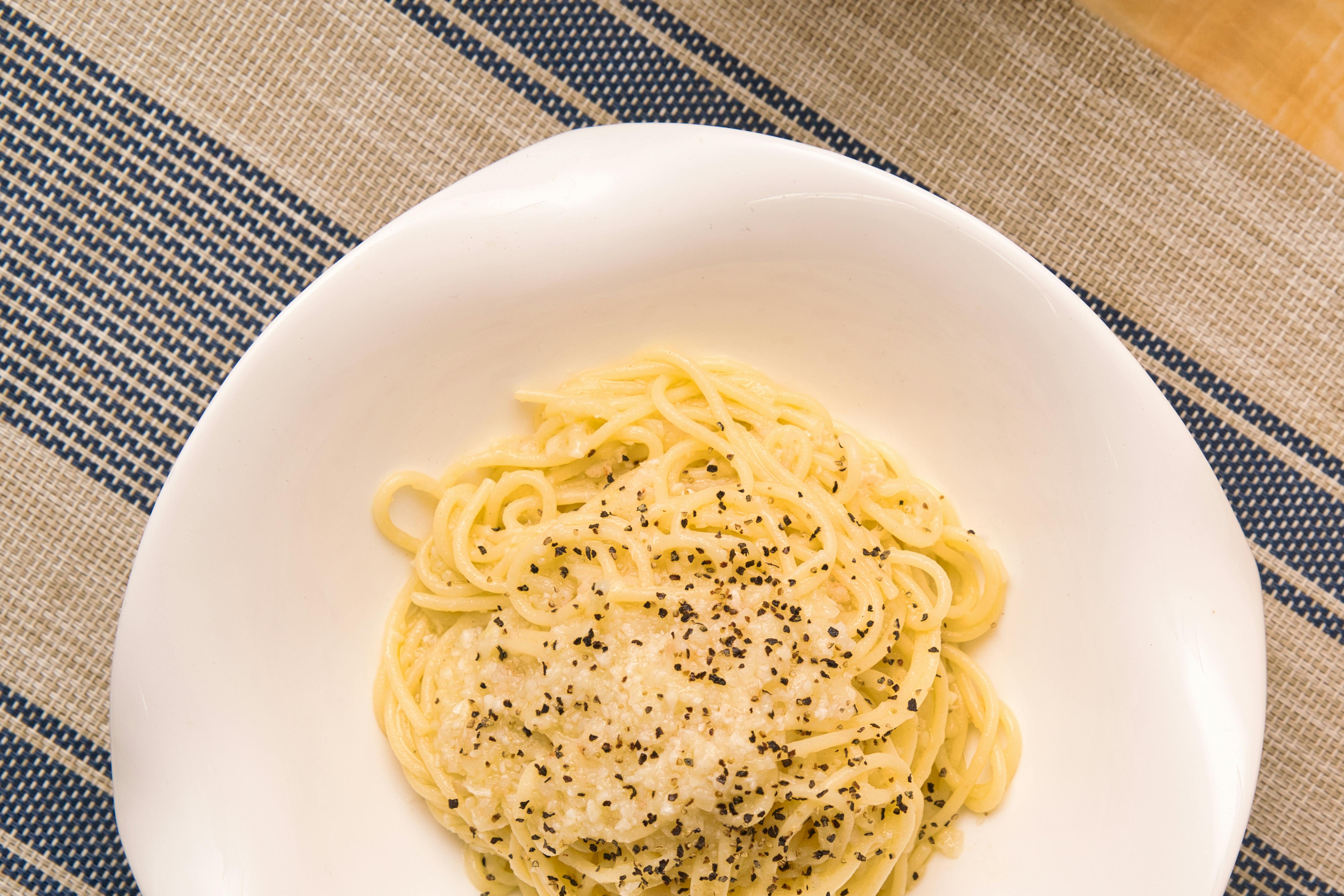
Photo: Takeshi Arai / Pexels
Italian
Cacio e Pepe
The diets react (see scores below)
Common Ingredients
- spaghetti
- Pecorino Romano
- black pepper
- butter
- olive oil
- salt
Specific recipes may vary.
Incompatible with 8 of 11 diets
Diet Ratings
Cacio e Pepe is fundamentally built on spaghetti, a refined grain pasta that is one of the most keto-incompatible foods possible. A standard serving (2 oz dry / ~56g) of spaghetti contains approximately 40-43g of net carbs, which alone hits or exceeds the entire daily keto carb budget. The dish cannot be modified to be keto-compatible without replacing its primary and defining ingredient. The other components — Pecorino Romano, butter, olive oil, and black pepper — are all keto-friendly, but they are incidental to the core disqualifying ingredient.
Cacio e Pepe is fundamentally incompatible with a vegan diet. The dish's identity is built around Pecorino Romano, a hard sheep's milk cheese, which is a direct animal dairy product. Butter, also listed as an ingredient, is a dairy product derived from cow's milk. Both are clearly excluded under vegan rules. The remaining ingredients — spaghetti (typically egg-free in its basic form), black pepper, olive oil, and salt — are plant-based, but the non-vegan components are not incidental additives; they are the core, defining elements of this dish. A vegan version could theoretically be made using nutritional yeast, cashew-based cheese, or vegan butter substitutes, but the dish as described cannot be considered vegan.
Cacio e Pepe is fundamentally incompatible with the Paleo diet. The dish is built almost entirely on non-Paleo ingredients: spaghetti is a wheat-based grain (a clear avoid), Pecorino Romano is a dairy product (excluded by all major Paleo frameworks), butter is a dairy derivative (also excluded, especially in the strict Cordain school), and salt is an added ingredient discouraged on Paleo. Olive oil and black pepper are the only components that pass Paleo scrutiny. With its core identity resting on grains and dairy, this dish cannot be adapted into Paleo without ceasing to be Cacio e Pepe entirely.
Cacio e Pepe is a classic Roman pasta dish that sits uneasily within Mediterranean diet principles. The refined white pasta (spaghetti) is a processed grain lacking the fiber and nutrients of whole grain alternatives. Pecorino Romano is a high-fat, high-sodium aged cheese used in significant quantity, placing it beyond the 'moderate dairy' guideline. Butter, while used in small amounts here alongside olive oil, is an animal fat not aligned with the olive-oil-primary principle. The dish does include olive oil and is plant-based in terms of protein, but it is calorie-dense with saturated fat and refined carbohydrates, and provides minimal vegetables, legumes, or fiber. Occasional enjoyment is acceptable, but it should not be a dietary staple.
Traditional central Italian (Roman) cuisine has long incorporated aged sheep's milk cheeses like Pecorino and pasta as cultural staples, and some Mediterranean diet researchers acknowledge that regional pasta dishes in moderate portions — especially when made with durum wheat semolina — are compatible with a Mediterranean eating pattern. A small amount of butter is also found in Northern Italian traditions that overlap with broader Mediterranean heritage.
Cacio e Pepe is fundamentally incompatible with the carnivore diet. The primary ingredient is spaghetti, a grain-based pasta that is explicitly excluded from all tiers of carnivore eating. While Pecorino Romano (a sheep's milk cheese) and butter are animal-derived, they are minor components overwhelmed by the plant-based foundation of this dish. Olive oil is a plant-derived oil, also excluded. Black pepper, though used in small amounts, is a plant-based spice. The dish has no meaningful animal protein source. There is no variation of this dish that could be adapted to carnivore without completely deconstructing it — at which point it would no longer be Cacio e Pepe.
Cacio e Pepe contains multiple Whole30-excluded ingredients. Spaghetti is a grain-based pasta (wheat), which is explicitly excluded from the Whole30 program. Pecorino Romano is a dairy cheese, also explicitly excluded. Butter is excluded dairy (only ghee/clarified butter is permitted). These are not minor or borderline violations — they are core, explicitly named exclusions in the Whole30 rules. The dish is essentially defined by its two main ingredients (cheese and pasta), both of which are prohibited, making this entirely incompatible with the program.
Cacio e Pepe is built on two high-FODMAP ingredients. Regular wheat spaghetti is high in fructans — the primary FODMAP concern — at a standard pasta serving (typically 180-220g cooked). Pecorino Romano is an aged hard cheese; while most aged hard cheeses are low-FODMAP due to minimal residual lactose, Pecorino Romano is used in significant quantities in this dish (often 60-100g) and Monash data on Pecorino specifically is limited compared to Parmesan. The core problem is the wheat pasta: there is no safe standard serving of regular wheat pasta during the elimination phase. The remaining ingredients — black pepper, butter, olive oil, and salt — are all low-FODMAP and unproblematic. The dish can be made low-FODMAP by substituting gluten-free pasta (rice or corn-based), which would transform the verdict entirely.
Cacio e Pepe is fundamentally incompatible with the DASH diet in its traditional form. The dish is built around Pecorino Romano, one of the saltiest cheeses available (approximately 600–800mg sodium per ounce), full-fat butter, and added salt — creating a sodium load that can easily exceed 1,500–2,000mg in a single serving, threatening the entire daily DASH sodium budget. The cheese is also high in saturated fat, which DASH explicitly limits. The pasta, if made from refined white flour (as is traditional), provides minimal fiber compared to whole grain alternatives. Olive oil is DASH-friendly, and the pasta base is acceptable in portion-controlled whole-grain form, but these positives are overwhelmed by the high-sodium, high-saturated-fat cheese and butter combination. There is no lean protein, no vegetables, no fruits, and no low-fat dairy in this dish. It represents almost the inverse of DASH macronutrient priorities for a main course.
Cacio e Pepe is fundamentally incompatible with Zone Diet principles as a standalone dish. The primary macronutrient is refined pasta (spaghetti), a high-glycemic carbohydrate that Sears classifies as 'unfavorable' — it spikes insulin rapidly and is nutritionally dense in carbs with little fiber to offset glycemic load. The dish has virtually no lean protein — Pecorino Romano provides some protein but is primarily a high-saturated-fat cheese. The fat profile is a mix of saturated (butter, Pecorino) and monounsaturated (olive oil), which is suboptimal. Most critically, there is no lean protein source whatsoever, making the 40/30/30 block ratio essentially impossible to achieve with this dish as constructed. A Zone meal requires approximately 25g of lean protein, ~27g net carbs, and 10-15g of mostly monounsaturated fat per meal — Cacio e Pepe delivers a carb-and-saturated-fat-heavy profile with minimal usable protein. Even with careful portioning, the dish cannot be balanced without fundamentally altering it (adding lean protein, reducing pasta dramatically). As a category, pasta dishes without lean protein are among the most challenging Zone foods.
Cacio e Pepe is a simple Roman pasta dish with both anti-inflammatory and pro-inflammatory elements. On the positive side, black pepper contains piperine, a compound with demonstrated anti-inflammatory properties, and olive oil provides oleocanthal and monounsaturated fats that are cornerstone ingredients in anti-inflammatory eating. However, the dish is built primarily around refined white pasta (spaghetti), which is a refined carbohydrate that raises blood glucose and can promote inflammatory markers — whole grain pasta would meaningfully improve the profile. Pecorino Romano is a full-fat hard cheese, and while aged cheeses in small amounts are tolerated in some anti-inflammatory frameworks, the quantity used in cacio e pepe is substantial and contributes significant saturated fat. Butter is likewise a saturated fat that anti-inflammatory guidelines recommend limiting. There is no protein, fiber, or meaningful antioxidant load from vegetables or legumes. The dish is calorie-dense and nutritionally narrow from an anti-inflammatory standpoint. It is not a dish to avoid outright, but it is not aligned with anti-inflammatory principles as typically prepared. Substituting whole grain pasta, using more olive oil than butter, and reducing cheese quantity would improve the score.
Cacio e Pepe is a refined-carbohydrate, high-fat dish with virtually no meaningful protein source for GLP-1 patients. A standard serving of spaghetti (approximately 2 oz dry) provides roughly 7g protein — far below the 15-30g per meal target — and contributes ~40g of refined, low-fiber carbohydrates. Pecorino Romano adds modest additional protein but comes packaged with significant saturated fat, and butter adds further saturated fat with no nutritional benefit. Olive oil is the one favorable fat source here. The high fat content (saturated fat from cheese and butter) directly worsens GLP-1 side effects including nausea, bloating, and reflux. Slowed gastric emptying means a heavy, fatty, carb-dense meal like this sits in the stomach longer and amplifies discomfort. Refined pasta offers minimal fiber. The dish is calorie-dense relative to its nutritional return, which is especially counterproductive when total intake is already reduced. This dish could be modified — using a high-protein pasta, reducing butter, increasing Pecorino moderately, and adding a lean protein — but as traditionally prepared it fails on protein density, fiber, fat quality, and GLP-1 side effect risk. It scores 3 rather than 1-2 only because it is not fried, not sugary, not alcohol-based, and olive oil is present.
*See how scores were generated at our methodology page.
Nutritional profile
Six traits that cut across every diet.
Fiber & Plants
How much whole-plant food and fiber it delivers.
Healthy Fats
The quality of its fats (unsaturated, omega-3).
Whole / Unprocessed
How close it is to its natural, unprocessed form.
Gut Gentle
How easy it is on digestion (low FODMAP, few irritants).
Low Glycemic
How little it spikes your blood sugar.
Protein Density
How much protein it packs per calorie.
Controversy Index
Higher controversy = more disagreement between diets.
Diet-Specific Tips
 Mediterranean — 4/10
View tips
- Refined white pasta contradicts whole grain preference
- High amounts of Pecorino Romano exceed moderate dairy guidance
- Butter adds saturated animal fat, inconsistent with olive oil as primary fat
- Olive oil is present, which is a positive element
- No vegetables, legumes, or plant diversity in the dish
- No protein source; nutritionally unbalanced as a main
- Acceptable occasionally as a cultural dish but not a dietary staple
 Anti-Inflammatory — 4/10
View tips
- Refined white spaghetti is a high-glycemic refined carbohydrate — a notable pro-inflammatory concern
- Pecorino Romano is a full-fat cheese used in substantial quantity, contributing significant saturated fat
- Butter is a saturated fat that anti-inflammatory guidelines recommend limiting
- Black pepper (piperine) provides a genuine anti-inflammatory benefit
- Olive oil is a core anti-inflammatory fat, but its impact is diluted by the butter and cheese
- No vegetables, legumes, or other antioxidant-rich ingredients to offset the inflammatory components
- Whole grain pasta substitution would meaningfully improve the anti-inflammatory profile
 GLP-1 Friendly — 5/10
View tips
- Negligible protein relative to GLP-1 per-meal targets (~7g from pasta, modest addition from Pecorino vs. 15-30g goal)
- Refined carbohydrate base with minimal fiber — worsens blood sugar stability and satiety
- High saturated fat from Pecorino Romano and butter likely to worsen nausea, bloating, and reflux due to slowed gastric emptying
- Calorie-dense with low nutrient density per calorie — counterproductive given reduced appetite
- No primary protein source listed — dish was submitted with 'none' for protein, confirming the gap
- Olive oil is the one favorable element; black pepper is a mild GI irritant at high quantities but negligible at typical use