Photo: adrian vieriu / Pexels
The diets react (see scores below)

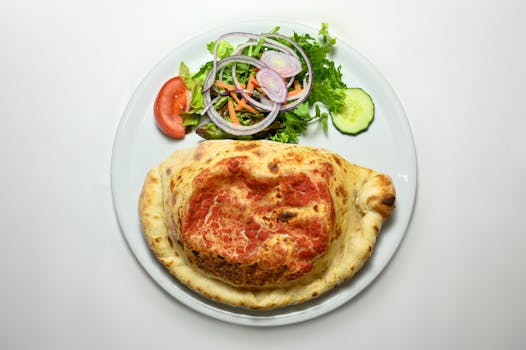
That’s a heavy plate — want to see the leaner version?
Common Ingredients
- pizza doughWhole wheat pizza dough
Whole-wheat dough adds fiber and lowers the refined-grain load versus pizza dough.
- ricottaCottage cheese
Cottage cheese keeps the soft-cheese body of ricotta with more protein and less fat.
- mozzarella
- Parmesan
- Italian sausageTurkey sausage
Turkey sausage keeps the seasoned-sausage role with less saturated fat and sodium than Italian sausage.
- tomato sauce
- garlic
- oregano
Specific recipes may vary.
Incompatible with 10 of 11 diets
Diet Ratings
A calzone is fundamentally built around pizza dough, which is a wheat-flour-based grain product. A single calzone contains roughly 50-70g of net carbs from the dough alone, immediately exceeding the entire daily keto carb budget. There is no modification or portion control that makes a traditional calzone compatible with ketosis — the dough is the dish. The fillings (ricotta, mozzarella, Parmesan, Italian sausage) are individually keto-friendly, but they cannot redeem a food whose structural foundation is a high-carb grain crust. Tomato sauce adds a small additional carb load. This is a clear, unambiguous incompatibility.
This calzone contains multiple animal-derived ingredients that are strictly excluded from a vegan diet. Ricotta, mozzarella, and Parmesan are all dairy products (containing casein and whey), and Italian sausage is a meat product. The dish is fundamentally built around animal ingredients and cannot be considered vegan in any interpretation.
Calzone is fundamentally incompatible with the Paleolithic diet. The dish is built on pizza dough, which is a wheat-flour-based grain product — one of the clearest exclusions in paleo. Beyond the dough, the filling contains multiple dairy products (ricotta, mozzarella, and Parmesan), all of which are excluded under strict paleo principles. The combination of a grain-based crust and multiple dairy fillers makes this dish among the most paleo-incompatible foods possible. While garlic, oregano, Italian sausage (in its unprocessed form), and tomato sauce are paleo-compatible components, they are entirely overwhelmed by the non-compliant foundation ingredients. There is no version of a traditional calzone that can be considered paleo.
This calzone combines multiple problematic elements from a Mediterranean diet perspective. The primary protein is Italian sausage (processed red meat), which is high in saturated fat and sodium and should be limited to rare occasions. The dough is made from refined white flour, a refined grain discouraged by Mediterranean diet principles. The dish is also heavy in full-fat dairy (ricotta, mozzarella, Parmesan combined), pushing well beyond moderate dairy consumption. While tomato sauce, garlic, and oregano are Mediterranean staples, they cannot offset the overall profile of this dish, which is centered on processed meat, refined carbohydrates, and excess saturated fat. This is an indulgent Italian-American preparation rather than a representation of traditional Mediterranean eating patterns.
Calzone is fundamentally incompatible with the carnivore diet. The dish is built on pizza dough — a grain-based, plant-derived carbohydrate that is strictly excluded under all tiers of carnivore eating. Beyond the dough, it contains tomato sauce (plant-derived), garlic (plant-derived), and oregano (plant-derived spice). While it does include some animal-derived ingredients (ricotta, mozzarella, Parmesan, Italian sausage), these are incidental to a dish whose structure and identity are entirely plant-based. The grain dough alone is an absolute disqualifier across all carnivore protocols — there is no version of this dish that can be made carnivore-compatible without it ceasing to be a calzone entirely.
A calzone violates Whole30 on multiple fronts. Pizza dough is made from wheat/grain flour, which is explicitly excluded. Ricotta, mozzarella, and Parmesan are all dairy products, also explicitly excluded. Even if those ingredients were somehow swapped out, a calzone is structurally a stuffed bread/pastry — directly analogous to the 'no recreating baked goods' rule that explicitly calls out pizza crust and similar items. This dish is incompatible with Whole30 by nearly every major rule.
Calzone contains multiple high-FODMAP ingredients that make it unsuitable during the elimination phase. Pizza dough made from wheat flour is high in fructans — one of the most problematic FODMAPs — and a standard calzone serving would contain a significant amount of wheat. Garlic is one of the highest-FODMAP foods tested by Monash, containing concentrated fructans even in very small amounts. Ricotta is high in lactose at standard serving sizes (low-FODMAP only at 2 tablespoons/40g, but calzones typically contain far more). Italian sausage frequently contains garlic, onion powder, and other high-FODMAP seasonings. Tomato sauce in commercial or restaurant preparations commonly includes garlic and onion. The combination of wheat dough, garlic, ricotta in large quantities, and seasoned sausage creates a dish with at least three to four independently high-FODMAP components at typical serving sizes. Mozzarella and Parmesan are low-FODMAP (hard/low-lactose cheeses), and oregano is fine, but these cannot offset the major FODMAP load from the other ingredients.
A calzone as described is a poor fit for the DASH diet on multiple fronts. The combination of full-fat ricotta, mozzarella, and Parmesan cheeses contributes substantial saturated fat and sodium. Italian sausage (and the noted primary proteins of salami or ham) are high-sodium, high-saturated-fat processed or cured meats that DASH explicitly limits. Refined white pizza dough provides little fiber and no meaningful micronutrient contribution relevant to DASH goals (potassium, magnesium, calcium from beneficial sources). The tomato sauce, garlic, and oregano are DASH-compatible ingredients, but they are overwhelmed by the problematic components. A single calzone can easily contain 1,200–2,000mg of sodium and 15–25g of saturated fat, both of which far exceed DASH per-meal targets. This dish aligns with virtually none of the DASH dietary priorities: it is not a vegetable, fruit, whole grain, low-fat dairy, or lean protein-centered meal.
A calzone presents significant Zone Diet challenges across all three macronutrient categories. The foundation — pizza dough — is a high-glycemic refined carbohydrate that Sears explicitly classifies as 'unfavorable,' spiking insulin and disrupting eicosanoid balance. The protein sources (Italian sausage, salami/ham) are high in saturated fat and processed meats, far from the lean protein ideal of skinless chicken or fish. The cheese trio (ricotta, mozzarella, Parmesan) adds additional saturated fat. The 40/30/30 ratio is essentially impossible to hit with this combination without extreme portion reduction — the dough alone dominates carb blocks with high-GI carbs, while the fat blocks skew heavily saturated rather than monounsaturated. The tomato sauce, garlic, and oregano are Zone-friendly (polyphenol-rich), but they cannot redeem the overall profile. A typical restaurant calzone could easily represent 4-6 carb blocks of unfavorable carbs, 4-6 protein blocks of fatty protein, and fat blocks dominated by saturated fat — making Zone balancing practically impossible without deconstructing the dish entirely. This scores a 3 rather than 1-2 because the tomato sauce and herbs have genuine Zone merit, and home modification (whole-wheat thin dough, lean turkey, reduced cheese) could theoretically move it to caution territory.
A calzone as described is a combination of several pro-inflammatory ingredients that stack unfavorably under anti-inflammatory principles. The base is refined white pizza dough — a refined carbohydrate that spikes blood sugar and provides minimal fiber or nutrients. The protein is Italian sausage (high in saturated fat and sodium, often containing nitrates/additives) along with implied salami or ham — all processed or cured red meats that are among the most pro-inflammatory protein choices. The cheese blend of ricotta, mozzarella, and Parmesan is full-fat dairy, which is in the 'limit' category and contributes significant saturated fat. The only redemptive elements are the tomato sauce (lycopene, antioxidants), garlic (allicin, anti-inflammatory), and oregano (polyphenols) — but these are minor contributors in the context of the overall dish. The combination of refined carbs, processed meat, and full-fat dairy creates a high saturated fat, high glycemic load, low-fiber meal profile that would likely increase inflammatory markers. This is not a food that fits anti-inflammatory principles even occasionally without significant modification (e.g., whole wheat dough, no processed meat, part-skim dairy, plant-forward fillings).
A calzone is a poor fit for GLP-1 patients on nearly every key criterion. The combination of refined-flour dough, full-fat ricotta, mozzarella, Parmesan, and Italian sausage creates a dish that is high in saturated fat, high in refined carbohydrates, and low in fiber. Italian sausage is a fatty, processed meat that is known to worsen GLP-1 GI side effects including nausea, bloating, and reflux. The dough provides minimal nutritional value per calorie and contributes to a heavy, dense meal that sits poorly in a slowed GLP-1 stomach. While the cheese blend does contribute some protein, the protein-to-fat and protein-to-calorie ratios are unfavorable — a typical calzone delivers 800–1,200+ calories with 40–60g of fat and only 25–35g of protein, making it calorie-dense with poor nutritional efficiency. The large portion size required to reach even modest protein targets makes it especially unsuitable for patients with reduced appetite. Garlic and spiced sausage may additionally trigger reflux in patients already experiencing GLP-1-related slowed gastric emptying.
*See how scores were generated at our methodology page.
Nutritional profile
Six traits that cut across every diet.
Fiber & Plants
How much whole-plant food and fiber it delivers.
Healthy Fats
The quality of its fats (unsaturated, omega-3).
Whole / Unprocessed
How close it is to its natural, unprocessed form.
Gut Gentle
How easy it is on digestion (low FODMAP, few irritants).
Low Glycemic
How little it spikes your blood sugar.
Protein Density
How much protein it packs per calorie.
Controversy Index
Higher controversy = more disagreement between diets.
Diet-Specific Tips
 Zone — 5/10
View tips
- Pizza dough is a high-glycemic refined carbohydrate explicitly classified as 'unfavorable' in Zone methodology
- Italian sausage and processed meats (salami/ham) are high in saturated fat, conflicting with Zone's lean protein guidelines
- Triple-cheese filling (ricotta, mozzarella, Parmesan) adds significant saturated fat far exceeding Zone's monounsaturated fat preference
- Macro ratio is structurally imbalanced — carb-heavy with unfavorable GI profile and fat-heavy with wrong fat type
- Tomato sauce, garlic, and oregano provide polyphenols and are Zone-favorable ingredients, but represent a small fraction of the dish
- Portion control alone cannot fix the fundamental macronutrient profile imbalance in a standard calzone