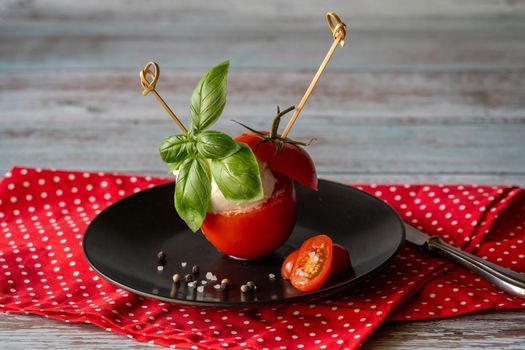
Photo: Gundula Vogel / Pexels
Italian
Caprese Skewers
The diets react (see scores below)
Common Ingredients
- cherry tomatoes
- bocconcini
- fresh basil
- balsamic glaze
- olive oil
- salt
Specific recipes may vary.
Incompatible with 4 of 11 diets
Diet Ratings
Caprese skewers are mostly keto-friendly — bocconcini (fresh mozzarella) is high in fat with negligible carbs, cherry tomatoes are low in net carbs in small portions (~3-4g per 100g), fresh basil and olive oil are fine. The critical issue is balsamic glaze, which is a concentrated reduction of balsamic vinegar with added sugar, typically containing 15-20g of net carbs per 2 tablespoons. A standard drizzle can easily push this snack into problematic carb territory. Without the glaze or with a very light touch, this dish would score much higher. As served with typical balsamic glaze portions, caution is warranted.
Some stricter keto practitioners would outright avoid this dish due to the balsamic glaze, arguing that any high-sugar condiment has no place in keto regardless of portion size, and that cherry tomatoes — while low in carbs — are a nightshade fruit that some carnivore-adjacent keto protocols exclude entirely.
Caprese Skewers are not vegan due to bocconcini, which is a fresh mozzarella cheese made from cow's or buffalo's milk — a clear dairy product. All other ingredients (cherry tomatoes, fresh basil, balsamic glaze, olive oil, salt) are fully plant-based. The dish fails vegan criteria solely because of this dairy inclusion. A vegan version could be made by substituting bocconcini with a plant-based mozzarella alternative.
Caprese Skewers contain multiple non-paleo ingredients that make this dish incompatible with the diet. Bocconcini is fresh mozzarella — a dairy product that is clearly excluded under paleo rules. Balsamic glaze is a reduced, concentrated balsamic vinegar often containing added sugars and is a processed condiment. Salt is also explicitly excluded. While cherry tomatoes, fresh basil, and olive oil are paleo-approved, the presence of dairy (bocconcini) alone is sufficient to disqualify the dish. The combination of dairy, added salt, and a processed glaze makes this a clear avoid.
Caprese skewers are a classic Italian dish built around fresh, whole ingredients that align closely with Mediterranean principles. Cherry tomatoes, fresh basil, and olive oil are staple Mediterranean foods. However, bocconcini (fresh mozzarella) is a dairy product, and Mediterranean diet guidelines place dairy in the moderate category — acceptable in small amounts but not a foundation food. The balsamic glaze is a minor concern as it can be concentrated in sugars depending on formulation, though traditionally it is used sparingly as a condiment. Overall, this is a largely plant-forward snack with a moderate dairy component, making it a reasonable but not fully core Mediterranean choice.
Some traditional Italian and broader Mediterranean interpretations readily include fresh cheeses like mozzarella as a valued part of the diet, and classic Caprese is considered a model Mediterranean dish by many Italian dietary authorities; under this view, the score could push into the low 'approve' range.
Caprese Skewers are almost entirely plant-based and completely incompatible with the carnivore diet. Cherry tomatoes, fresh basil, balsamic glaze, and olive oil are all plant-derived and strictly excluded. The only animal-derived ingredient is bocconcini (fresh mozzarella), which is itself a debated dairy product on carnivore — but even if dairy were accepted, it plays a minor supporting role in a dish dominated by forbidden plant foods. There is no meaningful animal protein source, and the dish as a whole represents the antithesis of carnivore eating.
Bocconcini is a fresh mozzarella cheese, which is dairy — a clearly excluded category on Whole30. Dairy (including all forms of cheese, milk, and yogurt) is explicitly prohibited for the 30-day program, and there is no exception for fresh or minimally processed cheeses. The remaining ingredients (cherry tomatoes, fresh basil, olive oil, salt) are all compliant, and balsamic glaze is generally acceptable if it contains no added sugar (label-reading required), but the presence of bocconcini makes this dish non-compliant regardless.
Most ingredients in Caprese Skewers are low-FODMAP: cherry tomatoes are low-FODMAP at up to 5 cherry tomatoes per serve (fructose becomes an issue at higher quantities), olive oil is FODMAP-free, fresh basil is low-FODMAP in small culinary amounts, and salt is FODMAP-free. The two points of concern are bocconcini and balsamic glaze. Bocconcini is a fresh mozzarella with moderate lactose content — Monash rates fresh mozzarella as low-FODMAP at 40g but high-FODMAP at larger servings, and a typical caprese serving often includes 3–4 balls which can approach or exceed this threshold. Balsamic glaze is the bigger concern: while plain balsamic vinegar is low-FODMAP at 1 tablespoon, balsamic glaze is a reduction with added sugars (often honey or concentrated grape juice containing excess fructose) and is typically drizzled generously, making it a moderate-to-high FODMAP risk in practice. A light drizzle of a glucose-based glaze could be safe, but standard commercial balsamic glazes often contain high-fructose ingredients that tip this dish into caution territory.
Monash University rates standard balsamic vinegar as low-FODMAP at 1 tablespoon, but balsamic glaze (a sweetened reduction) lacks specific Monash testing and many clinical FODMAP practitioners advise avoiding it during elimination due to concentrated sugars. Similarly, fresh mozzarella/bocconcini is borderline — a generous snack portion can easily exceed the 40g low-FODMAP threshold, leading some practitioners to recommend avoiding fresh cheeses during strict elimination.
Caprese skewers contain several DASH-friendly components — cherry tomatoes provide potassium and antioxidants, fresh basil adds micronutrients, olive oil is a DASH-approved healthy fat, and balsamic glaze in small amounts adds minimal sugar. However, bocconcini (fresh mozzarella) is a full-fat dairy product, which DASH specifically discourages in favor of low-fat or fat-free dairy. While fresh mozzarella is lower in sodium than aged cheeses, it still contributes saturated fat. Added salt further tips the sodium balance in the wrong direction. Balsamic glaze can also be high in added sugars. The dish is not inherently harmful and its vegetable and olive oil components align with DASH, but the full-fat dairy and added salt prevent a full approval.
NIH DASH guidelines explicitly specify low-fat or fat-free dairy, placing bocconcini outside core recommendations. However, updated clinical interpretations note that recent meta-analyses (including studies post-2015) have not consistently linked full-fat dairy to worse cardiovascular outcomes, and some DASH-oriented clinicians now allow fresh mozzarella in moderation — especially given its lower sodium content compared to aged cheeses.
Caprese skewers are a pleasant Zone-friendly snack concept, but they fall short of a balanced Zone block combination. The cherry tomatoes provide low-glycemic carbohydrates with good polyphenol content, fresh basil adds polyphenols, and olive oil is an ideal monounsaturated fat — all Zone-favorable. Bocconcini (fresh mozzarella) contributes both protein and fat, but it is a full-fat dairy source with moderate saturated fat content, which Sears classifies as less favorable than lean proteins. The critical issue is the absence of a lean protein source, meaning this snack is carb-and-fat heavy without sufficient protein to achieve the 40/30/30 ratio. The balsamic glaze also introduces concentrated sugars — small amounts are manageable, but it raises the glycemic load slightly. To make this Zone-compliant, pairing with a lean protein (e.g., sliced turkey, grilled chicken, or tofu) and minimizing the balsamic glaze would be advised. As-is, it functions better as a partial snack component than a standalone Zone block.
Later Sears anti-inflammatory writings place greater emphasis on polyphenols and omega-3s, and would likely view the tomato-basil-olive oil combination very favorably for its polyphenol density. Some Zone practitioners also argue that bocconcini, being a minimally processed whole dairy food, is acceptable in context and that small saturated fat amounts are not a concern in Sears' more recent framework — potentially rating this snack more favorably if portions are kept small.
Caprese skewers have a mixed anti-inflammatory profile. On the positive side, cherry tomatoes provide lycopene and other antioxidants (carotenoids, vitamin C), fresh basil contributes polyphenols and anti-inflammatory essential oils, and olive oil (presumably extra virgin) is a cornerstone of the anti-inflammatory diet due to oleocanthal and monounsaturated fats. Balsamic glaze, however, is a concentrated source of added sugars and is typically heavily reduced — this is a meaningful drawback, as added sugars are a key driver of inflammation. The bocconcini (fresh mozzarella) is full-fat dairy, which falls in the 'limit' category due to saturated fat content, though it is less processed than aged high-fat cheeses. The dish is not deeply inflammatory, but it is not strongly anti-inflammatory either — it's a moderate snack with real benefits tempered by the glazed sugar component and full-fat dairy. Using a light drizzle of balsamic vinegar (unreduced) rather than a sweet glaze and opting for part-skim mozzarella would improve the profile meaningfully.
Mainstream anti-inflammatory authorities like Dr. Weil consider tomatoes (nightshades) beneficial due to lycopene and antioxidant content, and include moderate full-fat dairy like fresh mozzarella as an acceptable occasional food. However, AIP (Autoimmune Protocol) practitioners such as Dr. Tom O'Bryan exclude nightshades like tomatoes entirely, arguing solanine and lectins can trigger inflammation in sensitive individuals — making this dish more problematic for those following autoimmune-focused anti-inflammatory approaches.
Caprese skewers are a light, easy-to-digest snack with some positives for GLP-1 patients, but fall short of ideal due to limited protein and moderate fat content. Cherry tomatoes provide hydration, fiber, and micronutrients. Fresh basil adds antioxidants. Olive oil contributes unsaturated fat, which is preferred over saturated fat but still calorie-dense. Balsamic glaze adds a small sugar load. The main drawback is bocconcini (fresh mozzarella): it delivers some protein (~5-7g per standard 2-3 piece serving) but also a meaningful amount of saturated fat (~6-8g), which can worsen GLP-1 side effects like nausea and bloating. With no primary protein source, this snack does not meaningfully contribute to the 100-120g daily protein target. Portion is naturally small and skewer format is snack-friendly, which suits GLP-1 eating patterns. As an occasional light snack it is acceptable, but patients should pair it with a higher-protein food or choose lower-fat cheese alternatives to improve its nutritional profile.
Some GLP-1-focused RDs view fresh mozzarella favorably as a whole-food dairy protein with good digestibility and moderate nutrient density, and would rate this dish more positively for patients who tolerate dairy well. Others caution that the saturated fat content in bocconcini, even in small servings, is enough to exacerbate nausea or reflux in patients with heightened GI sensitivity on GLP-1 medications, and recommend avoiding full-fat soft cheeses entirely during dose escalation phases.
*See how scores were generated at our methodology page.
Nutritional profile
Six traits that cut across every diet.
Fiber & Plants
How much whole-plant food and fiber it delivers.
Healthy Fats
The quality of its fats (unsaturated, omega-3).
Whole / Unprocessed
How close it is to its natural, unprocessed form.
Gut Gentle
How easy it is on digestion (low FODMAP, few irritants).
Low Glycemic
How little it spikes your blood sugar.
Protein Density
How much protein it packs per calorie.
Controversy Index
Higher controversy = more disagreement between diets.
Diet-Specific Tips
 Keto — 5/10
View tips
- Balsamic glaze is high in sugar and net carbs — the primary concern
- Bocconcini is keto-approved: high fat, near-zero carbs
- Cherry tomatoes are borderline: low net carbs per piece but can accumulate
- Olive oil and fresh basil are fully keto-compatible
- Dish can be made keto-compliant by omitting or minimizing the balsamic glaze
- Standard serving with normal glaze drizzle likely adds 8-15g net carbs from glaze alone
 Mediterranean — 6/10
View tips
- Cherry tomatoes and fresh basil are core Mediterranean plant foods
- Extra virgin olive oil as the fat source is canonical
- Bocconcini/mozzarella is dairy — acceptable in moderation but not a staple
- Balsamic glaze may add concentrated sugars; portion size matters
- No processed meats, refined grains, or added sugars beyond the glaze
- Traditional Italian dish with strong Mediterranean cultural roots
 Low-FODMAP — 4/10
View tips
- Balsamic glaze contains concentrated sugars and possibly honey/HFCS — high FODMAP risk at typical serving
- Bocconcini (fresh mozzarella) is low-FODMAP only at ≤40g; standard snack portions may exceed this lactose threshold
- Cherry tomatoes are low-FODMAP at up to 5 per serving — portion control needed
- Olive oil and fresh basil are FODMAP-free and safe
- Overall dish safety is highly dependent on glaze ingredients and portion sizes
 DASH — 5/10
View tips
- Cherry tomatoes are a DASH-approved vegetable rich in potassium and antioxidants
- Bocconcini is full-fat dairy, conflicting with DASH low-fat dairy guidance
- Olive oil aligns with DASH healthy fat recommendations
- Added salt increases sodium load — omitting or minimizing it would improve DASH compatibility
- Balsamic glaze contains added sugars; use sparingly
- Low-fat fresh mozzarella substitution would improve the score to the approve range
 Zone — 6/10
View tips
- Cherry tomatoes are low-glycemic, high-polyphenol Zone-favorable carbs
- Olive oil is an ideal monounsaturated fat source — Zone approved
- Fresh basil adds polyphenols, consistent with Sears' anti-inflammatory focus
- Bocconcini is full-fat dairy with saturated fat — less favorable than lean protein in classic Zone
- No lean protein source present — 40/30/30 ratio cannot be achieved without addition
- Balsamic glaze adds concentrated sugars — use sparingly to limit glycemic load
- Dish works as a partial Zone snack component but lacks protein balance
 Anti-Inflammatory — 6/10
View tips
- Cherry tomatoes provide lycopene, vitamin C, and antioxidant carotenoids
- Extra virgin olive oil is a core anti-inflammatory fat (oleocanthal)
- Fresh basil contributes anti-inflammatory polyphenols
- Balsamic glaze is high in concentrated sugars — a pro-inflammatory concern
- Bocconcini is full-fat dairy, categorized as 'limit' on anti-inflammatory frameworks
- Tomatoes are nightshades — beneficial for most, but flagged by AIP protocols for sensitive individuals
- No omega-3 sources, refined carbs, or trans fats present
 GLP-1 Friendly — 5/10
View tips
- Low protein density — bocconcini provides modest protein but not enough to meaningfully support 100-120g daily target
- Moderate saturated fat from bocconcini may worsen GLP-1 GI side effects (nausea, bloating, reflux)
- Olive oil adds unsaturated fat, which is preferred, but increases calorie density in a small-volume snack
- Balsamic glaze contributes a small added sugar load — portion control important
- Cherry tomatoes provide hydration, fiber, and micronutrients — genuinely beneficial
- Naturally small portions and skewer format suit GLP-1 eating patterns
- No primary protein source limits utility as a standalone snack for GLP-1 patients
- Easy to digest — no fried, spicy, or heavy components