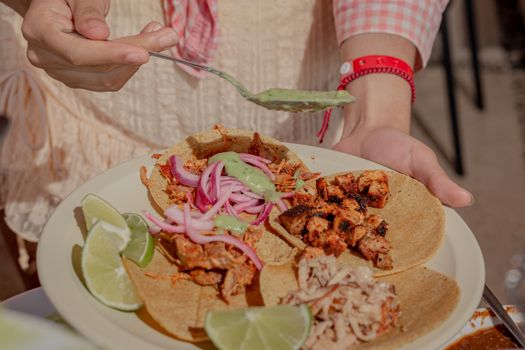
Photo: Mou Foto Diseño / Pexels
Mexican
Carnitas Tacos
The diets react (see scores below)
Common Ingredients
- pork shoulder
- corn tortillas
- white onion
- cilantro
- lime
- salsa verde
- orange
- cumin
Specific recipes may vary.
Incompatible with 6 of 11 diets
Diet Ratings
Carnitas Tacos are fundamentally incompatible with a ketogenic diet primarily due to the corn tortillas, which are a grain-based, high-carb wrapper. A standard corn tortilla contains approximately 12-15g net carbs each, and tacos typically use 2-3 tortillas per serving, easily delivering 25-45g net carbs from the tortillas alone — nearly or entirely exhausting the daily keto carb budget before accounting for anything else. The orange used in traditional carnitas also adds sugar and carbs during cooking. The pork shoulder itself is keto-friendly (high fat, quality protein), and the toppings (onion in small amounts, cilantro, lime juice, salsa verde) are relatively low-carb, but the structural element of the dish — the corn tortilla — makes the dish as served a keto non-starter. A modified version using lettuce wraps or no wrap could transform the carnitas into an approved keto meal.
Carnitas Tacos contain pork shoulder as the primary protein, which is a direct animal product (mammal flesh). This is an unambiguous violation of vegan dietary principles. The remaining ingredients — corn tortillas, white onion, cilantro, lime, salsa verde, orange, and cumin — are all plant-based, but the presence of pork makes the dish entirely incompatible with a vegan diet. No meaningful debate exists within the vegan community on this point.
Carnitas Tacos are disqualified primarily by corn tortillas, which are made from corn — a grain that is explicitly excluded from the paleo diet. Corn is a domesticated cereal grain not available in its modern form to Paleolithic humans and contains anti-nutrients that paleo principles reject. The remaining ingredients are largely paleo-compliant: pork shoulder is an excellent paleo protein, white onion, cilantro, lime, orange, and cumin are all approved whole foods, and salsa verde (assuming made from tomatillos, peppers, and herbs) is generally acceptable. However, the corn tortilla is a foundational, structural component of the dish — not an optional garnish — making the dish as presented incompatible with paleo. A paleo adaptation would require replacing corn tortillas with lettuce wraps or another grain-free vessel.
Carnitas tacos are centered on pork shoulder, a red/processed meat that the Mediterranean diet limits to a few times per month. Traditional carnitas preparation involves braising or frying pork in lard, adding saturated fat that directly contradicts the olive-oil-as-primary-fat principle. While corn tortillas, onion, cilantro, lime, salsa verde, and citrus are wholesome plant-based components, they serve merely as accompaniments to a large portion of fatty pork. The dish as a whole is protein-forward with red meat, not plant-forward, and is not aligned with Mediterranean dietary patterns.
Carnitas Tacos are fundamentally incompatible with the carnivore diet. While pork shoulder is a carnivore-approved ingredient, the dish is built around multiple plant-based components: corn tortillas (grain), white onion, cilantro, lime, salsa verde, orange, and cumin. The corn tortillas alone are a disqualifying grain-based food. The remaining plant ingredients — citrus fruits used in traditional carnitas preparation, alliums, herbs, and spices — compound the violation. Even if the pork were evaluated in isolation it would be acceptable, the structural and flavor identity of this dish is entirely dependent on plant foods. No modification short of removing every ingredient except the pork would bring this dish into carnivore compliance.
Carnitas Tacos are excluded from Whole30 primarily because of the corn tortillas, which are made from corn — a grain explicitly banned on the Whole30 program. Beyond the tortilla issue, the taco format itself is a wrap/tortilla-based structure that falls squarely into the 'no recreating junk food or grain-based vessels' rule. The remaining ingredients (pork shoulder, white onion, cilantro, lime, salsa verde, orange, cumin) are individually Whole30-compatible, but the dish as constructed cannot be made compliant simply by swapping toppings — the tortilla is structural to the dish. A compliant carnitas bowl using the same fillings without the tortilla would be approved.
Carnitas Tacos have both low-FODMAP-friendly components and a significant FODMAP concern. Pork shoulder, corn tortillas, cilantro, lime juice, orange (small amount used in carnitas cooking), and cumin are all low-FODMAP at standard servings. Garlic-infused oil, if used, would be safe, but the primary issue here is white onion, which is high in fructans and is a classic high-FODMAP ingredient. Salsa verde is also a concern, as commercial or homemade versions often contain onion and/or garlic. If white onion is used as a topping (even a small garnish), it poses a real fructan risk during elimination. Corn tortillas themselves are low-FODMAP (2 tortillas per serving per Monash). The dish is borderline: the base proteins and grains are safe, but the onion and salsa verde ingredients make this risky without modification.
Monash University confirms white onion is high-FODMAP even in small amounts due to fructans, and most clinical FODMAP practitioners would advise avoiding it entirely during elimination. Salsa verde commonly contains onion and garlic, and unless the recipe is verified to be free of these, many practitioners would rate this dish as 'avoid' during strict elimination rather than 'caution.'
Carnitas tacos present a mixed DASH diet profile. The primary concern is pork shoulder, a fatty cut that is traditionally slow-cooked in lard or its own fat, resulting in moderate-to-high saturated fat content — which DASH explicitly limits. However, the dish also contains several DASH-friendly components: corn tortillas are a whole grain option lower in sodium than flour tortillas; white onion, cilantro, lime, and salsa verde add vegetables and flavor without significant sodium (depending on preparation); and orange and cumin contribute antioxidants and flavor. The dish is not inherently high in sodium if prepared fresh, but carnitas are often seasoned heavily or served with condiments that raise sodium. The overall fat profile from pork shoulder is the primary limiting factor. In moderate portions — one or two small tacos with fresh toppings — this dish can fit cautiously within DASH, but the saturated fat from carnitas keeps it from full approval.
NIH DASH guidelines clearly limit red and fatty meats including pork shoulder due to saturated fat content. However, some updated DASH-oriented clinicians note that if carnitas are prepared with trimmed pork and citrus-braising rather than lard, the saturated fat burden is meaningfully reduced — making occasional consumption more compatible with DASH than the traditional preparation suggests.
Carnitas tacos present a mixed Zone profile that requires careful portioning to fit the 40/30/30 framework. Pork shoulder is the primary concern — it is a higher-fat cut of pork with significant saturated fat content, unlike the lean proteins (skinless chicken, fish, egg whites) that Zone favors. Traditional carnitas are also often cooked in lard or rendered fat, further elevating saturated fat. That said, pork shoulder does provide solid protein blocks and is not categorically excluded from the Zone. Corn tortillas are a moderately unfavorable carbohydrate — they are higher glycemic than most vegetables and whole grains, though not as damaging as white flour tortillas. Two small corn tortillas (the typical taco format) contribute meaningful net carbs but are manageable if portion-controlled. The remaining ingredients are Zone-friendly: white onion, cilantro, lime, salsa verde, and orange (used in carnitas cooking for flavor rather than consumed in large quantity) are low-glycemic, polyphenol-rich, and anti-inflammatory. Cumin adds no macro concern. To fit Zone blocks, a practical approach would be to use one corn tortilla instead of two, choose a leaner pork cut or trim visible fat, and add extra salsa verde and onion/cilantro to boost the carb portion with favorable low-GI vegetables. The dish as traditionally prepared tilts toward unfavorable in Zone terminology due to fatty protein and moderate-GI tortillas, but is absolutely workable with adjustments — hence 'caution' rather than 'avoid.'
Some Zone practitioners and Sears' later anti-inflammatory writing (The Zone Diet's evolution toward OmegaRx Zone and related work) place less emphasis on avoiding saturated fat per se and more on the omega-6 to omega-3 ratio. Under this lens, pork shoulder is not dramatically problematic if the overall meal remains balanced and polyphenol-rich — the salsa verde and citrus in carnitas actually support the anti-inflammatory goals. A more permissive Zone interpreter might score this a 6, noting that the traditional Mexican preparation with fresh vegetables and citrus is far superior to processed fast food alternatives.
Carnitas tacos present a mixed anti-inflammatory profile. The primary concern is pork shoulder, a relatively fatty cut of red/processed-adjacent meat that is high in saturated fat, particularly when cooked in the traditional carnitas method (braised or fried in its own fat or lard). Saturated fat is associated with elevated inflammatory markers like CRP and IL-6, and pork shoulder falls into the 'limit' category under anti-inflammatory guidelines. On the positive side, several ingredients offer meaningful anti-inflammatory benefits: cumin contains anti-inflammatory flavonoids and antioxidants; salsa verde typically features tomatillos, jalapeños, and garlic — all rich in antioxidants and polyphenols; lime and orange provide vitamin C and flavonoids; cilantro and white onion contribute quercetin and other anti-inflammatory phytonutrients; and corn tortillas, as a whole grain, are a neutral-to-mildly positive carbohydrate source. The dish is notably free of refined sugars, trans fats, seed oils, or artificial additives. Overall, the anti-inflammatory merit of the toppings and aromatics partially offsets the pro-inflammatory burden of the fatty pork. Portion size and preparation method matter considerably — leaner carnitas made without lard would score higher.
Some anti-inflammatory practitioners, including those following Mediterranean-adjacent frameworks, view pork in moderation as acceptable, noting that pork shoulder contains oleic acid and B vitamins alongside saturated fat, and that the overall dish's phytonutrient density from tomatillos, citrus, and spices may mitigate systemic inflammatory impact. However, stricter anti-inflammatory protocols (and AIP-aligned approaches) would flag pork shoulder's saturated fat load and typical lard-based preparation as clearly pro-inflammatory, especially for those with existing inflammatory conditions.
Carnitas tacos present a mixed nutritional profile for GLP-1 patients. Pork shoulder is a meaningful protein source but is one of the fattier cuts of pork — traditional carnitas is braised or slow-cooked in lard or its own fat, making it high in saturated fat per serving, which can worsen GLP-1 side effects like nausea, bloating, and reflux. Two small corn tortillas add modest fiber and are a reasonable lower-fat, lower-calorie carbohydrate choice compared to flour tortillas. The toppings (white onion, cilantro, lime, salsa verde) are low-calorie, nutrient-positive, and digestive-friendly. Orange juice or zest used in the braise adds minimal sugar at realistic volumes. The dish is portion-sensitive: two small street-style tacos in a modest serving can be acceptable, but larger portions amplify the fat load significantly. The primary concern is the fat content of the protein source — pork shoulder carnitas is not a lean protein, and the cooking method typically concentrates that fat rather than reducing it. Protein yield is real but diluted by a high fat-to-protein ratio compared to GLP-1-preferred proteins like chicken breast or fish.
Some GLP-1-focused dietitians allow carnitas occasionally if portions are strictly controlled (1-2 small tacos) and excess braising fat is drained, arguing that the protein and satiety value outweigh the fat drawback in real-world adherence. Others caution that fatty pork is among the most common triggers for nausea and delayed gastric emptying symptoms in GLP-1 patients and recommend substituting leaner proteins like grilled chicken or fish in the same taco format.
*See how scores were generated at our methodology page.
Nutritional profile
Six traits that cut across every diet.
Fiber & Plants
How much whole-plant food and fiber it delivers.
Healthy Fats
The quality of its fats (unsaturated, omega-3).
Whole / Unprocessed
How close it is to its natural, unprocessed form.
Gut Gentle
How easy it is on digestion (low FODMAP, few irritants).
Low Glycemic
How little it spikes your blood sugar.
Protein Density
How much protein it packs per calorie.
Controversy Index
Higher controversy = more disagreement between diets.
Diet-Specific Tips
 Low-FODMAP — 5/10
View tips
- White onion is high-FODMAP due to fructans — a primary concern even in small garnish quantities
- Corn tortillas are low-FODMAP at 2 per serving (Monash-tested)
- Pork shoulder is low-FODMAP — a safe protein choice
- Salsa verde frequently contains onion and/or garlic, both high-FODMAP
- Cilantro, lime, cumin, and small amounts of orange are low-FODMAP
- Dish can be made low-FODMAP by substituting green onion tops for white onion and using a verified low-FODMAP salsa
 DASH — 4/10
View tips
- Pork shoulder is a fatty cut high in saturated fat, which DASH limits
- Traditional carnitas preparation often uses lard, significantly increasing saturated fat
- Corn tortillas are preferable to flour tortillas for DASH — lower sodium and whole grain
- Fresh toppings (onion, cilantro, lime, salsa verde) are DASH-friendly vegetables
- Orange and cumin add potassium and anti-inflammatory compounds
- Sodium content is relatively controlled if fresh salsa verde is used vs. canned
- Portion control is critical — one to two small tacos may be acceptable in moderation
- Trimming fat and braising in citrus rather than lard improves DASH compatibility
 Zone — 5/10
View tips
- Pork shoulder is a higher-fat, higher-saturated-fat protein — unfavorable compared to lean Zone proteins like chicken breast or fish
- Corn tortillas are a moderate-GI carbohydrate classified as 'unfavorable' in Zone terminology, though less problematic than flour tortillas
- Salsa verde, white onion, cilantro, and lime are all Zone-favorable low-GI, polyphenol-rich ingredients that support the anti-inflammatory principle
- Orange used in carnitas braising contributes minimal net carbs per serving and adds polyphenols — negligible Zone concern
- Traditional carnitas cooking method (confit in lard) significantly raises saturated fat load beyond what the pork shoulder alone contributes
- Portion control is essential: one small tortilla with trimmed pork and generous vegetable toppings can fit Zone blocks; standard restaurant portions likely do not
- The dish lacks a deliberate monounsaturated fat source (e.g., avocado, olive oil) that would round out an ideal Zone fat block
 Anti-Inflammatory — 4/10
View tips
- Pork shoulder is high in saturated fat, which is linked to elevated CRP and IL-6 — falls in the 'limit' category
- Traditional carnitas preparation often involves lard or rendered fat, increasing saturated fat load
- Cumin provides anti-inflammatory flavonoids and antioxidants
- Salsa verde (tomatillos, garlic, chili) is rich in antioxidants and polyphenols
- Lime and orange contribute vitamin C and flavonoids
- Cilantro and white onion provide quercetin and phytonutrients
- Corn tortillas are a whole grain, nutritionally neutral-to-mild positive
- No refined sugars, trans fats, seed oils, or artificial additives present
- Preparation method (lard vs. no lard) and portion size significantly affect inflammatory impact
 GLP-1 Friendly — 4/10
View tips
- Pork shoulder is a high-fat cut — not a lean protein source preferred for GLP-1 patients
- Traditional carnitas preparation concentrates saturated fat, increasing risk of nausea and reflux
- Corn tortillas are preferable to flour tortillas — lower fat, modest fiber, smaller portion size
- Toppings (onion, cilantro, lime, salsa verde) are GLP-1-friendly and add micronutrient value
- Dish is highly portion-sensitive — 1-2 small tacos may be tolerable; larger servings worsen fat load
- Protein content is real but fat-to-protein ratio is unfavorable compared to GLP-1-ideal proteins
- Orange in the braise adds negligible sugar concern at typical quantities