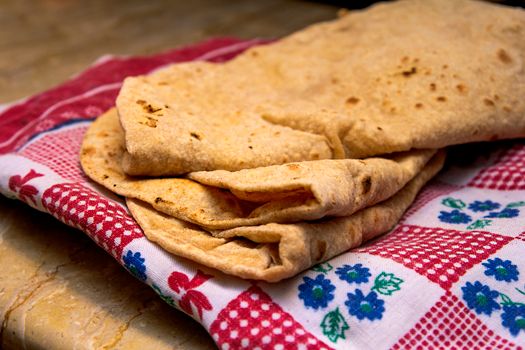
Photo: Usman Yousaf / Pexels
The diets react (see scores below)
Common Ingredients
- whole wheat flour
- water
- salt
- ghee
Specific recipes may vary.
Incompatible with 6 of 11 diets
Diet Ratings
Chapati is made primarily from whole wheat flour, a grain that is fundamentally incompatible with ketogenic eating. A single standard chapati (approximately 30-40g) contains roughly 15-20g of net carbs, meaning even one or two pieces can consume or exceed the entire daily carb budget for strict keto. Whole wheat flour is a high-glycemic grain with minimal fiber offset relative to its total carbohydrate content. Despite the presence of ghee (a keto-friendly fat), the dominant ingredient is whole wheat flour, which disqualifies the dish entirely. There is no meaningful modification possible while retaining the identity of the food.
Chapati as listed contains ghee, which is clarified butter — a dairy product derived from cow's milk. This is a clear animal-derived ingredient that disqualifies the dish from vegan compliance. The other ingredients (whole wheat flour, water, salt) are fully plant-based, and chapati can easily be made vegan by simply omitting the ghee or substituting a plant-based oil such as coconut oil or vegan margarine. The dish itself is rated on the ingredients as provided.
Chapati is fundamentally a flatbread made from whole wheat flour, which is a grain and one of the clearest exclusions in the paleo diet. Wheat contains gluten, lectins, and phytates — the anti-nutrients that paleo authorities like Loren Cordain, Robb Wolf, and Mark Sisson unanimously flag as harmful. The presence of ghee (a debated ingredient) and salt (excluded) are secondary concerns; the primary disqualifier is whole wheat flour. No version of chapati can be made paleo-compliant without replacing the wheat flour entirely, at which point it is no longer chapati.
Chapati is made primarily from whole wheat flour, which aligns well with the Mediterranean diet's preference for whole grains over refined grains. However, it is not a traditional Mediterranean food, and the inclusion of ghee (clarified butter) introduces saturated animal fat, which contrasts with the Mediterranean diet's emphasis on extra virgin olive oil as the primary fat. The whole grain base earns credit, but ghee pushes it toward caution territory. If prepared with olive oil instead of ghee, it would rate more favorably.
Some Mediterranean diet practitioners accept whole wheat flatbreads as a reasonable substitute for whole grain pita or other traditional breads, noting that the whole grain component is the key factor and the small amount of ghee is negligible. Traditional Middle Eastern and Eastern Mediterranean cuisines do use some animal fats in bread preparation.
Chapati is a flatbread made primarily from whole wheat flour, a grain — one of the most strictly excluded food categories on the carnivore diet. Grains are plant-derived, high in carbohydrates, and contain antinutrients such as gluten, lectins, and phytates, which are key reasons carnivore practitioners eliminate them entirely. The presence of ghee (a dairy derivative) is the only animal-derived ingredient, but it cannot redeem a dish that is fundamentally a grain-based bread. There is universal consensus across all carnivore factions — from the strictest Lion Diet to the more inclusive animal-based approaches — that wheat and grains are completely off the table.
Chapati is made from whole wheat flour, which is a grain explicitly excluded on the Whole30 program. Beyond the grain ingredient itself, chapati is a flatbread — a category that falls squarely under the 'no recreating baked goods/junk food' rule, which explicitly lists wraps, tortillas, and similar flatbreads as prohibited even if made with otherwise compliant ingredients. Both the core ingredient (wheat) and the food form (flatbread/wrap) independently disqualify this dish.
Chapati is made primarily from whole wheat flour, which is high in fructans — one of the most problematic FODMAPs. Whole wheat flour is higher in fructans than refined white wheat flour, making it even more problematic. A standard serving of chapati (1-2 pieces, ~40-80g) contains a significant fructan load that is not compatible with the FODMAP elimination phase. The remaining ingredients — water, salt, and ghee — are all low-FODMAP and contribute no FODMAP concern. However, the whole wheat flour base makes this dish clearly high-FODMAP at any standard serving size. Monash University rates wheat-based flatbreads as high-FODMAP, and there is no fermentation process (unlike sourdough) that would reduce fructan content here.
Chapati is made primarily from whole wheat flour, which is a DASH-approved whole grain providing fiber, magnesium, and potassium. However, the inclusion of ghee (clarified butter) introduces saturated fat, which DASH guidelines explicitly limit. Ghee is essentially pure butterfat (~60% saturated fat), and while the amount used per chapati is relatively small (typically 1/4 to 1/2 tsp per piece), it does nudge this otherwise DASH-friendly whole grain bread into 'caution' territory. Salt content is typically moderate and controllable. Without ghee, plain chapati (dry-roasted) would score as 'approve' given its whole grain base. The preparation method matters significantly — chapati made without ghee or with a minimal brush of heart-healthy oil (e.g., olive oil) would be more DASH-compatible.
NIH DASH guidelines restrict saturated fat broadly, which places ghee-containing preparations in the caution zone. However, some updated clinical interpretations note that the quantity of ghee in a single chapati is small (under 1g saturated fat), and whole wheat chapati remains a nutrient-dense whole grain; moderate consumption in the context of an otherwise DASH-adherent diet may be acceptable per some registered dietitians.
Chapati is a whole wheat flatbread that falls into the 'unfavorable' carbohydrate category in Zone terminology — it's a grain-based carb with a moderate-to-high glycemic index, though meaningfully better than white bread or white rice. The Zone allows 0-1 servings of whole grains per day, so chapati can technically fit as that single grain serving when portioned carefully (one small chapati ≈ 1-2 carb blocks). The ghee adds saturated fat, which Zone methodology — particularly Sears' earlier work — sought to limit in favor of monounsaturated fats. However, ghee is used in small amounts here (typically 1/4 to 1/2 tsp per chapati), making the saturated fat load modest. As a side dish paired with lean protein (dal, grilled chicken, fish) and low-GI vegetables, a single chapati can be incorporated into a Zone-balanced meal. The main challenge is that it provides carbohydrate blocks with limited micronutrient density compared to Zone-preferred vegetable carbs, and offers no protein or favorable fat contribution on its own.
Sears' later writings (The Anti-Inflammation Zone, Toxic Fat) place greater emphasis on polyphenols and omega-3s and are somewhat more permissive about whole grains as occasional carb blocks. Some Zone practitioners treat one small whole-wheat chapati as an acceptable 'unfavorable' carb block — usable within the system, just not preferred. The saturated fat from ghee is also re-evaluated more favorably in Sears' later anti-inflammatory framework, which distinguishes between saturated fats and more harmful dietary fats.
Chapati made with whole wheat flour sits in a neutral-to-mildly-beneficial position on the anti-inflammatory spectrum. Whole wheat flour retains the bran and germ, providing fiber, B vitamins, magnesium, and small amounts of polyphenols — all of which support gut health and have modest anti-inflammatory associations. Fiber intake is consistently linked to lower CRP levels in research. However, chapati is still a refined-adjacent grain product with a moderate glycemic load, and refined carbohydrates in excess are a known driver of inflammation. The ghee is the most contested ingredient: it is a saturated fat source that falls in the 'limit' category per anti-inflammatory guidelines, though some Ayurvedic and functional nutrition practitioners argue that grass-fed ghee contains butyrate and conjugated linoleic acid (CLA) with anti-inflammatory properties. Salt and water are neutral. Overall, chapati in moderate portions as part of a diverse, vegetable-rich diet is acceptable and preferable to white-flour flatbreads, but it does not carry meaningful anti-inflammatory benefit and the ghee slightly undermines its profile.
Dr. Weil's anti-inflammatory framework emphasizes whole grains over refined grains and would likely view chapati favorably compared to white bread or naan. Some functional nutrition practitioners, however, argue that wheat — particularly gluten and wheat lectin — can trigger low-grade intestinal inflammation and increased intestinal permeability, even in non-celiac individuals; Autoimmune Protocol (AIP) and some gut-health-focused anti-inflammatory frameworks exclude all wheat. On ghee specifically, traditional Ayurveda and some integrative medicine practitioners (e.g., Dr. Deepak Chopra's framework) consider small amounts of grass-fed ghee anti-inflammatory due to butyrate content, while mainstream anti-inflammatory nutrition science treats saturated fat as a net negative.
Chapati made with whole wheat flour provides moderate fiber (~2-3g per piece) and is relatively easy to digest compared to heavily processed refined-grain breads. It is low in fat when made plain, but the addition of ghee (clarified butter, a saturated fat) adds caloric density with minimal nutritional return for GLP-1 patients eating small portions. It offers virtually no protein, making it a poor standalone choice when every bite must count toward the 100-120g daily protein target. As a side carbohydrate paired with a high-protein, high-fiber main dish (e.g., dal, grilled chicken, lentil curry), one small chapati is acceptable. The whole wheat base is meaningfully better than refined-flour alternatives like white bread or naan made with maida. Portion sensitivity is high — one chapati (~40g) is reasonable; two or three displace protein-dense foods from a small-capacity stomach.
Some GLP-1-focused dietitians accept chapati as a practical, culturally appropriate carbohydrate vehicle that pairs well with protein- and fiber-rich Indian dishes, arguing that the whole wheat fiber and low glycemic index relative to white rice make it a useful base. Others caution that the ghee addition and near-zero protein density make it counterproductive for patients with very limited appetite, recommending it be skipped in favor of an extra serving of dal or legumes that provide both carbohydrate and protein simultaneously.
*See how scores were generated at our methodology page.
Nutritional profile
Six traits that cut across every diet.
Fiber & Plants
How much whole-plant food and fiber it delivers.
Healthy Fats
The quality of its fats (unsaturated, omega-3).
Whole / Unprocessed
How close it is to its natural, unprocessed form.
Gut Gentle
How easy it is on digestion (low FODMAP, few irritants).
Low Glycemic
How little it spikes your blood sugar.
Protein Density
How much protein it packs per calorie.
Controversy Index
Higher controversy = more disagreement between diets.
Diet-Specific Tips
 Mediterranean — 5/10
View tips
- Whole wheat flour is a positive — whole grain aligns with Mediterranean principles
- Ghee is a saturated animal fat, not aligned with Mediterranean fat guidelines (olive oil preferred)
- Not a traditional Mediterranean food, though functionally similar to whole grain flatbreads
- Minimal processing and simple ingredients are positives
- Small amount of ghee per serving may be considered negligible by some authorities
 DASH — 5/10
View tips
- Whole wheat flour is a DASH-approved whole grain with fiber and key minerals
- Ghee contains ~60% saturated fat, which DASH guidelines recommend limiting
- Small amount of ghee per chapati limits but does not eliminate saturated fat concern
- Salt is moderate and controllable during preparation
- Substituting ghee with a small amount of olive or canola oil would improve DASH compatibility
- Plain dry-roasted chapati without ghee would qualify as 'approve'
 Zone — 5/10
View tips
- Whole wheat is an 'unfavorable' Zone carbohydrate — moderate-to-high glycemic, limited micronutrient density compared to vegetables
- Zone permits 0-1 grain servings per day; one small chapati fits within this allowance as a single carb block contribution
- Ghee adds saturated fat, which is limited in classic Zone methodology but used in small amounts here
- No protein contribution — must be paired with lean protein source to achieve Zone 40/30/30 balance
- Better than white bread or white rice due to higher fiber content and lower glycemic index from whole wheat
- Useful as a meal vehicle/side when portioned to one chapati and combined with Zone-favorable proteins and vegetables
 Anti-Inflammatory — 5/10
View tips
- Whole wheat flour provides fiber, B vitamins, and polyphenols with modest anti-inflammatory associations
- Moderate glycemic load — whole wheat is better than refined white flour but still a high-carbohydrate food
- Ghee is a saturated fat classified as 'limit' in anti-inflammatory guidelines, though butyrate content is a potential mitigating factor
- No omega-3s, antioxidant-rich vegetables, or strongly anti-inflammatory compounds present
- Gluten and wheat lectins are debated triggers for intestinal inflammation in sensitive or autoimmune-prone individuals
- Portion size and dietary context are key — chapati in small quantities alongside anti-inflammatory foods is acceptable
 GLP-1 Friendly — 5/10
View tips
- Whole wheat flour provides moderate fiber — better than refined grain alternatives
- Near-zero protein — does not contribute to the 100-120g daily protein target
- Ghee adds saturated fat and calories with limited nutritional benefit for GLP-1 patients
- Small gastric capacity means chapati may displace higher-priority protein and fiber foods
- Culturally important food — acceptable in controlled portions as a pairing with protein-rich dishes
- Easy to digest and not fried — does not worsen GLP-1 GI side effects significantly
- Portion-sensitive: one small chapati is acceptable; multiple servings are not recommended