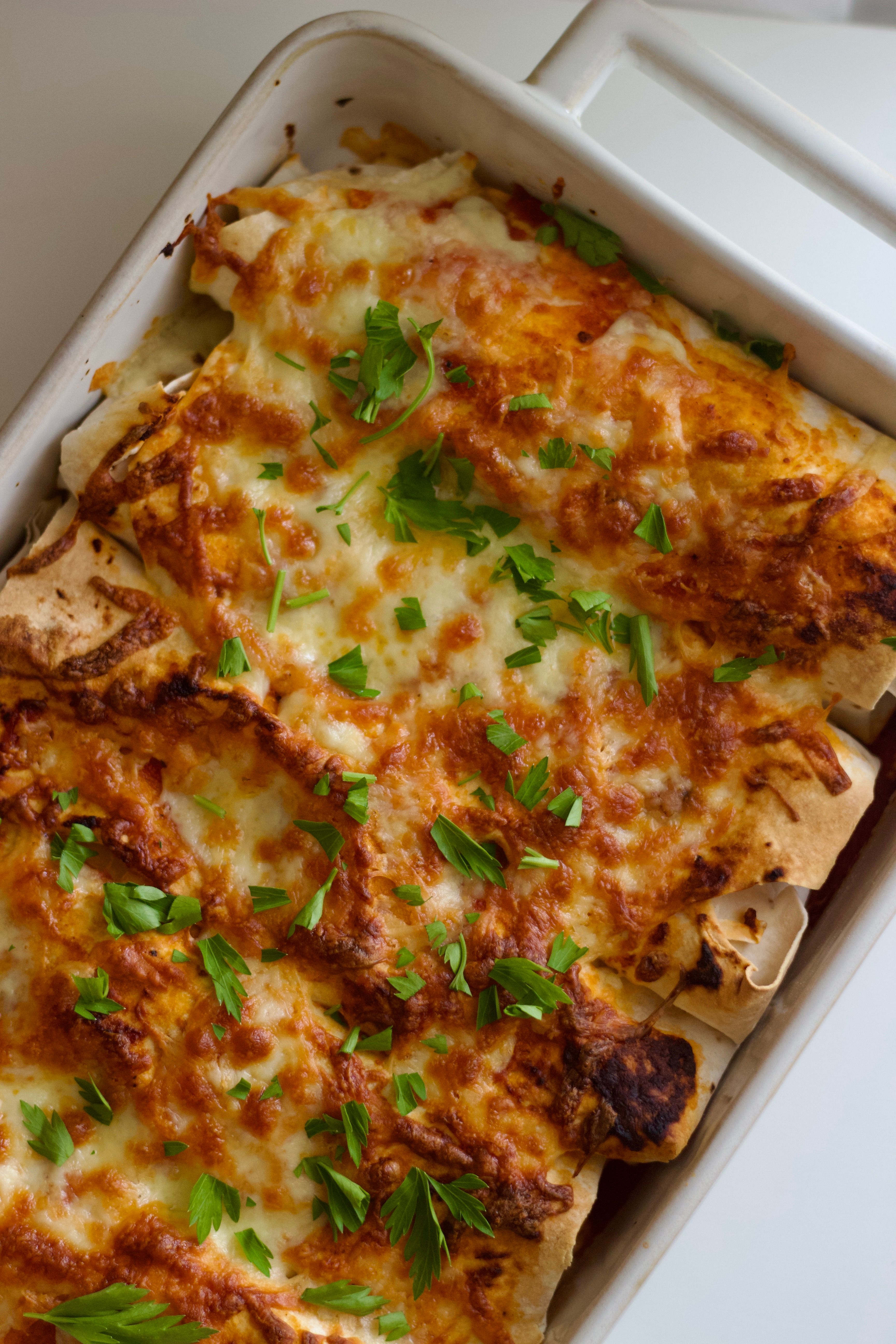
Photo: Zehra Yılmaz / Pexels
Mexican
Cheese Enchiladas
The diets react (see scores below)
Common Ingredients
- corn tortillas
- Monterey Jack cheese
- cheddar cheese
- red enchilada sauce
- onion
- cumin
- garlic
Specific recipes may vary.
Incompatible with 7 of 11 diets
Diet Ratings
Cheese enchiladas are fundamentally incompatible with a ketogenic diet. The primary structural component — corn tortillas — is a high-carb grain product containing roughly 12-15g net carbs per tortilla, and a standard serving typically includes 2-3 tortillas, putting net carbs at 24-45g from tortillas alone, nearly or fully consuming the entire daily keto carb budget in a single dish. Red enchilada sauce also commonly contains added sugars and thickeners that add further carbs. While the Monterey Jack and cheddar cheeses are keto-friendly high-fat ingredients, they cannot offset the carb load from the tortillas and sauce. This dish cannot be consumed in any meaningful portion without breaking ketosis.
Cheese Enchiladas contain two dairy-based cheeses — Monterey Jack and cheddar — both of which are animal-derived products excluded from a vegan diet. Dairy cheese is produced from animal milk and typically contains rennet, an enzyme derived from animal stomachs. All remaining ingredients (corn tortillas, red enchilada sauce, onion, cumin, garlic) are fully plant-based, but the dish is fundamentally defined by its cheese filling and cannot be considered vegan as described. A vegan version could be made by substituting the cheeses with plant-based alternatives (cashew cheese, store-bought vegan shreds) and verifying the enchilada sauce contains no lard or chicken stock.
Cheese Enchiladas are fundamentally incompatible with the Paleo diet. The dish's two primary components — corn tortillas and cheese — are both firmly excluded. Corn tortillas are made from corn, a grain that is universally rejected in all mainstream paleo frameworks. Monterey Jack and cheddar cheese are dairy products, also excluded across all paleo authorities. The red enchilada sauce likely contains added salt, preservatives, and possibly other non-paleo additives. While onion, garlic, and cumin are paleo-approved, they are minor ingredients that cannot redeem a dish built almost entirely on non-paleo foundations.
Cheese enchiladas contain several elements that partially align with Mediterranean principles but fall short of being a core dish. Corn tortillas are a whole grain product and acceptable, and the aromatics (onion, garlic, cumin) are welcomed. However, the dish is dominated by Monterey Jack and cheddar cheese — high-fat dairy — used in substantial quantities as the primary filling and topping, which exceeds the 'moderate' dairy guideline. There is no primary protein from fish, legumes, or poultry to anchor the dish nutritionally. The enchilada sauce, depending on preparation, may contain refined ingredients or added sodium. Overall, this is an acceptable occasional dish if portions are reasonable, but the heavy cheese load and absence of plant-forward or lean protein components prevent a higher score.
Some Mediterranean diet interpreters would score this lower, noting that generous amounts of saturated-fat-rich cheese as the sole protein source conflicts with the diet's emphasis on lean proteins and olive oil as the primary fat; traditional Mediterranean dairy (yogurt, feta in small amounts) differs significantly from the cheese-heavy profile here.
Cheese Enchiladas are fundamentally incompatible with the carnivore diet. The dish is built almost entirely on plant-based foods: corn tortillas (grain), red enchilada sauce (plant-based, likely containing tomatoes, chili peppers, and other vegetables), onion (vegetable), cumin (plant spice), and garlic (vegetable). While Monterey Jack and cheddar cheese are animal-derived dairy products, they are minor components in a dish dominated by excluded ingredients. No aspect of this dish's core structure is carnivore-compliant — it is a classic plant-grain-based Mexican dish with cheese as an accompaniment, not an animal-protein-centered meal.
Cheese Enchiladas contain multiple Whole30-excluded ingredients. Corn tortillas are made from corn, which is a grain explicitly excluded from the Whole30 program. Both Monterey Jack and cheddar cheese are dairy products, which are also explicitly excluded (only ghee and clarified butter are allowed as dairy exceptions). Additionally, this dish falls squarely into the 'no recreating baked goods/junk food' category — tortillas and wraps are specifically listed as prohibited even when made with compliant ingredients. There is no compliant version of this dish possible within Whole30 rules.
Cheese enchiladas contain multiple high-FODMAP ingredients that make this dish unsuitable during the elimination phase. Onion is one of the highest-FODMAP foods tested by Monash University, rich in fructans, and is problematic even in small amounts. Garlic is similarly high in fructans and a major FODMAP trigger. Red enchilada sauce typically contains both onion and garlic as core ingredients, often in concentrated form (powder or cooked down), which intensifies FODMAP load. While corn tortillas are low-FODMAP and hard aged cheeses like cheddar and Monterey Jack are low-lactose and generally well-tolerated, the onion and garlic content — both directly listed as ingredients and embedded in the sauce — make this dish a high-FODMAP meal at any standard serving. Cumin is low-FODMAP in typical culinary quantities. The combination of two major fructan sources (onion + garlic) with no easy substitution in this preparation firmly places it in the 'avoid' category.
Cheese enchiladas pose multiple challenges for the DASH diet. The primary protein source is full-fat cheese (Monterey Jack and cheddar), which is high in saturated fat and sodium — both explicitly limited by NIH/NHLBI DASH guidelines. A typical serving of two cheese enchiladas can contain 800–1,200mg of sodium (largely from the cheese and canned enchilada sauce) and 15–25g of saturated fat, making it difficult to fit within DASH's daily saturated fat ceiling (~7% of calories) or sodium limits (1,500–2,300mg/day). Red enchilada sauce, especially canned or jarred commercial varieties, adds substantial additional sodium. While corn tortillas are a whole grain and a DASH-friendly component, and onion and garlic are beneficial, the dominant ingredients — full-fat cheese and high-sodium sauce — disqualify this dish as a DASH staple. A modified version using reduced-fat cheese, homemade low-sodium enchilada sauce, and added vegetables (beans, peppers) could improve the score to the caution range.
Cheese enchiladas present several Zone Diet challenges. The dish lacks lean protein entirely — the primary protein source is full-fat cheese (Monterey Jack and cheddar), which is high in saturated fat and delivers protein alongside significant fat, disrupting the clean 30% protein / 30% fat split. Corn tortillas are a moderate-glycemic carbohydrate — better than wheat flour tortillas but still a starchy 'unfavorable' carb in Zone terminology. The enchilada sauce and onion/garlic do contribute some low-glycemic carb value. The overall macro balance skews heavily toward fat (saturated) and moderate-glycemic carbs, with inadequate lean protein. To make this more Zone-compatible, one would need to add lean protein (grilled chicken or shrimp), limit cheese quantity, use a single small corn tortilla, load with vegetables, and keep fat portions controlled. As-written, however, the dish is cheese-heavy with no lean protein anchor, making Zone ratio targeting very difficult without significant modifications.
Cheese enchiladas present a mixed anti-inflammatory profile. On the positive side, corn tortillas are a whole grain with reasonable fiber and lower glycemic impact than refined wheat. Garlic and onion are well-regarded anti-inflammatory alliums rich in quercetin and organosulfur compounds. Cumin provides anti-inflammatory phenolics, and red enchilada sauce typically contains chili peppers and tomatoes, both antioxidant-rich (capsaicin, lycopene) with anti-inflammatory properties. However, the dominant ingredient is full-fat cheese — both Monterey Jack and cheddar are high in saturated fat, which anti-inflammatory guidelines recommend limiting due to its potential to promote inflammatory signaling. Cheese is explicitly in the 'limit' category under full-fat dairy. There is no omega-3-rich protein, no leafy greens, and the dish is calorie-dense with saturated fat as the primary macronutrient driver. The dish is not highly processed and avoids trans fats, refined sugar, and artificial additives, which keeps it from the 'avoid' tier. As an occasional dish in an otherwise anti-inflammatory diet, it is acceptable, but the high saturated fat load from two full-fat cheeses prevents an 'approve' rating.
Some anti-inflammatory researchers and practitioners (e.g., those following Mediterranean-adjacent models) argue that moderate full-fat dairy — especially aged cheese — has a neutral or even slightly protective inflammatory profile due to its conjugated linoleic acid (CLA) content and probiotic potential, and that the saturated fat-inflammation link is less direct than once thought. In contrast, Dr. Weil's framework and most established anti-inflammatory protocols clearly categorize high-fat cheese as a food to limit, supporting the 'caution' designation here.
Cheese enchiladas present a mixed profile for GLP-1 patients. The corn tortillas offer modest fiber and are easier to digest than flour tortillas, and the dish is not fried. However, the primary protein source is cheese — a high-saturated-fat, moderate-protein food — with no lean protein listed. Two to three cheese enchiladas would deliver meaningful saturated fat and moderate calories but relatively low protein density per calorie, which is suboptimal when every bite must count nutritionally. The red enchilada sauce, cumin, garlic, and onion are generally well-tolerated in moderate amounts, though spicy or acidic enchilada sauces can trigger reflux or nausea in GLP-1 patients with slowed gastric emptying. The dish is not fried and is portion-friendly in small servings, which prevents a lower score. As written — cheese only, no lean protein — this falls into caution territory. Adding grilled chicken, black beans, or low-fat cottage cheese would significantly improve the GLP-1 suitability of this dish.
Some GLP-1-focused RDs view cheese as an acceptable protein contributor given its satiety value and small-portion compatibility, particularly for patients struggling to meet protein targets through lean sources alone. Others flag the saturated fat load and low protein-per-calorie ratio as disqualifying for a primary protein vehicle, recommending cheese be used only as a topping or accent rather than the main protein source.
*See how scores were generated at our methodology page.
Nutritional profile
Six traits that cut across every diet.
Fiber & Plants
How much whole-plant food and fiber it delivers.
Healthy Fats
The quality of its fats (unsaturated, omega-3).
Whole / Unprocessed
How close it is to its natural, unprocessed form.
Gut Gentle
How easy it is on digestion (low FODMAP, few irritants).
Low Glycemic
How little it spikes your blood sugar.
Protein Density
How much protein it packs per calorie.
Controversy Index
Higher controversy = more disagreement between diets.
Diet-Specific Tips
 Mediterranean — 5/10
View tips
- Corn tortillas are a whole grain and acceptable
- Heavy use of high-fat dairy cheese as primary filling pushes dairy beyond moderate consumption
- No fish, legume, or plant protein present
- Onion and garlic are Mediterranean-friendly aromatics
- Enchilada sauce may contain added sodium or refined ingredients
- Not a traditional Mediterranean dish but can be adapted to fit with modifications
 Zone — 4/10
View tips
- No lean protein source — cheese is the sole protein, bringing excessive saturated fat with it
- Corn tortillas are moderate-glycemic 'unfavorable' carbs in Zone — usable in small portions but not ideal
- High saturated fat from dual-cheese filling conflicts with Zone's monounsaturated fat preference
- Onion and garlic are Zone-favorable low-glycemic carb contributors but minimal in quantity
- Enchilada sauce may contain added sugar depending on preparation, further elevating glycemic load
- Dish could be rescued with addition of lean protein and vegetable-heavy sides, but as-is is macro-unbalanced
 Anti-Inflammatory — 4/10
View tips
- Full-fat cheese (cheddar + Monterey Jack) is high in saturated fat — explicitly in the 'limit' category under anti-inflammatory guidelines
- Corn tortillas are preferable to refined flour tortillas; provide fiber and whole-grain benefit
- Garlic and onion are strong anti-inflammatory alliums (quercetin, organosulfur compounds)
- Cumin adds anti-inflammatory phenolic compounds
- Red enchilada sauce with chili peppers and tomatoes provides capsaicin and lycopene — beneficial antioxidants
- No omega-3-rich protein present; dish is nutritionally lopsided toward saturated fat
- No artificial additives, trans fats, or refined sugars — avoids the worst pro-inflammatory offenders
- Acceptable occasionally within an otherwise anti-inflammatory dietary pattern
 GLP-1 Friendly — 4/10
View tips
- No lean protein source — cheese is the sole protein, with poor protein-to-fat ratio
- High saturated fat from Monterey Jack and cheddar may worsen nausea, bloating, or reflux
- Corn tortillas provide modest fiber and are easier to digest than flour alternatives
- Not fried — preparation method is a positive factor
- Enchilada sauce acidity or spice level may aggravate GLP-1-related GI sensitivity
- Small portion of 1-2 enchiladas is feasible given reduced appetite, limiting total fat exposure
- Dish is nutrient-poor per calorie without a lean protein addition