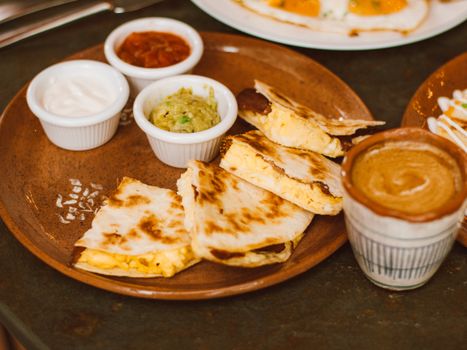
Photo: ROMAN ODINTSOV / Pexels
Mexican
Cheese Quesadilla
The diets react (see scores below)
Common Ingredients
- flour tortilla
- Oaxaca cheese
- Monterey Jack cheese
- butter
- salsa
- sour cream
Specific recipes may vary.
Incompatible with 8 of 11 diets
Diet Ratings
A cheese quesadilla is fundamentally incompatible with ketogenic eating due to its flour tortilla base. A standard flour tortilla (10-inch) contains approximately 35-40g of net carbs on its own, which nearly or entirely exhausts the entire daily keto carb budget in a single serving. While the cheeses (Oaxaca and Monterey Jack) and butter are keto-friendly high-fat dairy ingredients, and sour cream is acceptable in moderation, the flour tortilla is a grain-based product that cannot be made keto-compatible through portion control — even half a standard quesadilla would push most people out of ketosis. Salsa adds a small amount of additional carbs. The dish as constructed is a grain-forward meal and must be avoided on keto.
A cheese quesadilla contains multiple animal-derived ingredients that are explicitly excluded from a vegan diet. Oaxaca cheese and Monterey Jack cheese are dairy products made from cow's milk. Butter is a dairy fat. Sour cream is a fermented dairy product. All four of these ingredients are direct animal products, making this dish entirely incompatible with vegan principles. The flour tortilla and salsa are plant-based, but they are vastly outnumbered by the animal-derived components. There is no ambiguity here — dairy is unequivocally excluded from veganism by all major vegan organizations.
A cheese quesadilla is fundamentally incompatible with the Paleo diet. Every primary component violates core Paleo principles: flour tortillas are made from wheat, a grain explicitly excluded; Oaxaca cheese, Monterey Jack cheese, and sour cream are all dairy products, which are banned due to their post-Paleolithic origin; and butter, while sometimes debated, is still a dairy derivative. Salsa made from tomatoes, peppers, and herbs could technically be Paleo-friendly on its own, but it cannot redeem a dish built entirely on non-Paleo foundations. This dish represents one of the clearest possible violations of Paleo guidelines — grains and dairy combined as the core structural and flavor components.
A cheese quesadilla is largely incompatible with Mediterranean diet principles. The flour tortilla is a refined grain with no whole-grain equivalent in Mediterranean cuisine. Butter is used as the cooking fat rather than extra virgin olive oil. The dish is heavy on cheese (two full-fat cheeses), which classifies dairy as exceeding moderate amounts. Sour cream adds further saturated fat. There are no vegetables, legumes, whole grains, or plant-forward components. The combination of refined grains, butter, and excess dairy runs contrary to core Mediterranean diet principles.
A cheese quesadilla is fundamentally incompatible with the carnivore diet. The primary component — flour tortilla — is a grain-based plant food, which is strictly excluded on carnivore. While the cheeses (Oaxaca and Monterey Jack) and butter are animal-derived dairy products that some carnivore practitioners include, they are surrounded by and inseparable from the tortilla in this dish. Salsa is plant-derived (tomatoes, peppers, onions, cilantro) and entirely off-limits. Sour cream is dairy and debated but at least animal-derived. The dish as a whole is plant-food-dominant and grain-based, making it a clear avoid with high confidence across all tiers of carnivore practice.
This dish contains multiple excluded ingredients under Whole30 rules. Flour tortillas are made from wheat (a grain), which is explicitly excluded. Oaxaca cheese and Monterey Jack cheese are dairy products, also explicitly excluded. Butter is dairy and excluded (only ghee/clarified butter is permitted). Sour cream is dairy and excluded. Additionally, a quesadilla itself falls squarely into the 'no recreating baked goods/junk food' category, as tortillas/wraps are specifically listed as prohibited even if compliant ingredients could theoretically be found. This dish fails on nearly every ingredient.
This dish has multiple high-FODMAP ingredients that make it unsuitable during the elimination phase. Flour tortillas are made from wheat, which is high in fructans — a primary FODMAP trigger. This is the most significant issue. Oaxaca cheese is a fresh, high-moisture cheese similar to mozzarella or string cheese; while lower in lactose than soft cheeses, it contains more than aged hard cheeses and may be problematic in standard serving sizes. Monterey Jack is a semi-soft cheese that retains moderate lactose and is borderline. Sour cream contains lactose and is rated high-FODMAP at standard servings (Monash advises limiting to 2 tablespoons). Butter is low-FODMAP. Salsa can be high-FODMAP depending on whether it contains onion or garlic, which most commercial salsas do. The wheat tortilla alone is sufficient to classify this dish as avoid during elimination, and the combination of lactose-containing dairy ingredients compounds the FODMAP load significantly.
A cheese quesadilla made with flour tortilla, Oaxaca cheese, Monterey Jack cheese, butter, salsa, and sour cream presents multiple DASH diet concerns. The dish is dominated by full-fat dairy (two high-fat cheeses plus sour cream) and uses butter for cooking, resulting in high saturated fat content — directly contrary to DASH guidelines that specify low-fat or fat-free dairy and limited saturated fat. The sodium load is substantial: both Oaxaca and Monterey Jack cheeses are moderately high in sodium, the flour tortilla adds more, and salsa contributes additional sodium, likely pushing a single serving well over 700-900mg of sodium. The refined flour tortilla offers minimal fiber compared to whole grains emphasized by DASH. There is no lean protein, fiber-rich legume, vegetable, or fruit component to offset these negatives. The combination of high saturated fat, high sodium, full-fat dairy, and refined carbohydrates makes this dish poorly aligned with DASH principles across multiple dimensions.
A cheese quesadilla is a challenging Zone meal due to multiple structural problems. The flour tortilla is a high-glycemic refined carbohydrate — an 'unfavorable' carb in Zone terminology that spikes insulin rapidly. The primary macronutrient contributors are saturated fat (butter, Oaxaca cheese, Monterey Jack cheese) with no lean protein source listed — the dish lacks the lean protein block that anchors every Zone meal. The fat profile is dominated by saturated fat rather than the preferred monounsaturated fats (olive oil, avocado, almonds). The 40/30/30 ratio is severely distorted: this dish runs very high in fat and carbs with minimal lean protein, making Zone balancing nearly impossible without major reconstruction. Salsa is Zone-friendly (tomatoes, peppers = favorable low-GI carbs), and sour cream contributes modest fat. However, the core architecture — refined flour tortilla + full-fat cheese + butter, no lean protein — represents almost every Zone unfavorable pattern simultaneously. A score of 3 reflects that it is technically edible food that isn't pure sugar, but it cannot be reasonably incorporated into a Zone meal without wholesale ingredient substitution.
A cheese quesadilla made with flour tortilla, full-fat cheeses, and butter presents a mixed anti-inflammatory profile that leans moderately pro-inflammatory. Flour tortillas are refined carbohydrates with minimal fiber, contributing to glycemic load and lacking the benefits of whole grains. Oaxaca and Monterey Jack cheeses are full-fat dairy — both relatively high in saturated fat, which anti-inflammatory guidelines recommend limiting. Butter adds additional saturated fat and is explicitly in the 'limit' category. The salsa is a genuine bright spot: tomatoes, chiles, onion, and garlic all contain antioxidants and polyphenols with anti-inflammatory properties. Sour cream adds more full-fat dairy with minimal redeeming nutritional value from an anti-inflammatory standpoint. The dish lacks omega-3s, meaningful fiber, antioxidant-rich vegetables, or anti-inflammatory herbs and spices beyond what's in the salsa. It's not categorically pro-inflammatory the way fried processed foods or trans-fat-laden dishes would be, but the combination of refined carbs, butter, and multiple full-fat cheeses makes this a 'caution' food best consumed occasionally rather than regularly.
A cheese quesadilla made with flour tortilla, Oaxaca cheese, Monterey Jack cheese, and butter is a high-fat, moderate-calorie dish with limited protein density and minimal fiber. The refined flour tortilla offers little nutritional value and digests quickly without providing lasting satiety. The two-cheese filling delivers some protein but is primarily a saturated fat source, and the butter used for cooking adds additional fat. High fat content is a particular concern for GLP-1 patients because it slows gastric emptying further (compounding the medication's effect), worsens nausea, bloating, and reflux. Salsa is a positive addition — low calorie, some fiber, good hydration — but sour cream adds more saturated fat with minimal nutritional payoff. This dish as described has no listed primary protein, which is a significant gap given that protein is the top dietary priority. It is not fried and is easy to eat in small portions, which prevents a lower score, but it largely fails the nutrient-density-per-calorie standard central to GLP-1 dietary guidance.
Some GLP-1-focused registered dietitians will note that cheese does provide meaningful calcium and usable protein, and that a small quesadilla can fit into a calorie-reduced plan if portion size is tightly controlled. The disagreement centers on whether the saturated fat load and GI side-effect risk outweigh the convenience and palatability benefit, with individual tolerance to high-fat dairy varying considerably among GLP-1 patients.
*See how scores were generated at our methodology page.
Nutritional profile
Six traits that cut across every diet.
Fiber & Plants
How much whole-plant food and fiber it delivers.
Healthy Fats
The quality of its fats (unsaturated, omega-3).
Whole / Unprocessed
How close it is to its natural, unprocessed form.
Gut Gentle
How easy it is on digestion (low FODMAP, few irritants).
Low Glycemic
How little it spikes your blood sugar.
Protein Density
How much protein it packs per calorie.
Controversy Index
Higher controversy = more disagreement between diets.
Diet-Specific Tips
 Zone — 5/10
View tips
- Flour tortilla is a high-glycemic refined carb — unfavorable Zone carbohydrate
- No lean protein source — the dish lacks the protein block essential to Zone balance
- Fat is predominantly saturated (cheese, butter) rather than monounsaturated
- Macro ratio is heavily skewed toward fat and refined carbs, breaking 40/30/30
- Salsa is Zone-friendly but insufficient to redeem the overall dish
- Butter adds unnecessary saturated fat with no Zone benefit
- Would require complete reconstruction (corn/whole-grain tortilla, added lean protein, less cheese) to approach Zone compatibility
 Anti-Inflammatory — 4/10
View tips
- Refined flour tortilla — low fiber, high glycemic load, no whole grain benefit
- Multiple full-fat cheeses (Oaxaca + Monterey Jack) — high saturated fat, anti-inflammatory guidelines recommend limiting full-fat dairy
- Butter — explicitly in the 'limit' category due to saturated fat content
- Salsa — positive contribution of lycopene, capsaicin, quercetin, and allicin from tomatoes, chiles, and garlic
- Sour cream — additional full-fat dairy, no anti-inflammatory benefit
- No omega-3 fatty acids, no legumes, no anti-inflammatory herbs/spices beyond salsa
 GLP-1 Friendly — 4/10
View tips
- High saturated fat from two cheese varieties plus butter likely to worsen GLP-1 GI side effects (nausea, bloating, reflux)
- Refined flour tortilla adds empty refined carbohydrates with negligible fiber
- No primary protein source — dish falls well short of the 15–30g per meal protein target
- Small portion possible but nutrient density per calorie is poor
- Sour cream adds further saturated fat with minimal nutritional benefit
- Salsa is the one redeeming ingredient: low calorie, adds hydration and micronutrients
- Not fried, which prevents a lower score, but cooking in butter partially offsets this