Photo: Ray Suarez / Pexels
Italian
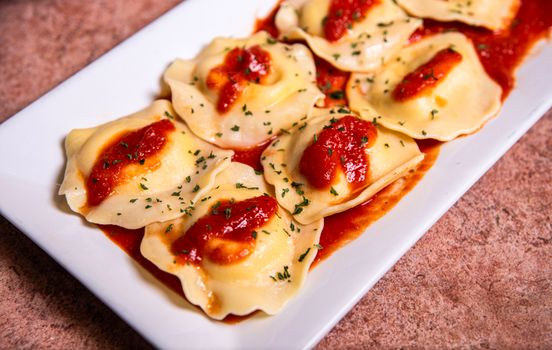
Cheese Ravioli
The diets react (see scores below)
Common Ingredients
- fresh pasta
- ricotta
- Parmesan
- mozzarella
- egg
- marinara sauce
- basil
Specific recipes may vary.
Incompatible with 6 of 11 diets
Diet Ratings
Cheese ravioli is fundamentally incompatible with a ketogenic diet. Fresh pasta is made from refined wheat flour, a grain-based, high-carb ingredient that is a direct keto disqualifier. A standard serving of cheese ravioli (about 1 cup or ~250g) contains roughly 40-50g of net carbs from the pasta alone, easily exceeding the entire daily carb allowance in a single dish. Marinara sauce adds additional sugars and carbs on top. While the ricotta, Parmesan, mozzarella, egg, and basil are individually keto-friendly, the pasta shell is the dominant component and cannot be portioned around — it is structural to the dish. No reasonable serving size makes this compatible with ketosis.
Cheese Ravioli contains multiple animal-derived ingredients that are unambiguously excluded from a vegan diet. Ricotta, Parmesan, and mozzarella are all dairy products (milk-derived), and egg is used in both the fresh pasta dough and potentially the filling. These are core animal products with no debate within the vegan community. The marinara sauce and basil are plant-based, but the dish as a whole is clearly not vegan-compatible.
Cheese Ravioli is fundamentally incompatible with the Paleo diet. Fresh pasta is made from wheat flour, a grain explicitly excluded from Paleo eating. Ricotta, Parmesan, and mozzarella are all dairy products, also strictly prohibited. The combination of two major Paleo-excluded food categories (grains and dairy) in the core components of this dish makes it a clear avoid with no ambiguity. The egg and basil are Paleo-compliant, and marinara sauce (tomatoes, herbs) can be Paleo-friendly, but these minor elements cannot redeem a dish built on wheat pasta and three types of cheese.
Cheese ravioli sits at the intersection of several Mediterranean diet considerations. The fresh pasta is a refined grain, which Mediterranean guidelines tolerate but don't emphasize over whole grains. The filling combines ricotta, Parmesan, and mozzarella — all dairy products acceptable in moderation under Mediterranean principles. The egg is similarly moderate. The marinara sauce and fresh basil are genuinely Mediterranean-friendly components — tomatoes, herbs, and ideally olive oil. The dish lacks the whole-grain base and plant-forward protein (legumes, fish) that would elevate it, and the triple-cheese filling pushes dairy beyond the 'moderate' threshold. However, it is not processed, contains no red meat or added sugars, and is rooted in traditional Italian cuisine. Overall, an acceptable occasional dish but not a Mediterranean staple.
Traditional Southern Italian and Greek cuisines regularly include pasta with cheese and tomato-based sauces as everyday meals, and some Mediterranean diet authorities (including those referencing the original Crete/Greece dietary patterns) would accept this as culturally authentic. However, modern clinical Mediterranean diet guidelines (e.g., PREDIMED-based frameworks) would note the refined pasta and high dairy load and recommend whole-grain pasta with a lighter cheese application.
Cheese Ravioli is fundamentally incompatible with the carnivore diet. The dish is built almost entirely around plant-derived and grain-based ingredients. Fresh pasta is a grain product (wheat flour), which is completely excluded. Marinara sauce is a plant-based tomato sauce, also entirely off-limits. Basil is a plant herb. While the filling does contain animal-derived ingredients — ricotta, Parmesan, mozzarella, and egg — these are secondary components embedded in a dish whose foundational structure violates carnivore principles. Even setting aside the dairy debate within the carnivore community, the pasta shell and marinara sauce alone are disqualifying. This dish cannot be modified or adapted to be carnivore-compatible without being entirely reconstructed into a different dish.
Cheese Ravioli contains multiple Whole30-excluded ingredients. Fresh pasta is a grain-based food (wheat flour), which is explicitly excluded. Ricotta, Parmesan, and mozzarella are all dairy products, also explicitly excluded. Beyond the ingredient violations, ravioli itself is a pasta/noodle — a form of food explicitly called out in Rule 4 as one of the 'no recreating' prohibited items even if somehow made with compliant ingredients. This dish fails on at least three independent grounds: grains (pasta), dairy (three cheeses), and the pasta/noodle prohibition.
Cheese Ravioli is problematic for the low-FODMAP elimination phase on multiple fronts. Fresh pasta is made from wheat flour, which is high in fructans — a major FODMAP trigger. Ricotta and mozzarella are both soft, fresh cheeses with notable lactose content; ricotta in particular is high-lactose and explicitly listed as high-FODMAP by Monash University at standard serving sizes used in ravioli filling. Parmesan is aged and low-lactose (low-FODMAP), and egg is safe, but they don't offset the other issues. Marinara sauce is a further concern: commercially prepared versions typically contain onion and garlic, both of which are among the highest-fructan foods tested by Monash. Even homemade marinara often includes onion and garlic. With at least three high-FODMAP components — wheat pasta (fructans), ricotta (lactose), and marinara with onion/garlic (fructans) — this dish is not suitable during the elimination phase at any standard serving size.
Cheese ravioli contains a combination of ricotta, Parmesan, and mozzarella — a triple-cheese filling that raises saturated fat and sodium content significantly above what DASH guidelines ideally recommend. DASH specifies low-fat or fat-free dairy, and the use of full-fat ricotta and mozzarella along with salty Parmesan pushes this dish into moderate concern territory. The fresh pasta (refined wheat) provides minimal fiber compared to whole-grain alternatives preferred by DASH. However, the marinara sauce contributes lycopene, potassium, and vegetables, and the dish is not heavily processed or fried. The basil adds phytonutrients. Sodium is a key concern — Parmesan alone can add 400-500mg per ounce, and marinara sauce is typically moderately high in sodium. This dish can fit within DASH if portion-controlled (1 cup serving), made with part-skim ricotta and mozzarella, low-sodium marinara, and ideally whole-wheat pasta — but as commonly prepared in restaurants or from standard recipes, it sits in the caution zone rather than being a DASH-endorsed choice.
NIH DASH guidelines specify low-fat dairy and limit saturated fat, which would place full-fat cheese-heavy dishes under restriction. However, updated clinical interpretations note that recent meta-analyses (including those cited in the 2020-2025 Dietary Guidelines context) suggest full-fat dairy may not adversely affect cardiovascular outcomes, and some DASH-aligned dietitians now permit part-skim cheese in moderation — making a carefully portioned, part-skim cheese ravioli more acceptable than strict traditional DASH would suggest.
Cheese ravioli presents significant Zone challenges but isn't categorically off-limits. The primary issue is the carbohydrate profile: fresh pasta is a high-glycemic, refined carbohydrate that counts as an 'unfavorable' Zone carb, delivering a rapid glucose spike that disrupts the eicosanoid balance Sears emphasizes. A typical serving of cheese ravioli (4-5 pieces) delivers a heavy carb load with minimal fiber to slow absorption. The cheese filling (ricotta, Parmesan, mozzarella) provides decent protein but also carries saturated fat, which Zone — especially earlier Sears writings — limits. On the positive side, the tomato-based marinara sauce contributes lycopene and polyphenols, which align with Zone's anti-inflammatory emphasis, and basil adds beneficial polyphenols. The egg in the pasta provides some lean protein contribution. To use this in a Zone-compatible way, portion would need to be drastically reduced (2-3 ravioli maximum) and paired with a large side of low-glycemic vegetables to rebalance the carb ratio, plus a lean protein source to compensate for the saturated-fat-heavy cheese protein. In practice, most restaurant or packaged servings are too carb-heavy and fat-skewed to fit the 40/30/30 template without significant modification. This dish is workable as an occasional meal component with discipline, but not a Zone-friendly staple.
Cheese ravioli presents a mixed anti-inflammatory profile. On the positive side, marinara sauce is rich in lycopene (a potent antioxidant from cooked tomatoes) and fresh basil contributes polyphenols and anti-inflammatory flavonoids. Eggs provide selenium and choline. However, the dish is dominated by full-fat dairy (ricotta, Parmesan, mozzarella), which is in the 'limit' category due to saturated fat content that can promote inflammatory markers like IL-6 at higher intakes. Fresh pasta (refined white flour) is a refined carbohydrate that raises blood glucose and lacks the fiber of whole grains, contributing to a moderate inflammatory load. The dish is also low in omega-3s and antioxidant-rich vegetables. This is not a strongly pro-inflammatory dish — it lacks trans fats, added sugars, processed additives, or seed oils — but it leans toward the unfavorable end of the anti-inflammatory spectrum due to the concentration of saturated fat from multiple cheese sources and refined carbohydrates. Acceptable occasionally, but not a staple on an anti-inflammatory diet.
Some anti-inflammatory nutritionists (notably those following Mediterranean diet principles, which overlap significantly with anti-inflammatory frameworks) view moderate full-fat dairy, especially aged cheeses like Parmesan, as largely neutral or even beneficial due to fermentation byproducts and fat-soluble vitamins like K2. The Mediterranean dietary pattern, which this dish broadly resembles, is associated with reduced inflammatory markers in population studies, suggesting that context and overall diet quality matter more than any single ingredient.
Cheese ravioli offers a moderate protein contribution from ricotta, Parmesan, mozzarella, and egg, but falls well short of the 15–30g per meal protein target without a supplementary protein source. The refined pasta shell is low in fiber and relatively easy to digest in small portions, which is a minor plus, but it contributes mostly refined carbohydrate calories with limited nutritional density. The three-cheese filling adds meaningful saturated fat, which can worsen GLP-1 side effects like nausea, bloating, and reflux — especially in typical restaurant-sized portions. Marinara sauce is a positive element, adding lycopene, some fiber, and hydration with relatively few calories, provided it is not heavily oiled. Basil is a non-issue. The dish is not fried or spicy, and is palatable in small servings, but the fat-to-protein ratio is unfavorable for GLP-1 patients and the refined grain base adds empty carbohydrate calories. A small portion (4–6 ravioli) paired with a lean protein side and a vegetable could make this acceptable, but as a standalone main it underdelivers on protein and fiber while overdelivering on saturated fat and refined carbs.
Some GLP-1-focused dietitians consider cheese-filled pasta a reasonable occasional option because the dairy proteins (casein and whey) in ricotta and mozzarella do contribute meaningful protein and calcium, and the dish is generally well-tolerated digestively in small amounts. Others flag the saturated fat load and refined grain base as counterproductive given the reduced caloric budget on GLP-1 therapy, arguing that every meal should be optimized for protein density rather than used on moderate-protein, high-carb dishes.
*See how scores were generated at our methodology page.
Nutritional profile
Six traits that cut across every diet.
Fiber & Plants
How much whole-plant food and fiber it delivers.
Healthy Fats
The quality of its fats (unsaturated, omega-3).
Whole / Unprocessed
How close it is to its natural, unprocessed form.
Gut Gentle
How easy it is on digestion (low FODMAP, few irritants).
Low Glycemic
How little it spikes your blood sugar.
Protein Density
How much protein it packs per calorie.
Controversy Index
Higher controversy = more disagreement between diets.
Diet-Specific Tips
 Mediterranean — 5/10
View tips
- Refined pasta rather than whole grain — tolerated but not preferred
- Triple-cheese filling (ricotta, Parmesan, mozzarella) pushes dairy above moderate levels
- Marinara sauce and fresh basil are strongly Mediterranean-aligned ingredients
- No red meat, no added sugars, no highly processed components
- Egg is an acceptable moderate-frequency ingredient
- Dish is traditional Italian cuisine with cultural Mediterranean roots
- Low saturation of plant-forward or whole-food protein sources
 DASH — 5/10
View tips
- Multiple full-fat cheeses (ricotta, mozzarella, Parmesan) elevate saturated fat above DASH targets
- High sodium load from Parmesan and marinara sauce (potentially 700-1000mg+ per serving)
- Refined pasta provides minimal fiber; whole-wheat pasta would improve DASH compatibility
- Marinara sauce contributes beneficial potassium, lycopene, and vegetable content
- Part-skim dairy substitutions and low-sodium marinara would meaningfully improve DASH score
- Portion control critical — restaurant servings typically 2-3x a DASH-appropriate serving
 Zone — 4/10
View tips
- Fresh pasta is a high-glycemic 'unfavorable' carbohydrate in Zone terminology, causing rapid glucose response
- Typical serving size delivers excessive carbohydrate blocks relative to protein and fat blocks
- Cheese filling (ricotta, Parmesan, mozzarella) is higher in saturated fat, not the preferred monounsaturated fat profile
- No lean protein source listed — cheese protein is accompanied by significant saturated fat, making block balancing harder
- Marinara sauce and basil contribute beneficial polyphenols and lycopene, consistent with Zone's anti-inflammatory focus
- Could theoretically fit Zone with a very small portion (2-3 pieces) paired with abundant vegetables and lean protein, but impractical in standard servings
 Anti-Inflammatory — 4/10
View tips
- High saturated fat from multiple full-fat dairy sources (ricotta, Parmesan, mozzarella) — in the 'limit' category
- Refined white pasta flour — lacks fiber, raises glycemic load
- Marinara sauce provides lycopene (anti-inflammatory carotenoid from cooked tomatoes)
- Fresh basil contributes polyphenols and flavonoids
- Egg contributes choline and selenium (modest anti-inflammatory benefit)
- No omega-3 fatty acids, minimal antioxidant-rich vegetables
- No trans fats, artificial additives, or high-fructose corn syrup — avoids the worst inflammatory offenders
 GLP-1 Friendly — 5/10
View tips
- Moderate protein from dairy cheeses and egg but insufficient as a standalone main — falls short of 15–30g per meal target
- Refined pasta shell adds refined carbohydrate with minimal fiber
- Three-cheese filling contributes notable saturated fat, increasing risk of nausea and reflux on GLP-1
- Marinara sauce is a positive addition — low calorie, some fiber, hydrating
- No added fried elements, not spicy — digestibility is acceptable in small portions
- Highly portion-sensitive: a small serving (4–6 ravioli) is more compatible than a full restaurant portion
- Nutrient density per calorie is below ideal for GLP-1 patients with reduced appetite