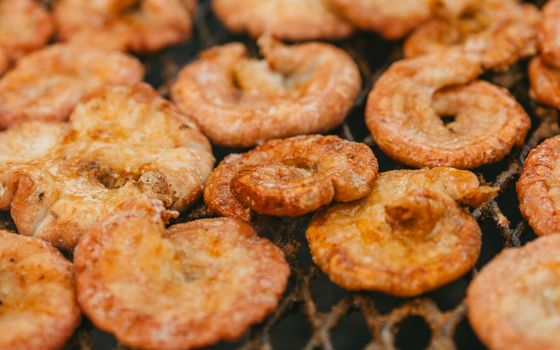
Photo: Guillermo Berlin / Pexels
Mexican
Chicharrones
The diets react (see scores below)
Common Ingredients
- pork skin
- salt
- lime
- hot sauce
Specific recipes may vary.
Incompatible with 6 of 11 diets
Diet Ratings
Chicharrones (fried pork skin) are one of the most keto-friendly snacks available. Pork skin is essentially pure protein and fat with zero carbohydrates. The seasonings — salt, lime juice, and hot sauce — contribute negligible carbs (lime juice adds a trivial amount, and most hot sauces are nearly carb-free in typical serving amounts). This snack is naturally grain-free, sugar-free, and fits perfectly within ketogenic macros. It is widely recommended by keto practitioners as an ideal chip substitute.
Chicharrones are made from fried pork skin, a direct animal product from a pig. This is unambiguously non-vegan. The primary ingredient is pork skin, which is an animal-derived product involving slaughter. The remaining ingredients (salt, lime, hot sauce) are plant-based, but the foundational ingredient disqualifies this dish entirely from vegan compatibility.
Chicharrones are made from pork skin, which is a natural animal product and would otherwise be paleo-approved. However, two ingredients disqualify this dish under strict paleo rules: added salt and hot sauce. Salt is excluded from the paleo framework as an added/processed ingredient not available in pure Paleolithic form. Hot sauce is a processed condiment that typically contains added salt, vinegar, and preservatives. Lime juice is fine and paleo-approved. Without the salt and hot sauce, plain fried pork skin would be a solid paleo snack. The commercial preparation of chicharrones almost universally includes salt as a primary ingredient, making the standard version non-compliant.
Many practical paleo practitioners, including Mark Sisson, take a relaxed view on small amounts of salt and minimally processed condiments, arguing that the ancestral framework should focus on macronutrient and food group compliance rather than trace mineral salts. Under this more flexible interpretation, chicharrones would be considered a high-protein, zero-carb paleo-friendly snack, and some paleo recipe sites actively feature them.
Chicharrones are deep-fried pork skin, which directly contradicts Mediterranean diet principles on multiple levels. Pork is a red/processed meat that should be consumed only a few times per month, and pork skin is one of the fattiest, most calorie-dense cuts with very high saturated fat content. The deep-frying process adds more unhealthy fat and the dish is highly processed by nature. While lime and hot sauce are negligible condiments, they cannot offset the core issue: this is essentially a processed, high-saturated-fat pork product with no redeeming plant-forward nutritional value. The Mediterranean diet strongly emphasizes plant-based snacks such as nuts, olives, and fresh vegetables instead.
Chicharrones (fried pork skin) are an animal-derived snack that many carnivore practitioners enjoy. The pork skin and salt are fully carnivore-compliant. However, this version includes lime juice and hot sauce, both of which are plant-derived ingredients that violate strict carnivore rules. Lime is a citrus fruit, and hot sauce typically contains peppers, vinegar (often plant-fermented), and sometimes sugar or other additives. Plain pork rinds with salt only would score an 8-9, but the plant-based condiments pull this dish into caution territory. Many real-world carnivore practitioners would consume chicharrones with these accompaniments without concern, but purists would reject the lime and hot sauce outright.
Strict carnivore adherents following protocols like the Lion Diet or Baker's meat-only approach would reject the lime and hot sauce as plant-derived ingredients containing compounds (citric acid, capsaicin, plant antinutrients) that contradict the elimination purpose of the diet. They would only accept pork skin prepared with salt alone.
Chicharrones (fried pork skins) are made from pork skin, salt, lime, and hot sauce — all of which are individually Whole30-compatible. Pork skin itself is a natural animal product, and frying in animal fat or compliant oil is acceptable. However, commercial chicharrones and hot sauces frequently contain non-compliant additives (added sugar, MSG historically though now allowed, preservatives, or other flavorings), so label-reading is essential. Homemade chicharrones with compliant hot sauce are clearly fine, but packaged versions require scrutiny. The dish as described with clean ingredients is technically compliant.
Official Whole30 guidance allows pork rinds/chicharrones as a compliant snack when ingredients check out, but some Whole30 practitioners flag them as a 'SWYPO-adjacent' snack food that can replicate the crunch of chips and encourage mindless snacking behaviors the program aims to break — though Melissa Urban has not officially categorized plain pork rinds as a banned junk-food recreation.
Chicharrones (fried pork skin) are an excellent low-FODMAP snack. Pork skin itself contains no carbohydrates and therefore no FODMAPs. Salt adds no FODMAPs. Lime juice in small amounts used as a condiment is low-FODMAP (Monash rates lime juice as low-FODMAP at standard serving sizes). The primary caution is the hot sauce — most plain chili-based hot sauces (e.g., Tabasco, Valentina) are low-FODMAP at typical serving sizes, but some commercial hot sauces contain garlic or onion powder, which are high-FODMAP fructan sources. Assuming a standard hot sauce without garlic/onion additives, this dish is very safe during the elimination phase.
The hot sauce ingredient introduces uncertainty — many popular Mexican hot sauces (e.g., Cholula, Tapatio) contain garlic or onion powder, which would make them high-FODMAP. Clinical FODMAP practitioners would advise checking the specific hot sauce label carefully; garlic/onion powder even in small amounts can trigger symptoms in sensitive individuals during elimination.
Chicharrones (fried pork skin) are fundamentally incompatible with the DASH diet. They are extremely high in sodium — a typical 1 oz serving contains 500–700mg or more — directly conflicting with DASH's sodium limits of <2,300mg/day (standard) or <1,500mg/day (low-sodium). Pork skin is also very high in saturated fat, which DASH explicitly limits to reduce cardiovascular risk. The addition of salt and hot sauce (typically high in sodium) further compounds the sodium load. Pork skin provides no meaningful fiber, potassium, magnesium, or calcium — the key nutrients DASH emphasizes. As a fried, processed snack derived from fatty pork, chicharrones fall squarely in the 'avoid' category across all major DASH diet guidelines.
Chicharrones (fried pork skin) present a mixed Zone Diet picture. They are essentially a pure protein-and-fat food with zero carbohydrates, which makes them inherently incompatible with the 40/30/30 Zone ratio on their own — but as a snack component they can be paired with low-GI carb sources to approach Zone balance. The fat profile is the primary concern: pork skin is high in saturated fat, which Sears' earlier Zone writings discouraged, though it does contain some oleic acid (monounsaturated). The protein content is reasonable and the ingredients (salt, lime, hot sauce) are Zone-neutral. As a standalone snack, chicharrones lack carbohydrates entirely, making it impossible to hit Zone ratios without pairing. The high saturated fat content and fried preparation are unfavorable by Zone standards. However, a small portion (roughly 1 oz) used as a protein/fat component alongside vegetables or fruit could be worked into a Zone snack block.
Some Zone practitioners and Sears' later anti-inflammatory writings (particularly 'The Mediterranean Zone') acknowledge that not all saturated fat is equally problematic and that whole-food animal proteins, even higher-fat ones, can be incorporated in small quantities. Additionally, chicharrones have a near-zero glycemic impact and are sometimes embraced in low-inflammation eating frameworks for their collagen and protein content. A strict early Zone reading would rate these lower (score 3), while a modern Zone-aligned reader might accept them as an occasional small-portion fat/protein block.
Chicharrones are deep-fried pork skin, making them essentially pure saturated fat and collagen with virtually no redeeming anti-inflammatory nutrients. The primary concern is the very high saturated fat content — pork skin is predominantly saturated and monounsaturated fat, with meaningful levels of palmitic acid, which is associated with activation of pro-inflammatory NF-κB pathways and elevated inflammatory markers like CRP and IL-6 at high intake levels. The deep-frying process (typically in lard or refined oil at very high temperatures) generates lipid oxidation products and advanced glycation end products (AGEs), both of which drive inflammatory signaling. There is no meaningful fiber, polyphenols, omega-3s, or antioxidants in the base preparation. The lime and hot sauce (chili) are minor brightening elements — lime provides a small amount of vitamin C and chili contains capsaicin with mild anti-inflammatory properties — but their quantities are trivially small relative to the pork skin base and do not meaningfully offset the inflammatory profile. Salt contributes to no inflammatory concern directly but supports the overall processed/cured nature of the snack. Anti-inflammatory frameworks from Dr. Weil, the IF Rating system, and mainstream research all place high-fat pork products and fried foods in the 'limit' or 'avoid' category.
Chicharrones are deep-fried pork skin — a high-fat, fried snack with virtually no fiber and no meaningful micronutrient density. A standard 1 oz serving contains roughly 9g fat (mostly saturated), ~9g protein, and 0g fiber. While the protein-per-calorie ratio is not terrible in isolation, the fat content and frying method directly worsen GLP-1 side effects including nausea, bloating, reflux, and slowed gastric emptying. The addition of hot sauce further risks aggravating reflux and GI discomfort. Salt content is high, which can contribute to water retention. This is the opposite of what a GLP-1 patient needs in a snack: easy digestibility, high protein density, low fat, and nutrient density per calorie. Every drawback category applies here.
*See how scores were generated at our methodology page.
Nutritional profile
Six traits that cut across every diet.
Fiber & Plants
How much whole-plant food and fiber it delivers.
Healthy Fats
The quality of its fats (unsaturated, omega-3).
Whole / Unprocessed
How close it is to its natural, unprocessed form.
Gut Gentle
How easy it is on digestion (low FODMAP, few irritants).
Low Glycemic
How little it spikes your blood sugar.
Protein Density
How much protein it packs per calorie.
Controversy Index
Higher controversy = more disagreement between diets.
Diet-Specific Tips
 Keto — 9/10
View tips
- Pork skin has zero net carbs — pure protein and fat
- High fat content aligns with keto macronutrient targets
- Salt, lime, and hot sauce add negligible carbs at normal serving sizes
- No grains, starches, or added sugars
- Whole, minimally processed ingredient profile
- Commonly recommended as a keto-friendly chip alternative
 Carnivore — 5/10
View tips
- Pork skin is a legitimate animal-derived product and well-accepted on carnivore
- Salt is universally approved on carnivore
- Lime juice is a plant-derived fruit — excluded on strict carnivore
- Hot sauce contains plant ingredients (peppers, vinegar) and possibly sugar or additives — not carnivore-compliant
- Plain chicharrones with salt only would be approved; the condiments create the caution rating
- Many pragmatic carnivore practitioners overlook small amounts of spices or lime but purists do not
 Whole30 — 6/10
View tips
- Pork skin is a natural animal product and Whole30-compliant
- Salt and lime are fully compliant
- Hot sauce requires label-reading — many brands contain added sugar or non-compliant ingredients
- Commercial chicharrones may contain additives; homemade versions are safer
- Not classified as a 'junk food recreation' under Rule 4, but snack-food context warrants mindfulness
 Low-FODMAP — 9/10
View tips
- Pork skin is carbohydrate-free and inherently FODMAP-free
- Salt contains no FODMAPs
- Lime juice is low-FODMAP at condiment serving sizes per Monash
- Hot sauce brand matters — garlic/onion-free varieties (e.g., plain Tabasco) are low-FODMAP
- Many commercial hot sauces contain garlic or onion powder, which are high-FODMAP fructans
- No high-FODMAP ingredients if hot sauce is garlic/onion-free
 Zone — 4/10
View tips
- Zero carbohydrates — cannot meet 40/30/30 ratio without pairing with carb sources
- High saturated fat content from fried pork skin — unfavorable in classic Zone
- No fiber, no polyphenols, no micronutrient density
- Protein content is present but comes packaged with significant fat
- Lime and hot sauce are Zone-neutral and add polyphenol value marginally
- Fried preparation method is unfavorable in Zone's anti-inflammatory framework
- Small portions could serve as a protein/fat block component in a carefully constructed Zone snack