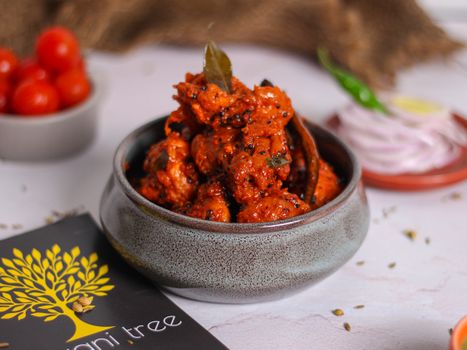
Photo: Prabal Pratap Singh / Pexels
The diets react (see scores below)
Common Ingredients
- chicken thighs
- yogurt
- Kashmiri chili
- ginger
- garlic
- curry leaves
- green chilies
- cornstarch
Specific recipes may vary.
Incompatible with 6 of 11 diets
Diet Ratings
Chicken 65 is built on a keto-friendly base — chicken thighs are high-fat, moderate-protein, and zero-carb. The spices, curry leaves, ginger, garlic, and chilies add negligible net carbs. However, two ingredients create concern: cornstarch (used as a coating/binder) adds meaningful net carbs and is a grain-derived starch incompatible with strict keto, and yogurt contributes lactose (milk sugar). A standard restaurant serving likely uses 2-3 tbsp of cornstarch for a full batch, contributing roughly 4-8g net carbs per serving, plus the yogurt adds another 2-4g. Total net carbs per serving could range from 6-12g depending on portion size — manageable within a daily keto budget if carefully portioned, but a risk if consumed freely. The dish can be made keto-friendly at home by substituting cornstarch with a small amount of almond flour or psyllium husk and using full-fat Greek yogurt sparingly.
Strict keto practitioners would flag cornstarch as a hard avoid regardless of quantity, since any grain-derived starch can disrupt ketosis in sensitive individuals and sets a poor precedent for ingredient tolerance. Some clinical keto protocols also exclude all dairy including yogurt due to its insulinogenic lactose content.
Chicken 65 contains two clear animal-derived ingredients: chicken thighs (poultry/meat) and yogurt (dairy). Both are explicitly excluded under all vegan frameworks. There is no ambiguity here — this dish is fundamentally built on animal products and is entirely incompatible with a vegan diet.
Chicken 65 contains two clear non-paleo ingredients: yogurt (dairy) and cornstarch (a highly processed grain derivative). Yogurt is excluded under strict paleo rules as a dairy product, and cornstarch — derived from corn — is both a grain product and a heavily processed starch used as a coating/thickener. The chicken, Kashmiri chili, ginger, garlic, curry leaves, and green chilies are all paleo-approved, but the presence of dairy and a grain-based starch makes this dish non-compliant. The dish could theoretically be adapted (substituting coconut cream for yogurt and arrowroot for cornstarch), but as traditionally prepared it fails paleo criteria on two counts.
Chicken 65 is a deep-fried Indian snack made primarily from chicken thighs, which places it in the 'caution' zone for two reasons: (1) poultry is acceptable in the Mediterranean diet but only in moderate amounts, not as a daily staple, and (2) the dish is typically deep-fried, which contradicts the Mediterranean principle of using extra virgin olive oil as the primary fat in non-frying applications. The marinade ingredients — yogurt, garlic, ginger, chili — are individually compatible, and yogurt is a Mediterranean-approved dairy. However, cornstarch as a coating and deep-frying in unspecified oil add refined starch and potentially unhealthy fats. If prepared by baking or air-frying with olive oil, the score would rise closer to a 5-6. As traditionally prepared (deep-fried), it sits at the lower end of caution.
Some Mediterranean diet practitioners would score this higher, noting that the yogurt marinade, aromatic spices, and lean poultry align well with the diet's spirit, and that occasional fried dishes appear in traditional Mediterranean cuisines (e.g., Greek tiganites, Spanish tapas). The concern is primarily the frying method and refined cornstarch, not the dish's core composition.
Chicken 65 is heavily incompatible with the carnivore diet. While chicken thighs are an acceptable animal protein, virtually every other ingredient violates carnivore principles. Cornstarch is a plant-derived starch used as a coating/binder and is explicitly excluded. Yogurt, while animal-derived, is dairy and debated even in its plain form — here it functions as a marinade alongside multiple plant-based ingredients. Kashmiri chili, ginger, garlic, curry leaves, and green chilies are all plant-derived spices, aromatics, and vegetables that are excluded on carnivore. This dish is fundamentally a spiced, battered, fried preparation built around plant-based seasonings and a starch coating — the opposite of a carnivore-friendly preparation. The chicken itself is the only salvageable component.
Chicken 65 contains two excluded ingredients that make it non-compliant with Whole30. First, yogurt is a dairy product and is explicitly excluded from the Whole30 program. Second, cornstarch is explicitly listed as an excluded ingredient on Whole30. Either of these alone would disqualify the dish. The remaining ingredients — chicken thighs, Kashmiri chili, ginger, garlic, curry leaves, and green chilies — are all fully compliant.
Chicken 65 contains two high-FODMAP ingredients that are dealbreakers during the elimination phase: garlic and yogurt. Garlic is one of the highest-FODMAP foods tested by Monash University, containing significant fructans even in tiny amounts (as little as 1/4 clove can be problematic). Standard recipes use multiple garlic cloves as a core flavoring agent, making this unavoidable. Yogurt contains lactose, which is a disaccharide FODMAP — standard yogurt is high-FODMAP at a typical serving. While lactose-free yogurt is a possible substitute, traditional Chicken 65 uses regular yogurt as a marinade. The remaining ingredients are largely low-FODMAP: chicken thighs (protein, FODMAP-free), Kashmiri chili (low-FODMAP spice), ginger (low-FODMAP at typical culinary amounts), curry leaves (low-FODMAP), green chilies (low-FODMAP), and cornstarch (low-FODMAP thickener). However, the garlic alone is sufficient to rate this dish 'avoid' — it cannot be reduced to a safe level in any standard preparation of this dish.
Chicken 65 presents a mixed DASH profile. The dish uses chicken thighs (higher in saturated fat than breast meat, though still a lean protein source compared to red meat), yogurt (a DASH-friendly low-fat dairy ingredient rich in calcium and potassium), and beneficial aromatics like ginger, garlic, curry leaves, and green chilies that add flavor without sodium. However, the dish is typically deep-fried or pan-fried, which increases total fat content significantly. Cornstarch adds refined carbohydrates with minimal nutritional benefit. Restaurant versions often contain added salt and sodium-heavy marinades, pushing sodium levels up. The Kashmiri chili is primarily for color and mild heat with negligible DASH concern. As a snack, portion size is typically moderate, which helps limit overall impact. A home-prepared, baked or air-fried version using low-fat yogurt and minimal added salt would align much better with DASH principles.
NIH DASH guidelines would flag the saturated fat from chicken thighs and the deep-frying method as concerns, recommending skinless breast meat and low-fat cooking techniques. However, updated clinical interpretations note that when prepared with low-fat yogurt, moderate portions, and baked rather than fried, this dish can fit within a DASH framework as an occasional protein-rich snack, with some practitioners emphasizing that the anti-inflammatory spice profile (ginger, garlic, curry leaves) adds functional benefit.
Chicken 65 is a spiced Indian fried (or pan-fried) chicken dish that has several Zone-relevant considerations. The chicken thighs provide good protein but are higher in saturated fat than skinless chicken breast — the Zone's preferred lean protein. Yogurt adds a small carb and protein component and is acceptable in Zone. The cornstarch used as a coating raises the glycemic concern: it's a high-glycemic refined starch that adds unfavorable carb blocks and can spike insulin. The spices (Kashmiri chili, ginger, garlic, curry leaves, green chilies) are polyphenol-rich and anti-inflammatory, which aligns well with Sears' later nutritional philosophy emphasizing polyphenols. The dish is typically deep-fried, adding significant fat — often from omega-6-heavy seed oils (vegetable/canola oil), which is contrary to Zone's anti-inflammatory fat principles. However, if prepared with less oil or pan-fried, and portioned carefully (using thigh meat as a 3-block protein portion ~75-80g cooked), it can fit into a Zone snack when paired with low-GI vegetables. The cornstarch and frying oil are the primary obstacles. This dish is workable but requires modification: substituting with chicken breast, minimizing cornstarch, and using a Zone-favorable cooking fat.
Some Zone practitioners may rate this more favorably if the cornstarch is minimal and the dish is baked or air-fried. Sears' later anti-inflammatory work would highlight the polyphenol-dense spice profile (ginger, garlic, curry leaves) as genuinely beneficial, potentially nudging the score upward. Conversely, strict early Zone followers would penalize the chicken thighs' saturated fat and the high-GI cornstarch coating more heavily.
Chicken 65 presents a mixed anti-inflammatory profile. On the positive side, it features several strongly anti-inflammatory spices and aromatics: ginger and garlic are well-documented anti-inflammatory agents, curry leaves contain antioxidant flavonoids and alkaloids, green and Kashmiri chilies provide capsaicin which has documented anti-inflammatory effects, and yogurt offers probiotics that support gut health and may reduce systemic inflammation. Chicken thighs are a lean-to-moderate protein source that falls in the 'acceptable in moderation' category. However, Chicken 65 is typically a deep-fried dish, and that preparation method significantly undermines the anti-inflammatory properties. Deep frying typically uses refined seed oils (sunflower, vegetable, or canola) at high heat, generating oxidized lipids and potentially trans-fatty acids — both pro-inflammatory. Cornstarch adds refined carbohydrate with no nutritional benefit. The spice marinade itself would score highly, but the frying method and refined starch drag the overall score down considerably. If prepared as a baked or air-fried dish, this could approach an 'approve' rating.
Some anti-inflammatory practitioners who follow Dr. Weil's principles might argue the cumulative anti-inflammatory power of garlic, ginger, chili, and curry leaves is significant enough to offset moderate frying, particularly if a more stable oil like refined avocado or coconut oil is used. Conversely, stricter AIP-aligned practitioners would flag the nightshade chilies as potentially problematic for those with autoimmune conditions, though mainstream anti-inflammatory guidance considers chilies beneficial.
Chicken 65 is a deep-fried Indian snack made with chicken thighs — a higher-fat cut — coated in cornstarch and fried at high heat, then tossed with green chilies and curry leaves. While the dish contains meaningful protein and the yogurt marinade adds some benefit, the preparation method is the primary disqualifier for GLP-1 patients. Deep frying significantly increases fat content per serving, directly worsening the nausea, bloating, and reflux that GLP-1 medications already promote through slowed gastric emptying. The use of chicken thighs rather than breast further increases saturated fat load. The green chilies and chili-forward spice profile add a second strike — spicy foods can aggravate GLP-1-related GI discomfort and reflux. Cornstarch coating adds refined carbohydrates with minimal nutritional value. As a snack category item, it is also difficult to portion in a way that offsets these drawbacks. The underlying protein source (chicken) is excellent, but the preparation renders it unsuitable.
*See how scores were generated at our methodology page.
Nutritional profile
Six traits that cut across every diet.
Fiber & Plants
How much whole-plant food and fiber it delivers.
Healthy Fats
The quality of its fats (unsaturated, omega-3).
Whole / Unprocessed
How close it is to its natural, unprocessed form.
Gut Gentle
How easy it is on digestion (low FODMAP, few irritants).
Low Glycemic
How little it spikes your blood sugar.
Protein Density
How much protein it packs per calorie.
Controversy Index
Higher controversy = more disagreement between diets.
Diet-Specific Tips
 Keto — 5/10
View tips
- Cornstarch coating adds net carbs and is grain-derived — primary concern
- Yogurt contributes lactose/sugar, though small amounts of full-fat yogurt are tolerated by most keto practitioners
- Chicken thighs are an ideal keto protein with favorable fat content
- Spices and aromatics are essentially zero net carbs
- Portion control is critical — a large serving could approach 10-12g net carbs
- Home preparation allows keto-friendly substitutions for cornstarch
 Mediterranean — 4/10
View tips
- Poultry is permitted in moderation — not a core Mediterranean staple
- Typically deep-fried, introducing refined fats not aligned with EVOO-based cooking
- Cornstarch is a refined starch, minimally nutritious
- Yogurt marinade is a positive Mediterranean element
- Spices and aromatics (garlic, ginger, chili) are diet-compatible
- Preparation method (frying vs. baking) significantly impacts healthfulness
 DASH — 5/10
View tips
- Chicken thighs higher in saturated fat than DASH-preferred skinless white meat
- Deep-frying significantly increases total fat content — baking or air-frying improves DASH compatibility
- Yogurt is a DASH-approved low-fat dairy ingredient providing calcium
- No intrinsically high-sodium ingredients, but preparation and restaurant versions often add substantial salt
- Cornstarch adds refined starch with no DASH nutritional value
- Beneficial aromatics (garlic, ginger, curry leaves) align with DASH flavor-without-sodium principle
- Moderate snack-sized portions help limit saturated fat and calorie load
 Zone — 5/10
View tips
- Chicken thighs are higher in saturated fat than Zone-preferred lean proteins like skinless chicken breast
- Cornstarch is a high-glycemic refined starch that adds unfavorable carb blocks
- Typically deep-fried in omega-6-heavy seed oils, contrary to Zone anti-inflammatory fat principles
- Spices (ginger, garlic, curry leaves, Kashmiri chili) are polyphenol-rich and anti-inflammatory — a Zone positive
- Yogurt marinade is a favorable, low-glycemic carb and protein contributor
- Can be made Zone-compatible with modifications: chicken breast, minimal cornstarch, baking or air-frying
 Anti-Inflammatory — 5/10
View tips
- Ginger and garlic are potent anti-inflammatory agents with strong research support
- Chili peppers (Kashmiri and green) provide capsaicin, an anti-inflammatory compound
- Curry leaves contain antioxidant flavonoids and may reduce oxidative stress
- Yogurt marinade offers probiotics beneficial for gut-immune axis
- Deep frying in refined seed oils introduces oxidized lipids and pro-inflammatory omega-6 fatty acids
- Cornstarch adds refined carbohydrate with no anti-inflammatory benefit
- Chicken thighs are moderate — acceptable lean-ish protein but higher in saturated fat than breast
- Preparation method (fried vs. baked/air-fried) substantially changes the inflammatory profile