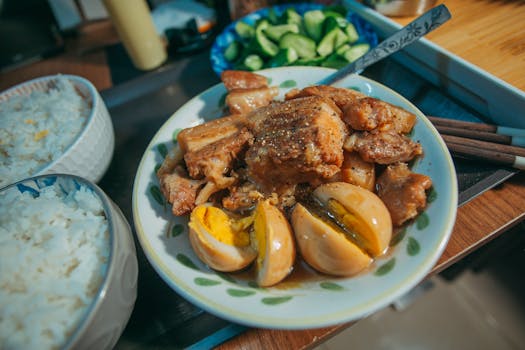
Photo: FOX ^.ᆽ.^= ∫ / Pexels
Filipino
Chicken Adobo
The diets react (see scores below)
Common Ingredients
- chicken
- soy sauce
- cane vinegar
- garlic
- bay leaves
- black peppercorns
- onion
- sugar
Specific recipes may vary.
Incompatible with 5 of 11 diets
Diet Ratings
Chicken Adobo is fundamentally protein- and fat-friendly (chicken thighs/skin provide good fat, the protein is keto-compatible), and the core aromatics — garlic, bay leaves, black peppercorns, onion — add minimal net carbs at typical cooking quantities. The main concerns are the added sugar (directly incompatible with strict keto) and soy sauce (contains a small amount of carbs). Cane vinegar itself is very low-carb. In a typical Filipino recipe, sugar may range from 1–2 tsp to a tablespoon per whole chicken, which in a single serving adds only ~1–3g net carbs from sugar — borderline but not catastrophic. A keto-adapted version (omitting or replacing sugar with a zero-carb sweetener, using tamari or coconut aminos) would upgrade this to an 'approve.' As prepared with sugar, it sits in the caution zone: manageable with portion control but not inherently keto-pure.
Strict keto and carnivore-leaning practitioners argue that any added sugar — regardless of the small per-serving amount — has no place in a ketogenic diet and should be an automatic disqualifier; they would rate this 'avoid' until the sugar is fully eliminated.
Chicken Adobo is a Filipino braised dish whose primary and defining ingredient is chicken, a direct animal product. There is no ambiguity here: chicken is poultry and categorically excluded under all vegan frameworks. The remaining ingredients (soy sauce, cane vinegar, garlic, bay leaves, black peppercorns, onion, sugar) are all plant-based, but they are secondary to the chicken, which is the protein centerpiece of the dish. No vegan version of this dish exists under the name 'Chicken Adobo' — a plant-based adaptation would substitute a different protein (e.g., tofu, jackfruit, mushroom) and would be a distinct dish.
Chicken Adobo contains several non-paleo ingredients that make it incompatible with the diet in its traditional form. Soy sauce is a double violation — it is both a legume-derived product (soy) and a heavily processed, grain-fermented condiment with added salt. Sugar (cane sugar) is refined and explicitly excluded. While the chicken, garlic, bay leaves, black peppercorns, and onion are all paleo-approved, and cane vinegar is generally accepted in moderation, the soy sauce and refined sugar are hard stops. This dish cannot be considered paleo without significant modification (e.g., replacing soy sauce with coconut aminos and omitting sugar).
Chicken Adobo features poultry as its primary protein, which is acceptable in moderation under Mediterranean diet principles (a few servings per week). However, several aspects pull it away from Mediterranean alignment: soy sauce is a heavily processed, high-sodium condiment with no place in traditional Mediterranean cuisine; cane vinegar is acceptable but wine vinegar or lemon juice would be more typical; added sugar, even in small amounts, is discouraged; and the dish uses no olive oil, which is the cornerstone Mediterranean fat. The aromatics (garlic, onion, bay leaves, black peppercorns) are genuinely Mediterranean-friendly. Overall, this is a flavorful dish that can be eaten occasionally, but its reliance on soy sauce, absence of olive oil, and added sugar make it a moderate mismatch with Mediterranean principles.
Some flexible Mediterranean diet interpretations focus primarily on protein source and overall dietary pattern rather than individual condiments, arguing that a modest portion of soy-braised chicken with garlic and aromatic spices can fit within a broadly plant-forward, low-red-meat eating pattern. Modern clinical adaptations of the Mediterranean diet also acknowledge cultural food traditions and may permit such dishes occasionally as part of an otherwise compliant diet.
Chicken Adobo is fundamentally incompatible with the carnivore diet. While chicken itself is an acceptable animal protein, this dish is defined by its marinade and sauce, which contains multiple plant-derived and processed ingredients: soy sauce (fermented soybeans and wheat — both legume and grain), cane vinegar (plant-derived), garlic (plant), bay leaves (plant), black peppercorns (plant), onion (plant), and sugar (processed plant derivative). The dish cannot be separated from these core components — they are not incidental additives but the defining flavor profile of Adobo. The presence of soy sauce alone disqualifies it, as it is a processed legume-and-grain product. Sugar adds further disqualification as a processed carbohydrate. This dish is essentially plant-seasoned chicken, not a carnivore meal.
Chicken Adobo as listed contains two excluded ingredients: soy sauce (a soy-based product, and soy is explicitly excluded on Whole30) and sugar (added sugar is explicitly excluded). While the chicken, cane vinegar, garlic, bay leaves, black peppercorns, and onion are all compliant, the presence of soy sauce and sugar makes this dish non-compliant. A Whole30-compatible version could be made by substituting coconut aminos for the soy sauce and omitting the sugar entirely.
Chicken Adobo contains two major high-FODMAP ingredients that make it unsuitable during the elimination phase: garlic and onion. Both are among the highest-fructan foods in the Monash database and are problematic even in small quantities. Garlic is rated high-FODMAP at just 1 clove, and onion is high-FODMAP at any meaningful serving. These are structural ingredients in this dish — not garnishes — meaning they cannot be reduced to safe levels without fundamentally changing the recipe. Soy sauce in small amounts (1 tablespoon) is considered low-FODMAP by Monash, cane vinegar is low-FODMAP, chicken is low-FODMAP, and bay leaves and black peppercorns are used in negligible quantities and are safe. However, the garlic and onion alone disqualify this dish for elimination phase.
Chicken Adobo features lean chicken as its protein base, which aligns well with DASH principles. However, the primary concern is the soy sauce, which is the dominant sodium source in this dish. A typical serving of soy sauce used in adobo can contribute 800–1,500mg of sodium per serving, potentially exceeding half the standard DASH daily sodium limit (2,300mg) or the entire low-sodium DASH limit (1,500mg) in a single dish. The remaining ingredients — cane vinegar, garlic, bay leaves, black peppercorns, onion — are DASH-friendly and even beneficial (garlic and onion provide potassium and antioxidants). The small amount of sugar is a minor concern but not disqualifying at typical levels. The dish is not categorically excluded from DASH, but the sodium load from soy sauce makes it problematic without modification. Substituting low-sodium soy sauce or coconut aminos and reducing the quantity used could significantly improve DASH compatibility.
NIH DASH guidelines explicitly restrict high-sodium condiments like soy sauce, which would push this dish toward 'avoid' territory. However, updated clinical interpretations recognize that traditional dishes like adobo can be adapted for DASH compliance using low-sodium soy sauce alternatives, and some DASH-oriented dietitians allow higher-sodium meals occasionally if daily totals are managed — making a blanket 'avoid' verdict overly rigid in practice.
Chicken Adobo is built around a lean protein (chicken) that aligns well with Zone principles, and the aromatics (garlic, onion, bay leaves, peppercorns) are low-glycemic and Zone-favorable. The cane vinegar is essentially calorie-free and may even have a glycemic-dampening effect. However, two factors introduce caution: soy sauce adds significant sodium and is a processed condiment (though used in small quantities), and the inclusion of sugar — even a small amount — raises the glycemic load of the dish. Traditional recipes vary widely in how much sugar is added; some versions add a tablespoon or more, which meaningfully increases the unfavorable carbohydrate load. The dish lacks significant fat, so a Zone-balanced plate would require pairing with a monounsaturated fat source (e.g., a side of avocado or a drizzle of olive oil) and low-glycemic vegetables to hit the 40/30/30 target. Skin-on chicken also increases saturated fat content, which Zone traditionally discourages. With skinless chicken, minimal sugar, and proper Zone accompaniments, this dish can be made Zone-compatible.
Some Zone practitioners would rate this more favorably, noting that the sugar used in adobo is typically a very small amount relative to the whole dish and negligible per serving, and that the vinegar's acetic acid actually helps moderate glycemic response. Dr. Sears' later anti-inflammatory writings also de-emphasize rigid avoidance of small amounts of added sugar if the overall meal ratio is maintained. In that framing, a well-portioned Chicken Adobo with vegetables could approach a clean Zone meal.
Chicken Adobo has a mixed anti-inflammatory profile. On the positive side, garlic is a well-established anti-inflammatory ingredient with allicin and organosulfur compounds that reduce inflammatory markers. Vinegar (cane vinegar) is neutral to mildly beneficial. Black peppercorns contain piperine, which has anti-inflammatory properties and notably enhances curcumin absorption. Bay leaves contain compounds with mild anti-inflammatory activity. Chicken (presumably bone-in, skin-on for traditional adobo) is a lean-to-moderate protein — generally acceptable in the anti-inflammatory framework as a 'moderate' category food. The concerns center on soy sauce, which is high in sodium and typically made from refined, highly processed ingredients; while fermented soy has some benefits, commercial soy sauce's high sodium content can contribute to systemic inflammation at regular intake levels. The added sugar, though likely small in quantity, is a mild negative. Traditional adobo also uses skin-on chicken, meaning moderate saturated fat content. Overall, this is a home-cooked dish with real anti-inflammatory ingredients (garlic, vinegar, peppercorns) but tempered by sodium-heavy soy sauce and modest added sugar — placing it solidly in the 'caution/moderate' zone. Using low-sodium soy sauce or tamari and minimizing added sugar would improve the profile.
Some anti-inflammatory practitioners would rate this more favorably, noting that garlic and black pepper are potent anti-inflammatory spices and that traditional fermented soy products have documented gut-health and anti-inflammatory benefits (Dr. Weil emphasizes whole soy foods positively). Others following stricter low-sodium or AIP-adjacent protocols would flag the soy sauce and sugar more harshly, potentially rating the dish closer to 'avoid' territory for those with inflammatory conditions.
Chicken adobo is built around chicken, which is an excellent GLP-1-friendly protein source, but the overall dish rating depends heavily on which cut is used and how it is prepared. Traditional adobo is commonly made with bone-in, skin-on thighs or drumsticks, which add significant saturated fat and can worsen nausea, bloating, and reflux — the core GLP-1 side effects. The braising liquid (soy sauce, vinegar, garlic, onion, bay leaves, peppercorns) is low-calorie, supports flavor without empty calories, and the vinegar may modestly support blood sugar stability. The small amount of sugar is not a meaningful concern at typical recipe quantities. Sodium from soy sauce is worth noting — GLP-1 patients often have reduced food intake and may not need further appetite suppression from high-sodium meals, and sodium can mask adequate hydration. The dish contains minimal fiber and no high-fiber ingredients, so it should be paired with vegetables or legumes to meet fiber targets. Rated caution rather than approve primarily because of the likely presence of high-fat cuts and skin in the traditional preparation, and the elevated sodium load. Made with skinless chicken breast, the score would rise to 7-8.
Some GLP-1-focused dietitians would rate a skinless chicken breast version of adobo as a clear approve, arguing the vinegar-based braise is one of the most GI-friendly cooking methods and the dish is naturally portion-friendly. Others flag the high sodium content of soy sauce as a practical concern for patients already managing fluid retention or cardiovascular risk, and note that many patients on GLP-1s are not drinking enough water to offset it.
*See how scores were generated at our methodology page.
Nutritional profile
Six traits that cut across every diet.
Fiber & Plants
How much whole-plant food and fiber it delivers.
Healthy Fats
The quality of its fats (unsaturated, omega-3).
Whole / Unprocessed
How close it is to its natural, unprocessed form.
Gut Gentle
How easy it is on digestion (low FODMAP, few irritants).
Low Glycemic
How little it spikes your blood sugar.
Protein Density
How much protein it packs per calorie.
Controversy Index
Higher controversy = more disagreement between diets.
Diet-Specific Tips
 Keto — 5/10
View tips
- Added sugar directly violates keto zero-sugar rule, though per-serving impact may be small (~1–3g net carbs)
- Soy sauce adds minor carbs; tamari or coconut aminos are common keto substitutions
- Chicken (especially dark meat with skin) is a strong keto protein and fat source
- Cane vinegar is very low net carb and not a meaningful concern
- Garlic and onion add negligible carbs at typical recipe quantities per serving
- Dish is easily made keto-compliant by omitting/substituting sugar — a minor modification
 Mediterranean — 4/10
View tips
- Chicken is an acceptable moderate-frequency protein under Mediterranean guidelines
- Soy sauce is a heavily processed, high-sodium ingredient not used in traditional Mediterranean cooking
- No olive oil used — the foundational Mediterranean fat is absent
- Added sugar contradicts Mediterranean principles of minimal added sugars
- Garlic, onion, bay leaves, and peppercorns are Mediterranean-compatible aromatics
- Vinegar is acceptable but wine vinegar or lemon juice would be more regionally appropriate
- Dish is not inherently harmful but lacks the characteristic Mediterranean nutritional profile
 DASH — 4/10
View tips
- High sodium from soy sauce — a single serving may contribute 800–1,500mg sodium, challenging both standard and low-sodium DASH targets
- Chicken is a DASH-approved lean protein
- Vinegar, garlic, onion, and spices are DASH-compatible and nutritionally beneficial
- Small amount of added sugar is a minor concern but not significant at typical recipe levels
- Low-sodium soy sauce substitution would substantially improve DASH compatibility (score could rise to 7)
- No saturated fat concerns from the ingredient list, assuming skin-removed chicken
 Zone — 6/10
View tips
- Lean chicken protein is Zone-favorable and provides a solid protein block
- Added cane sugar is an unfavorable carbohydrate that raises glycemic load depending on quantity used
- Soy sauce contributes processed sodium but negligible macronutrient impact
- Vinegar may actually improve glycemic response — a mild positive factor
- Dish is very low in fat; must be paired with monounsaturated fat to achieve 30% fat ratio
- Skin-on preparation adds saturated fat, which Zone traditionally limits
- Aromatics (garlic, onion, bay leaves) are low-glycemic and Zone-approved
 Anti-Inflammatory — 5/10
View tips
- Garlic: strong anti-inflammatory — allicin, organosulfur compounds reduce CRP and IL-6
- Black peppercorns: piperine has documented anti-inflammatory activity
- Cane vinegar: neutral to mildly beneficial, aids glycemic response
- Soy sauce: high sodium content is a meaningful concern; sodium promotes inflammatory pathways at high intake
- Added sugar: small amount but still a mild pro-inflammatory factor
- Chicken: acceptable lean protein in anti-inflammatory framework, though skin-on adds saturated fat
- Bay leaves: minor anti-inflammatory compounds (eugenol)
- Overall dish: whole-food, home-cooked base with mixed anti-inflammatory and pro-inflammatory elements
 GLP-1 Friendly — 6/10
View tips
- Excellent protein source if made with skinless chicken breast; significantly higher fat if made with skin-on thighs or drumsticks
- High sodium from soy sauce — relevant given reduced fluid intake on GLP-1s
- Vinegar-based braising liquid is GI-gentle and low in empty calories
- Minimal fiber — needs pairing with vegetables or legumes to meet daily fiber targets
- No fried components; braising is a GLP-1-friendly cooking method
- Small amount of sugar in the recipe is not clinically significant at typical serving sizes
- Traditional preparation with skin-on cuts is the most common version and drives the caution rating