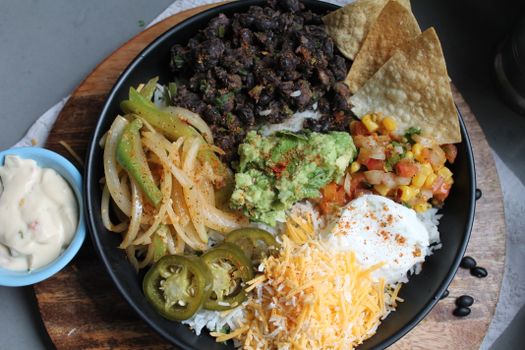
Photo: Nourishment DECODED / Pexels
Mexican
Chicken Burrito Bowl
The diets react (see scores below)
Common Ingredients
- grilled chicken
- cilantro lime rice
- black beans
- salsa
- corn
- cheddar cheese
- sour cream
- guacamole
Specific recipes may vary.
Incompatible with 6 of 11 diets
Diet Ratings
The Chicken Burrito Bowl as described is heavily incompatible with a ketogenic diet. The cilantro lime rice alone contributes roughly 40-50g of net carbs per serving, immediately exceeding or maxing out the daily keto carb limit. Black beans add another 20-25g net carbs, and corn adds approximately 15-20g more. Combined, these three ingredients deliver well over 75-100g of net carbs, making ketosis virtually impossible. While grilled chicken, cheddar cheese, sour cream, guacamole, and salsa are individually keto-friendly, they cannot offset the massive carb load from the rice, beans, and corn. This dish could theoretically be modified into a keto-compliant bowl by eliminating rice, beans, and corn entirely, but as presented it is a clear avoid.
This dish contains multiple animal products that are strictly prohibited on a vegan diet. Grilled chicken is poultry (direct animal flesh), cheddar cheese is a dairy product made from animal milk, and sour cream is a dairy-based ingredient. Any one of these three ingredients alone would disqualify this dish from vegan compliance. The remaining ingredients — cilantro lime rice, black beans, salsa, corn, and guacamole — are fully plant-based and could form the basis of a vegan version if the animal products were removed.
The Chicken Burrito Bowl contains multiple non-paleo ingredients that are clearly excluded under any interpretation of the paleo diet. Cilantro lime rice is a grain and strictly off-limits. Black beans are a legume, also universally excluded. Corn is a grain and excluded. Cheddar cheese and sour cream are dairy products, excluded under all mainstream paleo frameworks. While grilled chicken, salsa, and guacamole are paleo-compliant, the majority of the dish's bulk and character comes from non-paleo foods. This dish cannot be considered paleo in its standard form.
The Chicken Burrito Bowl contains a mix of Mediterranean-compatible and less compatible elements. Grilled chicken is an acceptable lean protein (poultry is moderate in the Mediterranean diet), and black beans, corn, salsa, and guacamole are genuinely plant-forward components that align well with Mediterranean principles — legumes, vegetables, and healthy fats from avocado. The cilantro lime rice is likely white rice, a refined grain that is less preferred but tolerated in moderation by some Mediterranean traditions. The main concerns are cheddar cheese and sour cream: both are dairy products higher in saturated fat than the preferred Mediterranean dairy (yogurt, feta), and sour cream in particular is not a Mediterranean staple. The dish lacks olive oil as the primary fat and is not rooted in Mediterranean cuisine, but it is not inherently unhealthy. Overall it lands in cautious/moderate territory — acceptable occasionally, especially if sour cream and cheddar are minimized.
Some Mediterranean diet interpreters would view the legumes, vegetables, and avocado-based fat as sufficiently plant-forward to rate this more favorably, particularly if white rice is replaced with brown rice and dairy toppings are reduced. Others would note that dairy like cheese and sour cream, while not canonical, are acceptable in small amounts even under strict Mediterranean guidelines.
The Chicken Burrito Bowl is almost entirely incompatible with the carnivore diet. While grilled chicken is an animal product and cheddar cheese and sour cream are dairy (debated but accepted by many practitioners), the dish is dominated by multiple plant-based foods that are strictly excluded: cilantro lime rice (grain), black beans (legume), salsa (plant-based), corn (grain/vegetable), and guacamole (avocado — plant fat). The only potentially carnivore-compatible components are the grilled chicken, cheddar cheese, and sour cream, which together represent a small fraction of the dish. This is fundamentally a plant-heavy meal with animal products as accompaniments, not the other way around.
This dish contains multiple excluded ingredients that make it clearly non-compliant with Whole30. Rice (a grain) is excluded. Black beans (legumes) are excluded — unlike green beans, sugar snap peas, or snow peas, black beans have no exception. Corn is a grain and is excluded. Cheddar cheese is dairy and is excluded. Sour cream is dairy and is excluded. That's five distinct Whole30 violations in a single dish. The grilled chicken, salsa, and guacamole would individually be compliant, but the combination as presented cannot be made Whole30-compatible without fundamentally restructuring the dish.
This dish contains multiple high-FODMAP ingredients that make it unsuitable during the elimination phase. Black beans are very high in GOS (galacto-oligosaccharides) and are high-FODMAP even at small servings — a typical burrito bowl portion (1/2 cup or more) is well above the Monash threshold. Guacamole is problematic because it is typically made in quantities exceeding the safe 1/8 avocado serving (40g), and commercially prepared guacamole often contains onion and garlic, adding fructans. Salsa almost universally contains onion and garlic, both high-FODMAP due to fructans. Sour cream contains lactose and is high-FODMAP at typical serving sizes (over 2 tablespoons). While several components are individually low-FODMAP — grilled chicken (approved), cilantro lime rice (approved if plain rice, caution if lime juice is excessive), canned corn at small portions (low-FODMAP at 1/2 cup), and cheddar cheese (low-lactose, approved) — the combination of black beans, salsa with alliums, excess guacamole, and sour cream creates a dish with multiple significant FODMAP triggers that cannot be easily avoided without fundamentally changing the dish.
The Chicken Burrito Bowl contains a mix of DASH-friendly and DASH-problematic ingredients. On the positive side, grilled chicken is a lean protein, black beans provide fiber, potassium, and plant-based protein, corn and salsa (if fresh) are vegetables, and guacamole supplies heart-healthy monounsaturated fats. However, cheddar cheese and sour cream are full-fat dairy products high in saturated fat and sodium, which DASH explicitly limits in favor of low-fat or fat-free dairy. Cilantro lime rice, if made with white rice, lacks the whole-grain fiber DASH emphasizes. Restaurant-style preparations of this dish can easily exceed 1,000–1,500mg of sodium in a single serving due to seasoned rice, seasoned chicken, salsa, and cheese combined, pushing toward or past the standard DASH sodium limit for the entire day. The dish is salvageable with modifications: swapping cheddar and sour cream for low-fat alternatives, using brown rice, and monitoring sodium in seasoning would substantially improve its DASH compatibility.
NIH DASH guidelines clearly specify low-fat or fat-free dairy and sodium limits under 2,300mg/day, putting cheddar cheese and sour cream in the 'limit' category. However, updated clinical interpretations and emerging research (including meta-analyses in Lancet and EJCN) suggest full-fat dairy may not adversely affect cardiovascular risk markers, leading some DASH-oriented dietitians to allow modest amounts of full-fat dairy, which would improve this dish's rating if guacamole and beans are credited for their strong cardiovascular benefits.
The Chicken Burrito Bowl has genuine Zone-friendly elements but requires significant modification to achieve the 40/30/30 target ratio. Grilled chicken is an excellent lean Zone protein source. Black beans provide both protein and low-glycemic carbohydrate and are favorable in Zone. Salsa is a low-calorie, polyphenol-rich condiment that fits well. Guacamole supplies desirable monounsaturated fat from avocado. However, several ingredients create Zone imbalance: cilantro lime rice is a high-glycemic refined carbohydrate that can quickly overwhelm the carb block allotment; corn is classified as an 'unfavorable' high-glycemic vegetable in Zone methodology; cheddar cheese adds saturated fat and should be minimized; and sour cream adds saturated fat with little protein or carb benefit. As served in a typical restaurant portion, the carbohydrate load (rice + beans + corn) is likely double or triple a Zone-appropriate amount, and the fat profile skews saturated. With deliberate modifications — replacing or drastically reducing rice, eliminating corn, swapping sour cream for a smaller guacamole portion, and limiting cheese — the bowl can approximate Zone ratios. The dish is highly customizable, which is its key advantage.
Some Zone practitioners and Sears' later writings (The Mediterranean Zone) place greater emphasis on polyphenol-rich foods and overall anti-inflammatory quality, potentially giving this bowl more credit for its salsa, guacamole, and black beans. Others note that black beans' fiber significantly reduces net carbs, making the bean-heavy version more Zone-compatible than it first appears. Conversely, strict early-Zone followers would flag the rice and corn combination as making this bowl nearly impossible to balance without a near-complete rebuild.
The Chicken Burrito Bowl is a mixed dish from an anti-inflammatory standpoint. On the positive side, it contains several beneficial components: grilled chicken is a lean protein (preferred over red meat), black beans provide fiber, plant protein, and anti-inflammatory polyphenols, guacamole delivers heart-healthy monounsaturated fats from avocado (a well-recognized anti-inflammatory food), salsa contributes lycopene and antioxidants from tomatoes, and cilantro is a mild anti-inflammatory herb. Corn adds some fiber and carotenoids. The concerns center on cheddar cheese and sour cream — both are full-fat dairy products relatively high in saturated fat, which anti-inflammatory guidelines recommend limiting. The cilantro lime rice, while better than refined white flour options, is typically white rice, which is a refined carbohydrate with limited fiber. Portion size matters considerably here: a bowl heavy on guac and beans with modest cheese and sour cream leans more favorable, while one heavy on full-fat dairy toppings shifts the profile toward caution. Overall, this is a customizable, mostly whole-food dish with real anti-inflammatory highlights, but the full-fat dairy and refined rice prevent an 'approve' rating without modification.
Most anti-inflammatory practitioners would rate this dish as acceptable with modifications (swapping full-fat dairy for smaller portions or omitting sour cream/cheese). However, Autoimmune Protocol (AIP) adherents would flag both corn and full-fat dairy as problematic, and some would caution against nightshade-containing salsa for sensitive individuals. Mainstream anti-inflammatory nutrition (Dr. Weil's pyramid) considers moderate dairy and lean poultry acceptable, supporting the 'caution' rather than 'avoid' classification.
The chicken burrito bowl has a strong nutritional foundation — grilled chicken, black beans, salsa, and corn deliver solid protein (roughly 35-45g depending on portions), meaningful fiber (8-12g from beans, corn, and rice), and good micronutrient density. These components are well-suited for GLP-1 patients. However, the combination of cheddar cheese, sour cream, and guacamole adds a significant saturated and total fat load to a single meal. While guacamole provides heart-healthy unsaturated fats, all three toppings together can push the meal toward the heavy, high-fat profile that worsens GLP-1 side effects — particularly nausea, bloating, and delayed gastric emptying on top of already-slowed digestion. The cilantro lime rice is a refined carbohydrate with modest fiber, adding caloric bulk without strong nutritional return. As assembled with all toppings, this is a caution — not an avoid — because the protein and fiber core is genuinely strong. Modified with reduced or eliminated sour cream and cheese, and a smaller rice portion, this dish moves comfortably into approve territory.
Some GLP-1-focused RDs would approve a burrito bowl outright, arguing that the protein and fiber content is exactly what patients need and that small amounts of cheese, sour cream, and avocado improve satiety and palatability, supporting adherence. Others caution that the combined fat load from multiple high-fat toppings in a single small-portion meal is disproportionate for GLP-1 patients whose slowed gastric emptying makes fat tolerance especially unpredictable.
*See how scores were generated at our methodology page.
Nutritional profile
Six traits that cut across every diet.
Fiber & Plants
How much whole-plant food and fiber it delivers.
Healthy Fats
The quality of its fats (unsaturated, omega-3).
Whole / Unprocessed
How close it is to its natural, unprocessed form.
Gut Gentle
How easy it is on digestion (low FODMAP, few irritants).
Low Glycemic
How little it spikes your blood sugar.
Protein Density
How much protein it packs per calorie.
Controversy Index
Higher controversy = more disagreement between diets.
Diet-Specific Tips
 Mediterranean — 5/10
View tips
- Grilled chicken is acceptable as a moderate poultry protein
- Black beans are an excellent legume source, strongly Mediterranean-compatible
- Guacamole provides healthy monounsaturated fats similar in profile to olive oil
- Cilantro lime rice is likely refined white rice — less preferred than whole grains
- Cheddar cheese and sour cream are high-saturated-fat dairy, not typical Mediterranean choices
- No olive oil as primary fat source
- Salsa and corn add vegetable variety and align with plant-forward principles
- Dish is not Mediterranean in origin, reducing cultural/traditional alignment
 DASH — 5/10
View tips
- Grilled chicken is a DASH-approved lean protein
- Black beans provide fiber, potassium, and plant-based protein — core DASH foods
- Cheddar cheese and sour cream are full-fat dairy, high in saturated fat and sodium — DASH limits these
- Guacamole provides heart-healthy monounsaturated fats, DASH-compatible in moderation
- Cilantro lime rice is likely white rice, lacking whole-grain fiber emphasized by DASH
- Combined sodium content of seasoned components can approach or exceed 2,300mg in a single serving
- Salsa and corn are vegetable-based and DASH-friendly
- Dish is highly modifiable: low-fat dairy swaps and brown rice would raise score to 7–8
 Zone — 5/10
View tips
- Grilled chicken is an ideal lean Zone protein source
- Black beans are a favorable dual protein/carb Zone block ingredient
- Guacamole provides preferred monounsaturated fat
- Cilantro lime rice is a high-glycemic unfavorable carb that dominates the carb block budget
- Corn is classified as an unfavorable high-glycemic vegetable in Zone
- Cheddar cheese and sour cream add saturated fat without Zone benefit
- As served, total carbohydrate load likely exceeds Zone targets by 2-3x
- Dish is highly customizable — reducing rice and corn significantly improves Zone compatibility
 Anti-Inflammatory — 6/10
View tips
- + Grilled lean chicken preferred over red or processed meat
- + Black beans: high fiber, plant protein, anti-inflammatory polyphenols
- + Guacamole/avocado: monounsaturated fats, anti-inflammatory
- + Salsa: lycopene and antioxidants from tomatoes
- - Cheddar cheese and sour cream: full-fat dairy, saturated fat, anti-inflammatory guidelines recommend limiting
- - White rice base: refined carbohydrate, low fiber
- ~ Corn: mild anti-inflammatory antioxidants (lutein, zeaxanthin) but AIP protocols exclude it
- ~ Dish is highly customizable — portion ratios significantly affect inflammatory profile
 GLP-1 Friendly — 6/10
View tips
- Strong protein base from grilled chicken and black beans — approximately 35-45g per full serving
- Good fiber contribution from black beans and corn, supporting GLP-1 digestion concerns
- Cheddar cheese and sour cream add saturated fat, increasing GI side effect risk
- Guacamole adds healthy unsaturated fat but contributes to overall fat load when combined with other high-fat toppings
- Cilantro lime rice is a refined carbohydrate — lower fiber density than whole grain alternatives
- Salsa is a net positive: low calorie, high water content, flavorful in small portions
- Dish is highly modifiable — removing or reducing sour cream and cheese significantly improves the GLP-1 profile
- Portion sensitivity is high: a full restaurant-sized bowl may exceed comfortable stomach capacity for GLP-1 patients