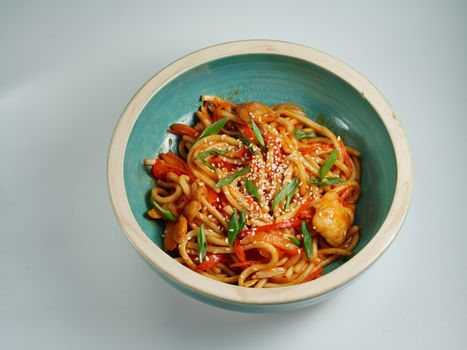
Chinese
Chicken Chow Mein
The diets react (see scores below)
Common Ingredients
- chow mein noodles
- chicken breast
- cabbage
- carrots
- bean sprouts
- soy sauce
- oyster sauce
- sesame oil
Specific recipes may vary.
Incompatible with 6 of 11 diets
Diet Ratings
Chicken Chow Mein is fundamentally incompatible with a ketogenic diet. The primary ingredient — chow mein noodles — are wheat-based and deliver an enormous carbohydrate load, easily exceeding the entire daily net carb allowance (20-50g) in a single serving. Oyster sauce also contains added sugars and starch. Carrots add modest additional carbs. While chicken, cabbage, bean sprouts, soy sauce, and sesame oil are relatively keto-friendly components, the noodles alone make this dish a clear 'avoid' with no realistic portion size that would keep net carbs within keto limits.
Chicken Chow Mein contains multiple animal-derived ingredients that make it incompatible with a vegan diet. Chicken breast is direct animal flesh, oyster sauce is derived from oysters (shellfish), and the chow mein noodles may contain eggs depending on the variety. Any one of these ingredients alone would disqualify the dish; together they represent a clear and unambiguous non-vegan meal with no meaningful debate within the vegan community.
Chicken Chow Mein is fundamentally incompatible with the Paleo diet. The dish is built on chow mein noodles, which are wheat-based grain products — one of the clearest exclusions in all paleo frameworks. Beyond the noodles, soy sauce is a fermented soy product (a legume) and typically contains wheat, making it doubly non-paleo. Oyster sauce is a processed condiment containing added sugar, salt, and thickeners. Sesame oil is a seed oil, explicitly excluded under paleo guidelines. While chicken breast, cabbage, carrots, and bean sprouts are paleo-friendly ingredients, the foundational components of this dish — grains, soy, processed sauces, and seed oil — place it firmly in the avoid category. There is no meaningful way to rehabilitate this dish without replacing most of its defining ingredients.
Chicken Chow Mein contains several elements that conflict with Mediterranean diet principles. The chow mein noodles are refined wheat noodles, not whole grain. Soy sauce and oyster sauce are highly processed condiments with significant sodium, not part of the Mediterranean tradition. Sesame oil, while a plant-based fat, is not olive oil and is not a Mediterranean staple. The chicken breast is a lean protein acceptable in moderation, and the vegetables (cabbage, carrots, bean sprouts) are positive elements. However, the overall dish profile — refined noodles, processed sauces, non-Mediterranean fat sources, and a cuisine framework entirely outside Mediterranean tradition — keeps this from being more than a marginal fit. The vegetable content prevents a full 'avoid' rating, but the refined grains and processed sauces are meaningful negatives.
Chicken Chow Mein is fundamentally incompatible with the carnivore diet. The dish is built around chow mein noodles (grain-based, wheat flour), which are a plant-derived, processed carbohydrate — entirely excluded. The remaining ingredients compound the violation: cabbage, carrots, and bean sprouts are all plant foods; soy sauce is fermented soy (legume-derived) with additives; oyster sauce contains sugar and starch fillers; and sesame oil is a plant-derived oil. The only carnivore-compatible component is the chicken breast itself, which represents a small fraction of the dish. This is essentially a plant and grain dish with chicken as a secondary ingredient, making it a clear avoid with high confidence across all carnivore camps.
Chicken Chow Mein contains multiple Whole30-excluded ingredients. Chow mein noodles are made from wheat flour, a grain that is explicitly excluded from the Whole30 program. Soy sauce contains soy (a legume) and wheat (a grain), both excluded. Oyster sauce typically contains sugar and often starch-based thickeners. These are not minor or debatable issues — grains and soy are core exclusions of the Whole30 program. Even if compliant substitutes existed for the sauces (e.g., coconut aminos instead of soy sauce), the chow mein noodles themselves make this dish fundamentally incompatible and unreformable under the Whole30 framework without a complete departure from the dish's identity.
Chicken Chow Mein as described contains multiple high-FODMAP ingredients that make it unsuitable during the elimination phase. The primary concern is chow mein noodles, which are typically made from wheat flour — a significant source of fructans (a key FODMAP). Wheat-based noodles are clearly high-FODMAP per Monash University. Oyster sauce typically contains wheat and often garlic/onion extracts, adding further fructan load. Standard soy sauce also contains wheat (tamari is the low-FODMAP alternative). While chicken breast, carrots, bean sprouts, sesame oil, and small amounts of cabbage are low-FODMAP, the noodle and sauce components are sufficient to classify this dish as high-FODMAP overall. The dish would require significant substitutions — rice noodles or 100% buckwheat noodles, tamari instead of soy sauce, and a certified gluten-free/onion-garlic-free oyster sauce or omission — to be considered during elimination.
Chicken Chow Mein contains several DASH-friendly components — lean chicken breast, cabbage, carrots, and bean sprouts all align well with DASH principles. However, the dish as commonly prepared is high in sodium due to soy sauce and oyster sauce, which together can contribute 800–1,500mg of sodium per serving, a substantial portion of even the standard DASH daily limit of 2,300mg. Refined chow mein noodles lack the fiber benefit of whole grains. Sesame oil is unsaturated and acceptable in small amounts. The vegetable content is a positive, but the sodium burden from the sauces makes this dish problematic for DASH compliance without significant modification.
Chicken Chow Mein has a fundamentally workable Zone profile that is disrupted primarily by the chow mein noodles. The dish features lean chicken breast (an ideal Zone protein), and several favorable low-glycemic vegetables — cabbage, carrots, and bean sprouts — all of which are Zone-friendly carb sources. However, chow mein noodles are refined wheat noodles with a moderately high glycemic index, making them an 'unfavorable' carbohydrate in Zone terminology. They will dominate the carb blocks and spike insulin more than desired. Sesame oil is omega-6-heavy and not the preferred monounsaturated fat source (olive oil or avocado would be better), though the quantity used is typically small. Soy sauce and oyster sauce add sodium and minor sugars but are used in condiment quantities that don't meaningfully shift macros. With careful portioning — reducing noodle volume significantly, emphasizing the vegetables, keeping chicken portions at roughly 3 oz (1 Zone block equivalent of ~21g protein per serving), and limiting sesame oil — this dish can be made Zone-compatible. Restaurant or takeout versions almost certainly use excess noodles and oil, making them harder to balance. Home-prepared with noodle reduction is much more manageable.
Chicken Chow Mein presents a mixed anti-inflammatory profile. On the positive side, it features lean chicken breast (a 'moderate' protein), colorful vegetables including cabbage, carrots, and bean sprouts (sources of antioxidants and fiber), and sesame oil (contains sesamin and sesamol, antioxidant lignans with modest anti-inflammatory properties). The vegetable load contributes meaningful phytonutrients. However, the dish has notable drawbacks: chow mein noodles are refined carbohydrates with a high glycemic index, which can trigger inflammatory responses via blood sugar spikes. Soy sauce and oyster sauce contribute significant sodium, and oyster sauce often contains added sugar and preservatives. The overall dish is not heavily processed in its home-cooked form, but the refined noodle base and high-sodium condiments prevent it from being anti-inflammatory-positive. Sesame oil is generally favorable in small amounts but is relatively high in omega-6 fatty acids compared to olive oil. The dish is balanced enough to be acceptable occasionally but is not optimized for anti-inflammatory eating — swapping refined noodles for soba (buckwheat) or rice noodles and using low-sodium tamari would improve the profile considerably.
Some anti-inflammatory practitioners would rate this more favorably given its substantial vegetable content and lean protein, arguing the overall food matrix matters more than individual ingredients like refined noodles in a single meal. Conversely, stricter interpretations — such as those aligned with AIP or low-glycemic anti-inflammatory protocols — would flag the refined noodles and high-sodium sauces more harshly and push this toward an 'avoid' rating.
Chicken chow mein offers a reasonable protein source from lean chicken breast and a variety of vegetables (cabbage, carrots, bean sprouts) that contribute fiber and micronutrients. However, the chow mein noodles are refined carbohydrates with low fiber and moderate glycemic impact, and the combination of oyster sauce and soy sauce adds significant sodium. Sesame oil, while an unsaturated fat, increases the overall fat content of the dish. The noodle-heavy nature of traditional chow mein means protein and fiber density per calorie is lower than ideal for GLP-1 patients — a standard restaurant or home serving is often noodle-dominant with a modest protein portion. It is not fried and contains beneficial vegetables, keeping it out of the avoid category, but the refined noodle base and sodium load are meaningful drawbacks. Portion control is especially important here: a small, protein-forward serving with extra vegetables and reduced noodles is significantly better than a standard serving.
Some GLP-1-focused dietitians view dishes like chow mein favorably because the mixed vegetable content and lean protein make it one of the more nutritious takeout options available, and the sodium concern is secondary to overall food quality for most patients. Others caution that refined noodle dishes raise blood sugar quickly and displace higher-priority protein and fiber calories in an already reduced appetite window, making whole-grain or legume-based alternatives strongly preferable.
*See how scores were generated at our methodology page.
Nutritional profile
Six traits that cut across every diet.
Fiber & Plants
How much whole-plant food and fiber it delivers.
Healthy Fats
The quality of its fats (unsaturated, omega-3).
Whole / Unprocessed
How close it is to its natural, unprocessed form.
Gut Gentle
How easy it is on digestion (low FODMAP, few irritants).
Low Glycemic
How little it spikes your blood sugar.
Protein Density
How much protein it packs per calorie.
Controversy Index
Higher controversy = more disagreement between diets.
Diet-Specific Tips
 Mediterranean — 4/10
View tips
- Chow mein noodles are refined grains, not whole grain — contradicts Mediterranean grain guidance
- Soy sauce and oyster sauce are highly processed, high-sodium condiments not aligned with Mediterranean principles
- Sesame oil is not extra virgin olive oil; Mediterranean diet specifies olive oil as the primary fat
- Chicken breast is an acceptable lean protein in moderation
- Vegetables (cabbage, carrots, bean sprouts) are positive Mediterranean-compatible ingredients
- Dish is rooted in Chinese cuisine with no traditional overlap with Mediterranean dietary patterns
 DASH — 4/10
View tips
- High sodium from soy sauce and oyster sauce — potentially 800–1,500mg per serving
- Lean chicken breast is an approved DASH protein source
- Cabbage, carrots, and bean sprouts are DASH-approved vegetables
- Refined chow mein noodles are not whole grain — lower fiber value
- Sesame oil is an unsaturated fat, acceptable in moderation
- Low-sodium soy sauce and reduced oyster sauce would meaningfully improve the DASH score
- Portion control and sauce reduction are key to making this dish more DASH-compatible
 Zone — 5/10
View tips
- Refined chow mein noodles are an unfavorable high-glycemic carbohydrate that skews the carb block ratio
- Chicken breast is an ideal lean Zone protein source
- Cabbage, bean sprouts, and carrots are favorable low-glycemic Zone vegetables
- Sesame oil is omega-6 dominant, less preferred than monounsaturated fats like olive oil
- Dish is salvageable with significant noodle reduction and increased vegetable proportion
- Sodium load from soy sauce and oyster sauce is a secondary concern, not a Zone disqualifier
- Restaurant portions almost certainly over-deliver noodles and fat relative to Zone targets
 Anti-Inflammatory — 5/10
View tips
- Refined chow mein noodles raise glycemic load and can promote inflammatory response
- Lean chicken breast is an acceptable moderate protein
- Cabbage, carrots, and bean sprouts contribute antioxidants and fiber
- Soy sauce and oyster sauce add high sodium and potential additives/sugar
- Sesame oil has antioxidant lignans but is higher in omega-6 than preferred fats like EVOO
- No omega-3 sources present; anti-inflammatory potential is limited by noodle base
 GLP-1 Friendly — 5/10
View tips
- Lean chicken breast provides good protein but total protein per serving depends heavily on chicken-to-noodle ratio
- Chow mein noodles are refined carbohydrates with low fiber, reducing nutrient density per calorie
- Cabbage, carrots, and bean sprouts contribute fiber and micronutrients — a genuine positive
- Sesame oil and oyster sauce add fat and high sodium, which may worsen GLP-1 GI side effects
- Dish is not fried, which keeps fat content more moderate than many Chinese-American takeout options
- Portion-sensitive: a noodle-dominant serving scores lower; a vegetable- and protein-dominant serving scores higher
- High sodium content may contribute to water retention and should be noted for patients monitoring blood pressure