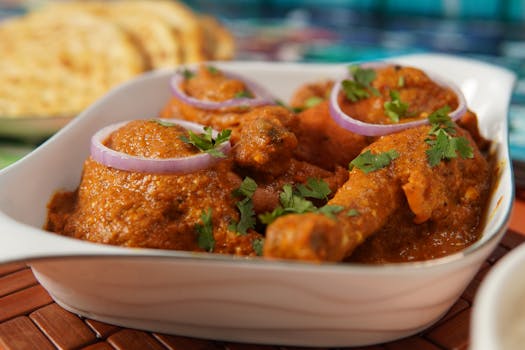
Photo: Mian Shahbaz Anjum / Pexels
Indian
Chicken Do Pyaza
The diets react (see scores below)
Common Ingredients
- chicken
- yellow onions
- tomatoes
- ginger
- garlic
- garam masala
- yogurt
- cilantro
Specific recipes may vary.
Incompatible with 5 of 11 diets
Diet Ratings
Chicken Do Pyaza ('do pyaza' meaning double onions) is a protein-forward Indian dish that is generally keto-friendly in concept, but the notably high quantity of onions is the primary concern. Onions contain roughly 7-8g net carbs per 100g, and a traditional Do Pyaza recipe uses a large volume — often 2-3 large onions per serving of chicken — which can push net carbs to 15-25g from onions alone. Tomatoes add another 3-4g net carbs. Yogurt contributes minimal carbs in small amounts. Chicken is an ideal keto protein. Ginger, garlic, garam masala, and cilantro add negligible carbs in typical quantities. The dish can fit keto with strict portion control and reduced onion quantity, but as traditionally prepared with the characteristic double-onion loading, it risks approaching or exceeding the lower daily carb threshold in a single serving.
Strict keto practitioners argue that the cumulative onion and tomato load makes this dish too carb-heavy without significant recipe modification, and that it should be avoided rather than cautiously consumed. Lazy keto followers, however, often allow it freely, trusting that the high protein and fat from chicken keep overall macros manageable.
Chicken Do Pyaza contains two unambiguously non-vegan ingredients: chicken (poultry, a direct animal product) and yogurt (a dairy product derived from animal milk). Both are categorically excluded under any definition of veganism. There is no version of this dish that could be considered vegan without a complete reformulation replacing both the chicken and the yogurt with plant-based alternatives.
Chicken Do Pyaza is disqualified primarily by yogurt, which is a dairy product explicitly excluded from the paleo diet. The remaining ingredients — chicken, yellow onions, tomatoes, ginger, garlic, garam masala (a spice blend), and cilantro — are all paleo-compliant. However, yogurt is a core component of this dish, not an optional garnish; it forms the marinade and sauce base. Removing it would fundamentally alter the dish. Because dairy is a clear paleo exclusion with high consensus, the dish as described cannot be approved.
Chicken Do Pyaza is a poultry-based dish, and chicken falls into the 'moderate' category of Mediterranean diet foods — acceptable a few times per week but not a daily staple. The dish's supporting ingredients are largely Mediterranean-friendly: onions, tomatoes, garlic, ginger, and yogurt are all whole, minimally processed foods aligned with the diet's plant-forward principles. Cilantro and spices like garam masala add flavor without concern. The main caveats are the Indian spice profile (not traditional Mediterranean) and the yogurt marinade, which is fine in moderation. No red meat, no refined grains, no added sugars, and no highly processed ingredients are present, which keeps this from falling into 'avoid' territory. Overall, this is a reasonable occasional meal if prepared with olive oil or a minimal amount of neutral fat.
Some Mediterranean diet practitioners, particularly those following a stricter traditional Greek or Italian framework, would note that poultry dishes should be kept to once or twice weekly and that the heavy spice profile and yogurt base are non-traditional; however, modern clinical interpretations of the Mediterranean diet focus on nutrient composition over regional authenticity, making this dish broadly acceptable in moderation.
Chicken Do Pyaza is fundamentally incompatible with the carnivore diet. While chicken itself is an acceptable animal protein, the dish is built around multiple plant-based ingredients that are strictly excluded: yellow onions and tomatoes form the entire sauce base, ginger and garlic are plant-derived aromatics, garam masala is a blend of plant spices, cilantro is an herb, and even the yogurt (while animal-derived) is used in a context saturated with plant compounds. The overwhelming majority of the dish's flavor, volume, and nutritional profile comes from excluded plant foods. This is not a borderline case — it is a quintessential plant-heavy curry that happens to contain chicken.
Chicken Do Pyaza contains yogurt, which is a dairy product explicitly excluded on the Whole30 program. Yogurt is specifically listed as a prohibited dairy item. All other ingredients — chicken, yellow onions, tomatoes, ginger, garlic, garam masala, and cilantro — are fully Whole30-compliant. However, the presence of yogurt (commonly used as a marinade or sauce base in this dish) disqualifies it as written. To make this dish Whole30-compliant, the yogurt would need to be omitted or substituted with a compliant alternative such as coconut cream or coconut milk.
Chicken Do Pyaza is fundamentally built around large quantities of onions — the name 'Do Pyaza' literally means 'double onions,' referring to onions being added at two stages of cooking. Onions are one of the highest-FODMAP foods due to fructans and are not safe at any meaningful quantity during the elimination phase. Garlic is also a high-FODMAP ingredient rich in fructans and is unsafe at any serving size. Yogurt contains lactose and is high-FODMAP unless lactose-free. The combination of double onions, garlic, and yogurt makes this dish incompatible with the FODMAP elimination phase. Chicken, tomatoes (in small amounts), ginger, garam masala, and cilantro are individually low-FODMAP, but the core defining ingredients of this dish are high-FODMAP offenders that cannot be omitted without fundamentally changing the dish.
Chicken Do Pyaza is well-aligned with DASH diet principles. The dish features lean protein (chicken), DASH-emphasized vegetables (onions, tomatoes, garlic, ginger), and yogurt (a low-fat dairy source if plain/low-fat yogurt is used). The spice blend (garam masala, cilantro) adds flavor without sodium if no added salt is used, supporting the DASH strategy of using herbs and spices to reduce sodium reliance. Onions and tomatoes contribute potassium, magnesium, and fiber. The dish contains no red meat, no tropical oils, no added sugars, and no heavy saturated fats in its base form. Sodium content depends heavily on preparation — home-cooked versions with minimal added salt are DASH-compatible, while restaurant versions may carry higher sodium. Yogurt type matters: low-fat or fat-free yogurt is preferred over full-fat per standard DASH guidelines.
NIH DASH guidelines specify low-fat or fat-free dairy, so use of full-fat yogurt would technically reduce DASH compatibility; however, updated clinical interpretations increasingly accept full-fat yogurt given emerging evidence that full-fat dairy does not adversely affect cardiovascular outcomes, suggesting this dish remains broadly acceptable regardless of yogurt fat content.
Chicken Do Pyaza is an excellent Zone Diet candidate. The dish centers on skinless chicken (lean protein, ideal Zone building block), double the onions ('do pyaza' means double onions), tomatoes, ginger, garlic, yogurt, and aromatic spices. All carbohydrate sources — onions, tomatoes, ginger, garlic — are low-glycemic vegetables and flavorings that Zone explicitly favors. Yogurt contributes modest protein and a small amount of fat. Garam masala and anti-inflammatory spices like ginger and garlic align with Sears' polyphenol and anti-inflammatory emphasis. The dish contains no high-glycemic carbs, no refined grains, no added sugars, and no seed oils. Fat content is naturally low, making it easy to add a small amount of monounsaturated fat (e.g., a drizzle of olive oil for cooking) to hit the 30% fat target. With appropriate portioning — roughly 85-100g chicken, a generous vegetable base, and minimal added fat — this dish slots cleanly into a 3-block Zone meal. The only consideration is that yogurt adds a small saturated fat contribution, but this is negligible in typical quantities.
Chicken Do Pyaza is a well-composed anti-inflammatory dish. Lean chicken provides a moderate protein source that falls squarely in the 'acceptable' category per anti-inflammatory guidelines. The defining feature of Do Pyaza — a double dose of onions (cooked and added again later) — is a significant asset: onions are rich in quercetin, a potent flavonoid with well-documented anti-inflammatory and antioxidant properties. Tomatoes contribute lycopene and vitamin C. Ginger and garlic are both strongly emphasized in anti-inflammatory frameworks (gingerols and allicin respectively reduce pro-inflammatory cytokines). Garam masala typically contains turmeric, cumin, coriander, cardamom, black pepper, and cloves — all anti-inflammatory spices; black pepper also enhances curcumin bioavailability. Yogurt provides probiotics that support gut health, a key pillar of reducing systemic inflammation, though it is a low-fat dairy product warranting moderate use. Cilantro adds modest antioxidant value. The dish contains no refined carbohydrates, added sugars, trans fats, or seed oils. The main limiting factor is the lean-protein classification of chicken (rather than omega-3-rich fish) and full-fat yogurt if used, which places it in the solid-approve rather than top-tier range.
Chicken Do Pyaza is a strong GLP-1-friendly dish. Lean chicken provides high-quality protein (roughly 25-30g per serving depending on portion size), directly supporting the top dietary priority of muscle preservation during weight loss. The dish is built around a double dose of onions (the 'do pyaza' concept), which adds meaningful fiber and prebiotic benefit. Tomatoes, ginger, and garlic contribute additional micronutrients and anti-inflammatory compounds with minimal caloric cost. Yogurt adds a small protein boost and supports digestibility. Garam masala is a moderate spice blend — aromatic rather than acutely hot — and is generally well tolerated. The overall fat profile is lean, assuming the dish is prepared without heavy oil or cream additions, which is typical of the base recipe. Easy to portion in small servings, nutrient-dense per calorie, and highly satisfying in modest amounts. The main watch point is preparation method: restaurant versions may add butter, cream, or excess oil that would shift this toward caution.
Some GLP-1 clinicians flag that warm spiced dishes can occasionally trigger nausea or reflux in patients who are GI-sensitive, particularly early in treatment or around dose escalation days. Individual tolerance to garam masala and garlic varies, and a minority of patients report that allium-heavy dishes (onion, garlic) worsen bloating due to slowed gastric emptying interacting with fermentable compounds.
*See how scores were generated at our methodology page.
Nutritional profile
Six traits that cut across every diet.
Fiber & Plants
How much whole-plant food and fiber it delivers.
Healthy Fats
The quality of its fats (unsaturated, omega-3).
Whole / Unprocessed
How close it is to its natural, unprocessed form.
Gut Gentle
How easy it is on digestion (low FODMAP, few irritants).
Low Glycemic
How little it spikes your blood sugar.
Protein Density
How much protein it packs per calorie.
Controversy Index
Higher controversy = more disagreement between diets.
Diet-Specific Tips
 Keto — 5/10
View tips
- High double-onion quantity is the defining carb risk — potentially 15-25g net carbs per serving from onions alone
- Tomatoes add 3-4g additional net carbs
- Yogurt is low-carb in small amounts but some strict protocols flag it for insulin response
- Chicken provides excellent keto-compatible protein with no carbs
- Spices (garam masala, ginger, garlic, cilantro) are negligible in carb terms
- Dish can be made keto-compatible by reducing onion volume by 50% or more
- No added sugars, grains, or starches in the base recipe
 Mediterranean — 5/10
View tips
- Chicken is a moderate-consumption protein in the Mediterranean diet — acceptable but not a daily staple
- Onions, tomatoes, garlic, and ginger are whole plant foods strongly aligned with Mediterranean principles
- Yogurt is a permitted dairy component in moderation
- No red meat, refined grains, added sugars, or highly processed ingredients
- Indian spice profile and cooking tradition are non-Mediterranean but nutritionally compatible
- Dish compatibility depends on cooking fat used — olive oil would be preferred
 DASH — 8/10
View tips
- Lean chicken protein strongly aligns with DASH lean protein guidelines
- Double onion base and tomatoes provide potassium, magnesium, and fiber
- No red meat, tropical oils, or added sugars
- Low-fat yogurt preferred over full-fat per standard DASH dairy guidelines
- Sodium level is preparation-dependent — home-cooked with minimal salt is DASH-friendly; restaurant versions may be higher
- Garam masala and aromatics support DASH herb/spice-over-salt flavoring strategy
 Zone — 8/10
View tips
- Lean chicken protein is a cornerstone Zone-favorable protein source
- Double onions and tomatoes provide low-glycemic, polyphenol-rich carbohydrates
- Ginger and garlic are anti-inflammatory — aligns with Sears' omega-3/polyphenol focus
- Yogurt contributes protein and modest fat; minimal saturated fat concern
- No refined carbohydrates, added sugars, or high-glycemic ingredients
- Naturally low in fat — easy to calibrate with a small amount of monounsaturated cooking oil
- Spices add flavor with negligible macro impact, no Zone concerns
 Anti-Inflammatory — 8/10
View tips
- Double-dose onions high in quercetin — a well-researched anti-inflammatory flavonoid
- Garlic and ginger are emphasized anti-inflammatory ingredients with strong research support
- Garam masala delivers turmeric, cumin, cardamom, and cloves — all anti-inflammatory spices
- Tomatoes provide lycopene and vitamin C
- Yogurt offers probiotic benefit; low-fat versions align better with anti-inflammatory guidelines
- Lean chicken is an acceptable moderate protein — not pro-inflammatory but not omega-3-rich
- No refined carbs, added sugars, trans fats, or problematic seed oils
 GLP-1 Friendly — 8/10
View tips
- High lean protein from chicken supports muscle preservation
- Double onion base adds significant fiber and prebiotic value
- Yogurt contributes additional protein and aids digestibility
- Garam masala is aromatic rather than acutely spicy — generally GLP-1 tolerable
- Low fat in standard home preparation
- Nutrient-dense per calorie with minimal empty calories
- Portion-friendly — satisfying in small servings
- Watch for restaurant versions with added cream, butter, or excess oil