Photo: Talha Kuğu / Pexels
Mexican
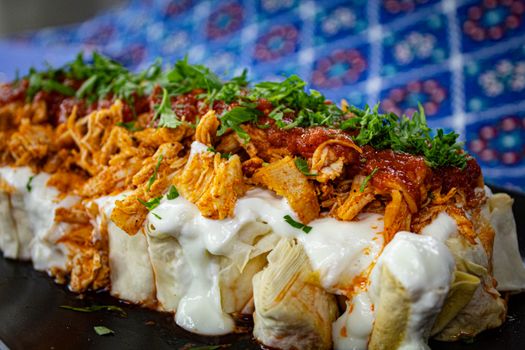
Chicken Enchiladas
The diets react (see scores below)
Common Ingredients
- corn tortillas
- shredded chicken
- red enchilada sauce
- Monterey Jack
- onion
- cumin
- garlic
- sour cream
Specific recipes may vary.
Incompatible with 6 of 11 diets
Diet Ratings
Chicken enchiladas are fundamentally incompatible with a ketogenic diet. Corn tortillas are the primary disqualifier — a single corn tortilla contains approximately 12-15g net carbs, and a standard serving of 2-3 enchiladas would deliver 24-45g net carbs from tortillas alone, potentially maxing out or exceeding the entire daily keto carb allowance before accounting for any other ingredients. Red enchilada sauce typically contains added sugars and thickeners that add further carbs. While the shredded chicken, Monterey Jack, sour cream, and spices are keto-friendly, the structural foundation of this dish (corn tortillas + enchilada sauce) makes it unsuitable for ketosis without complete reconstruction.
Chicken Enchiladas contain multiple animal products that are categorically excluded from a vegan diet. Shredded chicken is animal flesh, Monterey Jack is a dairy-based cheese, and sour cream is a dairy product. These are not trace contaminants or processing aids — they are primary, intentional ingredients. There is no vegan interpretation of this dish as described.
Chicken Enchiladas contain multiple non-paleo ingredients that disqualify the dish entirely. Corn tortillas are a grain product and strictly excluded from all paleo frameworks. Monterey Jack cheese and sour cream are dairy, both excluded under standard paleo rules. Red enchilada sauce typically contains added salt, preservatives, and often additional non-paleo additives. The shredded chicken, onion, cumin, and garlic are paleo-compliant, but the structural and core components of this dish — tortillas, cheese, sour cream, and processed sauce — make it fundamentally incompatible with a paleo diet.
Chicken enchiladas sit at the boundary of Mediterranean diet compatibility. The dish has some redeeming elements — chicken (acceptable poultry), corn tortillas (a whole grain, though not a Mediterranean staple), onion, garlic, and cumin (aromatic vegetables and spices that align well). However, the combination of Monterey Jack cheese and sour cream adds significant saturated fat from dairy, pushing beyond moderate dairy use. The red enchilada sauce can be vegetable-forward and spiced, which is a mild positive. The overall dish is not Mediterranean in tradition or construction, and the dairy-heavy profile combined with refined/processed sauce ingredients make it a moderate-concern item rather than something to build a Mediterranean eating pattern around. Occasional consumption is acceptable, but it should not be a regular feature.
Some Mediterranean diet interpreters apply flexible 'Mediterranean-style eating' principles that emphasize the positive components — lean poultry, whole-grain corn tortillas, plant-based aromatics — and would argue that a lighter version with reduced cheese and no sour cream could fit into a broadly Mediterranean-inspired pattern. Traditional Mediterranean cuisines do incorporate dairy and poultry in moderate amounts, and the dish's core protein and grain components are not inherently problematic.
Chicken Enchiladas are fundamentally incompatible with the carnivore diet. The dish is built on corn tortillas — a grain-based plant food that is entirely excluded. The red enchilada sauce contains plant-based ingredients (tomatoes, chili peppers, and other vegetables). Onion, garlic, and cumin are all plant-derived foods (vegetable and spices) that are excluded. While the shredded chicken, Monterey Jack, and sour cream are animal-derived, they are minor components of a dish whose core structure is plant-based. No amount of modification short of a complete reconstruction would make this dish carnivore-compatible.
Chicken Enchiladas contain multiple Whole30-excluded ingredients. Corn tortillas are made from corn, which is a grain explicitly excluded from the Whole30 program. Additionally, Monterey Jack cheese and sour cream are both dairy products, which are also explicitly excluded. Even setting aside the dairy violations, corn tortillas fall under the 'no recreating baked goods/junk food' rule — wraps and tortillas are specifically called out as prohibited even when made with compliant ingredients. The red enchilada sauce may also contain added sugar, corn starch, or other non-compliant additives. This dish is incompatible with Whole30 in its traditional form.
This dish contains multiple high-FODMAP ingredients that make it unsuitable during the elimination phase. Garlic and onion are among the highest-FODMAP foods tested by Monash University, both containing significant fructans even in small amounts. These two ingredients alone are disqualifying for elimination phase. The red enchilada sauce almost certainly contains garlic and onion as base ingredients, compounding the problem. Sour cream is high in lactose and problematic at standard serving sizes. Monterey Jack cheese is lower in lactose than soft cheeses and may be tolerable in small amounts, but the combination of offenders here is severe. The corn tortillas and shredded chicken are themselves low-FODMAP and safe, but they cannot redeem a dish built around fructan-heavy aromatics and a lactose-containing dairy component.
Chicken enchiladas contain several DASH-friendly components — lean shredded chicken, corn tortillas (whole grain), onion, garlic, and cumin — but are offset by notable DASH concerns. Red enchilada sauce is typically high in sodium (canned versions commonly contain 300–500mg per serving), Monterey Jack cheese adds saturated fat and sodium, and sour cream is a full-fat dairy product that DASH guidelines recommend limiting. The cumulative sodium from sauce, cheese, and sour cream in a standard restaurant or home preparation likely pushes a serving well above DASH-friendly thresholds. The dish is not categorically off-limits but requires significant modification — reduced-sodium enchilada sauce, reduced cheese quantity, and swapping sour cream for low-fat Greek yogurt — to align with DASH principles. As commonly consumed, it warrants caution rather than approval.
NIH DASH guidelines emphasize limiting sodium, saturated fat, and full-fat dairy, which standard chicken enchiladas clearly challenge. However, some DASH-oriented dietitians note that a homemade version with low-sodium sauce, reduced cheese, and lean chicken can fit within DASH daily targets, and recent evidence has softened strict limits on full-fat dairy — meaning a carefully prepared version could arguably edge toward acceptable in a DASH-conscious meal plan.
Chicken enchiladas have a favorable protein base (shredded chicken is a classic lean Zone protein) and beneficial aromatics (onion, garlic), but the dish as typically prepared creates Zone imbalances. Corn tortillas are a higher-glycemic, grain-based carbohydrate that Sears classifies as 'unfavorable' — they spike insulin more than vegetable carbs and dominate the carb block count quickly (one 6-inch corn tortilla ≈ 12g net carbs, roughly 1.3 carb blocks). A standard two-enchilada serving easily delivers 3-4 carb blocks from tortillas alone, crowding out room for favorable low-GI vegetable carbs. The Monterey Jack cheese and sour cream add saturated fat beyond the Zone's preferred monounsaturated fat profile, and the fat blocks can become disproportionate. Red enchilada sauce is generally acceptable (tomato-based, moderate glycemic impact). The dish is not a Zone wreck — the protein anchor is solid — but achieving the 40/30/30 ratio requires significant modification: reducing tortilla quantity to one small tortilla, increasing lean chicken proportion, adding vegetable sides, swapping sour cream for guacamole to shift fat toward monounsaturated, and using reduced-fat cheese. With careful portioning and modifications it can fit a Zone meal, hence caution rather than avoid.
Chicken enchiladas present a mixed anti-inflammatory profile. On the positive side, corn tortillas are a whole grain with reasonable fiber content and lower glycemic impact than refined flour tortillas. Shredded chicken (lean protein) is in the 'moderate' category of anti-inflammatory eating. Garlic, cumin, and onion all carry meaningful anti-inflammatory polyphenols and sulfur compounds. Red enchilada sauce typically contains chili peppers and tomatoes, both rich in antioxidants (capsaicin, lycopene). The negatives: Monterey Jack is a full-fat cheese, placing it in the 'limit' category due to saturated fat content. Sour cream is full-fat dairy, also in the 'limit' zone. The combination of these two dairy ingredients pushes the dish toward the moderate-to-cautionary range. The overall dish is not aggressively inflammatory — no refined flour tortillas, no processed meat, no trans fats, no added sugar — but the saturated fat load from cheese and sour cream, and the uncertainty around the enchilada sauce (commercial versions may contain additives, seed oils, or excess sodium), keep this firmly in the caution zone. A modified version using reduced-fat dairy or a cashew-based substitute, and homemade sauce, would score higher.
Some anti-inflammatory practitioners, particularly those following stricter protocols like AIP or low-lectin approaches (e.g., Dr. Steven Gundry), would flag corn tortillas as problematic due to lectin content in corn, and would also flag nightshade-based enchilada sauce (tomatoes, chili peppers). Mainstream anti-inflammatory guidance including Dr. Weil's framework, however, embraces colorful vegetables and peppers as antioxidant-rich and considers corn in whole form acceptable.
Chicken enchiladas have a solid protein foundation from shredded chicken, but several ingredients introduce meaningful drawbacks for GLP-1 patients. Monterey Jack cheese and sour cream add notable saturated fat, which can worsen nausea, reflux, and bloating — the most common GLP-1 side effects. Red enchilada sauce is generally tomato-based and acceptable, though commercial versions can be high in sodium. Corn tortillas are a reasonable whole-grain-adjacent carb with modest fiber and are easier to digest than flour tortillas. Cumin, garlic, and onion are nutritionally fine in standard amounts. The dish can work for GLP-1 patients if portion-controlled (1-2 enchiladas), cheese is reduced or swapped for a lower-fat option, and sour cream is used sparingly or replaced with plain Greek yogurt. As typically prepared in a restaurant or from a standard recipe, the fat load is high enough to risk GI side effects.
Some GLP-1-focused dietitians view a modest portion of chicken enchiladas as a practical, culturally appropriate meal that delivers meaningful protein and can be modified easily; others flag the combined saturated fat from cheese and sour cream as a reliable trigger for delayed gastric emptying symptoms and recommend avoiding the dish until GI tolerance is well established.
*See how scores were generated at our methodology page.
Nutritional profile
Six traits that cut across every diet.
Fiber & Plants
How much whole-plant food and fiber it delivers.
Healthy Fats
The quality of its fats (unsaturated, omega-3).
Whole / Unprocessed
How close it is to its natural, unprocessed form.
Gut Gentle
How easy it is on digestion (low FODMAP, few irritants).
Low Glycemic
How little it spikes your blood sugar.
Protein Density
How much protein it packs per calorie.
Controversy Index
Higher controversy = more disagreement between diets.
Diet-Specific Tips
 Mediterranean — 4/10
View tips
- Chicken is an acceptable poultry protein in moderation
- Corn tortillas provide whole grain carbohydrates, though not a Mediterranean staple grain
- Monterey Jack cheese and sour cream contribute significant saturated fat from dairy
- Garlic and onion are Mediterranean-friendly aromatics
- Dish is non-Mediterranean in culinary tradition
- No olive oil; likely uses other fats in preparation
- Enchilada sauce may contain added sodium and processed ingredients
 DASH — 4/10
View tips
- Red enchilada sauce is high in sodium in standard canned/commercial forms
- Monterey Jack cheese contributes saturated fat and additional sodium
- Sour cream is full-fat dairy, which DASH guidelines recommend avoiding
- Corn tortillas and shredded chicken are DASH-compatible ingredients
- Onion, garlic, and cumin add flavor without sodium concerns
- Sodium load of the combined dish as typically prepared likely exceeds DASH per-meal targets
- Low-sodium sauce, reduced cheese, and low-fat dairy substitutions would improve DASH compatibility
 Zone — 5/10
View tips
- Shredded chicken is a lean, Zone-favorable protein source well-suited for protein blocks
- Corn tortillas are 'unfavorable' Zone carbs — higher glycemic index than vegetable carbs and calorie-dense in carb blocks
- Monterey Jack and sour cream contribute saturated fat, conflicting with Zone's preference for monounsaturated fats
- Standard serving size (2 enchiladas) likely delivers too many carb blocks from tortillas relative to protein and fat
- Onion and garlic are Zone-favorable, anti-inflammatory aromatics that add polyphenol value
- Dish can be Zone-adapted by limiting to one tortilla, adding vegetable sides, and substituting avocado for sour cream
 Anti-Inflammatory — 5/10
View tips
- Corn tortillas: whole grain, preferable to refined flour tortillas, moderate glycemic profile
- Lean chicken: acceptable moderate protein per anti-inflammatory guidelines
- Garlic, onion, cumin: anti-inflammatory spices and alliums with polyphenols
- Red enchilada sauce: chili and tomato base provides antioxidants (capsaicin, lycopene), but commercial versions may contain additives or seed oils
- Monterey Jack cheese: full-fat dairy, in the 'limit' category due to saturated fat
- Sour cream: full-fat dairy, adds additional saturated fat load
- No trans fats, no refined flour, no added sugar: avoids major inflammatory triggers
- Autoimmune consideration: nightshades (chili peppers, tomatoes in sauce) and corn are flagged by AIP and lectin-avoidance protocols
 GLP-1 Friendly — 5/10
View tips
- Shredded chicken provides good lean protein per serving
- Monterey Jack cheese adds saturated fat that may worsen nausea and reflux
- Sour cream is a high-fat, low-protein ingredient that adds GI risk
- Corn tortillas preferred over flour — modest fiber, easier to digest
- Portion sensitivity is high — 1-2 enchiladas is the appropriate ceiling
- Commercial enchilada sauce may carry high sodium load
- Dish is modifiable: reduced cheese, Greek yogurt instead of sour cream improves the profile significantly