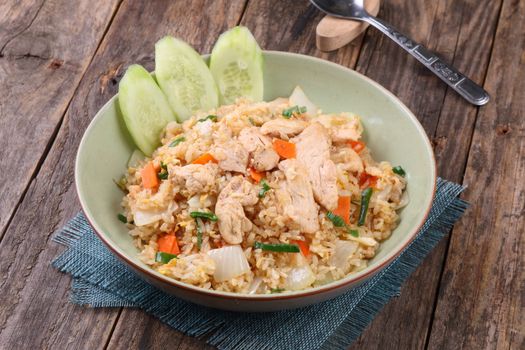
Chinese
Chicken Fried Rice
The diets react (see scores below)
Common Ingredients
- jasmine rice
- chicken breast
- eggs
- peas
- carrots
- scallions
- soy sauce
- sesame oil
Specific recipes may vary.
Incompatible with 5 of 11 diets
Diet Ratings
Chicken Fried Rice is fundamentally incompatible with a ketogenic diet. The primary ingredient, jasmine rice, is a high-glycemic starchy grain that delivers approximately 45g of net carbs per single cup serving — instantly exceeding or consuming the entire daily keto carb budget. There is no version of this dish in its standard form that can be made keto-friendly without completely replacing the rice. Additional problematic ingredients include peas and carrots, which contribute further net carbs. While chicken, eggs, sesame oil, scallions, and soy sauce are individually keto-compatible, they cannot offset the massive carbohydrate load from the rice base.
Chicken Fried Rice contains two distinct animal products: chicken breast (poultry) and eggs. Both are explicitly excluded under vegan dietary rules. There is no ambiguity here — poultry is animal flesh and eggs are an animal-derived product. The remaining ingredients (jasmine rice, peas, carrots, scallions, soy sauce, sesame oil) are plant-based, but the presence of chicken and eggs makes this dish clearly non-vegan.
Chicken Fried Rice contains multiple non-paleo ingredients that are clearly excluded under any interpretation of the paleo diet. Jasmine rice is a grain — excluded by all mainstream paleo authorities. Soy sauce contains both soy (a legume) and wheat (a grain), making it doubly non-paleo. Sesame oil is a seed oil, explicitly excluded in favor of animal fats and approved plant oils. Peas are legumes and also excluded. While chicken, eggs, carrots, and scallions are paleo-approved, the foundational components of this dish — the rice, soy sauce, sesame oil, and peas — are all firmly off-limits. This dish cannot be meaningfully modified and still be considered Chicken Fried Rice.
Chicken Fried Rice contains several elements that conflict with Mediterranean diet principles while retaining some acceptable components. Jasmine rice is a refined white grain, not a whole grain, which the Mediterranean diet discourages in favor of whole grains like brown rice, farro, or barley. Chicken breast and eggs are acceptable in moderation (poultry/eggs category), and the vegetables — peas, carrots, scallions — are positive contributions. However, sesame oil replaces extra virgin olive oil as the primary fat, which is atypical for the Mediterranean pattern, and soy sauce introduces high sodium and a heavily processed condiment not associated with this dietary tradition. The dish is not inherently harmful but sits outside the Mediterranean framework in its grain choice, fat source, and flavor profile.
Some flexible Mediterranean diet interpretations, particularly those emphasizing overall dietary patterns rather than strict ingredient lists, might accept this dish as a reasonable balanced meal given its lean protein, eggs, and vegetable content — arguing that occasional refined grains and non-olive-oil fats are permissible within a broadly plant-forward, whole-food approach.
Chicken Fried Rice is almost entirely plant-based ingredients and is completely incompatible with the carnivore diet. Jasmine rice is a grain and the single largest ingredient by volume. Peas and carrots are vegetables. Scallions are plant-based aromatics. Soy sauce is a fermented legume-derived condiment containing plant compounds, gluten, and often additives. Sesame oil is a plant-derived oil. The only carnivore-compatible ingredients in this dish are the chicken breast and eggs, which together make up a minority of the overall composition. No modification short of a complete recipe overhaul could make this dish carnivore-appropriate.
Chicken Fried Rice contains multiple Whole30-excluded ingredients. Jasmine rice is a grain and is explicitly prohibited on the Whole30 program. Soy sauce contains both soy (a legume) and wheat (a grain), both of which are excluded categories. These are not edge cases or ambiguous ingredients — they are core exclusions of the Whole30 program. The remaining ingredients (chicken breast, eggs, peas, carrots, scallions, sesame oil) are individually compliant, but the dish as a whole cannot be made Whole30-compatible without fundamentally changing its nature by removing the rice and substituting coconut aminos for soy sauce.
Chicken fried rice contains several low-FODMAP staples — jasmine rice, chicken breast, eggs, sesame oil, and carrots are all safe. However, three ingredients introduce FODMAP concerns at typical serving sizes. Peas (green/garden peas) are high in GOS and fructans at standard portions (Monash rates them as high-FODMAP above ~1 tablespoon, but a typical fried rice serving contains significantly more). Scallions/green onions are low-FODMAP only when using the green tops exclusively — if the white bulb portions are included (as is common in restaurant cooking), they contribute fructans. Soy sauce (regular) contains wheat and is technically high-FODMAP, though the very small amounts typically used per serving may fall below threshold; gluten-free tamari is the recommended substitute. The combination of peas plus potentially bulb-inclusive scallions plus wheat-based soy sauce creates a cumulative FODMAP load that warrants caution during the strict elimination phase, even though the dish is fundamentally built on low-FODMAP ingredients.
Monash University rates small portions of peas (~1 tbsp) and scallion green tops as low-FODMAP, and regular soy sauce at 2 tablespoons as low-FODMAP — strict Monash adherents might approve this dish if portions of problematic ingredients are carefully controlled. However, many clinical FODMAP dietitians advise caution with restaurant-prepared fried rice during elimination due to the difficulty of verifying exact quantities of peas, which bulb portions of scallions are used, and whether tamari is substituted for soy sauce.
Chicken fried rice contains several DASH-friendly components — lean chicken breast, eggs, vegetables (peas, carrots, scallions), and some healthy fat from sesame oil — but is significantly undermined by soy sauce, which is extremely high in sodium (a single tablespoon contains ~900-1,000mg, and typical fried rice recipes use 2-4 tablespoons per serving). This alone can push a single serving close to or beyond the entire daily sodium ceiling under standard DASH (2,300mg) or well over the low-sodium DASH target (1,500mg). Jasmine rice is a refined white grain rather than a DASH-preferred whole grain. Sesame oil is a vegetable oil acceptable in small amounts on DASH. The dish is not categorically incompatible with DASH — the protein and vegetable components are appropriate — but as commonly prepared, the sodium load from soy sauce makes it a 'caution' food requiring meaningful modification. Using low-sodium soy sauce (reduced by ~40%) and portion control could improve the score substantially.
Chicken fried rice presents a classic Zone Diet challenge: the protein component (chicken breast, eggs) is excellent — lean, favorable, and easy to block. The vegetables (peas, carrots, scallions) add low-glycemic carbs and polyphenols. However, jasmine rice is the central problem. It is a high-glycemic, refined starch that Dr. Sears explicitly classifies as an 'unfavorable' carbohydrate. In a typical restaurant or home serving, jasmine rice dominates the carb block allocation, spiking insulin and throwing off the 40/30/30 ratio. Sesame oil adds omega-6 polyunsaturated fat, which Sears cautions against due to its pro-inflammatory potential — though the quantity is usually small. Soy sauce is negligible in macro terms. The dish is not a Zone disaster because the protein and vegetable components are sound, but as typically prepared, the rice portion is far too large to maintain Zone ratios. A Zone-compliant version would require dramatically reducing rice (to roughly 1/4 cup cooked per meal), increasing vegetable volume, and ensuring the chicken breast portion is appropriately sized (~3 oz). With those modifications, it works; as traditionally served, it does not.
Chicken fried rice has a mixed anti-inflammatory profile. On the positive side, chicken breast is a lean protein (anti-inflammatory framework approves lean poultry), eggs provide choline and selenium, peas and carrots contribute fiber, antioxidants, and carotenoids, scallions offer quercetin and sulfur compounds, and sesame oil contains sesamin and sesamol — lignans with documented antioxidant and modest anti-inflammatory properties. Soy sauce in typical cooking quantities is unlikely to be significantly pro-inflammatory, though it is high in sodium. The main concern is jasmine rice, a refined white rice with a high glycemic index that can spike blood sugar and promote inflammatory markers (CRP, IL-6) — it lacks the fiber and phytonutrients of brown or wild rice. The dish is also typically made with a neutral cooking oil (not specified here, but commonly vegetable or soybean oil), which would add an omega-6 burden. As specified with sesame oil only, that concern is reduced. Overall, this is a nutritionally moderate dish — lean protein and vegetables are positives, but the refined white rice base is a meaningful anti-inflammatory drawback. Substituting brown rice or cauliflower rice would meaningfully improve the profile.
Most anti-inflammatory practitioners would rate white rice as nutritionally neutral to mildly negative due to its high glycemic load, but some researchers (notably those studying traditional Asian dietary patterns) note that white rice consumption in Asian populations is not consistently associated with elevated inflammatory markers, possibly due to overall dietary context. Sesame oil is broadly accepted in anti-inflammatory cooking, though some stricter omega-6-focused protocols flag its linoleic acid content.
Chicken fried rice made with chicken breast and eggs offers meaningful protein from quality sources, and the peas and carrots add modest fiber and micronutrients. However, jasmine rice is a refined, high-glycemic grain with low fiber density, making it a suboptimal carbohydrate choice for GLP-1 patients who need every calorie to count nutritionally. Sesame oil adds fat — though it is an unsaturated fat and used in small amounts, it contributes to caloric density in a dish where portions are already small. Soy sauce is high in sodium, which is a concern given that GLP-1 patients are at increased risk for dehydration and electrolyte imbalance. The dish is easy to digest and not fried in the deep-fry sense, which works in its favor. Overall, this is an acceptable meal in a moderate, protein-forward portion — particularly if chicken and eggs are the dominant ingredients — but the refined rice base and sodium load prevent a full approval.
Some GLP-1-focused dietitians accept jasmine rice in small portions as an energy source that is gentle on the stomach and easy to digest, which matters when nausea limits food tolerance. Others argue that swapping jasmine rice for cauliflower rice or brown rice would substantially improve fiber and glycemic profile without sacrificing digestibility, and would recommend that modification before approving the dish.
*See how scores were generated at our methodology page.
Nutritional profile
Six traits that cut across every diet.
Fiber & Plants
How much whole-plant food and fiber it delivers.
Healthy Fats
The quality of its fats (unsaturated, omega-3).
Whole / Unprocessed
How close it is to its natural, unprocessed form.
Gut Gentle
How easy it is on digestion (low FODMAP, few irritants).
Low Glycemic
How little it spikes your blood sugar.
Protein Density
How much protein it packs per calorie.
Controversy Index
Higher controversy = more disagreement between diets.
Diet-Specific Tips
 Mediterranean — 4/10
View tips
- Jasmine rice is a refined white grain, not a whole grain
- Sesame oil is not extra virgin olive oil, the canonical Mediterranean fat
- Soy sauce is a highly processed, high-sodium condiment outside Mediterranean tradition
- Chicken breast and eggs are acceptable in moderation
- Peas, carrots, and scallions are positive vegetable contributions
- No Mediterranean herbs, spices, or olive oil to anchor the dish to the dietary pattern
 Low-FODMAP — 5/10
View tips
- Jasmine rice: low-FODMAP, safe staple
- Chicken breast: low-FODMAP, safe protein
- Eggs: low-FODMAP, safe
- Carrots: low-FODMAP at standard servings
- Peas: high-FODMAP above ~1 tbsp per serve (GOS/fructans) — typical fried rice portions exceed this threshold
- Scallions: low-FODMAP using green tops only; white bulb portions are high in fructans
- Soy sauce: contains wheat (fructans); gluten-free tamari is the low-FODMAP alternative
- Sesame oil: low-FODMAP, safe
- Cumulative FODMAP load from peas + scallion bulbs + soy sauce is a concern during elimination phase
 DASH — 5/10
View tips
- Soy sauce is very high in sodium — primary DASH concern; a standard serving can deliver 1,000-2,000mg sodium from soy sauce alone
- Jasmine rice is a refined grain; DASH recommends whole grains (e.g., brown rice) over refined white rice
- Chicken breast is a lean protein fully aligned with DASH guidelines
- Peas, carrots, and scallions contribute potassium, fiber, and micronutrients consistent with DASH vegetable goals
- Eggs are acceptable in moderation on DASH
- Sesame oil is a vegetable oil permitted in small amounts on DASH
- Low-sodium soy sauce substitution would significantly improve DASH compatibility
- Swapping jasmine rice for brown rice would further improve alignment with DASH whole grain recommendations
 Zone — 5/10
View tips
- Jasmine rice is a high-glycemic, unfavorable carbohydrate in Zone terminology — the dominant ingredient works against Zone balance
- Chicken breast is an ideal lean Zone protein source
- Eggs contribute additional lean protein and fat, fitting well into Zone blocks
- Peas and carrots are moderate-glycemic vegetables; peas have higher carb density requiring careful blocking
- Sesame oil is omega-6-heavy rather than monounsaturated, conflicting with Zone's anti-inflammatory fat preference
- As traditionally portioned, carbohydrate load from rice far exceeds Zone's 40% carb ratio guideline
- Dish can be Zone-adapted by drastically reducing rice and increasing vegetable volume
 Anti-Inflammatory — 5/10
View tips
- Jasmine (white) rice is high-glycemic and lacks fiber — a meaningful anti-inflammatory drawback
- Chicken breast is a lean protein, approved in the anti-inflammatory framework
- Eggs provide choline and selenium with mixed but generally acceptable inflammatory profile
- Peas and carrots add fiber, carotenoids, and antioxidants
- Sesame oil contains lignans (sesamin, sesamol) with antioxidant properties
- Scallions contribute quercetin and anti-inflammatory sulfur compounds
- Soy sauce adds significant sodium but is used in small quantities
- No trans fats, processed additives, or red meat present
 GLP-1 Friendly — 5/10
View tips
- Chicken breast and eggs provide quality, lean protein — positive
- Jasmine rice is a refined, low-fiber, high-glycemic carbohydrate — negative
- Sesame oil is an unsaturated fat but adds caloric density — mildly negative
- Soy sauce is high in sodium, a concern given GLP-1 dehydration risk — negative
- Peas and carrots contribute modest fiber and micronutrients — positive
- Not deep-fried; easy to digest — positive
- Dish is portion-sensitive: protein-to-rice ratio matters significantly for GLP-1 patients