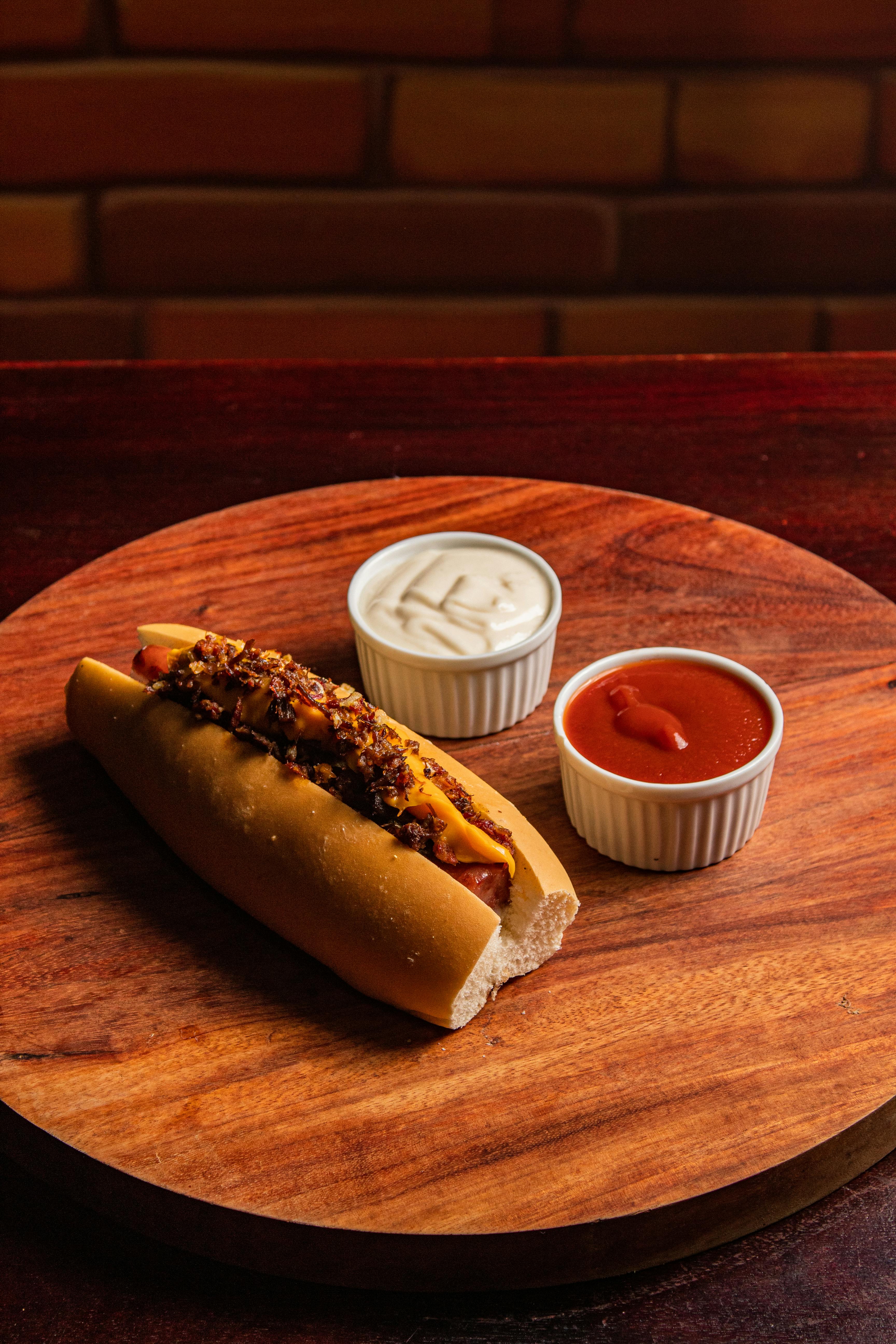
Photo: Wallace Castro / Pexels
The diets react (see scores below)
Common Ingredients
- beef hot dog
- hot dog bun
- ground beef chili
- cheddar cheese
- yellow onion
- mustard
Specific recipes may vary.
Incompatible with 10 of 11 diets
Diet Ratings
The chili dog as traditionally prepared is fundamentally incompatible with ketogenic eating. The hot dog bun alone contributes approximately 20-25g of net carbs, which nearly or fully exhausts the entire daily keto carb budget in a single serving. The ground beef chili may also contain added sugars, beans, or tomato-based ingredients that add further net carbs. While the beef hot dog, cheddar cheese, and mustard are individually keto-friendly, and the ground beef component is fine, the bun is an absolute deal-breaker. There is no reasonable portion adjustment that makes a standard chili dog keto-compatible without fundamentally deconstructing the dish.
The chili dog contains multiple animal products: beef hot dog (meat), ground beef chili (meat), and cheddar cheese (dairy). Three distinct animal-derived ingredients are present, making this completely incompatible with a vegan diet. There is no ambiguity here.
The Chili Dog contains multiple non-paleo ingredients that make it clearly incompatible with the diet. The hot dog bun is a grain-based processed food (wheat flour), which is strictly excluded. Beef hot dogs are processed meats containing additives, preservatives, and added salt — also excluded. Cheddar cheese is dairy, which is not permitted. Mustard often contains added salt, vinegar, and preservatives. While yellow onion and ground beef chili (if made without beans) could be paleo-friendly components, the overall dish is dominated by grains, processed meats, and dairy, making it firmly in the avoid category.
The chili dog is a poor fit for the Mediterranean diet on multiple fronts. The primary proteins are a processed beef hot dog and ground beef chili — both red/processed meats that the Mediterranean diet limits to a few times per month at most. Processed meats like hot dogs are explicitly discouraged due to high sodium, saturated fat, nitrates, and additives. The hot dog bun is a refined grain product with little nutritional value. Cheddar cheese adds saturated fat beyond the moderate dairy allowance. There are no vegetables of substance, no olive oil, no legumes, and no whole grains. The only marginally positive elements are yellow onion and mustard, which are negligible in the overall nutritional profile of this dish.
The Chili Dog is fundamentally incompatible with the carnivore diet. While it contains some animal-derived components (beef hot dog, ground beef, cheddar cheese), the dish as a whole is disqualifying due to multiple plant-based ingredients. The hot dog bun is a grain-based bread product — a clear violation. Yellow onion is a plant vegetable. Mustard is a plant-derived condiment containing seeds and vinegar. The chili itself, depending on preparation, typically contains beans, tomatoes, chili peppers, and other plant ingredients. Even the beef hot dog, though meat-based, commonly contains fillers, sugar, and plant-based additives that would reduce its score. No reasonable adaptation of this dish qualifies as carnivore — it is structurally a sandwich built around plant components.
The Chili Dog contains multiple Whole30-excluded ingredients. The hot dog bun is made from grains (wheat), which are explicitly excluded. Cheddar cheese is dairy, which is excluded. Beef hot dogs commonly contain added sugar, nitrates, and other non-compliant additives. Additionally, even if all ingredients were somehow compliant, a chili dog served in a bun falls squarely into the 'no recreating junk food' rule — hot dogs in buns are the archetypal junk food the program discourages. The dish cannot be made Whole30-compliant in its standard form.
The Chili Dog as described contains multiple high-FODMAP ingredients that make it unsuitable during the elimination phase. The hot dog bun is wheat-based, making it high in fructans. Yellow onion is one of the highest-FODMAP foods tested by Monash University, loaded with fructans and GOS, and is a standard ingredient in chili. Ground beef chili typically contains onion and garlic as base ingredients, further compounding the fructan load. Even a small amount of onion is enough to trigger symptoms in sensitive individuals. Cheddar cheese is low-FODMAP (aged hard cheeses are virtually lactose-free), the beef hot dog itself is generally low-FODMAP, and mustard is low-FODMAP — but these safe ingredients cannot rescue a dish with three significant FODMAP sources. The combination of a wheat bun, onion, and onion/garlic-laden chili makes this dish firmly in the 'avoid' category during elimination.
A chili dog is heavily misaligned with DASH diet principles across multiple dimensions. The beef hot dog is a processed red meat — high in sodium (typically 400–600mg per frankfurter), saturated fat, and nitrates/nitrites, all of which DASH explicitly limits. The white hot dog bun is a refined grain with minimal fiber or nutrients. Ground beef chili adds more saturated fat and sodium (canned or seasoned chili can contribute 400–800mg sodium per serving). Cheddar cheese is full-fat dairy, high in saturated fat and sodium (~180mg per oz), directly counter to DASH's low-fat dairy emphasis. Mustard is a relatively minor contributor but adds additional sodium. The only DASH-positive element is yellow onion, which provides modest potassium and fiber. The combined sodium load for this dish easily exceeds 1,000–1,500mg in a single serving — more than half to the full daily sodium budget under the stricter 1,500mg DASH target. Saturated fat content is also well above DASH limits. Processed red meat (hot dogs) is explicitly among the foods DASH recommends minimizing.
The Chili Dog presents multiple Zone Diet challenges that make it difficult to incorporate even with careful portioning. The hot dog bun is a high-glycemic refined carbohydrate — exactly the type of unfavorable carb Zone discourages. The beef hot dog is a processed, fatty meat high in saturated fat and sodium, far from the lean protein ideal of Zone. Cheddar cheese adds additional saturated fat. Ground beef chili does provide some protein and, if bean-based, some low-glycemic carbs, but the overall fat profile skews heavily toward saturated fat rather than the monounsaturated fats Zone emphasizes. Yellow onion and mustard are Zone-friendly accents but negligible in impact. The 40/30/30 ratio here would be badly distorted: too much saturated fat, high-glycemic refined carbs from the bun, and processed protein. While technically one could eat a half-bun and small hot dog to approximate some Zone blocks, the food as presented is a poor Zone vehicle. It scores a 3 rather than 1-2 only because the chili component does contain protein and some vegetables, and the dish is not pure sugar or nutritionally empty — it has structural macro content, just poorly aligned with Zone ideals.
The chili dog is a highly pro-inflammatory dish by nearly every anti-inflammatory standard. The beef hot dog is a processed meat product typically containing nitrates/nitrites, preservatives, artificial additives, and a poor omega-6 to omega-3 ratio — processed meats are consistently flagged as pro-inflammatory across all major anti-inflammatory frameworks. The ground beef chili adds saturated fat and arachidonic acid from red meat. The white hot dog bun is a refined carbohydrate that spikes blood sugar and contributes to inflammatory signaling. Cheddar cheese is full-fat dairy, which is in the 'limit' category. The only redemptive elements are the yellow onion (quercetin, a polyphenol with anti-inflammatory properties) and mustard (contains turmeric/yellow mustard seed in small amounts). These minor positives are entirely overwhelmed by the cumulative pro-inflammatory load of processed meat, red meat, refined grains, and full-fat cheese. This dish represents a convergence of multiple 'avoid' and 'limit' category ingredients.
A chili dog combines multiple problematic elements for GLP-1 patients. The beef hot dog is a processed, high-fat, high-sodium meat with low protein density per calorie and significant saturated fat content. The refined white hot dog bun is a low-fiber, low-nutrient refined grain that offers empty calories. While the ground beef chili does contribute some protein and fiber (beans if included), the overall dish is dominated by processed meat and saturated fat. Cheddar cheese adds more saturated fat. The combination of high fat, processed meat, refined carbs, and moderate sodium is likely to worsen GLP-1 side effects including nausea, bloating, and reflux — especially given the slowed gastric emptying these medications cause. The dish is not portion-friendly, is low in fiber relative to calorie load, and fails on nutrient density per calorie. Yellow onion and mustard are benign additions but do not redeem the dish nutritionally.
*See how scores were generated at our methodology page.
Nutritional profile
Six traits that cut across every diet.
Fiber & Plants
How much whole-plant food and fiber it delivers.
Healthy Fats
The quality of its fats (unsaturated, omega-3).
Whole / Unprocessed
How close it is to its natural, unprocessed form.
Gut Gentle
How easy it is on digestion (low FODMAP, few irritants).
Low Glycemic
How little it spikes your blood sugar.
Protein Density
How much protein it packs per calorie.
Controversy Index
Higher controversy = more disagreement between diets.
Diet-Specific Tips
 Zone — 5/10
View tips
- Hot dog bun is a high-glycemic refined carbohydrate — unfavorable Zone carb source
- Beef hot dog is processed, high in saturated fat and sodium — not lean Zone protein
- Cheddar cheese adds further saturated fat, conflicting with Zone's monounsaturated fat preference
- Ground beef chili adds some protein but also saturated fat from fatty ground beef
- Overall macronutrient ratio skews toward saturated fat and high-GI carbs — difficult to balance into 40/30/30
- Yellow onion and mustard are Zone-favorable but negligible contributors to the overall profile