This dish contains raw or undercooked ingredients. Consume at your discretion.
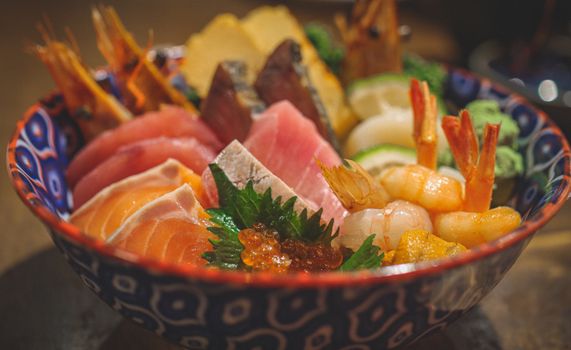
Photo: SpotwizardLee / Pexels
Japanese
Chirashi Bowl
The diets react (see scores below)
Common Ingredients
- sushi rice
- tuna
- salmon
- yellowtail
- tamago
- ikura
- cucumber
- nori
Specific recipes may vary.
Incompatible with 5 of 11 diets
Diet Ratings
Chirashi Bowl is fundamentally built on sushi rice, which is a high-glycemic refined grain heavily seasoned with rice vinegar and sugar. A standard serving of sushi rice (~150-200g) contains approximately 50-60g of net carbs on its own, which already exceeds or maxes out the entire daily keto carb budget in a single dish. While the toppings — tuna, salmon, yellowtail, ikura, and nori — are excellent keto-friendly proteins and fats, and cucumber and nori add negligible carbs, the rice base makes the dish as traditionally prepared entirely incompatible with ketosis. Tamago (sweet egg omelet) also contains added sugar, adding further carbs. There is no meaningful way to consume a chirashi bowl in its standard form while maintaining ketosis.
Chirashi Bowl contains multiple animal products that are strictly excluded from a vegan diet. Tuna, salmon, and yellowtail are fish; tamago is a sweetened egg omelette; and ikura consists of salmon roe (fish eggs). These ingredients make this dish entirely incompatible with vegan eating. The only vegan-compliant components are the sushi rice, cucumber, and nori.
Chirashi Bowl is fundamentally built on sushi rice, a grain that is strictly excluded from the paleo diet. All major paleo authorities (Cordain, Sisson, Wolf) agree that grains — including white rice — are non-paleo due to their anti-nutrient content and absence from the Paleolithic diet. Beyond the rice, nori (seaweed) is paleo-approved, and the proteins — tuna, salmon, yellowtail, and ikura (salmon roe) — are excellent paleo foods. Tamago (sweetened egg omelet) contains added sugar and is borderline. However, none of these approved ingredients rescue the dish from its grain foundation. The rice is not a minor garnish; it is the defining base of the bowl. Additionally, traditional chirashi is served with soy sauce, which is a legume-based, processed condiment that is also excluded. As prepared and served in its standard form, this dish cannot be considered paleo-compatible.
A Chirashi Bowl features excellent Mediterranean-compatible ingredients — multiple types of oily fish (tuna, salmon, yellowtail) rich in omega-3s, cucumber, and nori are all strongly aligned with Mediterranean principles. However, the base is sushi rice, a refined white rice product, which contradicts the Mediterranean preference for whole grains. The tamago (sweetened egg omelet) adds modest sugar, and ikura (fish roe) is fine in small amounts. The dish scores well on its abundant seafood content but is pulled down by the refined grain base and the absence of olive oil or legumes. Overall it is acceptable and nutritious, but the sushi rice prevents a full approval.
Some Mediterranean diet researchers note that traditional Mediterranean cuisines in parts of southern Europe and the Middle East do include white rice as a staple grain, and moderate consumption is tolerated in clinical versions of the diet (e.g., the PREDIMED-style approach). Under this interpretation, the fish-forward nature of the dish could elevate the score closer to approval.
A Chirashi Bowl is fundamentally incompatible with the carnivore diet. While the fish components (tuna, salmon, yellowtail), tamago (egg), and ikura (salmon roe) are carnivore-approved animal products, the dish is built on a foundation of sushi rice — a grain and a major plant-based carbohydrate that is strictly excluded. Additionally, cucumber is a vegetable (excluded), and nori (seaweed) is a plant-derived food. The multiple plant ingredients make this dish an avoid, even though the protein sources themselves would be acceptable. The dish cannot be considered carnivore-compatible as served.
Chirashi Bowl contains sushi rice, which is a grain and explicitly excluded on Whole30. Rice in any form (white, brown, sushi) is not permitted during the 30-day program. Additionally, tamago (sweet Japanese egg omelet) is typically made with sugar and mirin (a sweet rice wine), both of which are excluded. Ikura (salmon roe) is generally compliant on its own but is often seasoned with soy sauce, which contains soy — another excluded ingredient. The raw fish (tuna, salmon, yellowtail), cucumber, and nori are all Whole30-compliant, but the foundational grain base and several toppings make this dish incompatible with the program as it is commonly prepared.
Most ingredients in a chirashi bowl are low-FODMAP: sushi rice (white rice) is safe, raw fish (tuna, salmon, yellowtail) are protein-based and FODMAP-free, cucumber is low-FODMAP, and nori (dried seaweed) is low-FODMAP at standard serving sizes. However, two ingredients introduce meaningful concern. Tamago (Japanese sweet omelette) is typically made with mirin and sometimes sugar or dashi with additives — eggs themselves are low-FODMAP, but the sweetened preparation and mirin (which may contain wheat/fructans depending on brand) adds uncertainty. More significantly, ikura (salmon roe) is generally considered low-FODMAP, but sushi rice seasoning is the real wildcard: traditional sushi rice is prepared with rice vinegar, sugar, and often a small amount of seasoning that is usually fine, but restaurant preparations vary and some use mirin or seasoned rice vinegar blends. The dish as described contains no overtly high-FODMAP ingredients like onion, garlic, or wheat, but the processed/prepared components (tamago seasoning, sushi rice seasoning) introduce practical ambiguity in a restaurant context. At home with controlled ingredients, this could score 7-8. In a restaurant setting, the hidden seasonings in tamago and sushi rice preparation drop confidence.
Monash University rates white rice and plain fish as clearly low-FODMAP, and the core protein components are safe. However, clinical FODMAP practitioners often caution that restaurant sushi rice and tamago contain variable sweeteners and condiments (mirin, dashi stocks) that may include fructans or excess fructose, making strict elimination-phase compliance difficult without knowing exact preparation methods.
Chirashi bowl contains several DASH-friendly components — raw tuna, salmon, and yellowtail are excellent lean protein sources rich in omega-3 fatty acids, which align well with DASH's emphasis on fish. Cucumber is a low-sodium vegetable, and nori provides minerals like potassium and magnesium. However, sushi rice is prepared with rice vinegar, sugar, and salt, significantly increasing sodium and added sugar content beyond plain white rice. Ikura (salmon roe) is notably high in sodium, often contributing 200-400mg per tablespoon. Tamago (sweet egg omelet) adds moderate sugar and sodium. The dish as a whole can easily reach 800-1,200mg sodium per serving depending on portion sizes — before any soy sauce is added, which is commonly served alongside and could push totals well above DASH limits. White rice itself is also a refined grain rather than a whole grain, which DASH de-emphasizes. The lean fish protein and vegetables are genuinely DASH-positive, but the cumulative sodium from rice seasoning, roe, and tamago, plus refined grain base, place this firmly in 'caution' territory.
NIH DASH guidelines broadly recommend fish as a preferred protein and vegetables as dietary staples, both well-represented here. Some DASH-oriented clinicians note that when chirashi is consumed without added soy sauce and with reduced rice portions, the overall nutritional profile — high omega-3s, lean protein, micronutrient-rich toppings — compares favorably to many Western DASH meals; the sodium concern is largely mitigated by omitting condiments and controlling ikura portions.
A Chirashi Bowl contains excellent Zone-compatible components — raw tuna, salmon, and yellowtail are ideal lean proteins rich in omega-3 fatty acids, which aligns perfectly with Sears' anti-inflammatory focus. Cucumber and nori are favorable low-glycemic carbohydrate sources. However, the dish is anchored by sushi rice, which is short-grain white rice — a high-glycemic, unfavorable carbohydrate in Zone terminology. Sushi rice is also seasoned with rice vinegar and sugar, elevating its glycemic load further. In a typical chirashi bowl, rice constitutes a very large portion of the carbohydrate block, easily overwhelming the 40% carb target with high-GI calories rather than low-GI vegetables. Tamago (sweet egg omelet) adds additional sugar. Ikura (salmon roe) is a reasonable fat and protein source with omega-3 benefits. To make this Zone-compatible, the rice portion would need to be dramatically reduced (roughly half a cup or less) and supplemented with additional vegetables, making it an atypical serving size compared to restaurant portions. The protein profile is genuinely excellent — the fish lineup is among the best Zone proteins available.
Some Zone practitioners, particularly those following Sears' later writings emphasizing polyphenols and omega-3s over strict glycemic control, would argue that the extraordinary omega-3 content of tuna, salmon, and yellowtail — combined with the anti-inflammatory benefits of fish-forward eating — partially offsets the sushi rice concern. Sears himself has noted that overall inflammation markers matter more than any single glycemic spike, and a modest rice portion in the context of omega-3-rich fish could be nutritionally defensible. Additionally, compared to other rice-heavy dishes, chirashi's high fish-to-rice ratio when home-prepared can be favorable.
Chirashi bowl is a strong anti-inflammatory dish overall, anchored by its raw fish proteins. Tuna, salmon, and yellowtail are all excellent sources of long-chain omega-3 fatty acids (EPA and DHA), which are among the most well-researched anti-inflammatory nutrients and directly reduce inflammatory markers like CRP and IL-6. Ikura (salmon roe) is similarly dense in omega-3s and astaxanthin, a potent carotenoid antioxidant. Nori provides minerals, fiber, and additional anti-inflammatory compounds including fucoxanthin. Cucumber contributes antioxidants and hydration with minimal inflammatory load. Tamago (sweetened egg omelet) is a mild caution — eggs have a mixed profile in anti-inflammatory research, and the added sugar in tamago is a small negative. The main limiting factor is sushi rice: white short-grain rice seasoned with rice vinegar and sugar is a refined carbohydrate with a high glycemic index, which can modestly promote insulin response and inflammatory signaling when consumed in quantity. However, the portion of rice relative to the omega-3-rich fish largely offsets this concern. Overall, the dish is nutritionally aligned with anti-inflammatory principles, especially the heavy emphasis on fatty fish.
Most anti-inflammatory frameworks, including Dr. Weil's pyramid, strongly endorse fatty fish as a cornerstone food, making the fish components unambiguous. However, some stricter anti-inflammatory and autoimmune-protocol practitioners (e.g., AIP, Paul Jaminet's Perfect Health Diet) would flag the white rice as a refined grain to limit or avoid, while others in the ancestral health space consider plain white rice a relatively benign 'safe starch.' The tamago's added sugar is a minor concern that most mainstream anti-inflammatory guidance would note but not condemn in small amounts.
A chirashi bowl offers meaningful nutritional positives for GLP-1 patients — tuna, salmon, and yellowtail are lean-to-moderate protein sources with beneficial omega-3 fatty acids, and the cucumber and nori add modest fiber and micronutrients. However, sushi rice is a refined carbohydrate with little fiber, high glycemic load, and occupies significant caloric real estate in a small-appetite context. Ikura (salmon roe) and tamago (sweetened egg omelet) add fat and sugar respectively, and the overall protein-per-calorie density of the bowl is diluted by the rice base. Portion size is also a concern — restaurant chirashi bowls are typically large, and the rice volume makes it easy to fill up on carbs before adequate protein is consumed. Raw fish carries a small food safety consideration for immunocompromised or sensitive individuals, though this is generally low risk in healthy adults. The dish is not fried, not heavily processed, and contains omega-3-rich fish, which earns it a caution rather than avoid — but it is not optimized for GLP-1 dietary priorities without modification.
Some GLP-1-focused dietitians would rate this higher, noting that oily fish like salmon are among the most nutrient-dense protein sources available and that a modest rice portion is acceptable within a balanced meal. Others would rate it lower, arguing that refined sushi rice adds empty carbohydrate calories that a reduced-appetite patient cannot afford, and would recommend substituting cauliflower rice or significantly reducing the rice portion to improve protein and fiber density.
*See how scores were generated at our methodology page.
Nutritional profile
Six traits that cut across every diet.
Fiber & Plants
How much whole-plant food and fiber it delivers.
Healthy Fats
The quality of its fats (unsaturated, omega-3).
Whole / Unprocessed
How close it is to its natural, unprocessed form.
Gut Gentle
How easy it is on digestion (low FODMAP, few irritants).
Low Glycemic
How little it spikes your blood sugar.
Protein Density
How much protein it packs per calorie.
Controversy Index
Higher controversy = more disagreement between diets.
Diet-Specific Tips
 Mediterranean — 5/10
View tips
- Multiple servings of oily fish (tuna, salmon, yellowtail) strongly align with Mediterranean seafood recommendations
- Sushi rice is a refined white grain, not a whole grain, which conflicts with Mediterranean dietary principles
- Tamago contains added sugar, a minor negative factor
- Cucumber and nori contribute plant-based nutrients
- No olive oil present; dish relies on no added healthy fats
- Ikura (fish roe) is acceptable in small quantities
 Low-FODMAP — 5/10
View tips
- Sushi rice (white rice base) is low-FODMAP
- Raw fish (tuna, salmon, yellowtail) are FODMAP-free proteins
- Ikura (salmon roe) is low-FODMAP
- Cucumber is low-FODMAP
- Nori is low-FODMAP at standard serving
- Tamago contains mirin and sweeteners — variable FODMAP risk depending on preparation
- Sushi rice seasoning (mirin, rice vinegar blends) may contain fructans or excess fructose in restaurant settings
- No high-FODMAP aromatics (garlic, onion) listed, but restaurant preparation may include hidden sources
 DASH — 5/10
View tips
- Tuna, salmon, and yellowtail are DASH-approved lean fish proteins rich in omega-3 fatty acids
- Sushi rice is seasoned with salt and sugar, increasing sodium and added sugar above plain rice
- Ikura (salmon roe) is high in sodium, potentially 200-400mg per serving
- Tamago adds moderate sugar and sodium
- White rice is a refined grain, not a whole grain as preferred by DASH
- Cucumber and nori contribute DASH-positive micronutrients
- No soy sauce included in listed ingredients, but commonly served alongside — would significantly raise sodium if used
- Overall sodium can approach or exceed 1,000mg per bowl before condiments
 Zone — 5/10
View tips
- Sushi rice is a high-glycemic, unfavorable Zone carbohydrate — typically the dominant carb source in this dish
- Sushi rice is sweetened with sugar, further increasing glycemic load
- Tuna, salmon, and yellowtail are near-ideal Zone proteins with strong omega-3 anti-inflammatory profiles
- Typical restaurant portion has far too much rice relative to Zone carb block limits
- Cucumber and nori are favorable low-glycemic carbohydrate sources that add balance
- Tamago adds additional sugar beyond the rice
- Ikura contributes beneficial omega-3 fats
- Dish can be Zone-adapted by halving the rice and adding more vegetables, but this deviates from traditional preparation
 Anti-Inflammatory — 7/10
View tips
- Tuna, salmon, and yellowtail are rich in EPA/DHA omega-3 fatty acids — core anti-inflammatory nutrients
- Ikura (salmon roe) provides omega-3s and astaxanthin, a potent anti-inflammatory carotenoid
- Nori supplies fucoxanthin, minerals, and fiber with anti-inflammatory properties
- Sushi rice is a refined, high-glycemic carbohydrate that can modestly promote inflammation
- Tamago contains added sugar, a mild pro-inflammatory ingredient
- Cucumber adds antioxidants and phytonutrients with negligible inflammatory load
- No processed ingredients, seed oils, trans fats, or artificial additives present
 GLP-1 Friendly — 5/10
View tips
- Sushi rice is a refined carbohydrate with low fiber and high glycemic load, diluting overall nutrient density
- Salmon and tuna provide lean protein and omega-3 fatty acids — strong positives for GLP-1 patients
- Ikura adds moderate fat; tamago adds sugar — both reduce the dish's nutritional efficiency
- No significant fiber sources beyond cucumber and nori — fiber target contribution is minimal
- Restaurant portion sizes typically skew large, making it easy to over-consume rice relative to protein
- Raw fish is generally safe but a minor consideration for GI-sensitive patients on GLP-1 medications
- Dish is not fried, not heavily processed, and free of carbonation or alcohol — no hard disqualifiers