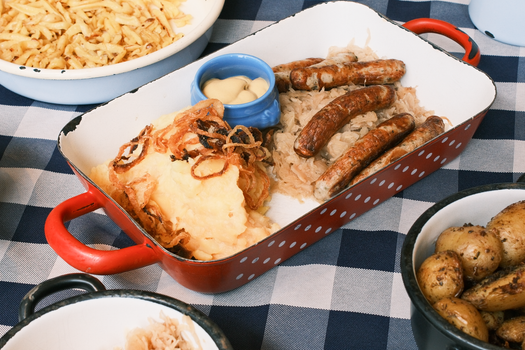
Photo: Anh Nguyen / Pexels
French
Choucroute Garnie
The diets react (see scores below)
Common Ingredients
- sauerkraut
- pork sausages
- smoked pork
- potatoes
- juniper berries
- white wine
- onion
- bay leaves
Specific recipes may vary.
Incompatible with 7 of 11 diets
Diet Ratings
Choucroute Garnie has a strong keto-friendly foundation — sauerkraut is a low-carb fermented vegetable, and the pork sausages and smoked pork provide excellent high-fat protein. However, the inclusion of potatoes is a significant problem. Potatoes are a starchy vegetable with roughly 15-17g net carbs per 100g, and a traditional serving of Choucroute Garnie includes a substantial portion of them, easily pushing the dish well over the daily 20-50g net carb limit on its own. The white wine contributes minor residual carbs but is not a major concern in cooking quantities. The dish can be made keto-compatible by simply omitting the potatoes, but as traditionally prepared it is not suitable for strict ketosis.
Choucroute Garnie is a traditional Alsatian dish centered entirely on animal products. It contains multiple pork-derived ingredients — pork sausages and smoked pork — as its primary protein components. These are direct animal products and are categorically excluded from a vegan diet. The remaining ingredients (sauerkraut, potatoes, juniper berries, white wine, onion, bay leaves) are plant-based, but they serve as accompaniments to the meat, which is the defining and dominant element of the dish. There is no meaningful debate within the vegan community about this dish's incompatibility with vegan principles.
Choucroute Garnie contains multiple non-paleo ingredients that disqualify it. Pork sausages and smoked pork are processed meats that typically contain added salt, preservatives, nitrates, and fillers — directly excluded under paleo rules. Sauerkraut, while fermented cabbage at its core, is traditionally made with added salt and is a processed food. White wine is an alcoholic fermented product (caution-tier at best). Potatoes are debated but even if allowed, they don't redeem this dish. The combination of processed meats, added salt, and preserved/processed ingredients makes this dish fundamentally incompatible with paleo principles. The only clearly paleo-compliant ingredients are onion, juniper berries, and bay leaves.
Choucroute Garnie is an Alsatian dish centered on multiple forms of processed and cured pork — sausages and smoked pork — which are high in saturated fat, sodium, and preservatives. Red and processed meats are strongly discouraged in the Mediterranean diet, limited to only a few times per month at most. The dish has no olive oil, no legumes, and no emphasis on plant-based whole foods. While sauerkraut (fermented cabbage) and onion are vegetable components, they play a supporting role to the dominant processed meat proteins. Potatoes and white wine are minor positives but do not redeem the overall profile. This dish fundamentally contradicts Mediterranean dietary principles.
Choucroute Garnie is fundamentally incompatible with the carnivore diet. While it does contain animal products (pork sausages and smoked pork), the dish is dominated by plant-based ingredients: sauerkraut (fermented cabbage), potatoes, onion, juniper berries, white wine, and bay leaves. The majority of ingredients are explicitly excluded from the carnivore diet. Sauerkraut is a plant food, potatoes are a starchy carbohydrate, and the aromatics and wine are all plant-derived. Even if one were to isolate the pork components, the sausages likely contain fillers, spices, or other additives. This dish cannot be modified into a carnivore-compatible meal without essentially deconstructing it entirely.
Choucroute Garnie is a classic Alsatian dish that is largely Whole30-compatible in concept — sauerkraut, potatoes, juniper berries, white wine (explicitly allowed), onion, and bay leaves are all compliant ingredients. However, the dish hinges on two problematic components: pork sausages and smoked pork. Commercial pork sausages almost universally contain added sugar, fillers, or non-compliant binders, making off-the-shelf versions non-compliant. Similarly, smoked pork products (such as smoked ham hocks or bacon) frequently contain added sugar, sulfites (now allowed post-2024), or other additives. Compliant versions of both can be sourced or made from scratch, but require careful label-reading or DIY preparation. The dish itself does not violate the spirit of Whole30 — it is a hearty, whole-food-forward meal, not a recreation of junk food — so if compliant sausages and smoked pork are used, this dish would be approvable.
Some Whole30 practitioners argue that even with fully compliant labels, relying on processed sausages and cured smoked meats as the centerpiece of a meal runs counter to the program's emphasis on whole, minimally processed foods. Melissa Urban's guidance generally discourages making processed meats a dietary staple, even when technically compliant.
Choucroute Garnie contains onion as a listed ingredient, which is high in fructans and is a major FODMAP trigger — one of the clearest 'avoid' foods during the elimination phase. Onion is problematic even in small cooked quantities and is essentially impossible to make low-FODMAP when included as a whole ingredient (as opposed to garlic-infused oil). Beyond onion, sauerkraut (fermented cabbage) is moderate-to-high FODMAP at typical serving sizes — Monash rates it as low-FODMAP only at very small portions (around 30g or 2 tablespoons), whereas a main-course serving would far exceed this. White wine used in cooking may contribute some FODMAP load depending on quantity and reduction. Pork sausages are a concern because commercial sausages frequently contain garlic, onion powder, or wheat-based fillers, all of which are high-FODMAP — without knowing the specific sausage formulation, this adds further risk. Plain smoked pork, potatoes, juniper berries, and bay leaves are low-FODMAP and safe. However, the combination of onion (unavoidable FODMAP trigger) and sauerkraut served in a typical portion makes this dish unsuitable during the elimination phase without significant modification.
Choucroute Garnie is highly problematic for the DASH diet on multiple fronts. Sauerkraut is extremely high in sodium (approximately 900mg per half-cup), and the dish is compounded by cured/smoked pork and pork sausages — both heavily processed meats that are among the highest-sodium, highest-saturated-fat foods in any cuisine. Smoked and cured meats are explicitly the type of food DASH guidelines discourage. A typical serving of this dish could easily contain 2,000–3,500mg of sodium, exceeding the entire daily DASH sodium budget in a single meal. The saturated fat load from multiple pork products further disqualifies it under DASH principles. While potatoes, onion, white wine, juniper berries, and bay leaves are DASH-neutral or acceptable ingredients, they cannot offset the overwhelming sodium and saturated fat burden of the protein components and fermented cabbage base.
Choucroute Garnie presents a mixed Zone profile. On the positive side, sauerkraut is a fermented, low-glycemic vegetable that aligns well with Zone principles and provides polyphenols and beneficial probiotics. White wine in cooking, onion, juniper berries, and bay leaves are all Zone-compatible. However, the dish has several significant Zone challenges: (1) Potatoes are explicitly flagged as 'unfavorable' high-glycemic carbs in Dr. Sears' Zone framework and should be minimized or omitted. (2) Pork sausages and smoked pork are typically fatty, processed meats — high in saturated fat and sodium, with an unfavorable omega-6 profile. Zone prefers lean proteins, and fatty cured meats complicate the 30% protein / 30% fat ratio balance since the fat is largely saturated rather than monounsaturated. (3) The overall fat load from multiple pork products is high and predominantly saturated. To make this more Zone-compatible, one would need to: eliminate or sharply reduce potatoes, choose leaner pork cuts over sausages and smoked pork, reduce portion sizes of meat significantly, and increase the sauerkraut and vegetable component. As traditionally prepared, the dish is protein-and-fat heavy with unfavorable fat quality and glycemic carbs, making precise Zone blocking difficult without significant modification.
Some Zone practitioners argue that the low-glycemic sauerkraut base and moderate white wine make this dish more redeemable than other French starchy mains. Dr. Sears' later anti-inflammatory work (Zone Perfect Meals in Minutes, The Anti-Inflammation Zone) somewhat relaxed concerns about moderate saturated fat in whole-food animal protein contexts, meaning the smoked pork could be viewed more charitably if portions are strictly controlled. Additionally, if potatoes are replaced with additional sauerkraut or low-GI vegetables, the Zone score improves meaningfully.
Choucroute Garnie presents a genuinely mixed inflammatory profile. On the positive side, sauerkraut is fermented cabbage — a probiotic-rich food whose beneficial bacteria and short-chain fatty acid production can support gut health and reduce systemic inflammation. Juniper berries and bay leaves offer modest antioxidant contributions. White wine (used in cooking, residual amounts) aligns with Dr. Weil's moderate allowance for alcohol. Onions provide quercetin and other flavonoids. However, the dish is anchored by pork sausages and smoked pork — both processed red meats that are explicitly limited or avoided in anti-inflammatory frameworks due to high saturated fat content, sodium, nitrates/nitrites in cured/smoked products, and heme iron oxidation products linked to elevated inflammatory markers (CRP, IL-6). The potatoes are a neutral starch with modest anti-inflammatory benefit (resistant starch when cooled). The overall dish is high in sodium, high in saturated fat, and depends on processed pork products as its primary caloric base — factors that collectively push it toward a pro-inflammatory profile despite the redeeming qualities of sauerkraut and aromatics.
Choucroute Garnie is a poor fit for GLP-1 patients across nearly every key dietary criterion. The dish is dominated by high-fat, processed pork products — sausages and smoked pork are typically loaded with saturated fat and sodium, both of which worsen GLP-1 side effects including nausea, bloating, and reflux. Slowed gastric emptying means fatty, dense meats sit in the stomach far longer, compounding GI discomfort. While sauerkraut is technically a fermented, fiber-containing vegetable, it is high in sodium and the overall dish provides very low fiber density relative to its fat and calorie load. Potatoes add refined starch with minimal protein contribution. White wine contributes alcohol, which adds empty calories. The dish requires a large serving volume to deliver meaningful protein, and the protein it does deliver comes packaged with significant saturated fat — the opposite of the lean, high-density protein sources prioritized for GLP-1 patients. Nutrient density per calorie is poor. This dish hits multiple 'avoid' triggers simultaneously: high saturated fat, processed meats, alcohol, high sodium, and poor digestibility for a slowed GI tract.
*See how scores were generated at our methodology page.
Nutritional profile
Six traits that cut across every diet.
Fiber & Plants
How much whole-plant food and fiber it delivers.
Healthy Fats
The quality of its fats (unsaturated, omega-3).
Whole / Unprocessed
How close it is to its natural, unprocessed form.
Gut Gentle
How easy it is on digestion (low FODMAP, few irritants).
Low Glycemic
How little it spikes your blood sugar.
Protein Density
How much protein it packs per calorie.
Controversy Index
Higher controversy = more disagreement between diets.
Diet-Specific Tips
 Keto — 4/10
View tips
- Potatoes are a high-starch vegetable (~15-17g net carbs/100g) and are a core component — this alone likely exceeds keto limits in a standard serving
- Sauerkraut is keto-friendly: low net carbs (~1-2g per 100g) and probiotic benefits
- Pork sausages and smoked pork are high-fat, high-protein — excellent keto foods
- White wine used in cooking contributes minimal residual carbs after reduction
- Dish is easily modified to be keto-approved by removing potatoes
- Juniper berries, onion, and bay leaves used in small seasoning quantities are negligible carb contributors
 Whole30 — 5/10
View tips
- White wine is explicitly allowed on Whole30
- Sauerkraut is compliant (fermented cabbage and salt)
- Potatoes are fully compliant on Whole30
- Commercial pork sausages almost always contain added sugar or non-compliant fillers — compliant versions must be verified
- Smoked pork products frequently contain added sugar or curing agents — label-reading required
- Dish concept does not violate the 'no recreating junk food' rule
- Compliant versions of all ingredients exist but require careful sourcing
 Zone — 4/10
View tips
- Potatoes are a high-glycemic 'unfavorable' carb explicitly discouraged in Zone
- Sauerkraut is an excellent low-glycemic, fermented Zone-friendly carbohydrate
- Pork sausages and smoked pork are high in saturated fat, conflicting with Zone's preference for lean protein
- Multiple pork products create a disproportionately high saturated fat load relative to Zone's 30% fat target from monounsaturated sources
- Portion control would be very challenging — traditional serving sizes far exceed Zone block targets
- Dish can be modified (remove potatoes, reduce meat portions) to become more Zone-compatible
- Anti-inflammatory profile is weak due to processed meats and high omega-6/saturated fat ratio
 Anti-Inflammatory — 4/10
View tips
- Sauerkraut provides probiotics and fermentation-derived SCFAs with gut-health and anti-inflammatory benefits
- Pork sausages and smoked pork are processed red meats — high in saturated fat, sodium, and often nitrates/nitrites
- Processed and cured meats are consistently associated with elevated inflammatory markers in research
- Juniper berries and onions contribute modest antioxidant/flavonoid value
- White wine used in cooking aligns with moderate allowance in Dr. Weil's framework
- High sodium content from cured pork and sauerkraut may exacerbate inflammatory conditions
- Potatoes are a neutral starch — not pro-inflammatory but not meaningfully anti-inflammatory either