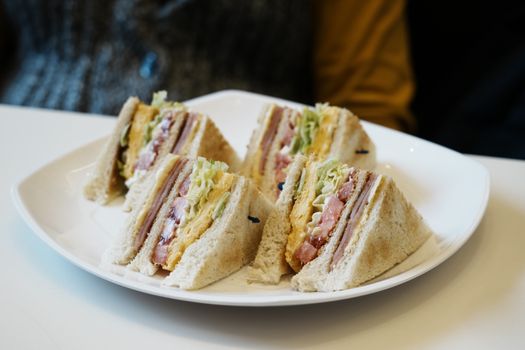
Photo: Yuen Tou Zan / Pexels
American
Classic Club Sandwich
The diets react (see scores below)
Common Ingredients
- turkey breast
- bacon
- white bread
- lettuce
- tomato
- mayonnaise
- Swiss cheese
Specific recipes may vary.
Incompatible with 9 of 11 diets
Diet Ratings
The Classic Club Sandwich is fundamentally incompatible with a ketogenic diet due to its white bread base. A standard club sandwich uses 2-3 slices of white bread, contributing approximately 40-60g of net carbs from the bread alone — enough to exceed or nearly max out the entire daily keto carb budget in a single meal. White bread is a refined grain with virtually no fiber to offset its carb load. The remaining ingredients — turkey breast, bacon, lettuce, tomato, mayonnaise, and Swiss cheese — are largely keto-friendly on their own, but they cannot redeem the dish in its standard form. The sandwich as a category depends structurally on bread, making it inherently problematic. There is no meaningful portion adjustment that allows white bread consumption within keto parameters.
The Classic Club Sandwich contains multiple animal products and is entirely incompatible with a vegan diet. Turkey breast is poultry (meat), bacon is cured pork (meat), mayonnaise is typically made with eggs, and Swiss cheese is a dairy product. Every primary protein and the condiment in this dish are derived from animals, making this one of the clearest possible violations of vegan dietary principles. There are no edge cases or ambiguities here.
The Classic Club Sandwich contains multiple non-paleo ingredients that disqualify it clearly and unambiguously. White bread is a refined grain product — one of the most fundamentally excluded foods in all paleo frameworks. Swiss cheese is dairy, excluded across all paleo authorities. Bacon, while meat-based, is a processed food typically cured with added salt, nitrates, and preservatives. Mayonnaise is commonly made with soybean or canola oil — both seed oils explicitly excluded under paleo rules. Turkey breast and lettuce/tomato are the only paleo-compliant components. The dish as a whole is fundamentally incompatible with the Paleolithic diet.
The Classic Club Sandwich conflicts with Mediterranean diet principles on multiple fronts. Bacon is a processed red meat high in saturated fat and sodium, which the Mediterranean diet explicitly discourages. White bread is a refined grain with minimal nutritional value, contrary to the whole grain emphasis. Mayonnaise is a processed condiment made from refined oils rather than the preferred extra virgin olive oil. Swiss cheese and turkey are more acceptable in moderation, and the lettuce and tomato are positive elements, but they are insufficient to offset the problematic core ingredients. The overall profile — processed meat, refined grain, processed fat source — places this firmly in 'avoid' territory.
The Classic Club Sandwich is fundamentally incompatible with the carnivore diet. While it contains some animal-derived ingredients (turkey breast, bacon, Swiss cheese, mayonnaise with eggs), the dish is built around white bread — a grain-based, plant-derived food that is strictly excluded on all tiers of the carnivore diet. Additionally, lettuce and tomato are plant foods explicitly prohibited, and commercial mayonnaise typically contains plant-based oils (soybean or canola oil). The sandwich format itself is defined by its bread, making this dish structurally non-carnivore. There is no version of a classic club sandwich that can be considered carnivore-compatible without a complete reconstruction that would render it an entirely different dish.
The Classic Club Sandwich contains multiple excluded ingredients that make it clearly incompatible with the Whole30 program. White bread is a grain-based product (wheat), which is explicitly excluded. Swiss cheese is dairy, also explicitly excluded. Bacon commonly contains added sugar and may contain other non-compliant additives. Even if compliant versions of bacon and mayonnaise were sourced, the bread alone would disqualify this dish. Furthermore, a sandwich itself falls squarely into the 'no recreating bread/junk food' rule — sandwiches and wraps are explicitly listed as off-limits on Whole30.
The Classic Club Sandwich is high-FODMAP primarily due to white wheat bread, which is a significant source of fructans — one of the most problematic FODMAP categories. A standard club sandwich uses 2-3 slices of white bread, making fructan intake substantial. Swiss cheese also contains lactose (though in relatively small amounts per slice, multiple slices could add up). Turkey breast, bacon, lettuce, tomato (limit to 65g/3 slices per Monash), and mayonnaise are individually low-FODMAP at standard servings. However, the wheat bread alone disqualifies this dish during the elimination phase. To make a low-FODMAP version, gluten-free bread would need to be substituted, and Swiss cheese should be kept to 1-2 thin slices (hard cheeses are lower in lactose).
The Classic Club Sandwich conflicts with DASH guidelines on multiple fronts. Bacon is a processed, cured meat that is high in sodium and saturated fat — both of which DASH explicitly limits. White bread is a refined grain, not the whole grain DASH emphasizes. Mayonnaise contributes saturated fat and sodium. Swiss cheese, while lower in sodium than many cheeses, still adds saturated fat and contributes to total sodium load. Together, a typical club sandwich can deliver 1,200–1,800mg of sodium in a single serving, which represents 52–78% of the standard DASH daily sodium limit and potentially exceeds the entire low-sodium DASH daily allowance. The turkey breast and vegetables (lettuce, tomato) are DASH-compatible elements, but they are outweighed by the problematic components. The combination of processed meat, refined grains, full-fat condiments, and high sodium makes this dish a poor fit for the DASH eating plan.
The Classic Club Sandwich presents significant Zone Diet challenges primarily due to its white bread base and its overall macro imbalance. White bread is a high-glycemic, 'unfavorable' carbohydrate in Zone terminology — it spikes blood sugar rapidly and has minimal fiber, making it difficult to balance within the 40/30/30 framework. The sandwich does contain Zone-friendly elements: turkey breast is a lean, favorable protein source, and lettuce and tomato are low-glycemic vegetable carbs. However, bacon adds saturated fat (unfavorable in Zone), Swiss cheese adds more saturated fat, and mayonnaise is typically made with omega-6-heavy seed oils (soybean or canola), which Sears specifically flags as pro-inflammatory. The fat profile skews heavily toward saturated and omega-6 fats rather than the preferred monounsaturated fats. To make this Zone-compatible, you would need to: swap white bread for a low-glycemic alternative or use one thin slice only, eliminate or minimize bacon, replace mayo with avocado or olive-oil-based spread, and control portion sizes carefully. As served in a classic preparation, it is a caution item — technically usable in Zone if heavily modified, but problematic as traditionally constructed.
The Classic Club Sandwich presents a mixed anti-inflammatory profile. On the positive side, turkey breast is a lean protein acceptable in moderation, and lettuce and tomato contribute modest antioxidants and phytonutrients. However, the dish has several pro-inflammatory components that collectively pull the score down. Bacon is processed red meat, high in saturated fat, sodium, and nitrates/nitrites, all of which are associated with increased inflammatory markers — this is the most significant concern. White bread is a refined carbohydrate with a high glycemic index that can spike blood sugar and promote inflammatory responses. Mayonnaise is typically made with refined seed oils (soybean or canola), contributing omega-6 fatty acids; while a single serving is not catastrophic, it adds to the dish's overall inflammatory burden. Swiss cheese is a full-fat dairy product, acceptable in small amounts but not anti-inflammatory. The combination of processed meat, refined carbs, and seed-oil-based condiment makes this a dish that should be consumed occasionally rather than regularly on an anti-inflammatory diet. Modifications — such as swapping white bread for whole grain, eliminating or reducing bacon, and replacing mayo with avocado or extra virgin olive oil — would substantially improve its profile.
The Classic Club Sandwich presents a mixed nutritional profile for GLP-1 patients. Turkey breast is a lean, high-quality protein source and a genuine positive, but bacon adds saturated fat and is a processed meat that GLP-1 guidelines recommend limiting. Mayonnaise is calorie-dense and high in fat, contributing to the nausea and reflux risk that high-fat foods carry on GLP-1 medications. Swiss cheese adds moderate protein but also saturated fat. White bread is a refined grain with low fiber and low nutrient density — a poor use of limited appetite on GLP-1s. The overall dish is moderately high in fat, low in fiber, and built on an empty-calorie carbohydrate base, which runs counter to the core priorities of protein density and nutrient density per calorie. The portion size is also substantial for a GLP-1 patient with reduced gastric capacity, and the layered fat sources (bacon, mayo, cheese together) meaningfully increase GI side effect risk. Turkey breast alone would score much higher — the issue is the full combination as prepared.
*See how scores were generated at our methodology page.
Nutritional profile
Six traits that cut across every diet.
Fiber & Plants
How much whole-plant food and fiber it delivers.
Healthy Fats
The quality of its fats (unsaturated, omega-3).
Whole / Unprocessed
How close it is to its natural, unprocessed form.
Gut Gentle
How easy it is on digestion (low FODMAP, few irritants).
Low Glycemic
How little it spikes your blood sugar.
Protein Density
How much protein it packs per calorie.
Controversy Index
Higher controversy = more disagreement between diets.
Diet-Specific Tips
 Anti-Inflammatory — 4/10
View tips
- Bacon is processed red meat high in saturated fat, sodium, and nitrates — a notable pro-inflammatory ingredient
- White bread is a refined carbohydrate with high glycemic index, associated with increased inflammatory markers
- Mayonnaise typically contains refined seed oils (high omega-6), adding to inflammatory load
- Turkey breast is a lean protein, acceptable in anti-inflammatory eating
- Lettuce and tomato contribute antioxidants and anti-inflammatory phytonutrients, though in modest quantities
- Swiss cheese adds saturated fat; full-fat dairy is flagged as a food to limit
- Overall dish is calorie-dense with few strong anti-inflammatory components to offset the pro-inflammatory ones
 GLP-1 Friendly — 4/10
View tips
- Turkey breast is a lean, high-quality protein source — a genuine positive
- Bacon is a processed, high-saturated-fat meat explicitly flagged for limiting on GLP-1 diets
- Mayonnaise is calorie-dense and high in fat, increasing nausea and reflux risk
- Swiss cheese adds protein but also saturated fat, compounding the fat load alongside bacon and mayo
- White bread is a refined grain: low fiber, low nutrient density, poor use of limited appetite
- No meaningful fiber contributors in this dish
- Large portion relative to reduced gastric capacity on GLP-1 medications
- Multiple fat sources combined in one meal is a known GLP-1 GI trigger