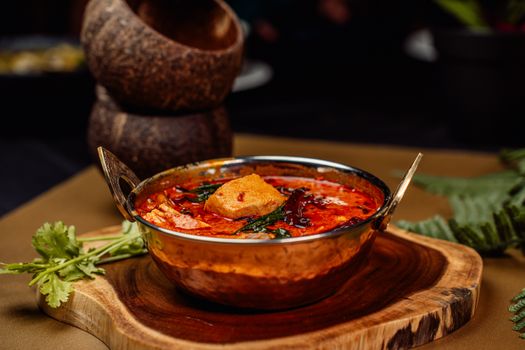
Photo: athul santhosh / Pexels
Indian
South Indian Coconut Fish Curry
The diets react (see scores below)
Common Ingredients
- white fish
- coconut milk
- curry leaves
- mustard seeds
- tamarind
- ginger
- green chilies
- turmeric
Specific recipes may vary.
Incompatible with 2 of 11 diets
Diet Ratings
South Indian Coconut Fish Curry is a strong keto fit overall. White fish provides lean, high-quality protein, and full-fat coconut milk supplies significant healthy fats (primarily MCTs, which are particularly beneficial for ketosis). The aromatics — curry leaves, mustard seeds, ginger, green chilies, and turmeric — contribute negligible net carbs in typical cooking quantities. The main concern is tamarind, which contains meaningful carbohydrates (roughly 25g net carbs per 100g of paste/pulp). However, in a typical curry, tamarind is used sparingly (1-2 tablespoons of paste) for tartness, contributing perhaps 3-6g net carbs to the whole dish and roughly 1-2g per serving. At standard portion sizes, the dish comfortably stays within keto daily limits, making it approvable with awareness of tamarind quantity.
Strict keto practitioners and clinical protocol followers may flag tamarind as a sugar-containing ingredient to avoid entirely, arguing that even small amounts of fruit-derived sugars can disrupt metabolic state in insulin-sensitive individuals. Some in this camp would substitute tamarind with apple cider vinegar or lemon juice to achieve tartness without any fruit sugars.
South Indian Coconut Fish Curry contains white fish as its primary protein, which is an animal product explicitly excluded under all vegan dietary frameworks. Fish are animals, and their flesh is unambiguously non-vegan. The remaining ingredients — coconut milk, curry leaves, mustard seeds, tamarind, ginger, green chilies, and turmeric — are all fully plant-based, but the presence of fish makes the dish incompatible with a vegan diet regardless.
South Indian Coconut Fish Curry is an excellent paleo dish. Every ingredient aligns cleanly with paleo principles: white fish is a premier hunter-gatherer protein source; coconut milk is a whole-food fat widely accepted in paleo; curry leaves, mustard seeds, tamarind, ginger, green chilies, and turmeric are all natural herbs, spices, and plant foods available in unprocessed form. There are no grains, legumes, dairy, refined sugars, seed oils, or processed additives. The dish is nutrient-dense, anti-inflammatory (turmeric, ginger), and representative of the whole-food animal protein plus vegetables and natural fats framework that defines paleo eating.
This dish features white fish as its primary protein, which is strongly encouraged in the Mediterranean diet (2-3 times weekly). The spices — turmeric, ginger, green chilies, curry leaves, mustard seeds, and tamarind — are all whole, plant-based ingredients with anti-inflammatory properties broadly consistent with Mediterranean principles. However, coconut milk is a significant departure: the Mediterranean diet uses extra virgin olive oil as its primary fat source, and coconut milk is high in saturated fat, which is not characteristic of traditional Mediterranean cuisine. The dish scores well on protein choice and whole-food spice profile, but the coconut milk base pulls it away from core Mediterranean fat guidelines, warranting a cautious rating rather than approval.
Some modern, flexible interpretations of the Mediterranean diet focus on its anti-inflammatory and whole-food principles rather than strict geographic origins, and would view coconut milk as an acceptable plant-based fat in modest amounts, especially given the strong fish and spice profile. Conversely, stricter clinical guidelines (such as those from the Harvard T.H. Chan School of Public Health) emphasize replacing saturated fats with unsaturated ones, placing coconut milk in direct tension with Mediterranean fat recommendations regardless of culinary tradition.
While white fish is a carnivore-approved animal protein, this dish is heavily plant-based in its preparation. Coconut milk, curry leaves, mustard seeds, tamarind, ginger, green chilies, and turmeric are all plant-derived ingredients that are explicitly excluded on the carnivore diet. The fish itself represents only a fraction of the dish's composition, and the entire flavor and cooking framework is built around plant foods and spices. This dish cannot be adapted within its current form — it would need to be stripped down to just the fish prepared with animal fats and salt to be carnivore-compatible.
All ingredients in this South Indian Coconut Fish Curry are fully Whole30-compliant. White fish is an explicitly allowed protein. Coconut milk is a compliant natural fat (check labels to ensure no added sugars or non-compliant additives, but plain coconut milk is standard and allowed). Curry leaves, mustard seeds, ginger, green chilies, and turmeric are all herbs and spices, which are explicitly permitted. Tamarind is a natural fruit-based souring agent with no excluded ingredients. This dish is a straightforward, whole-food preparation with no grains, legumes, dairy, added sugars, or other excluded ingredients.
Most ingredients in this dish are low-FODMAP: white fish is protein with no FODMAPs, curry leaves are used in small quantities and are low-FODMAP, mustard seeds are low-FODMAP, ginger is low-FODMAP at standard culinary amounts (up to ~1 tsp), turmeric is low-FODMAP, and green chilies are low-FODMAP. The two ingredients requiring attention are coconut milk and tamarind. Coconut milk is low-FODMAP at 1/2 cup (125ml) per Monash but becomes high-FODMAP at larger serves due to sorbitol content — a curry sauce often uses more than this threshold. Tamarind is low-FODMAP at small amounts (1 tablespoon of tamarind paste per Monash) but can exceed safe limits depending on how much is used for flavor balance in the recipe. The dish is fundamentally sound from a FODMAP perspective, but the dose-dependent nature of coconut milk and tamarind introduces practical risk depending on preparation, making a cautious approval more appropriate than a full approval.
Monash University rates coconut milk as low-FODMAP at up to 1/2 cup per serve, but many clinical FODMAP practitioners note that curry recipes routinely exceed this amount per portion, and the sorbitol content can trigger symptoms — some practitioners advise using a small amount of coconut cream diluted with water as a workaround. Tamarind paste at 1 tablespoon is considered safe per Monash, but the actual amount used in restaurant-style or home curries is variable and not always disclosed.
South Indian Coconut Fish Curry has both DASH-friendly and DASH-problematic elements. On the positive side, white fish is an excellent lean protein source encouraged by DASH guidelines, and the spices (turmeric, ginger, mustard seeds, curry leaves, green chilies, tamarind) are low-sodium, anti-inflammatory, and nutritionally neutral or beneficial. However, the primary concern is full-fat coconut milk, which is high in saturated fat — a macronutrient DASH explicitly limits. A typical serving using full-fat coconut milk can deliver 10-15g of saturated fat, significantly impacting the daily saturated fat budget. If light or reduced-fat coconut milk is substituted, the dish becomes considerably more DASH-compatible. Tamarind adds a small amount of natural sugars and potassium, which is net positive. Sodium levels depend heavily on preparation — no added salt versions score higher. Overall, this dish sits in the caution zone due to coconut milk's saturated fat content, despite its otherwise lean, spice-forward profile.
NIH DASH guidelines explicitly restrict saturated fat and identify tropical oils (including coconut products) as foods to limit, which would push this dish toward 'avoid' territory if coconut milk is used liberally. However, some updated clinical interpretations note that the medium-chain triglycerides (MCTs) in coconut milk may have a different metabolic profile than long-chain saturated fats, and that modest portions of coconut milk in an otherwise nutrient-rich dish may be acceptable within a DASH-adjacent eating pattern — though the AHA and most DASH clinicians still recommend limiting coconut-based fats.
South Indian Coconut Fish Curry has strong Zone-compatible elements but requires careful portioning due to coconut milk. White fish is an excellent lean protein source, ideal for Zone meals. The aromatic ingredients (curry leaves, mustard seeds, tamarind, ginger, green chilies, turmeric) are low-calorie, polyphenol-rich, and anti-inflammatory — well-aligned with Sears' later emphasis on polyphenols and omega-3 balance. The problem is coconut milk: it is high in saturated fat (predominantly lauric acid) and contains medium-chain triglycerides. Early Zone writings strictly limit saturated fat, making full-fat coconut milk an 'unfavorable' fat source. However, the fat profile here is not monounsaturated (olive oil, avocado, almonds), which is the Zone ideal. In practical terms, a portion-controlled serving using light coconut milk or a reduced quantity of full-fat coconut milk can fit into a Zone meal — you would count the coconut milk fat against your fat blocks and limit the serving size to keep saturated fat in check. The dish lacks carbohydrate blocks as described, so it would need to be paired with low-glycemic vegetables or a small amount of fruit to achieve the 40/30/30 ratio. As a main dish component, it scores as a cautious approve: the protein is ideal, the spices are anti-inflammatory, but the coconut milk fat source requires portioning discipline.
Sears' later works (The Anti-Inflammation Zone, The OmegaRx Zone) take a more nuanced view of saturated fat, acknowledging that medium-chain triglycerides in coconut are metabolized differently than long-chain saturated fats and may not drive the same inflammatory eicosanoid pathways. Some Zone practitioners following Sears' updated anti-inflammatory framework would rate this dish more favorably, particularly if made with light coconut milk, citing the strong polyphenol profile of the spices and the omega-3-friendly white fish as offsetting the coconut fat concern.
This South Indian curry has a strong anti-inflammatory foundation. Turmeric provides curcumin, one of the most well-studied anti-inflammatory compounds. Ginger contains gingerols and shogaols with demonstrated anti-inflammatory and antioxidant effects. Green chilies supply capsaicin, which inhibits NF-κB inflammatory pathways. Curry leaves are rich in carbazole alkaloids and antioxidants. Tamarind contributes polyphenols and tartaric acid with antioxidant properties. Mustard seeds contain glucosinolates and selenium. White fish (e.g., tilapia, cod, snapper) is lean, low in saturated fat, and a clean protein source, though it is not as omega-3-rich as fatty fish like salmon or mackerel — this is the dish's main nutritional limitation. The primary point of debate is coconut milk: it is high in saturated fat (predominantly lauric acid), which many anti-inflammatory frameworks — including Dr. Weil's — recommend limiting. However, lauric acid's inflammatory impact is debated, and traditional anti-inflammatory cuisine (including Ayurvedic practice) has long used coconut in therapeutic contexts. The overall spice profile is excellent, and the dish avoids seed oils, refined carbohydrates, added sugars, and processed ingredients entirely.
Coconut milk is high in saturated fat, and mainstream anti-inflammatory guidelines (including Dr. Weil's pyramid) recommend limiting saturated fat intake, which could lower this dish's rating. However, a significant counter-argument from paleo and ancestral health practitioners holds that lauric acid in coconut has antimicrobial and potentially anti-inflammatory properties, and that whole-food saturated fats behave differently from processed sources — making coconut milk acceptable or even beneficial in this framework.
South Indian Coconut Fish Curry has genuine strengths for GLP-1 patients — white fish is a lean, high-quality protein source that is easy to digest, and the dish includes anti-inflammatory, digestion-supporting spices (turmeric, ginger, curry leaves, mustard seeds). Tamarind adds trace fiber and micronutrients with minimal calories. However, the primary concern is coconut milk: a standard curry made with full-fat coconut milk is high in saturated fat, which can worsen GLP-1 side effects including nausea, bloating, and reflux. Green chilies are a moderate GI irritant that some patients on GLP-1s tolerate poorly due to slowed gastric emptying amplifying spice exposure time. The dish is portion-sensitive — a small serving with light coconut milk over a high-fiber grain (e.g., brown rice) can be a solid GLP-1-compatible meal, but a generous restaurant-style portion in full-fat coconut milk tips this into problematic territory. The dish can be upgraded meaningfully by substituting light coconut milk or reducing coconut milk volume, keeping chili moderate, and pairing with fiber-rich sides.
Some GLP-1-focused dietitians accept coconut milk in modest amounts given that the medium-chain triglycerides (MCTs) it contains may be somewhat easier to metabolize than long-chain saturated fats, and argue that the lean fish protein and anti-inflammatory spice profile outweigh the fat concern in small portions. Others flag that GLP-1 patients have heightened sensitivity to high-fat meals due to delayed gastric emptying and recommend avoiding coconut milk entirely in favor of tomato- or broth-based curries.
*See how scores were generated at our methodology page.
Nutritional profile
Six traits that cut across every diet.
Fiber & Plants
How much whole-plant food and fiber it delivers.
Healthy Fats
The quality of its fats (unsaturated, omega-3).
Whole / Unprocessed
How close it is to its natural, unprocessed form.
Gut Gentle
How easy it is on digestion (low FODMAP, few irritants).
Low Glycemic
How little it spikes your blood sugar.
Protein Density
How much protein it packs per calorie.
Controversy Index
Higher controversy = more disagreement between diets.
Diet-Specific Tips
 Keto — 8/10
View tips
- White fish is an excellent lean keto protein source
- Full-fat coconut milk provides MCT-rich healthy fats, ideal for ketosis
- Tamarind adds some net carbs but is used in small quantities — portion control matters
- Aromatics (curry leaves, mustard seeds, ginger, chilies, turmeric) are keto-safe in cooking amounts
- No grains, starchy vegetables, or added sugars in the ingredient list
- Dish is whole and unprocessed, aligning with keto food quality principles
 Paleo — 9/10
View tips
- White fish is a top-tier paleo protein — unprocessed, wild-caught ideal
- Coconut milk is a whole-food fat fully approved across all paleo frameworks
- Turmeric and ginger are anti-inflammatory spices with strong paleo endorsement
- Tamarind is a natural fruit-derived souring agent with no paleo objections
- Mustard seeds and curry leaves are unprocessed whole spices — fully compliant
- No grains, legumes, dairy, seed oils, or refined ingredients present
- Dish is naturally low in anti-nutrients and highly nutrient-dense
 Mediterranean — 5/10
View tips
- White fish is a Mediterranean-approved protein, encouraged 2-3 times per week
- Coconut milk is high in saturated fat and not a traditional Mediterranean fat source
- No olive oil present — the canonical Mediterranean primary fat is absent
- All spices and aromatics are whole, minimally processed plant foods
- No refined grains, added sugars, or processed ingredients
- Non-Mediterranean cuisine tradition introduces interpretive ambiguity
 Whole30 — 9/10
View tips
- White fish is explicitly allowed as a seafood protein
- Coconut milk is a compliant natural fat — verify no added sugars or carrageenan on packaged versions (though carrageenan is now allowed per 2024 rules)
- Curry leaves, mustard seeds, turmeric, ginger, and green chilies are all compliant herbs and spices
- Tamarind is a natural fruit-derived ingredient with no excluded components
- No grains, legumes, dairy, or added sugars present
- Dish is a whole-food preparation with no 'junk food recreation' concerns
 Low-FODMAP — 6/10
View tips
- White fish is FODMAP-free and safe as primary protein
- Coconut milk is low-FODMAP at ≤1/2 cup but high-FODMAP at larger quantities due to sorbitol — portion size is critical
- Tamarind paste is low-FODMAP at ≤1 tablespoon; larger amounts may increase FODMAP load
- Curry leaves, mustard seeds, turmeric, and green chilies are all low-FODMAP at culinary amounts
- Ginger is low-FODMAP at up to ~1 tsp fresh grated — standard culinary use is safe
- No garlic or onion present — a major positive for a South Asian dish
- Overall FODMAP risk is serving-size dependent, particularly around coconut milk quantity
 DASH — 5/10
View tips
- Full-fat coconut milk is high in saturated fat, which DASH explicitly limits
- White fish is a DASH-approved lean protein source
- Spices (turmeric, ginger, mustard seeds, curry leaves) are sodium-free and anti-inflammatory
- No inherently high-sodium ingredients if prepared without added salt
- Substituting light coconut milk would improve DASH compatibility significantly
- Tamarind contributes potassium and natural acidity without sodium
- Portion size of coconut milk is critical to keeping saturated fat within DASH limits
 Zone — 6/10
View tips
- White fish is an ideal Zone lean protein — low fat, high protein, easily portioned to ~25g per meal
- Coconut milk is high in saturated fat, which conflicts with Zone's preference for monounsaturated fats
- Curry leaves, turmeric, ginger, and tamarind are polyphenol-rich and anti-inflammatory, aligning with Sears' updated dietary emphasis
- Dish as described is carbohydrate-deficient and must be paired with low-glycemic vegetables to achieve 40/30/30 ratio
- Light coconut milk or reduced portions of full-fat coconut milk can bring the dish into Zone compliance
- No high-glycemic ingredients present — tamarind adds a small carbohydrate load but is used in small quantities
- Overall fat block management is the primary challenge for Zone compliance
 Anti-Inflammatory — 7/10
View tips
- Turmeric (curcumin): well-established anti-inflammatory compound
- Ginger: gingerols and shogaols reduce inflammatory cytokines
- Green chilies: capsaicin inhibits NF-κB inflammatory signaling
- Curry leaves: rich in antioxidant carbazole alkaloids
- Tamarind: polyphenols with antioxidant and anti-inflammatory activity
- Mustard seeds: glucosinolates and selenium with anti-inflammatory properties
- White fish: lean protein, low saturated fat, but limited omega-3s compared to fatty fish
- Coconut milk: high in lauric acid (saturated fat) — debated in anti-inflammatory context
- No seed oils, refined grains, added sugars, or artificial additives
 GLP-1 Friendly — 5/10
View tips
- White fish is lean, high-quality protein — strong GLP-1 positive
- Full-fat coconut milk is high in saturated fat and can worsen nausea, bloating, and reflux
- Green chilies may irritate GI tract; slowed gastric emptying extends spice exposure
- Ginger and turmeric are digestion-supportive and anti-inflammatory
- Dish is highly portion- and preparation-sensitive — light coconut milk significantly improves the profile
- Low fiber content unless paired with whole grains or vegetables
- Tamarind adds micronutrients and mild digestive benefit with minimal caloric cost