Chinese
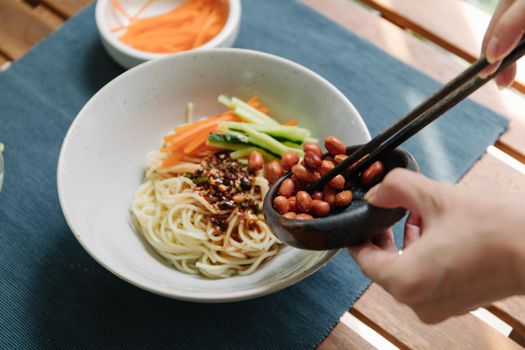
Cold Sesame Noodles
The diets react (see scores below)
Common Ingredients
- Chinese wheat noodles
- sesame paste
- soy sauce
- black vinegar
- sugar
- chili oil
- garlic
- scallions
Specific recipes may vary.
Incompatible with 7 of 11 diets
Diet Ratings
Cold Sesame Noodles are fundamentally incompatible with a ketogenic diet. The primary ingredient, Chinese wheat noodles, is a grain-based food with extremely high net carbs — a single serving can easily contain 40-60g of net carbs, instantly exceeding the daily keto limit on its own. Compounding this, the recipe includes added sugar, which has zero place in a ketogenic diet. While sesame paste, chili oil, soy sauce, garlic, and scallions are individually keto-friendly or low-carb, they cannot offset the massive carbohydrate load from the noodles and sugar. This dish would definitively break ketosis.
Cold sesame noodles as listed contain exclusively plant-based ingredients. Chinese wheat noodles are flour-and-water based, sesame paste is made from ground sesame seeds, soy sauce and black vinegar are fermented plant products, and chili oil, garlic, scallions, and sugar round out a fully vegan profile. No animal products or animal-derived ingredients are present. The dish is minimally processed and built around whole-food components (sesame, garlic, scallions), earning a solid score. One minor caveat: some Chinese wheat noodle brands include egg, so label-checking is advisable, but the standard category default is egg-free.
Cold Sesame Noodles is fundamentally incompatible with the Paleo diet. The base ingredient, Chinese wheat noodles, is a grain product — one of the most clearly excluded food categories in all paleo frameworks. Beyond the noodles, soy sauce is derived from fermented soybeans (a legume) and typically contains wheat, making it doubly non-paleo. Sugar is a refined sweetener, explicitly excluded. Black vinegar, while less problematic on its own, is grain-derived (typically from glutinous rice or sorghum). Sesame paste and chili oil both involve sesame oil, a seed oil excluded under paleo guidelines. The only paleo-compliant ingredients in this dish are garlic and scallions. With the majority of ingredients — including the dish's foundation — firmly in the 'avoid' category, this dish scores at the bottom of the scale.
Cold sesame noodles present several concerns from a Mediterranean diet perspective. The base is refined wheat noodles (not whole grain), which fall into the refined grains category discouraged by Mediterranean principles. The dish contains added sugar, which is minimized in the Mediterranean diet. Sesame paste is a nutritious seed-based fat, but it replaces the canonical extra virgin olive oil. Soy sauce is a processed condiment with high sodium. The garlic and scallions are positive elements. Overall, this dish is built on a refined grain base with added sugar and no whole food plant emphasis, making it a poor fit.
Some modern, flexible Mediterranean diet interpretations acknowledge sesame paste (tahini) as a nutritious plant-based fat used in Eastern Mediterranean cuisines like Lebanese and Israeli cooking, and might score this higher if whole grain noodles were substituted and sugar removed. The core aromatics (garlic, scallions, chili) align with Mediterranean flavor principles.
Cold Sesame Noodles are entirely plant-based and contain no animal products whatsoever. Every single ingredient violates carnivore diet principles: wheat noodles are a grain, sesame paste and chili oil are plant-derived fats, soy sauce is a fermented legume product, black vinegar is grain-derived, sugar is a refined carbohydrate, and garlic and scallions are vegetables. This dish represents the antithesis of carnivore eating — high-carbohydrate, plant-oil-heavy, with zero animal-derived nutrition. There is universal consensus across all carnivore diet camps, from the strictest Lion Diet to the more inclusive animal-based approach, that this dish is entirely incompatible.
Cold Sesame Noodles contain multiple excluded ingredients that disqualify it from Whole30. First, Chinese wheat noodles are a grain-based pasta/noodle product — grains (wheat) are explicitly excluded, and noodles are specifically called out in the 'no recreating' rule. Second, soy sauce contains soy (a legume) and typically wheat, both excluded. Third, sugar is an added sugar, explicitly excluded. Black vinegar may also contain grains. Even if individual substitutions were made (e.g., coconut aminos for soy sauce, omitting sugar), the dish as described with wheat noodles cannot be made Whole30-compliant, since there is no compliant noodle substitute that fits the program's rules (pasta and noodles are explicitly prohibited even with compliant ingredients).
Cold Sesame Noodles as traditionally prepared contain multiple high-FODMAP ingredients that make this dish unsuitable during the elimination phase. Chinese wheat noodles are made from wheat flour, which is high in fructans — a major FODMAP — and there is no realistic serving size at which a standard portion of wheat noodles becomes low-FODMAP. Garlic is one of the highest-FODMAP foods tested by Monash University, containing significant fructans even in very small amounts, and it is a core flavoring in this dish. Scallions (green onions) are moderate — the green tops are low-FODMAP but the white bulb portions are high in fructans; in typical preparation both parts may be used. Sesame paste (tahini) is generally low-FODMAP at standard servings (~2 tbsp). Soy sauce is low-FODMAP in small amounts (~2 tbsp). Black vinegar and sugar are low-FODMAP. Chili oil is low-FODMAP. However, the combination of wheat noodles and garlic alone makes this dish clearly high-FODMAP with no practical modification path without fundamentally changing the recipe (e.g., substituting rice noodles and garlic-infused oil).
Cold sesame noodles present multiple significant DASH diet concerns. The primary issue is sodium: soy sauce is extremely high in sodium (roughly 900–1,000mg per tablespoon), and a typical serving of this dish can easily exceed 1,000–1,500mg of sodium on its own — potentially consuming the entire day's allowance on the stricter DASH target of 1,500mg. Black vinegar adds modest additional sodium. Sesame paste (tahini) contributes healthy unsaturated fats and some calcium, which are DASH-positive, but the overall dish profile is dominated by high-sodium condiments. Sugar and chili oil add empty calories and fat with minimal nutritional benefit. The refined wheat noodles (not whole grain) offer little fiber. Garlic and scallions are DASH-friendly ingredients, but they are minor components. The dish lacks lean protein, significant potassium, calcium, or magnesium contributions, and provides no meaningful servings from the DASH-emphasized food groups (vegetables, fruit, low-fat dairy, whole grains). Modifications such as low-sodium soy sauce, whole-grain noodles, and added vegetables could improve the score considerably.
Cold Sesame Noodles present significant Zone Diet challenges. The dish is carbohydrate-dominant with high-glycemic Chinese wheat noodles as the base, added sugar in the sauce, and virtually no lean protein. The 40/30/30 macro ratio is severely disrupted: this meal skews heavily toward carbohydrates (likely 60-70% of calories) with inadequate protein and a fat profile dominated by sesame paste (high in omega-6 polyunsaturated fat from sesame, which Sears discourages due to its pro-inflammatory potential). The sugar addition pushes the glycemic load higher. Chili oil and sesame paste contribute fats, but these are not the preferred monounsaturated fats (olive oil, avocado, macadamia). With no protein source listed, this dish cannot function as a Zone meal without major reconstruction — adding a lean protein (chicken, shrimp, tofu) and dramatically reducing noodle portion. As-is, it is practically impossible to Zone-balance without fundamentally changing the dish, pushing it toward the lower end of the caution range.
Cold sesame noodles present a mixed anti-inflammatory profile. On the positive side, sesame paste (tahini) provides calcium, zinc, and sesamin/sesamolin — lignans with documented antioxidant and mild anti-inflammatory properties. Garlic is a well-established anti-inflammatory ingredient rich in allicin and organosulfur compounds. Chili oil contributes capsaicin, which has anti-inflammatory effects. Black vinegar contains polyphenols and acetic acid, which may support metabolic health. Scallions add quercetin and flavonoids. However, the dish is built on a refined wheat noodle base — a refined carbohydrate that provides minimal fiber and can spike blood glucose, potentially promoting low-grade inflammation. The added sugar is a modest but real concern, as added sugars are clearly pro-inflammatory. Soy sauce is highly processed and very high in sodium, though present in small quantities. The chili oil, depending on the base oil used (often a seed oil like soybean or vegetable oil), may introduce omega-6 concerns, though quantities are typically small. Overall, this is an 'acceptable in moderation' dish — not a health food but not flagrantly pro-inflammatory either. Swapping refined noodles for whole wheat or soba, reducing sugar, and using quality chili oil would meaningfully improve the profile.
Some anti-inflammatory practitioners, particularly those following a stricter Weil-aligned or blood sugar-focused approach, would rate this lower due to the refined white noodle base and added sugar, arguing that even moderate glycemic spikes from refined carbs consistently elevate CRP over time. Conversely, traditional food researchers note that fermented components like black vinegar and the micronutrient density of sesame paste elevate this above typical refined-carb dishes, and that dose matters — small amounts of sugar and sodium in a home-cooked dish differ meaningfully from processed food exposure.
Cold sesame noodles present several challenges for GLP-1 patients. The base is refined wheat noodles — high in refined carbohydrates, low in fiber, and moderate in calories with minimal nutritional density per bite. Sesame paste (tahini) is calorie-dense and high in fat, which can worsen GLP-1 side effects like nausea and delayed gastric emptying. Chili oil adds additional fat and may trigger reflux or GI discomfort in patients already sensitive to spicy or oily foods. Sugar adds empty calories. On the positive side, garlic and scallions offer micronutrients, black vinegar may aid digestion, and the dish is served cold making it easy to eat in small portions. However, the absence of any significant protein source is the most critical issue — protein is the top priority for GLP-1 patients to prevent muscle loss, and this dish as described provides essentially none. The fat-to-protein ratio is unfavorable. As an occasional small side dish paired with a lean protein (grilled chicken, edamame, tofu), it becomes more acceptable, but as a standalone main it is poorly suited for GLP-1 dietary needs.
Some GLP-1-focused dietitians may rate this more favorably if sesame paste is recognized as a source of unsaturated fats and plant-based micronutrients, and if the portion is kept very small as a flavor-forward accompaniment rather than a main dish. However, most clinical guidance for GLP-1 patients would flag the low protein, refined carb base, and high fat content as meaningful concerns, particularly for patients still managing nausea in early treatment phases.
*See how scores were generated at our methodology page.
Nutritional profile
Six traits that cut across every diet.
Fiber & Plants
How much whole-plant food and fiber it delivers.
Healthy Fats
The quality of its fats (unsaturated, omega-3).
Whole / Unprocessed
How close it is to its natural, unprocessed form.
Gut Gentle
How easy it is on digestion (low FODMAP, few irritants).
Low Glycemic
How little it spikes your blood sugar.
Protein Density
How much protein it packs per calorie.
Controversy Index
Higher controversy = more disagreement between diets.
Diet-Specific Tips
 Vegan — 8/10
View tips
- All listed ingredients are plant-derived
- Sesame paste provides healthy fats and protein from whole seeds
- Fermented condiments (soy sauce, black vinegar) are vegan-standard
- Chili oil typically uses plant-based oil infused with dried chili
- Caution: some Chinese wheat noodle brands add egg — verify the specific product label
- Sugar sourcing (bone char filtering) is a minor theoretical concern some strict vegans raise, but does not affect the dish's vegan classification
 Zone — 5/10
View tips
- High-glycemic Chinese wheat noodles are an 'unfavorable' Zone carb and dominate the calorie profile
- Added sugar in the sauce further elevates glycemic load
- No protein source listed — critically fails the 30% protein requirement
- Sesame paste is high in omega-6 fats, which Sears classifies as pro-inflammatory
- Chili oil and sesame fat are not the preferred monounsaturated fat sources (olive oil, avocado)
- Could theoretically be partially salvaged with very small noodle portions plus added lean protein, but the dish as described is not Zone-compatible
 Anti-Inflammatory — 5/10
View tips
- Sesame paste provides lignans (sesamin, sesamolin) with antioxidant and anti-inflammatory properties
- Garlic is a well-documented anti-inflammatory ingredient (allicin, organosulfur compounds)
- Chili oil contributes capsaicin, a known anti-inflammatory compound
- Black vinegar and scallions add polyphenols and flavonoids
- Chinese wheat noodles are a refined carbohydrate with low fiber — pro-inflammatory at regular consumption
- Added sugar, even in small amounts, is a clear anti-inflammatory concern
- Soy sauce is high in sodium and highly processed, though used in small quantities
- Chili oil base may introduce omega-6 seed oils depending on preparation
 GLP-1 Friendly — 4/10
View tips
- No meaningful protein source — fails the #1 GLP-1 dietary priority
- Refined wheat noodles are low in fiber and low in nutrient density per calorie
- Sesame paste is calorie-dense and high in fat, which may worsen nausea and delayed gastric emptying
- Chili oil adds saturated/pro-inflammatory fat and may trigger reflux or GI discomfort
- Sugar adds empty calories with no nutritional benefit
- Small portion tolerance is acceptable — dish can be eaten in modest amounts
- Could be rescued nutritionally if paired with a lean protein like grilled chicken, shrimp, or tofu