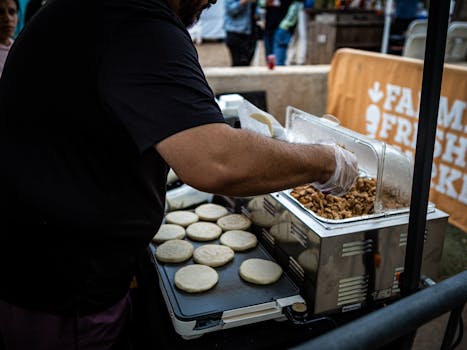
Photo: Connor Scott McManus / Pexels
The diets react (see scores below)
Common Ingredients
- masarepa
- cheese
- butter
- salt
- water
- corn
- oil
- scallions
Specific recipes may vary.
Incompatible with 5 of 11 diets
Diet Ratings
Arepas are fundamentally incompatible with a ketogenic diet. The primary ingredient, masarepa (precooked cornmeal), is a refined grain product with extremely high net carbs — a single standard arepa can contain 25-35g of net carbs on its own, easily exceeding or consuming the entire daily keto carb budget in one snack. Corn itself is also listed as an ingredient, further compounding the carbohydrate load. While the cheese and butter components are keto-friendly, they are minor contributors to the overall macronutrient profile. The dish is grain-based by definition and cannot be modified into a keto-compatible form without fundamentally changing what it is.
This arepa recipe contains cheese and butter, both of which are dairy products derived from animals. Dairy is unambiguously excluded from vegan diets under all mainstream vegan frameworks. The base ingredients — masarepa (precooked corn flour), corn, scallions, salt, water, and oil — are fully plant-based, but the inclusion of cheese and butter makes the dish as listed non-vegan. Arepas can easily be made vegan by omitting cheese and butter, substituting plant-based alternatives or simply using the plain dough with oil.
Arepas are fundamentally incompatible with the paleo diet. The primary ingredient, masarepa (pre-cooked cornmeal), is a processed grain product — corn is a grain explicitly excluded from paleo. Beyond masarepa, the dish contains multiple additional non-paleo ingredients: cheese is dairy, butter is dairy, salt (added) is excluded, and unspecified 'oil' likely refers to a seed oil. Corn itself, even in whole form, is a grain and excluded. With the majority of ingredients violating core paleo principles, this dish cannot be reconciled with the diet in any meaningful way.
Arepas are made from masarepa (refined/pre-cooked corn flour), which is a refined grain product rather than a whole grain, placing it closer to the 'minimize refined grains' category of the Mediterranean diet. The inclusion of cheese and butter adds saturated fat and dairy, which are acceptable in moderation but not core components. The oil used for cooking is unspecified — if it were olive oil, that would be more aligned; if it is a neutral vegetable oil or other fat, less so. Butter specifically is not a Mediterranean staple fat. Corn and scallions are positive vegetable components. Overall, arepas are a culturally distinct food with no direct Mediterranean tradition, made primarily from refined corn flour with added dairy fat, making them a moderate-caution item that could be eaten occasionally but is not a Mediterranean dietary staple.
Some Mediterranean diet interpreters note that corn-based foods have been integrated into certain Southern European and Mediterranean-adjacent cuisines (e.g., polenta in Northern Italy uses refined cornmeal similarly), and that the vegetable components and moderate dairy are not inherently problematic. If prepared with olive oil instead of butter and reduced cheese, arepas could be viewed as an acceptable occasional grain-based snack.
Arepas are fundamentally incompatible with the carnivore diet. The base ingredient is masarepa (pre-cooked corn flour), and the dish also contains whole corn — both are plant-derived grains that are strictly excluded from carnivore. Scallions are plant-based vegetables, also excluded. The plant-based oil is another excluded ingredient. While cheese and butter are animal-derived dairy products (debated but conditionally accepted by many carnivore practitioners), they are completely overwhelmed by the dominant plant-based components. This dish is a grain-based snack at its core, with no animal protein as the primary ingredient. There is universal consensus in the carnivore community that grain-based foods like corn and corn flour are among the most clearly excluded foods.
Arepas are fundamentally excluded from Whole30 on multiple grounds. First, masarepa (precooked corn flour) is a corn-based grain product, and corn/grains are explicitly excluded from the Whole30 program. Second, cheese is dairy, which is also explicitly excluded. Third, regular butter is excluded (only ghee/clarified butter is permitted). Finally, arepas fall squarely into the 'no recreating baked goods, bread, or grain-based staples' rule — they are essentially flatbreads/corn cakes, a category explicitly listed as off-limits (tortillas, wraps, crackers, etc. are all cited). Even if dairy were swapped out, the corn-flour base alone disqualifies this dish entirely.
Arepas are traditionally made from masarepa (precooked cornmeal), which is low-FODMAP and a safe base. Plain corn and oil are also low-FODMAP. However, several ingredients introduce FODMAP concerns: (1) Cheese — hard/aged cheeses (e.g., cheddar, parmesan) are low-FODMAP due to minimal lactose, but if a soft, fresh cheese like queso blanco or ricotta is used (common in arepas), lactose becomes an issue. The ingredient simply lists 'cheese,' so the type is ambiguous. (2) Butter — low-FODMAP at standard servings as it's low in lactose. (3) Scallions — the green tops are low-FODMAP, but the white bulb portions are high in fructans. If the recipe uses the whole scallion including white parts, this raises FODMAP load. (4) Corn — canned corn is low-FODMAP at ~1/2 cup; fresh corn on the cob is low-FODMAP at one small cob. These are manageable at typical arepa servings. Overall, the dish is potentially low-FODMAP if hard cheese is used and only green scallion tops are included, but the ambiguity of ingredients as listed — particularly cheese type and scallion portions — warrants a caution rating during the elimination phase.
Monash University rates masarepa (cornmeal) and corn as low-FODMAP at standard servings, which would suggest approval for a basic arepa. However, clinical FODMAP practitioners would flag the unspecified cheese (soft/fresh varieties are high in lactose) and scallion whites (high in fructans) as potential elimination-phase risks, making verification of these ingredients essential before approving this dish.
Arepas as commonly prepared contain several ingredients that require DASH diet consideration. Masarepa (precooked cornmeal) is a whole-grain-adjacent corn product that is relatively neutral, but the combination of added cheese, butter, salt, and oil raises concerns. Cheese adds saturated fat and sodium; butter is a saturated fat source that DASH limits; and added salt during preparation can push sodium content into moderate-to-high territory. On the positive side, corn is a vegetable/grain with some fiber, and scallions are a DASH-friendly vegetable. The dish is not inherently condemned — a modified version using minimal salt, reduced cheese, and substituting oil for butter would align better with DASH principles. As commonly prepared with full-fat cheese and butter, the saturated fat and sodium load place this in caution territory. A plain arepa (masarepa, water, minimal salt) would score higher (6-7), but the full recipe as listed warrants moderation.
NIH DASH guidelines do not specifically address arepas, but the saturated fat from cheese and butter clearly conflicts with DASH's emphasis on low-fat dairy and limited saturated fat. However, some DASH-oriented dietitians note that arepas can be adapted into a DASH-compatible food by using low-fat cheese, olive oil instead of butter, and reducing added salt — in that context, the corn base provides modest fiber and the dish fits within DASH grain servings.
Arepas present a challenging Zone profile. The primary ingredient, masarepa (pre-cooked cornmeal), is a high-glycemic refined grain carbohydrate — similar to white corn products that Sears classifies as 'unfavorable' carbs. Corn itself is also on Sears' unfavorable list due to its higher glycemic impact. Butter adds saturated fat rather than the preferred monounsaturated fat. Cheese provides some protein but also comes with saturated fat. Scallions and salt are nutritionally negligible in this context. The dish is carbohydrate-dominant with no lean protein anchor, making Zone block balancing difficult. However, arepas are not inherently impossible to work into a Zone meal — a small arepa paired with a lean protein filling (chicken, tuna) and a side salad could approximate Zone ratios. The problem is the arepa as typically prepared (with butter and cheese) skews high-glycemic carb and saturated fat simultaneously, with insufficient lean protein. As a standalone snack, it lacks the protein and fat quality needed to be Zone-favorable. Portion control (a small arepa) could reduce glycemic load, but the corn/masarepa base and saturated fat profile make this a caution item.
Some Zone practitioners note that masarepa, while corn-based, is a whole food with moderate fiber compared to white bread, and that small portions (one small arepa) can fit within a single carb block. Sears' later writings emphasize anti-inflammatory polyphenols and omega-3s over strict glycemic index alone, so practitioners focused on his later protocol might allow arepas occasionally if the meal is otherwise well-balanced with lean protein and vegetables.
Arepas present a mixed anti-inflammatory profile. The base (masarepa, a precooked cornmeal) is a refined grain product with a moderate-to-high glycemic index and minimal fiber, which can modestly promote inflammatory signaling when consumed regularly. Corn itself provides some antioxidants (lutein, zeaxanthin) and whole corn kernels add fiber and modest carotenoids. Scallions are mildly beneficial, containing quercetin and allicin-related compounds. However, the dish includes cheese and butter — both full-fat dairy sources that contribute saturated fat, which is flagged as 'limit' in anti-inflammatory frameworks. The type of oil used for cooking matters significantly: if a refined seed oil (corn, sunflower) is used, the omega-6 load increases further; if extra virgin olive oil is used, the profile improves. Salt is neutral at culinary amounts. Overall, the dish is a refined-starch, moderate-saturated-fat food with few strongly anti-inflammatory components. It's not aggressively pro-inflammatory like processed junk food, but it lacks the polyphenols, omega-3s, and fiber density that would earn an 'approve.'
Some nutrition researchers note that nixtamalization of corn (common in masa products) increases bioavailability of B vitamins and antioxidants and lowers the glycemic impact compared to unprocessed corn flour; from this perspective, masarepa-based dishes are a reasonable whole-food staple. Conversely, strict anti-inflammatory protocols would flag the refined starch base, saturated fat from butter and cheese, and unspecified cooking oil as compounding concerns that keep this dish firmly in the 'limit or moderate' category.
Arepas made with masarepa, cheese, butter, and oil are primarily a refined corn-based carbohydrate with moderate fat content and low protein density. The masarepa (pre-cooked cornmeal) is a refined grain with little fiber, and the combination of butter, oil, and cheese adds saturated fat that can worsen GLP-1 side effects like nausea, bloating, and reflux. Cheese contributes some protein but not enough to meet the 15-30g per meal target. Corn adds minimal fiber. The overall profile is calorie-moderate but nutritionally thin — low protein, low fiber, moderate-to-high fat — making it a poor fit for the nutrient-density requirement critical on GLP-1 medications. Scallions and corn offer minor micronutrient value. Arepas are portion-sensitive: a small plain arepa is more acceptable than a large cheese-and-butter-loaded version. If consumed, pairing with a high-protein filling (eggs, chicken, black beans) would significantly improve the nutritional profile and make this a more GLP-1-compatible choice.
Some GLP-1-focused dietitians view arepas as an acceptable cultural staple that can be adapted — using less butter, reduced-fat cheese, and high-protein fillings — making them workable within a GLP-1 eating pattern. Others flag refined cornmeal as a low-fiber, high-glycemic base that contributes empty calories at a time when every bite must count nutritionally, and recommend limiting or replacing them with higher-fiber whole-grain alternatives.
*See how scores were generated at our methodology page.
Nutritional profile
Six traits that cut across every diet.
Fiber & Plants
How much whole-plant food and fiber it delivers.
Healthy Fats
The quality of its fats (unsaturated, omega-3).
Whole / Unprocessed
How close it is to its natural, unprocessed form.
Gut Gentle
How easy it is on digestion (low FODMAP, few irritants).
Low Glycemic
How little it spikes your blood sugar.
Protein Density
How much protein it packs per calorie.
Controversy Index
Higher controversy = more disagreement between diets.
Diet-Specific Tips
 Mediterranean — 4/10
View tips
- Masarepa is a refined grain (pre-cooked corn flour), not a whole grain
- Butter is not a Mediterranean-aligned fat; olive oil is preferred
- Cheese adds moderate saturated fat and dairy, acceptable in limited amounts
- Corn and scallions are positive plant-based components
- No Mediterranean culinary tradition for this dish
- Could be improved by substituting olive oil for butter and reducing cheese
 Low-FODMAP — 5/10
View tips
- Masarepa (precooked cornmeal) is low-FODMAP — safe base ingredient
- Cheese type is unspecified: hard/aged cheese is low-FODMAP, but soft/fresh queso blanco is high in lactose
- Scallions: green tops are low-FODMAP, white bulb portions are high in fructans — preparation method matters
- Corn is low-FODMAP at standard serving sizes (~1/2 cup canned or one small cob)
- Butter is low-FODMAP at typical serving amounts
- Overall FODMAP safety depends heavily on cheese variety and which parts of scallion are used
 DASH — 5/10
View tips
- Cheese adds saturated fat and sodium — conflicts with DASH low-fat dairy guidance
- Butter is a saturated fat source DASH recommends limiting
- Added salt during preparation increases sodium load
- Masarepa (corn flour) provides moderate carbohydrate but limited fiber compared to whole grains
- Corn and scallions are DASH-friendly ingredients
- Plain or modified arepas (low-fat cheese, olive oil, minimal salt) would score higher
- Portion control is important as arepas are energy-dense
 Zone — 4/10
View tips
- Masarepa is a high-glycemic refined corn flour — classified as unfavorable in Zone
- Corn is explicitly on Sears' unfavorable carbohydrate list
- Butter contributes saturated fat rather than preferred monounsaturated fat
- Cheese adds protein but also saturated fat, not ideal Zone protein
- No lean protein source present — dish is carbohydrate-dominant
- Difficult to balance Zone blocks without significant modification (lean protein filling, reduced portion)
- Small portion of arepa could technically fit as a single carb block in a modified Zone meal
 Anti-Inflammatory — 4/10
View tips
- Masarepa is a refined, low-fiber corn product with moderate-to-high glycemic index
- Butter and cheese contribute saturated fat, flagged as 'limit' in anti-inflammatory guidelines
- Corn kernels add modest antioxidants (lutein, zeaxanthin) and fiber
- Scallions provide quercetin and mild anti-inflammatory allium compounds
- Cooking oil type is unspecified — EVOO would improve the profile; seed oils would worsen it
- No significant omega-3 sources, polyphenols, or strongly anti-inflammatory ingredients present
 GLP-1 Friendly — 4/10
View tips
- Low protein density — cheese adds some but falls well short of 15-30g per meal target
- Low fiber — masarepa is a refined grain with minimal fiber content
- Saturated fat from butter and cheese may worsen nausea, bloating, and reflux
- Oil used in cooking adds additional fat load
- No primary protein source listed — dish is carbohydrate-centered
- Small portion of corn and scallions offer minor micronutrient value
- Nutritional profile improves significantly if paired with high-protein fillings
- Moderate calorie density but poor nutrient-per-calorie ratio for GLP-1 patients