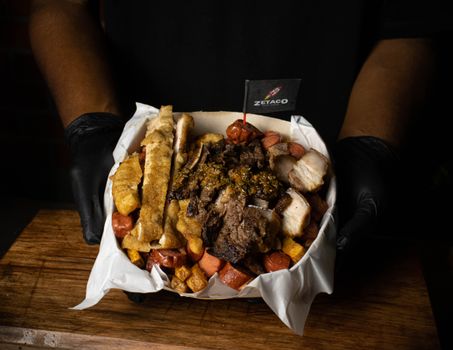
Photo: Manuel Camacho-Navarro / Pexels
Latin-American
Bandeja Paisa
The diets react (see scores below)
Common Ingredients
- red beans
- white rice
- ground beef
- chicharrón
- fried egg
- plantain
- avocado
- chorizo
Specific recipes may vary.
Incompatible with 11 of 11 diets
Diet Ratings
Bandeja Paisa is fundamentally incompatible with ketogenic diet principles. The dish is built around multiple high-carbohydrate staples: white rice (a grain with ~45g net carbs per cup), red beans (~30g net carbs per half cup), and plantain (~24g net carbs per half cup). Together, these three ingredients alone can easily deliver 100g+ of net carbs in a single serving, far exceeding the entire daily keto allowance of 20-50g. While several components are keto-friendly in isolation — chicharrón (fried pork skin), fried egg, avocado, and even ground beef and chorizo are excellent keto foods — the foundational carb-heavy ingredients make the dish as traditionally prepared wholly incompatible with ketosis. No reasonable portion adjustment can rescue this dish without fundamentally transforming it into something other than Bandeja Paisa.
Bandeja Paisa contains multiple animal products that are entirely incompatible with a vegan diet. Ground beef and chorizo are red meat products, chicharrón is fried pork skin, and the fried egg is an animal product. This dish is fundamentally built around animal proteins, making it one of the least vegan-compatible dishes in Latin American cuisine. The only plant-based components are red beans, white rice, plantain, and avocado, which are incidental side elements rather than the dish's identity.
Bandeja Paisa is fundamentally incompatible with the paleo diet. Two of its core components — red beans (a legume) and white rice (a grain) — are explicitly excluded from paleo eating. Red beans contain lectins and phytates that paleo authorities consistently flag as anti-nutrients, and grains of any kind are universally rejected under paleo principles. Chorizo and chicharrón are processed/cured meats that typically contain added salt, preservatives, and fillers, making them non-compliant processed foods. The fried egg, avocado, and plantain are paleo-approved, and plain ground beef is compliant, but these few friendly ingredients are outnumbered and outweighed by the dish's structural reliance on legumes and grains. This is a traditional Colombian feast plate built around exactly the food groups paleo excludes.
Bandeja Paisa is fundamentally at odds with Mediterranean diet principles on multiple fronts. The dish centers on multiple red and processed meats — ground beef, chicharrón (fried pork rinds), and chorizo — all in a single serving, far exceeding the Mediterranean diet's allowance of red meat a few times per month. Chicharrón and chorizo are highly processed, high in saturated fat, and represent exactly the foods Mediterranean guidelines explicitly discourage. White rice is a refined grain, and the dish is fried-heavy. The only redeeming components are red beans (an excellent legume), avocado (healthy monounsaturated fat), and plantain (a fruit/starch). These positive elements are insufficient to offset the dominant protein profile of multiple processed and red meats consumed together in one meal.
Bandeja Paisa is almost entirely incompatible with the carnivore diet. While it does contain carnivore-friendly components — ground beef, chicharrón (fried pork skin), a fried egg, and chorizo — these are heavily outnumbered by plant-based ingredients that are strictly excluded. Red beans are a legume, white rice is a grain, plantain is a starchy fruit, and avocado is a plant food. These four ingredients make up the bulk of the dish's volume and calories. The carnivore-compliant proteins cannot be separated from the plant components in the context of the dish as a whole. Chorizo may also contain plant-derived spices, fillers, or sugar depending on preparation. This dish is fundamentally a plant-heavy Colombian staple that happens to include some meat, not a meat dish with minor additions.
Bandeja Paisa contains multiple Whole30-excluded ingredients. White rice is a grain and is explicitly excluded. Red beans are legumes (not among the excepted legumes like green beans, sugar snap peas, or snow peas) and are explicitly excluded. Chorizo commonly contains added sugar, sulfites, or other non-compliant additives. The remaining components — ground beef, chicharrón (fried pork rind), fried egg, plantain, and avocado — are individually Whole30-compatible, but the dish as a whole cannot be made compliant without removing at least two core structural components (rice and red beans), which would fundamentally alter the dish.
Bandeja Paisa contains multiple high-FODMAP ingredients that make it unsuitable during the elimination phase. Red beans are high in GOS (galacto-oligosaccharides) and are a major FODMAP trigger at any standard serving size. Chorizo typically contains garlic and onion (fructans) as core ingredients, making it high-FODMAP. Avocado is low-FODMAP only at 1/8 of a fruit per Monash — the standard serving in this dish is likely 1/4 to 1/2 avocado, pushing it into high-FODMAP territory via excess fructose and polyols. The combination of these three ingredients alone renders the dish a clear avoid. White rice, fried egg, chicharrón (plain fried pork skin), and ripe plantain are individually low-FODMAP, and plain ground beef is safe. However, the red beans and chorizo are non-negotiable high-FODMAP items in standard portions, and the dish cannot be considered safe during elimination without fundamental reformulation.
Bandeja Paisa is fundamentally incompatible with the DASH diet. The dish combines multiple high-sodium, high-saturated-fat components that DASH explicitly restricts. Chicharrón (fried pork skin) is high in saturated fat and sodium. Chorizo is a processed, cured meat — one of the highest-sodium, highest-saturated-fat items on the DASH avoid list. Ground beef adds additional saturated fat. The fried egg and fried plantain add fat. The overall sodium content of this dish as commonly served in restaurants can easily exceed 1,500–2,500mg in a single serving, surpassing even the standard DASH daily limit. While individual ingredients like red beans, avocado, and plantain are DASH-friendly, they are overwhelmed by the multiple disqualifying components. DASH guidelines explicitly call for limiting red meat, avoiding processed/cured meats, and limiting saturated fat — this dish violates all three simultaneously at scale.
Bandeja Paisa is one of the most Zone-incompatible traditional dishes possible. As served, it represents a massive caloric overload with severely imbalanced macronutrient ratios. White rice is a high-glycemic, unfavorable Zone carb. Fried sweet plantain adds more high-glycemic carbohydrate load. Chicharrón (fried pork skin) is extremely high in saturated fat with no redeeming Zone qualities. Chorizo is a highly processed, fatty pork product with significant saturated fat and sodium — exactly what Zone discourages. The portion sizes in a traditional Bandeja Paisa are enormous, often 2-3x a standard Zone meal in calories alone. The carbohydrate load from white rice + beans + plantain together would represent many blocks of predominantly high-glycemic carbs, making 40/30/30 balance essentially impossible to achieve with the rest of the dish's components. While red beans and avocado are individually Zone-favorable (beans as a moderate-GI carb/protein source, avocado as monounsaturated fat), and the fried egg and ground beef provide protein, these positives are overwhelmed by the overall composition. This dish cannot reasonably serve as a Zone meal component without such radical deconstruction that it would no longer resemble the dish.
Bandeja Paisa is a Colombian platter that combines multiple pro-inflammatory elements in a single meal. Chicharrón (deep-fried pork skin) is high in saturated fat and typically cooked in lard or refined oils, representing a significant inflammatory burden. Chorizo is a processed cured meat containing nitrates, saturated fat, and often additives — a category anti-inflammatory guidelines consistently flag. Ground beef and pork together deliver a heavy saturated fat load, and the sheer quantity of animal protein across multiple sources amplifies this concern. White rice is a refined carbohydrate with minimal fiber, contributing to glycemic load. The fried egg, while moderate in isolation, adds to the cumulative saturated fat intake here. On the positive side, the dish does include meaningful anti-inflammatory elements: red beans provide fiber, plant protein, and polyphenols; avocado contributes monounsaturated fats and anti-inflammatory phytosterols; and plantain offers potassium and some resistant starch. However, these beneficial components are substantially outweighed by the processed meats, deep-fried chicharrón, and overall saturated fat density of the dish. As a complete platter, Bandeja Paisa represents the kind of high-saturated-fat, processed-meat-heavy meal that anti-inflammatory frameworks consistently identify as pro-inflammatory.
Bandeja Paisa is one of the most GLP-1-incompatible dishes that exists. It is a large-format, high-fat, high-calorie platter that violates nearly every GLP-1 dietary guideline simultaneously. Chicharrón is deep-fried pork belly — extremely high in saturated fat and one of the worst possible foods for GLP-1 side effects including nausea, reflux, and prolonged gastric distress given already-slowed gastric emptying. Chorizo is a high-fat processed meat with significant saturated fat and sodium. Ground beef adds additional saturated fat depending on fat percentage. White rice is a refined grain offering minimal fiber or nutrient density per calorie. The fried egg, while containing protein, is cooked in fat in a high-fat context. The overall portion size of this dish is enormous and fundamentally incompatible with the small-portion requirement of GLP-1 patients. While red beans and avocado are individually GLP-1-friendly components (fiber, protein, healthy fat), they cannot offset the cumulative fat load, portion volume, and digestive burden of this platter. A GLP-1 patient eating this dish would very likely experience severe nausea, reflux, bloating, and prolonged gastric discomfort. The dish has some redeeming protein and fiber from beans, but the delivery mechanism makes the whole incompatible with GLP-1 management.
*See how scores were generated at our methodology page.
Nutritional profile
Six traits that cut across every diet.
Fiber & Plants
How much whole-plant food and fiber it delivers.
Healthy Fats
The quality of its fats (unsaturated, omega-3).
Whole / Unprocessed
How close it is to its natural, unprocessed form.
Gut Gentle
How easy it is on digestion (low FODMAP, few irritants).
Low Glycemic
How little it spikes your blood sugar.
Protein Density
How much protein it packs per calorie.
Controversy Index
Higher controversy = more disagreement between diets.