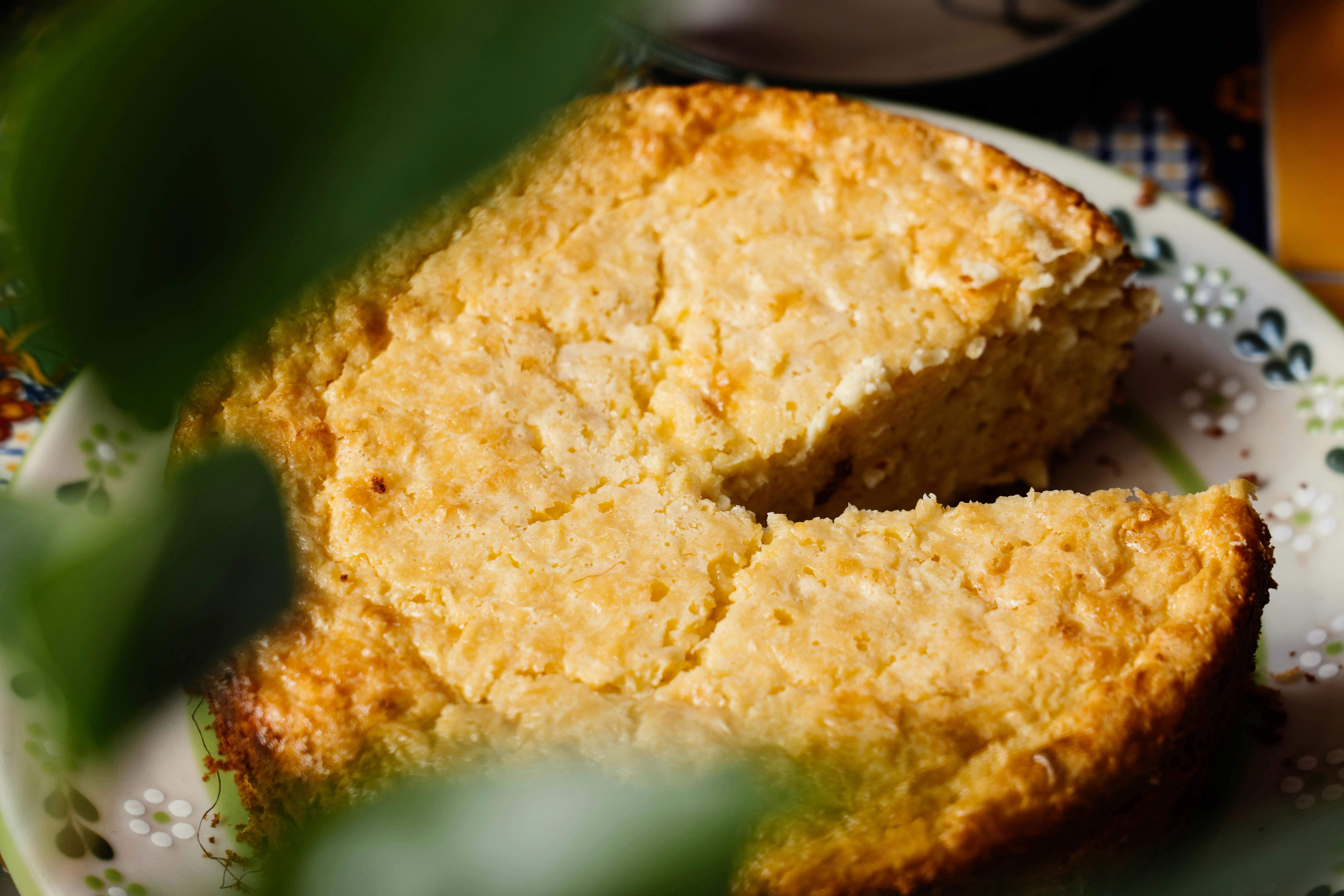
Photo: Alejandro JV / Pexels
The diets react (see scores below)
Common Ingredients
- cornmeal
- flour
- buttermilk
- eggs
- butter
- sugar
- baking powder
- salt
Specific recipes may vary.
Incompatible with 6 of 11 diets
Diet Ratings
Cornbread is fundamentally incompatible with a ketogenic diet. Its two primary ingredients — cornmeal and flour — are both high-carbohydrate grains that would spike blood glucose and destroy ketosis. A standard serving (one piece, ~60g) contains roughly 28-30g of net carbs, nearly exhausting or exceeding the entire daily keto carb budget in a single side dish. The added sugar compounds the problem further. Eggs and butter are keto-friendly, but they are minor components that cannot offset the overwhelming carbohydrate load from the grain base.
This cornbread contains three animal-derived ingredients: buttermilk (dairy), eggs, and butter (dairy). All three are clearly excluded under vegan principles. The base ingredients — cornmeal, flour, sugar, baking powder, and salt — are plant-based, but the recipe as listed is fundamentally non-vegan. Vegan versions of cornbread do exist and are widely made using plant-based milk (with a splash of vinegar to replicate buttermilk), flax eggs or commercial egg replacers, and vegan butter or oil, making it easy to adapt.
Cornbread is fundamentally incompatible with the Paleolithic diet. The two primary ingredients — cornmeal and flour (wheat) — are both grains, which are categorically excluded from paleo. Beyond the grains, buttermilk is a dairy product, refined sugar is a processed sweetener, butter is dairy (not ghee), added salt is excluded, and baking powder is a processed additive. Virtually every ingredient in this dish violates paleo principles. There is no meaningful paleo modification possible without reconstructing the dish entirely.
Cornbread is a refined grain product made primarily from cornmeal and white flour, sweetened with sugar, and enriched with butter — none of which align with Mediterranean diet principles. The primary fat is butter (saturated animal fat) rather than extra virgin olive oil, the grains are refined rather than whole, and added sugar further disqualifies it. This is an American Southern staple with no roots in Mediterranean culinary tradition and contradicts core principles on multiple fronts: refined grains, added sugars, and saturated fat from butter.
Cornbread is almost entirely plant-derived and is fundamentally incompatible with the carnivore diet. The primary ingredients — cornmeal and flour — are grains, which are strictly excluded. Sugar adds further disqualification as a processed carbohydrate. While eggs and butter are carnivore-approved animal products, they are minor components in a dish that is overwhelmingly grain-based. Baking powder also contains plant-derived starch fillers. There is no meaningful carnivore adaptation possible for this dish without completely reconstructing it.
Cornbread contains multiple excluded ingredients that make it clearly non-compliant with Whole30. Cornmeal is a grain (corn), flour is a grain (wheat), buttermilk is dairy, butter is dairy, and sugar is an added sweetener — all explicitly prohibited. Beyond the individual ingredients, cornbread is also a baked good that falls squarely into the 'no recreating baked goods' rule, which explicitly lists bread-like items as off-limits even if compliant ingredients could theoretically be used.
Traditional cornbread contains two notable FODMAP concerns: wheat flour (high in fructans) and buttermilk (contains lactose). Cornmeal itself is low-FODMAP and forms the base, but the addition of regular wheat flour introduces fructans. The amount of flour relative to cornmeal matters — many recipes use roughly equal parts, which would push the fructan load into high-FODMAP territory per standard serving (one slice/piece). Buttermilk is high in lactose, though the quantity per slice may be moderate. Eggs, butter, sugar, baking powder, and salt are all low-FODMAP. A standard piece of cornbread would likely contain enough wheat flour and buttermilk to be problematic during the elimination phase. A low-FODMAP version could be made by substituting gluten-free flour blend and lactose-free buttermilk (or lactose-free milk with vinegar), which would make it safe.
Monash University has not specifically tested traditional cornbread as a composite dish, so FODMAP load depends heavily on the flour-to-cornmeal ratio and serving size. Some FODMAP practitioners suggest that if the wheat flour component is small (e.g., 1/4 cup in a full batch yielding 12 pieces), the per-serving fructan amount may be within tolerable limits, but most clinical dietitians would recommend avoiding wheat-containing cornbread during strict elimination to avoid cumulative FODMAP stacking.
Traditional cornbread sits in the DASH 'caution' zone. While cornmeal is a grain-based ingredient, the recipe as written uses refined flour, butter (saturated fat), added sugar, salt, and baking powder — all of which add sodium, saturated fat, and empty calories that DASH discourages. A standard cornbread recipe can contain 300–500mg sodium per serving from salt and baking powder combined, plus 3–5g saturated fat from butter and buttermilk. It is not a whole grain product in the traditional sense (cornmeal is typically degerminated/refined), lacks the fiber, potassium, and magnesium density that DASH emphasizes, and the added sugar conflicts with DASH's limit on sweets. However, it is not as problematic as heavily processed or cured foods and can fit occasionally with portion control. A modified version using whole-grain cornmeal, reduced butter, low-fat buttermilk, minimal salt, and less sugar would score meaningfully higher.
NIH DASH guidelines classify refined grains as less preferred and flag sodium, saturated fat, and added sugar as targets for reduction — all present here. However, some DASH-oriented dietitians note that homemade cornbread, unlike processed baked goods, allows ingredient substitution (whole-grain cornmeal, low-fat dairy, less butter/salt) and can be incorporated as an occasional grain serving within DASH's 6–8 daily grain servings, especially in Southern dietary contexts where complete elimination may reduce adherence.
Cornbread is a high-glycemic, carbohydrate-dense baked good that presents significant challenges for Zone compliance. The primary ingredients — cornmeal and white flour — are both high-glycemic, refined grain carbohydrates that Sears explicitly classifies as 'unfavorable' carbs. Added sugar further elevates the glycemic load. Butter adds saturated fat rather than the preferred monounsaturated fat. The dish also lacks any meaningful lean protein component. A typical slice delivers a heavy carb load (mostly high-GI) with saturated fat, making it very difficult to balance into a 40/30/30 Zone block structure without extreme portion restriction (a very thin sliver) and pairing with substantial lean protein and favorable fat sources. While technically not a 'pure sugar' food and therefore avoids a score of 1-2, it scores at the very low end of 'caution' because even small portions contribute unfavorable macronutrient profiles with no Zone-friendly redeeming qualities — no lean protein, no monounsaturated fat, no low-GI carbs.
Traditional cornbread sits in a nutritionally mixed position from an anti-inflammatory standpoint. Cornmeal provides some fiber and B vitamins, and whole-grain versions retain more antioxidants (including ferulic acid), but standard cornbread uses refined or degerminated cornmeal that loses much of this benefit. All-purpose flour is a refined carbohydrate with a moderate-to-high glycemic impact, and refined carbs are associated with increased inflammatory markers. The added sugar, while modest in a savory recipe, still contributes to glycemic load. Butter and buttermilk introduce saturated fat, which is flagged as a 'limit' item in anti-inflammatory frameworks. Eggs offer some choline and protein but are a minor factor here. Baking powder and salt are neutral. There are no meaningful anti-inflammatory ingredients present — no omega-3s, no polyphenols, no significant antioxidants, no beneficial herbs or spices. As an occasional side dish it is acceptable, but it offers no positive anti-inflammatory value and its combination of refined grains, added sugar, and saturated fat makes regular consumption problematic. Substituting whole-grain cornmeal, reducing sugar, and replacing butter with olive oil would meaningfully improve its profile.
Traditional cornbread is a refined-grain side dish with minimal protein, moderate fat from butter and buttermilk, and added sugar. While it provides some calories and carbohydrates for energy, it scores poorly on the two highest priorities for GLP-1 patients: protein density and fiber. A standard slice (~60g) delivers roughly 2-3g protein and 1g fiber — well below the per-meal targets of 15-30g protein and the daily 25-30g fiber goal. The butter and eggs contribute saturated fat, and the sugar adds empty calories. With significantly reduced appetite on GLP-1 medications, spending stomach space on cornbread crowds out nutrient-dense foods. That said, it is not fried, not extremely high in fat per serving, and is relatively easy to digest, which keeps it out of the 'avoid' tier. Small portions alongside a high-protein main (e.g., a tablespoon-sized piece with chili or bean soup) are acceptable occasionally, but cornbread should not be a staple side dish for GLP-1 patients.
*See how scores were generated at our methodology page.
Nutritional profile
Six traits that cut across every diet.
Fiber & Plants
How much whole-plant food and fiber it delivers.
Healthy Fats
The quality of its fats (unsaturated, omega-3).
Whole / Unprocessed
How close it is to its natural, unprocessed form.
Gut Gentle
How easy it is on digestion (low FODMAP, few irritants).
Low Glycemic
How little it spikes your blood sugar.
Protein Density
How much protein it packs per calorie.
Controversy Index
Higher controversy = more disagreement between diets.
Diet-Specific Tips
 Low-FODMAP — 4/10
View tips
- Wheat flour is high in fructans — a primary FODMAP concern in this recipe
- Buttermilk is high in lactose, adding a second FODMAP category
- Cornmeal is low-FODMAP and the primary ingredient
- Eggs, butter, sugar, baking powder, and salt are all low-FODMAP
- FODMAP load per slice depends on flour-to-cornmeal ratio and batch size
- Low-FODMAP adaptation is possible with gluten-free flour and lactose-free buttermilk
 DASH — 4/10
View tips
- Refined cornmeal — not a whole grain, lower fiber than DASH-preferred grains
- Butter contributes saturated fat, which DASH limits
- Salt and baking powder together can push sodium to 300–500mg per serving
- Added sugar conflicts with DASH guidance on limiting sweets
- Buttermilk is a cultured dairy product but full-fat versions add saturated fat
- No significant source of potassium, magnesium, or calcium relative to DASH priorities
- Homemade preparation allows modification to improve DASH compatibility (whole-grain cornmeal, low-fat buttermilk, reduced salt/butter/sugar)
- Portion size matters — one small square occasionally is manageable within DASH grain servings
 Zone — 5/10
View tips
- Cornmeal and white flour are high-glycemic 'unfavorable' carbohydrates in Zone terminology
- Added sugar further elevates glycemic load and offers no nutritional value
- Butter contributes saturated fat rather than preferred monounsaturated fat
- No lean protein component — macros are almost entirely high-GI carbs and saturated fat
- Would require extreme portion control (very small slice) to incorporate into a Zone block
- Sears explicitly lists refined grain products as unfavorable carbohydrates to minimize
 Anti-Inflammatory — 4/10
View tips
- Refined cornmeal and all-purpose flour raise glycemic load and lack fiber/antioxidants of whole grains
- Added sugar contributes to glycemic spike and pro-inflammatory potential
- Butter and buttermilk provide saturated fat, flagged as 'limit' in anti-inflammatory protocols
- No meaningful anti-inflammatory compounds — no omega-3s, polyphenols, or key antioxidants
- Whole-grain cornmeal version would be marginally better but still lacks active anti-inflammatory properties
- Acceptable occasionally as a side; problematic as a dietary staple
 GLP-1 Friendly — 4/10
View tips
- Very low protein per serving (~2-3g) — fails the #1 GLP-1 dietary priority
- Low fiber (~1g per serving) — fails the #2 priority
- Added sugar contributes empty calories in a low-appetite context
- Refined grains (cornmeal + flour) offer limited nutrient density per calorie
- Moderate saturated fat from butter and buttermilk
- Easy to digest and not fried — avoids the worst GI triggers
- Portion-sensitive: small amounts alongside high-protein mains are tolerable