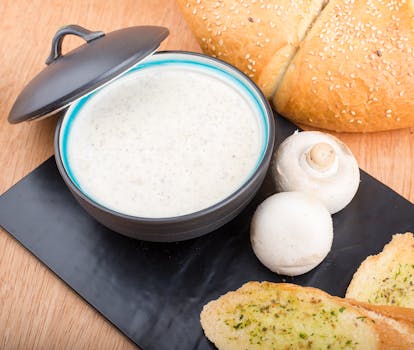
Photo: Shameel mukkath / Pexels
American
Cream of Mushroom Soup
The diets react (see scores below)
Common Ingredients
- mushrooms
- butter
- flour
- heavy cream
- chicken broth
- onion
- garlic
- thyme
Specific recipes may vary.
Incompatible with 8 of 11 diets
Diet Ratings
Cream of mushroom soup is mostly keto-friendly but contains flour as a thickening agent, which adds meaningful net carbs and is a grain-based ingredient incompatible with strict keto. The heavy cream and butter are excellent high-fat keto staples, and mushrooms, onion, garlic, and chicken broth are low-carb ingredients. However, the flour thickener is the dealbreaker for strict keto. A standard bowl (1 cup) with flour-thickened soup could contribute 8-12g net carbs primarily from the flour and onion, which is manageable with careful daily tracking but not ideal. A simple substitution of xanthan gum or cream cheese for the flour would make this fully keto-approved. As prepared with flour, it warrants caution rather than avoidance, since the quantity of flour per serving is typically small and the overall fat content is high.
This cream of mushroom soup contains multiple animal-derived ingredients that make it incompatible with a vegan diet. Butter is a dairy product, heavy cream is a dairy product, and chicken broth is made from animal bones and meat. Three distinct animal-derived ingredients are present, making this clearly non-vegan. Vegan versions can be made by substituting olive oil or vegan butter for butter, plant-based milk or cashew cream for heavy cream, and vegetable broth for chicken broth.
Cream of Mushroom Soup contains multiple non-paleo ingredients that disqualify it clearly. Flour (wheat) is a grain and strictly excluded from the paleo diet. Heavy cream is a dairy product, also excluded. Butter, while debated in some paleo circles, is still a dairy derivative. The combination of a grain-based thickener and dairy cream makes this dish incompatible with paleo principles. The paleo-friendly components — mushrooms, onion, garlic, thyme, and chicken broth — are outnumbered and overshadowed by the core structural ingredients that violate paleo rules. A paleo adaptation could substitute flour with arrowroot or coconut flour and replace cream with coconut cream, but as traditionally prepared, this dish is firmly in avoid territory.
Cream of Mushroom Soup contains several ingredients that conflict with Mediterranean diet principles. Butter replaces olive oil as the primary fat, heavy cream adds significant saturated fat, and refined flour is used as a thickener — none of these are core Mediterranean ingredients. The mushrooms, onion, garlic, and thyme are excellent Mediterranean staples, and chicken broth is acceptable, but the overall fat profile and preparation method are distinctly Western/American rather than Mediterranean. The dish is not inherently ultra-processed, but its heavy reliance on dairy fat and refined starch pushes it into avoid territory.
A more lenient interpretation might rate this 'caution' rather than 'avoid,' noting that mushroom-based soups are common in some southern European traditions, and that dairy and butter, while not preferred, are not entirely excluded from Mediterranean eating. Substituting olive oil for butter and using less cream would substantially improve its compatibility.
Cream of Mushroom Soup is fundamentally incompatible with the carnivore diet. The dish is built primarily around mushrooms, a fungus and plant food, which are strictly excluded. It also contains flour (a grain), onion, garlic, and thyme — all plant-derived ingredients that violate carnivore rules. While butter, heavy cream, and chicken broth are animal-derived components, they are minor supporting ingredients in what is essentially a plant-based soup. The flour used as a thickener is a processed grain product. Even the most permissive carnivore practitioners ('animal-based' camp) would not consume a dish whose primary ingredient and character are defined by plant foods. There is no meaningful carnivore adaptation possible without completely reconstructing the dish.
Cream of Mushroom Soup as described contains multiple Whole30-excluded ingredients. Butter (not ghee or clarified butter) is a dairy product and is explicitly excluded. Flour is a grain-derived ingredient and is excluded. Heavy cream is dairy and is excluded. Three separate excluded ingredients make this dish clearly non-compliant. A Whole30-compatible version could be made by substituting ghee for butter, omitting flour, and replacing heavy cream with full-fat coconut milk or a compliant alternative.
Cream of Mushroom Soup as traditionally prepared contains multiple high-FODMAP ingredients that make it essentially incompatible with the elimination phase. Onion and garlic are among the highest-FODMAP foods tested by Monash University, both high in fructans with no safe serving size during elimination. Mushrooms (most common varieties like button/cremini) are high in polyols (mannitol) and are high-FODMAP even at moderate servings (e.g., button mushrooms become high-FODMAP at just 75g). Wheat flour used for the roux contains fructans. Heavy cream is low-FODMAP in small amounts (lactose is minimal), and butter is safe. Chicken broth (plain, without onion/garlic) can be low-FODMAP, but commercial broths almost always contain onion and/or garlic. Thyme is low-FODMAP. With at minimum four high-FODMAP ingredients (onion, garlic, mushrooms, flour), this dish is a clear avoid during elimination — the problematic ingredients are structural to the recipe, not optional garnishes.
Cream of Mushroom Soup as traditionally prepared is poorly aligned with DASH diet principles. The primary culprits are heavy cream and butter, both of which are high in saturated fat — a macronutrient DASH explicitly limits. Heavy cream is essentially the opposite of the low-fat or fat-free dairy DASH emphasizes. Chicken broth (especially standard commercial broth) adds significant sodium, and even homemade broth contributes meaningfully to daily sodium load. While mushrooms, onion, garlic, and thyme are DASH-friendly ingredients, they are overwhelmed nutritionally by the high-saturated-fat dairy base. A single serving of this soup can easily contain 15–20g of fat, 8–12g of saturated fat, and 600–900mg of sodium depending on the broth used — consuming a meaningful fraction of DASH's daily saturated fat and sodium budgets in one dish. DASH guidelines explicitly call for avoiding full-fat dairy and limiting saturated fat, making this dish a poor fit as typically prepared.
Cream of mushroom soup presents a mixed Zone profile. Mushrooms are a favorable Zone carbohydrate — low glycemic, high in polyphenols, and count well toward the 8 daily vegetable servings. Onion and garlic are similarly favorable. However, the fat profile is problematic: butter is saturated fat and heavy cream adds significant saturated fat, both of which conflict with Zone's emphasis on monounsaturated fats and anti-inflammatory eating. Flour (likely white) adds a moderate-glycemic carbohydrate that displaces more favorable low-GI options. The dish also lacks any meaningful lean protein source, making it difficult to achieve the 30% protein target without significant additions. As a standalone, this soup skews heavily toward fat (predominantly saturated) with modest carbs and near-zero protein — roughly the inverse of a Zone-balanced meal. With modifications (replacing butter with olive oil, substituting half-and-half or omitting cream, adding chicken or tofu, using cornstarch instead of white flour), this could become more Zone-compatible. As traditionally made, it requires careful portioning and protein supplementation to incorporate into a Zone meal.
Some Zone practitioners in Sears' later anti-inflammatory framework (Zone Diet Evolution, The OmegaRx Zone) acknowledge that small amounts of saturated fat in context of an overall anti-inflammatory diet are less concerning than previously stated. A small serving of this soup paired with a lean protein and additional vegetables could approximate Zone ratios at the meal level, making the dish more of a fat block contributor than an outright problem food.
Cream of Mushroom Soup presents a mixed anti-inflammatory profile. On the positive side, mushrooms are actively encouraged in anti-inflammatory frameworks — they contain beta-glucans, ergothioneine, and polysaccharides that have demonstrated immunomodulatory and anti-inflammatory effects. Garlic and thyme are both emphasized anti-inflammatory spices with well-documented benefits (allicin, flavonoids, rosmarinic acid). Onion contributes quercetin. These ingredients provide genuine anti-inflammatory value. However, the dish is built on a foundation of butter and heavy cream, both of which are high-fat dairy products rich in saturated fat — a category the anti-inflammatory framework explicitly limits. The flour-based roux adds refined carbohydrates with little nutritional benefit. The heavy cream in particular is the defining concern: it's exactly the type of full-fat dairy that anti-inflammatory authorities like Dr. Weil recommend minimizing. The dish is not actively harmful in the way that trans fats or processed foods would be, but its fat base meaningfully offsets the benefits of its otherwise strong components. A modified version using olive oil, oat flour, and a light broth or unsweetened plant milk would shift this significantly toward 'approve.' As prepared with butter and heavy cream, it lands solidly in caution territory.
Cream of mushroom soup made with butter, heavy cream, and flour is a poor fit for GLP-1 patients. The heavy cream and butter contribute significant saturated fat per serving, which worsens nausea, bloating, and reflux — the exact side effects GLP-1 medications already provoke through slowed gastric emptying. The dish is also very low in protein (mushrooms provide minimal protein, and there is no primary protein source) and delivers most of its calories from fat and refined starch. Nutrient density per calorie is poor. The flour-thickened, fat-heavy base is slow to digest, increasing the likelihood of prolonged fullness, nausea, and GI discomfort. The one positive is that soup is liquid-forward and warm, which can be soothing and hydrating — but that benefit is outweighed by the fat load in this classic preparation.
*See how scores were generated at our methodology page.
Nutritional profile
Six traits that cut across every diet.
Fiber & Plants
How much whole-plant food and fiber it delivers.
Healthy Fats
The quality of its fats (unsaturated, omega-3).
Whole / Unprocessed
How close it is to its natural, unprocessed form.
Gut Gentle
How easy it is on digestion (low FODMAP, few irritants).
Low Glycemic
How little it spikes your blood sugar.
Protein Density
How much protein it packs per calorie.
Controversy Index
Higher controversy = more disagreement between diets.
Diet-Specific Tips
 Keto — 5/10
View tips
- Flour thickener adds net carbs and is a grain ingredient — primary concern
- Heavy cream and butter provide excellent high-fat keto macros
- Mushrooms, garlic, onion contribute minor carbs but are within typical keto limits
- Estimated 8-12g net carbs per cup depending on flour quantity — portion control required
- Easily made fully keto by substituting xanthan gum, cream cheese, or simply reducing/omitting flour
 Zone — 4/10
View tips
- Mushrooms are a favorable Zone carbohydrate — low glycemic and polyphenol-rich
- Heavy cream and butter are high in saturated fat, conflicting with Zone's monounsaturated fat preference
- White flour raises the glycemic index of the carbohydrate contribution
- No lean protein source — dish is nearly protein-free, making Zone balance at the meal level difficult
- Chicken broth adds minimal protein but improves the overall profile slightly
- Would need significant modification (olive oil, lean protein addition, cream reduction) to fit Zone ideals
- As traditionally prepared, macronutrient ratio is heavily fat-skewed with inadequate protein
 Anti-Inflammatory — 4/10
View tips
- Mushrooms: strong anti-inflammatory asset — beta-glucans, ergothioneine, immunomodulatory polysaccharides
- Garlic and thyme: well-established anti-inflammatory spices
- Onion: quercetin and flavonoids contribute antioxidant activity
- Heavy cream: high saturated fat, explicitly limited in anti-inflammatory protocols
- Butter: saturated fat, recommended to limit; no beneficial fatty acid profile compared to EVOO
- All-purpose flour: refined carbohydrate with no anti-inflammatory benefit
- Net profile: beneficial mushroom/allium/herb base undermined by high saturated fat dairy foundation