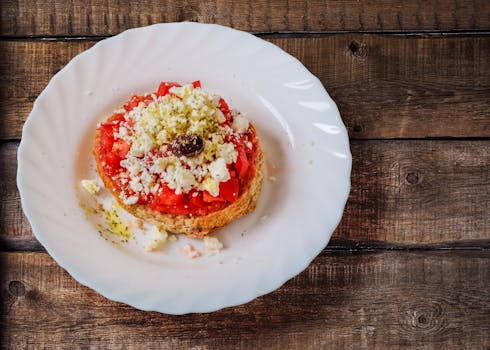
Photo: Daniela Elena Tentis / Pexels
Mediterranean
Cretan Dakos
The diets react (see scores below)
Common Ingredients
- barley rusk
- tomato
- feta cheese
- Kalamata olives
- olive oil
- oregano
- red onion
- capers
Specific recipes may vary.
Incompatible with 6 of 11 diets
Diet Ratings
Cretan Dakos is fundamentally built on a barley rusk (paximadi), which is a twice-baked whole grain bread that is extremely high in carbohydrates — typically 40-50g of net carbs per single rusk. This alone exceeds or nearly exhausts an entire day's keto carb budget before any other ingredients are considered. While several other components (feta, olives, olive oil, oregano, capers) are keto-friendly, and tomato and red onion are acceptable in small amounts, the barley rusk base makes the dish categorically incompatible with ketosis. There is no reasonable portion size of this dish that would fit within keto macros, as the rusk is the defining structural ingredient of Dakos and cannot simply be reduced to a negligible amount.
Cretan Dakos contains feta cheese, a dairy product derived from sheep's or goat's milk. Dairy is unambiguously excluded from a vegan diet under all major vegan frameworks. All other ingredients — barley rusk, tomato, Kalamata olives, olive oil, oregano, red onion, and capers — are fully plant-based, but the presence of feta cheese alone disqualifies this dish. A vegan version could be made by omitting the feta or substituting a plant-based cheese alternative.
Cretan Dakos is fundamentally incompatible with the paleo diet. The dish is built on a barley rusk as its base — barley is a grain and one of the clearest exclusions in paleo. Beyond the rusk, feta cheese is a dairy product, also firmly excluded. These two ingredients are not peripheral additions but the structural and flavor foundation of the dish. The remaining ingredients — tomato, Kalamata olives, olive oil, oregano, red onion, and capers — are all paleo-approved, but they cannot redeem a dish whose core components are explicit paleo violations. No meaningful paleo substitution exists that would preserve this dish's identity.
Cretan Dakos is a quintessential Mediterranean dish originating from Crete, one of the regions most studied for its adherence to the traditional Mediterranean diet. Nearly every ingredient aligns perfectly with Mediterranean principles: barley rusk is a whole grain with high fiber content, tomatoes and red onion are fresh vegetables, Kalamata olives provide healthy monounsaturated fats, extra virgin olive oil is the canonical fat source, capers are a traditional Mediterranean condiment, and oregano is a staple herb. Feta cheese is the only ingredient that warrants minor note, as dairy is consumed in moderation, but the amount used in Dakos is typically small and feta itself is a traditional, minimally processed cheese embedded in Greek and Cretan culinary heritage. This dish is essentially a textbook example of Mediterranean eating.
Cretan Dakos is almost entirely plant-based and grain-based, making it incompatible with the carnivore diet at a fundamental level. The base is a barley rusk — a grain product that is explicitly excluded from carnivore. The remaining ingredients are tomato, Kalamata olives, olive oil, oregano, red onion, and capers — all plant-derived foods that are strictly forbidden. The only carnivore-adjacent ingredient is feta cheese, which is a dairy product and would itself be debated within the carnivore community. There is no animal protein source, no meat, no eggs, and no animal fat. This dish represents the antithesis of carnivore eating — a Mediterranean grain-and-vegetable salad with a small amount of dairy.
Cretan Dakos contains two clearly excluded ingredients. First, barley rusk is made from barley, which is a grain — grains are explicitly prohibited on Whole30. Second, feta cheese is a dairy product, and dairy (other than ghee/clarified butter) is explicitly excluded. Either of these ingredients alone would disqualify the dish; together they make it firmly non-compliant. The remaining ingredients — tomato, Kalamata olives, olive oil, oregano, red onion, and capers — are all Whole30-compatible.
Cretan Dakos contains multiple high-FODMAP ingredients that make it unsuitable during the elimination phase. The primary issues are: (1) Barley rusk — barley is high in fructans, making the rusk base a significant FODMAP source. (2) Red onion — one of the highest-fructan foods; even small amounts are problematic during elimination. (3) Feta cheese — Monash rates feta as low-FODMAP at 40g due to low lactose, but it is a moderate concern depending on portion. (4) Kalamata olives are low-FODMAP. (5) Olive oil, oregano, and tomato are generally low-FODMAP at standard servings (though tomato paste/concentrated forms can be an issue; fresh tomato is fine). (6) Capers are low-FODMAP. The combination of barley rusk (fructans) and red onion (fructans) makes this dish a clear avoid during elimination. Even if red onion were omitted, the barley rusk alone would be a high-FODMAP trigger. A modified version using a gluten-free or sourdough spelt rusk and omitting red onion could potentially be made lower-FODMAP, but as traditionally prepared this dish is high-FODMAP.
Some FODMAP practitioners note that traditional Cretan barley rusks made with a high proportion of barley flour are definitively high-FODMAP, though Monash has not specifically tested all commercial barley rusk varieties — the fructan content of barley is well-established. Additionally, while feta is considered low-FODMAP at 40g per Monash University, some clinicians advise caution with aged cheeses in sensitive individuals, though this is not mainstream FODMAP guidance.
Cretan Dakos is a Mediterranean salad with several DASH-friendly components — whole grain barley rusks provide fiber and complex carbohydrates, tomatoes offer potassium and antioxidants, olive oil aligns with DASH's emphasis on healthy unsaturated fats, and red onion and oregano contribute beneficial phytonutrients. However, several ingredients raise DASH concerns. Feta cheese is a full-fat, relatively high-sodium cheese (roughly 316mg sodium per 30g serving). Kalamata olives are high in sodium (one serving of ~10 olives can contribute 300-500mg sodium). Capers are extremely high in sodium (~800mg per 2 tablespoons). Together, these three ingredients can push the dish's sodium content well above DASH thresholds for a single serving, particularly for the stricter 1,500mg/day target. The olive oil, while heart-healthy, adds significant calories and must be portion-controlled. The dish is not inherently incompatible with DASH but requires careful portioning — reduced feta, rinsed capers, and rinsed olives can substantially lower sodium content and make it more DASH-compatible.
NIH DASH guidelines specify low-fat dairy and strict sodium limits that feta, olives, and capers collectively violate. However, updated clinical interpretations increasingly recognize the Mediterranean dietary pattern — of which Dakos is emblematic — as cardiovascularly protective, and some DASH-aligned nutritionists argue that the overall dietary pattern and potassium-rich vegetables can offset moderate sodium from whole-food sources like olives and feta when consumed in controlled portions.
Cretan Dakos is a Mediterranean dish with several Zone-friendly components but structural challenges. The olive oil and Kalamata olives provide excellent monounsaturated fats — ideal Zone fat blocks. Tomatoes, red onion, capers, and oregano are favorable low-glycemic carbohydrates rich in polyphenols, which aligns strongly with Sears' anti-inflammatory framework. Feta cheese contributes some protein but is primarily a fat source with saturated fat content, and provides limited lean protein by Zone standards. The central problem is the barley rusk (paximadi): while barley is lower-glycemic than white bread and is technically a 'favorable' whole grain in Zone terms, it is still a grain-based carbohydrate that Sears classifies as 'unfavorable' in larger portions. Traditional Dakos is served with a substantial rusk base, which would skew the meal heavily toward carbohydrates with insufficient lean protein. The dish also lacks a primary lean protein source (chicken, fish, egg whites), making it difficult to hit the 30% protein target without significant modification. With portion control on the rusk, a small amount of feta, generous vegetables, and the addition of a lean protein, this dish could be Zone-adapted. As traditionally served, the carb-to-protein ratio is imbalanced.
Some Zone practitioners following Sears' later work (The Mediterranean Zone, 2014) would view this dish more favorably. Sears explicitly embraced the Cretan/Mediterranean dietary pattern, highlighting polyphenol-rich foods like olives, capers, tomatoes, and olive oil as ideal anti-inflammatory Zone foods. In this context, barley rusk as a whole grain carbohydrate base in modest portions could be acceptable, and feta in small amounts adds both protein and fat blocks. A generous portion of tomatoes and vegetables could balance the carb blocks favorably, making this closer to a 5-6 caution-to-approve in a Mediterranean Zone interpretation.
Cretan Dakos is a quintessential Mediterranean dish with a strong anti-inflammatory profile. Olive oil provides oleocanthal and monounsaturated fats with well-documented anti-inflammatory effects. Tomatoes deliver lycopene and vitamin C. Kalamata olives add additional polyphenols and healthy fats. Capers are exceptionally rich in quercetin and rutin, potent anti-inflammatory flavonoids. Oregano contributes rosmarinic acid and other antioxidants. Red onion provides quercetin and prebiotic fiber. The barley rusk (paximadi) is a whole grain with beta-glucan fiber that supports gut health and modulates inflammatory markers — it is a more nutritionally favorable carbohydrate base than refined bread. The primary concern is feta cheese, a full-fat dairy product that should be limited in strict anti-inflammatory protocols due to saturated fat content, though the portion is typically modest as a topping. The overall dish aligns closely with the Mediterranean dietary pattern, which is one of the most robustly supported dietary frameworks for reducing systemic inflammation.
Most anti-inflammatory authorities, including Dr. Weil's framework, embrace traditional Mediterranean foods like Dakos enthusiastically. However, strict AIP or dairy-free anti-inflammatory protocols would flag feta cheese for its saturated fat and potential dairy-related inflammatory response in sensitive individuals. Some practitioners also question whether commercial barley rusks, if made with refined flours or additives, fully retain whole-grain benefits.
Cretan Dakos is a nutrient-dense Mediterranean dish with meaningful fiber from the barley rusk, lycopene and hydration from fresh tomato, and beneficial unsaturated fats from olive oil and olives. However, it falls short on the #1 GLP-1 priority: protein. With no primary protein source, a typical serving delivers only 5-8g of protein (mostly from feta), well below the 15-30g per meal target. The barley rusk provides whole-grain fiber which is a genuine positive, but it is also a dense, dry carbohydrate that may feel heavy given slowed gastric emptying. Feta and Kalamata olives contribute moderate saturated and total fat, and the olives add sodium. Olive oil, while a healthy unsaturated fat, adds calorie density in a context where every calorie should carry nutritional weight. The dish is easy to digest in moderate portions and the ingredients are minimally processed and anti-inflammatory, which aligns well with GLP-1 dietary goals. Best used as a side dish or starter alongside a high-protein main rather than as a standalone meal.
Some GLP-1-focused dietitians view the Mediterranean fat profile here — olive oil, olives — as genuinely beneficial for cardiovascular health and satiety in small portions, and would rate this more favorably as a side. Others are more cautious about the low protein density and the caloric load of oil and cheese in a population with significantly reduced caloric intake, arguing that every meal must anchor on protein first.
*See how scores were generated at our methodology page.
Nutritional profile
Six traits that cut across every diet.
Fiber & Plants
How much whole-plant food and fiber it delivers.
Healthy Fats
The quality of its fats (unsaturated, omega-3).
Whole / Unprocessed
How close it is to its natural, unprocessed form.
Gut Gentle
How easy it is on digestion (low FODMAP, few irritants).
Low Glycemic
How little it spikes your blood sugar.
Protein Density
How much protein it packs per calorie.
Controversy Index
Higher controversy = more disagreement between diets.
Diet-Specific Tips
 Mediterranean — 9/10
View tips
- Barley rusk is a whole grain staple in Cretan cuisine, high in fiber and complex carbohydrates
- Fresh tomatoes and red onion provide plant-forward nutrition central to Mediterranean principles
- Kalamata olives contribute healthy monounsaturated fats and are a traditional Mediterranean staple
- Extra virgin olive oil as the primary fat is the gold standard of the Mediterranean diet
- Feta cheese is a traditional, minimally processed dairy used in modest quantities
- Capers and oregano are authentic Mediterranean flavor enhancers with minimal caloric impact
- No processed foods, added sugars, or refined grains present
- Dish originates from Crete, a foundational region of Mediterranean diet research
 DASH — 5/10
View tips
- Feta cheese is full-fat and high sodium — not aligned with DASH low-fat dairy guidance
- Kalamata olives contribute significant sodium (300-500mg per typical serving)
- Capers are very high sodium (~800mg per 2 tbsp) — rinsing reduces but does not eliminate this
- Barley rusks are a whole grain — DASH-positive fiber and complex carbohydrate source
- Tomatoes provide potassium and antioxidants — core DASH vegetable
- Olive oil is DASH-approved unsaturated fat but must be portion-controlled
- Combined sodium from feta + olives + capers can easily exceed 1,000mg per serving
- Low-sodium adaptation (reduced feta, rinsed olives and capers) would score significantly higher
 Zone — 5/10
View tips
- Barley rusk is a higher-carbohydrate grain base that can skew the meal's macronutrient ratio toward carbs if not portioned carefully
- Olive oil and Kalamata olives are ideal Zone monounsaturated fat sources
- Feta cheese provides fat and some protein but is not a lean protein source; saturated fat content is a minor concern
- No primary lean protein (chicken, fish, egg whites) — the dish has no Zone protein anchor
- Tomatoes, red onion, capers, and oregano are favorable low-glycemic, polyphenol-rich Zone carbohydrates
- Dish aligns with Sears' Mediterranean Zone anti-inflammatory principles but fails the 40/30/30 block balance without modification
- Traditional serving portion of rusk would require significant reduction to fit Zone carb block targets
 Anti-Inflammatory — 8/10
View tips
- Extra virgin olive oil: rich in oleocanthal (COX inhibitor) and monounsaturated fats — a cornerstone anti-inflammatory ingredient
- Capers: exceptionally high in quercetin and rutin, among the most concentrated dietary sources of anti-inflammatory flavonoids
- Kalamata olives: polyphenol-rich, add additional monounsaturated fats and anti-inflammatory compounds
- Tomatoes: lycopene, vitamin C, and beta-carotene provide antioxidant and anti-inflammatory activity
- Barley rusk (whole grain): beta-glucan fiber supports gut microbiome and reduces CRP; favorable over refined carbohydrates
- Oregano: rosmarinic acid and thymol provide meaningful antioxidant support
- Red onion: quercetin content and prebiotic fructooligosaccharides support anti-inflammatory gut health
- Feta cheese: full-fat dairy is a moderate concern; saturated fat content warrants some caution, though portions are typically small
 GLP-1 Friendly — 5/10
View tips
- Low protein — no primary protein source, ~5-8g per serving, well below the 15-30g per meal target
- Barley rusk provides whole-grain fiber and is more nutritious than refined grain alternatives
- Feta cheese adds some protein and calcium but also saturated fat and sodium
- Kalamata olives contribute healthy monounsaturated fats but add calorie density and sodium
- Olive oil is a preferred fat type but adds calorie load without protein
- High hydration content from fresh tomato is a positive for GLP-1 patients
- Works well as a side dish paired with a lean protein; poor choice as a standalone meal
- Moderate portion sensitivity — rusk quantity and olive oil drizzle significantly affect fat and calorie content