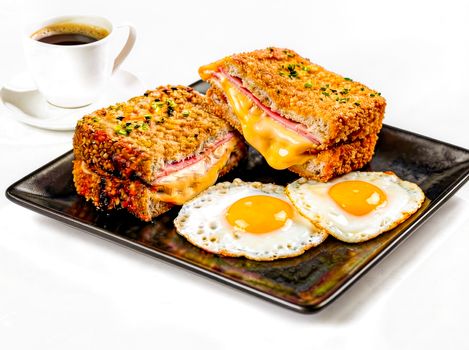
Photo: Cristian Arteaga / Pexels
French
Croque Monsieur
The diets react (see scores below)

That’s a heavy plate — want to see the leaner version?
Common Ingredients
- breadWhole wheat bread
Whole-wheat bread adds fiber and lowers the refined-grain load versus bread.
- ham
- Gruyère
- béchamel
- butterExtra virgin olive oil
Extra-virgin olive oil swaps saturated fat for monounsaturated fat in place of butter.
- Dijon mustard
- nutmeg
- flourWhole wheat flour
Whole-wheat flour adds fiber and lowers the refined-grain load versus flour.
Specific recipes may vary.
Incompatible with 10 of 11 diets
Diet Ratings
Croque Monsieur is fundamentally incompatible with ketogenic dieting. The two primary structural components — bread and béchamel sauce — are both high-carb ingredients that make this dish a keto non-starter. A standard serving of bread alone contributes 25-30g of net carbs, and the béchamel sauce is thickened with wheat flour, adding further carbohydrates. Together, a typical Croque Monsieur easily delivers 40-50g of net carbs per sandwich, which can single-handedly exceed or max out an entire day's carb allowance on a strict ketogenic diet. The ham, Gruyère, and butter are keto-friendly components, but they are entirely outweighed by the grain-based elements. No reasonable portion adjustment can make this dish keto-compatible in its traditional form.
Croque Monsieur is fundamentally incompatible with a vegan diet. It contains multiple animal products: ham (pork — animal flesh), Gruyère (dairy cheese), béchamel sauce (typically made with dairy milk), and butter (dairy fat). Every core component of this classic French sandwich relies on animal-derived ingredients, making it one of the clearest possible avoid verdicts.
Croque Monsieur is fundamentally incompatible with the Paleo diet. Nearly every core ingredient violates Paleo principles: bread is a grain-based product (wheat), Gruyère is dairy, béchamel is made from both dairy (milk/cream) and wheat flour, and flour itself is a grain derivative. Butter is a dairy product (debated but generally limited). Even the ham, while a pork product, is typically processed and salted. Dijon mustard may contain additives or non-Paleo ingredients. Nutmeg is the only clearly Paleo-compliant ingredient. This dish is essentially a showcase of Paleo's most excluded food categories — grains and dairy — stacked together in sandwich form.
The Croque Monsieur is fundamentally incompatible with Mediterranean diet principles. It combines multiple problematic elements: processed ham (pork/red-adjacent processed meat), refined white bread, butter as the primary fat (rather than olive oil), and a béchamel sauce built on butter and refined flour. The dish is high in saturated fat from multiple sources (butter, Gruyère, ham), contains processed meat, and offers no meaningful plant-based components. There are no vegetables, legumes, whole grains, or olive oil present. This is a quintessentially French bistro dish that sits at the opposite end of the spectrum from Mediterranean dietary principles.
Croque Monsieur is fundamentally incompatible with the carnivore diet. The dish is built on bread (a grain-based product, strictly excluded), béchamel sauce made with flour (another grain derivative), and Dijon mustard (plant-based condiment). Nutmeg is a plant spice, also excluded. While ham, Gruyère, and butter are animal-derived ingredients, they are entirely overwhelmed by the multiple plant-based and processed components. No amount of modification can make this dish carnivore-compliant without fundamentally reconstructing it into an entirely different dish.
Croque Monsieur contains multiple excluded ingredients that make it firmly non-compliant with Whole30. Bread is a grain product (wheat), which is explicitly excluded. Gruyère is dairy (cheese), which is excluded. Béchamel sauce contains both flour (a grain) and butter (dairy — only ghee/clarified butter is permitted). Regular butter itself is also excluded. These are not edge cases or debatable items — grains and dairy are foundational exclusions of the Whole30 program. The dish is also a classic sandwich, a form that falls under the 'no recreating baked goods/junk food' rule even if one were somehow to substitute compliant ingredients.
Croque Monsieur is fundamentally incompatible with the low-FODMAP elimination phase. The primary issue is the bread, which is standard wheat bread — high in fructans and one of the most significant FODMAP sources. The béchamel sauce compounds the problem with both wheat flour (fructans) and milk (lactose). Gruyère is a hard, aged cheese and is actually low-FODMAP due to minimal residual lactose. Ham is generally low-FODMAP. Butter, Dijon mustard (in small amounts), and nutmeg are low-FODMAP. However, the combination of wheat bread and a wheat-flour-plus-milk béchamel makes this dish unavoidably high-FODMAP at any standard serving. There is no realistic way to consume a Croque Monsieur in its traditional form during the elimination phase.
Croque Monsieur is fundamentally incompatible with DASH diet principles. It combines multiple high-sodium, high-saturated-fat ingredients: cured ham (high sodium, processed red/pork meat), Gruyère cheese (high saturated fat and sodium), béchamel sauce made with butter and whole milk (high saturated fat, full-fat dairy), and typically white bread (refined grain). A standard Croque Monsieur can easily contain 1,000–1,500mg of sodium per serving and 15–25g of saturated fat — representing a significant portion of or exceeding the daily DASH sodium limit in a single dish, while violating DASH's restrictions on saturated fat, full-fat dairy, and processed/cured meats. DASH guidelines explicitly limit processed meats, full-fat dairy, and high saturated fat foods.
The Croque Monsieur presents several Zone Diet challenges but isn't categorically off-limits. The primary issues are: (1) white bread is a high-glycemic carbohydrate that Sears classifies as 'unfavorable' — it raises insulin rapidly and disrupts the Zone's eicosanoid balance; (2) béchamel sauce compounds the problem by adding more flour (another high-glycemic carb) plus saturated fat from butter and full-fat milk; (3) butter is a saturated fat source that the Zone generally discourages in favor of monounsaturated fats. On the positive side, ham provides a reasonable lean protein contribution, Gruyère adds protein alongside fat, and Dijon mustard is essentially Zone-neutral. The macro ratio skews heavily toward high-glycemic carbohydrates and saturated fats, making it genuinely difficult to fit into a Zone-balanced meal without significant modification. However, a Zone practitioner could eat a small portion alongside a large salad with olive oil dressing to partially compensate for the glycemic load and shift the fat profile. As served in its classic form, this dish will spike insulin and deliver saturated fat rather than monounsaturated fat — both working against Zone principles — but it is not nutritionally empty like candy or soda.
The Croque Monsieur is a quintessentially pro-inflammatory dish by anti-inflammatory standards. It is built around multiple ingredients that the framework explicitly limits or avoids. Refined white bread provides rapidly digested carbohydrates with minimal fiber, spiking blood sugar and triggering inflammatory pathways. Gruyère is a high-fat cheese and butter is a saturated fat — both fall squarely in the 'limit' category. The béchamel sauce compounds the problem by combining butter, refined flour, and often full-fat dairy (milk or cream), creating a saturated fat and refined carb double hit. Ham is a processed red/pork meat product, high in sodium and often containing nitrates/nitrites — preservatives linked to inflammatory responses. The only redemptive elements are Dijon mustard (contains anti-inflammatory compounds from mustard seed) and nutmeg (a spice with modest antioxidant properties), but these are minor components that do not meaningfully offset the overall inflammatory profile. There are no omega-3 sources, no colorful vegetables or fruits, no legumes, and no anti-inflammatory oils (e.g., EVOO is not present — the fat is butter). This dish is a convergence of nearly every ingredient category the anti-inflammatory diet explicitly cautions against or avoids.
A Croque Monsieur is a poor fit for GLP-1 patients. It is built around high-fat, calorie-dense ingredients: Gruyère is a full-fat aged cheese, béchamel sauce is made from butter, flour, and whole milk, and additional butter is used for grilling or toasting. The bread is refined white bread, offering minimal fiber and low nutrient density per calorie. Ham provides modest protein, but the overall protein-to-fat ratio is unfavorable — the dish delivers substantial saturated fat alongside only moderate protein. The combination of melted cheese, butter, and a heavy cream-based sauce is exactly the high-fat, rich profile that worsens GLP-1 side effects including nausea, bloating, reflux, and prolonged gastric discomfort due to slowed gastric emptying. Refined bread contributes to blood sugar spikes with little fiber to blunt them. The dish is also calorie-dense in a small portion, meaning it crowds out more nutritious options in a reduced-appetite context.
*See how scores were generated at our methodology page.
Nutritional profile
Six traits that cut across every diet.
Fiber & Plants
How much whole-plant food and fiber it delivers.
Healthy Fats
The quality of its fats (unsaturated, omega-3).
Whole / Unprocessed
How close it is to its natural, unprocessed form.
Gut Gentle
How easy it is on digestion (low FODMAP, few irritants).
Low Glycemic
How little it spikes your blood sugar.
Protein Density
How much protein it packs per calorie.
Controversy Index
Higher controversy = more disagreement between diets.
Diet-Specific Tips
 Zone — 4/10
View tips
- White bread is a high-glycemic 'unfavorable' carbohydrate per Sears' Zone classification
- Béchamel sauce adds additional flour-based carbohydrates compounding the glycemic load
- Butter and Gruyère contribute saturated fat rather than preferred monounsaturated fat
- Ham provides lean protein that partially aligns with Zone protein guidelines
- Macro ratio as served is skewed away from the 40/30/30 Zone target toward carbs and fat
- Small portion with a large low-glycemic vegetable side could partially rehabilitate Zone compatibility