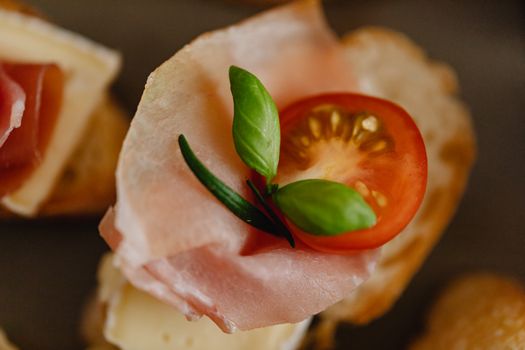
Photo: www.kaboompics.com / Pexels
Italian
Crostini with Prosciutto
The diets react (see scores below)
Common Ingredients
- baguette
- prosciutto
- ricotta
- fig jam
- arugula
- olive oil
- black pepper
Specific recipes may vary.
Incompatible with 7 of 11 diets
Diet Ratings
Crostini with Prosciutto is fundamentally incompatible with a ketogenic diet. The base ingredient — baguette — is a refined grain product with extremely high net carbs (roughly 15-20g per 2-3 slices of crostini alone), which can single-handedly exceed or consume the entire daily keto carb budget. Compounding this, fig jam is a concentrated source of sugar and high-glycemic carbohydrates. Together, these two ingredients make this dish a clear keto disqualifier. While individual components like prosciutto, ricotta, arugula, and olive oil are keto-friendly on their own, the dish as a whole cannot be adapted without fundamentally restructuring it (e.g., replacing the baguette with cucumber rounds or cheese crisps and omitting the fig jam entirely).
Crostini with Prosciutto contains two clear animal products: prosciutto (cured pork, a meat product) and ricotta (a dairy cheese made from whey). Both are unambiguously non-vegan. The remaining ingredients — baguette, fig jam, arugula, olive oil, and black pepper — are plant-based, but the presence of prosciutto and ricotta makes this dish entirely incompatible with a vegan diet. There is no meaningful debate within the vegan community regarding either ingredient.
Crostini with Prosciutto contains multiple non-paleo ingredients that make it fundamentally incompatible with the Paleolithic diet. The baguette is a wheat-based grain product — one of the clearest exclusions in paleo. Ricotta is dairy, also firmly excluded. Fig jam typically contains refined sugar or high concentrations of added sweeteners. While prosciutto, arugula, olive oil, and black pepper are paleo-friendly, the dish's foundation — bread and cheese — are both core violations. This is not a dish that can be made paleo-compliant with minor modifications; it would need to be reconstructed from the ground up.
This dish combines several elements that conflict with Mediterranean diet principles. The base is a baguette (refined white flour, not a whole grain), prosciutto is a cured/processed red meat that should be limited to a few times per month, and fig jam adds concentrated sugar. While ricotta, arugula, and olive oil are compatible with the diet, the overall profile is dominated by a refined grain base, processed red meat, and added sugar — a combination that runs contrary to core Mediterranean guidelines. As an occasional indulgence it is not catastrophic, but it cannot be considered a diet-aligned snack.
Some traditional Italian Mediterranean interpretations would view prosciutto as an acceptable occasional cured meat in small portions, and crostini as a traditional antipasto format rather than a dietary staple — advocates of this view might rate it as 'caution' rather than 'avoid,' especially given the arugula and olive oil components.
Crostini with Prosciutto is almost entirely incompatible with the carnivore diet. The base is a baguette — a grain-based bread that is strictly excluded. Fig jam is a plant-derived sugar concentrate. Arugula is a leafy green vegetable. Olive oil is a plant-derived fat. Black pepper is a plant spice. Ricotta, while dairy, is a minor component in a dish dominated by plant foods. The only carnivore-compatible ingredient is the prosciutto itself, and even that is a minor topping rather than the primary component. This dish is fundamentally a plant-forward snack with a small amount of cured meat as an accent, making it essentially off-limits on any tier of the carnivore diet.
This dish contains multiple excluded ingredients. The baguette is made from wheat (a grain), which is explicitly excluded on Whole30. Ricotta is dairy, also explicitly excluded. Fig jam typically contains added sugar, another excluded ingredient. Even if the fig jam were made with only fruit, the baguette and ricotta alone disqualify this dish entirely. Additionally, crostini itself falls under the 'no recreating baked goods/bread' rule — it is essentially toasted bread, a form explicitly excluded. Prosciutto, arugula, olive oil, and black pepper are compliant, but they cannot salvage a dish built on excluded foundations.
This dish contains multiple high-FODMAP ingredients that make it unsuitable during the elimination phase. The baguette is made from wheat flour, which is high in fructans — a primary FODMAP trigger. Fig jam is high-FODMAP due to figs containing excess fructose and polyols (sorbitol), and commercially prepared fig jam typically uses high-fructose sweeteners compounding the problem. Ricotta is moderate-to-high in lactose depending on the serving size; even a standard 2–3 tablespoon portion used on crostini can exceed the low-FODMAP threshold of approximately 40g. Together, the wheat baguette alone is sufficient to render this dish a clear 'avoid' during elimination. Prosciutto, arugula, olive oil, and black pepper are all low-FODMAP and unproblematic, but they cannot offset the three high-FODMAP components.
Crostini with prosciutto raises several DASH diet concerns. Prosciutto is a cured, processed meat that is very high in sodium (roughly 500-700mg per ounce) and saturated fat, both of which DASH explicitly limits. The baguette is a refined white flour product, not a whole grain, lacking the fiber DASH emphasizes. Fig jam adds significant added sugar. On the positive side, arugula provides DASH-friendly vegetables with potassium and magnesium, olive oil is a recommended healthy fat, ricotta contributes some calcium (though whole-milk ricotta carries saturated fat), and black pepper adds flavor without sodium. The combination of high-sodium cured meat plus refined grain plus added sugar makes this dish problematic for DASH, though it is not entirely without redeeming ingredients. As a small-portion snack with mindful serving sizes, it could be occasionally acceptable, but it is not a food DASH would emphasize or recommend regularly.
Crostini with Prosciutto presents multiple Zone Diet challenges. The baguette base is a high-glycemic refined carbohydrate — a classic Zone 'unfavorable' carb that spikes insulin quickly and offers little fiber to offset its glycemic load. Fig jam compounds the problem, adding concentrated simple sugars (another high-glycemic ingredient). Together, these two ingredients make the carbohydrate profile of this snack essentially the opposite of what Zone recommends. On the positive side, prosciutto provides lean-ish protein (though it is a cured meat with moderate saturated fat), arugula is an excellent Zone-favorable low-glycemic vegetable, olive oil is an ideal Zone monounsaturated fat, and ricotta contributes protein with moderate fat. The macronutrient ratio of this dish as prepared skews heavily carbohydrate with high-glycemic sources — the two pillars of a poor Zone meal. A Zone-adapted version would replace the baguette with cucumber rounds or endive leaves, eliminate the fig jam or use a tiny amount of fresh berries instead, and increase arugula volume. As served in its traditional form, this snack is difficult to incorporate into a Zone-balanced meal without significant reconstruction.
This dish presents a mixed anti-inflammatory profile. On the positive side, extra virgin olive oil is a cornerstone anti-inflammatory fat rich in oleocanthal, arugula provides glucosinolates and antioxidants, black pepper contains piperine which enhances absorption of polyphenols, and fig jam offers small amounts of polyphenols. However, several ingredients work against an anti-inflammatory framework: the baguette is a refined white flour carbohydrate with a high glycemic load that can promote inflammatory markers; prosciutto is a processed red meat high in sodium and saturated fat, which the framework recommends limiting; ricotta is a full-fat dairy product (moderate concern); and fig jam typically contains significant added sugar. The dish is not catastrophically inflammatory — it lacks trans fats, seed oils, or high-fructose corn syrup — but the combination of refined carbs, processed cured meat, and added sugar tips it into caution territory. As an occasional snack rather than a dietary staple, the harm is limited, but it cannot be approved under anti-inflammatory principles.
Crostini with prosciutto presents a mixed nutritional profile for GLP-1 patients. The base is a refined-grain baguette — low fiber, low protein, and high glycemic index — which is the structural problem. Prosciutto contributes some protein but is a processed, high-sodium, moderately high-fat cured meat served in thin slices, so the absolute protein per serving is low (roughly 4-6g for 1-2 slices). Ricotta adds a small amount of protein and fat. Fig jam is a concentrated sugar source with minimal nutritional value. Arugula is a positive addition — low calorie, micronutrient-dense, mildly bitter which can aid digestion. Olive oil is the preferred fat type for GLP-1 patients. Overall, this snack is low in protein, low in fiber, moderate in refined carbohydrates, contains added sugar from the fig jam, and uses a processed cured meat. It does not worsen GLP-1 side effects severely — it is not fried, not very spicy, not carbonated — but it fails to deliver meaningful protein or fiber per calorie, making it a poor use of limited appetite. The ricotta and prosciutto together might provide 6-9g protein in a realistic serving, well below the 15-30g per meal target. It is not an 'avoid' because the fats are mostly unsaturated, portions are inherently small, and it does not actively worsen GI side effects for most patients, but it is a low-value snack nutritionally for GLP-1 patients.
Some GLP-1-focused dietitians may accept crostini-style snacks as a social or adherence tool, arguing that small portions and palatability support long-term dietary compliance, and that prosciutto's protein density per gram of meat is reasonable even if total serving protein is low. Others would rate this more negatively, specifically flagging the fig jam's added sugar and the refined baguette as empty-calorie vehicles that displace higher-value foods in an already calorie-restricted eating pattern.
*See how scores were generated at our methodology page.
Nutritional profile
Six traits that cut across every diet.
Fiber & Plants
How much whole-plant food and fiber it delivers.
Healthy Fats
The quality of its fats (unsaturated, omega-3).
Whole / Unprocessed
How close it is to its natural, unprocessed form.
Gut Gentle
How easy it is on digestion (low FODMAP, few irritants).
Low Glycemic
How little it spikes your blood sugar.
Protein Density
How much protein it packs per calorie.
Controversy Index
Higher controversy = more disagreement between diets.
Diet-Specific Tips
 DASH — 4/10
View tips
- Prosciutto is high in sodium (~500-700mg/oz) — DASH limits sodium to <2,300mg/day (standard) or <1,500mg/day (low-sodium)
- Prosciutto is a cured/processed red meat, a category DASH explicitly limits
- Baguette is a refined grain, not a whole grain — DASH emphasizes whole grains
- Fig jam contributes added sugar, which DASH limits
- Ricotta (whole-milk) adds saturated fat; low-fat ricotta would be a more DASH-compatible substitute
- Arugula is DASH-positive: leafy green rich in potassium and magnesium
- Olive oil is a DASH-recommended healthy fat
- Small portion size could partially mitigate concerns, but the dish's core components conflict with DASH priorities
 Zone — 4/10
View tips
- Baguette is a high-glycemic refined carb — explicitly 'unfavorable' in Zone terminology
- Fig jam adds concentrated simple sugars, further spiking glycemic load
- Prosciutto provides protein but is a processed cured meat with moderate saturated fat
- Ricotta contributes protein and some fat but adds saturated fat
- Arugula is an ideal Zone vegetable — low glycemic, polyphenol-rich
- Olive oil is a perfect Zone monounsaturated fat source
- Overall macronutrient ratio is carbohydrate-heavy with high glycemic index, breaking Zone balance
- Portion control alone cannot rescue the glycemic quality of baguette and fig jam combination
 Anti-Inflammatory — 4/10
View tips
- Baguette is a refined carbohydrate with high glycemic load, promoting inflammatory markers
- Prosciutto is a processed cured red meat high in sodium and saturated fat
- Fig jam contributes added sugar
- Ricotta is a full-fat dairy — moderate inflammatory concern
- Extra virgin olive oil is a strong anti-inflammatory ingredient (oleocanthal)
- Arugula provides antioxidants and glucosinolates
- Black pepper contains piperine, a mild anti-inflammatory compound
- No trans fats, seed oils, or artificial additives present
 GLP-1 Friendly — 4/10
View tips
- Refined grain baguette base provides low fiber and low protein per calorie
- Prosciutto is a processed, high-sodium cured meat with limited protein per typical serving (4-6g)
- Fig jam adds concentrated sugar with negligible nutritional value — a meaningful drawback for GLP-1 patients
- Ricotta contributes small protein and fat; not a high-protein density ingredient per serving
- Olive oil and arugula are positives — preferred fat type and micronutrient-dense green
- Total protein per realistic serving likely 6-10g, well below the 15-30g per snack/meal target
- Not fried, not spicy, not carbonated — unlikely to acutely worsen GLP-1 GI side effects
- Low nutrient density per calorie overall — poor fit for patients who must maximize nutrition in reduced intake