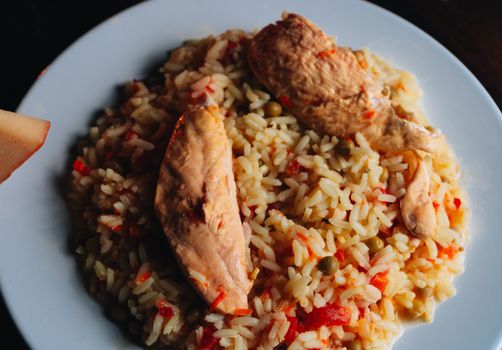
Photo: Andres Alaniz / Pexels
Latin-American
Arroz con Pollo (Cuban)
The diets react (see scores below)
Common Ingredients
- chicken
- rice
- bell peppers
- peas
- olives
- saffron
- onion
- tomato sauce
Specific recipes may vary.
Incompatible with 6 of 11 diets
Diet Ratings
Arroz con Pollo is fundamentally built around rice, which is a high-glycemic grain that delivers approximately 45g of net carbs per cup cooked. A standard serving of this dish would far exceed the 20-50g daily net carb limit for ketosis on its own. The additional carbohydrates from peas, tomato sauce, and onion compound the problem. While the chicken, olives, and saffron are keto-friendly, the dish cannot be meaningfully modified and still be called Arroz con Pollo — rice is structural to the recipe. This dish is incompatible with ketogenic eating in its traditional form.
Arroz con Pollo contains chicken as its primary protein and defining ingredient. Chicken is animal flesh and is unambiguously excluded under all vegan frameworks. There is no version of this dish that qualifies as vegan while retaining its core identity. The remaining ingredients (rice, bell peppers, peas, olives, saffron, onion, tomato sauce) are all plant-based, but the presence of chicken makes the dish entirely incompatible with a vegan diet.
Arroz con Pollo contains multiple non-paleo ingredients that disqualify it outright. Rice is a grain and is excluded under strict paleo guidelines. Peas are legumes and also excluded. Tomato sauce, depending on preparation, often contains added salt, sugar, or preservatives, making it a processed food. The chicken, bell peppers, onion, saffron, and olives are all paleo-approved, but the foundational grain (rice) and the legume (peas) are core components of this dish that cannot be simply omitted — they define the recipe itself. This is not a borderline case.
Arroz con Pollo features chicken (a moderate-consumption protein in the Mediterranean diet), paired with several Mediterranean-friendly vegetables and olives. The inclusion of white rice rather than a whole grain is a mild concern under modern Mediterranean diet guidelines, though rice is traditional in many Mediterranean-adjacent cuisines. The vegetables, olives, and aromatic ingredients are positive elements, while the tomato sauce base aligns well with plant-forward principles. Overall this is an acceptable dish in moderation, held back mainly by the white rice and the fact that poultry is not a daily staple.
Some Mediterranean diet interpretations, particularly those rooted in traditional Spanish and Southern European cuisines, accept white rice as a culturally appropriate grain used in moderation (e.g., Spanish arroz dishes). In those frameworks, this dish — rich in vegetables, olives, and lean poultry — could score closer to the lower end of 'approve.'
Arroz con Pollo is fundamentally incompatible with the carnivore diet. While chicken itself is an acceptable animal protein, the dish is built around rice (a grain) and contains numerous plant-based ingredients: bell peppers, peas, olives, onion, tomato sauce, and saffron. The majority of this dish's ingredients are explicitly excluded from the carnivore diet. Rice alone as a grain carbohydrate is a hard exclusion, and the combination of vegetables, legumes (peas), and plant-based condiments makes this dish entirely off-limits. There is no meaningful modification possible — removing the plant ingredients would leave only plain chicken, which is a different dish entirely.
Arroz con Pollo contains rice, which is explicitly excluded on the Whole30 program as a grain. Additionally, peas (green peas, not sugar snap or snow peas) are legumes and also excluded. Tomato sauce may also contain added sugar or other non-compliant ingredients. Even if the tomato sauce were compliant, the rice alone is a disqualifying ingredient — it is a named excluded grain. This dish cannot be made Whole30-compliant without fundamentally changing it (removing rice removes the 'arroz' entirely).
Cuban Arroz con Pollo contains multiple high-FODMAP ingredients that make it unsuitable during the elimination phase. Onion is one of the highest-FODMAP foods tested by Monash University, containing significant fructans even in small amounts — it is a primary aromatic in this dish and cannot be easily avoided. Peas (green/garden peas) are high in GOS at standard serving sizes (Monash rates them as high-FODMAP above 1/4 cup). Tomato sauce is problematic because commercially prepared versions frequently contain onion and garlic, and even plain tomato paste becomes high-FODMAP above 2 tablespoons due to excess fructose concentration. The combination of onion plus peas alone is sufficient to classify this dish as high-FODMAP at any realistic serving. Chicken, rice, bell peppers, saffron, and garlic-free olives are individually low-FODMAP, but they cannot offset the problematic ingredients in a traditional preparation.
Arroz con Pollo is a mixed dish with several DASH-friendly components — chicken (lean protein), bell peppers, onion, peas, and tomatoes align well with DASH principles. However, the olives contribute significant sodium, and commercial tomato sauce often contains added sodium. White rice (the typical base) is a refined grain with limited fiber compared to DASH-preferred whole grains. The overall sodium load from olives, tomato sauce, and any added seasoning or sofrito can push this dish well above DASH sodium targets per serving. With mindful preparation — using low-sodium tomato sauce, limiting olives, and substituting brown rice — this dish can move closer to DASH compliance, but as commonly prepared it warrants caution.
NIH DASH guidelines emphasize whole grains and low sodium, placing traditional Cuban Arroz con Pollo in the caution zone due to refined rice and olive/tomato sauce sodium. However, updated clinical interpretations note that the vegetable density, lean chicken, and legume content (peas) provide meaningful DASH nutrients (potassium, fiber, protein), and some DASH-oriented dietitians consider home-prepared versions with sodium modifications to be reasonably compatible with the diet.
Arroz con Pollo is a mixed dish with both Zone-friendly and Zone-challenging components. The chicken provides lean protein that fits well within Zone guidelines. Bell peppers, onion, peas, olives, and tomato sauce are all favorable Zone carbohydrate and fat sources — bell peppers and onion are low-glycemic vegetables, olives contribute monounsaturated fat, and peas provide moderate-glycemic carbs with fiber. Saffron is nutritionally negligible. The primary challenge is white rice, which is a high-glycemic carbohydrate that Dr. Sears explicitly classifies as 'unfavorable' in Zone terminology, causing rapid insulin spikes that disrupt the Zone's hormonal balance goals. In a traditional preparation, rice dominates the dish's carbohydrate profile, making it difficult to maintain the 40/30/30 ratio without significant modification. However, the dish is not impossible to Zone-ify: reducing the rice portion substantially, increasing the vegetable components, and ensuring a proper chicken-to-rice ratio can bring it into balance. The dish is not an 'avoid' because the protein and fat components are genuinely Zone-favorable, but the rice-heavy traditional preparation earns a 'caution' rating requiring careful portion control.
Some Zone practitioners argue that traditional Arroz con Pollo can be adapted by treating the rice as a single carbohydrate block and loading up on the vegetable components (bell peppers, peas, tomato). Dr. Sears' later writings in 'The Anti-Inflammation Zone' soften the strict avoidance of all grains, focusing more on overall glycemic load of the meal — if the rice portion is small relative to the chicken and vegetables, the dish's overall glycemic impact may be acceptable within a Zone-balanced plate.
Arroz con Pollo is a mixed dish from an anti-inflammatory perspective. On the positive side, it contains several beneficial ingredients: bell peppers and tomatoes are rich in antioxidants (vitamin C, lycopene, carotenoids); onions provide quercetin and other flavonoids; peas contribute fiber and plant protein; olives offer monounsaturated fats and polyphenols consistent with anti-inflammatory eating; and saffron is notable for its crocin and safranal compounds, which have demonstrated anti-inflammatory properties in research. Lean chicken (especially skinless) is a 'moderate' protein on the anti-inflammatory framework. The main concern is white rice, which is a refined carbohydrate with a higher glycemic index that can promote inflammatory signaling compared to whole grains like brown rice. Traditional Cuban versions often use white rice, which somewhat undermines the otherwise favorable vegetable and spice profile. The tomato sauce component is generally positive (lycopene becomes more bioavailable when cooked), though commercial tomato sauces may contain added sugar or sodium. Overall, the dish is a reasonably balanced meal with meaningful anti-inflammatory contributions from vegetables, olives, and saffron, but the white rice base and potential for processed tomato sauce keep it in the caution zone rather than approved.
A stricter anti-inflammatory practitioner (e.g., following AIP or a low-glycemic anti-inflammatory protocol) would flag white rice as a meaningful glycemic load issue and potentially note that nightshade ingredients (bell peppers, tomato sauce) could be problematic for autoimmune-sensitive individuals. Conversely, Dr. Weil's broader anti-inflammatory pyramid does not categorically exclude white rice and emphasizes the overall dietary pattern, under which a vegetable-rich dish like this might be considered acceptable, especially if portions are balanced.
Arroz con Pollo is a mixed dish with meaningful strengths and notable limitations for GLP-1 patients. The chicken provides a solid lean protein base (roughly 25-30g per standard serving depending on portion), and the vegetables — bell peppers, peas, onion, tomato sauce — contribute fiber, micronutrients, and antioxidants. Saffron and aromatics add flavor without fat or sugar. However, white rice is the dominant carbohydrate: low fiber, moderate glycemic load, and nutritionally thin per calorie. Olives add healthy unsaturated fat but also sodium. The dish is generally easy to digest and not greasy, which is a plus. The main concern is that rice takes up significant plate real estate — in the small portions GLP-1 patients eat, rice may crowd out higher-value protein and fiber. Tomato sauce and olives can occasionally trigger mild reflux in sensitive patients. Overall, this is an acceptable meal when portioned with chicken as the star and rice as a supporting element, not the base.
Some GLP-1-focused dietitians are comfortable with white rice in this context because the dish as a whole has protein and vegetables that moderate the glycemic impact, and palatability supports consistent eating — critical when appetite suppression risks inadequate intake. Others flag white rice more strongly, recommending a cauliflower rice substitution or brown rice to improve fiber density and nutrient value per calorie.
*See how scores were generated at our methodology page.
Nutritional profile
Six traits that cut across every diet.
Fiber & Plants
How much whole-plant food and fiber it delivers.
Healthy Fats
The quality of its fats (unsaturated, omega-3).
Whole / Unprocessed
How close it is to its natural, unprocessed form.
Gut Gentle
How easy it is on digestion (low FODMAP, few irritants).
Low Glycemic
How little it spikes your blood sugar.
Protein Density
How much protein it packs per calorie.
Controversy Index
Higher controversy = more disagreement between diets.
Diet-Specific Tips
 Mediterranean — 5/10
View tips
- Chicken is acceptable in moderation but not a Mediterranean staple protein
- White rice is a refined grain; whole grains are preferred under modern Mediterranean guidelines
- Olives are a strongly Mediterranean-approved ingredient
- Bell peppers, peas, onion, and tomato sauce add meaningful vegetable content
- No red meat, processed ingredients, or added sugars
- Saffron and aromatics reflect Mediterranean culinary traditions
 DASH — 5/10
View tips
- Olives are high in sodium, potentially adding 300-500mg per serving
- Commercial tomato sauce frequently contains significant added sodium
- White rice is a refined grain; brown rice would better align with DASH whole grain emphasis
- Chicken is a DASH-approved lean protein
- Bell peppers, onions, peas, and tomatoes contribute potassium, fiber, and vitamins consistent with DASH
- Dish can be DASH-optimized with low-sodium tomato sauce, reduced olives, and brown rice substitution
- Portion size is critical — rice-heavy servings increase refined carbohydrate load
 Zone — 5/10
View tips
- White rice is a high-glycemic 'unfavorable' carbohydrate per Zone guidelines
- Chicken is a lean protein source — highly Zone-favorable
- Bell peppers and onion are low-glycemic vegetables — Zone-favorable
- Olives provide monounsaturated fat — ideal Zone fat source
- Peas are moderate-glycemic with fiber, usable as Zone carb blocks
- Rice typically dominates the dish, skewing macros toward excess carbohydrate
- Portion reduction of rice and increase of vegetables can bring dish into Zone balance
- No processed ingredients, trans fats, or omega-6-heavy oils present
 Anti-Inflammatory — 5/10
View tips
- White rice is a refined carbohydrate — higher glycemic load is a mild pro-inflammatory concern
- Bell peppers and tomatoes provide antioxidants (vitamin C, lycopene, carotenoids)
- Olives contribute monounsaturated fats and polyphenols (anti-inflammatory)
- Saffron contains crocin and safranal with documented anti-inflammatory activity
- Onions provide quercetin and flavonoids
- Lean chicken is a moderate/acceptable protein source
- Peas add fiber and plant-based protein
- Tomato sauce quality varies — commercial versions may add sugar and sodium
- Nightshade ingredients (peppers, tomato) may be a concern for autoimmune-sensitive individuals
 GLP-1 Friendly — 6/10
View tips
- Lean chicken protein supports the 25-30g per meal protein target
- White rice is low fiber and low nutrient density per calorie — main limiting factor
- Peas and bell peppers add meaningful fiber and micronutrients
- Olives contribute heart-healthy unsaturated fat but add sodium
- Dish is not greasy or fried — generally well-tolerated digestively
- Tomato sauce and olives carry mild reflux risk for sensitive patients
- Portion composition matters: chicken-heavy servings outperform rice-heavy ones