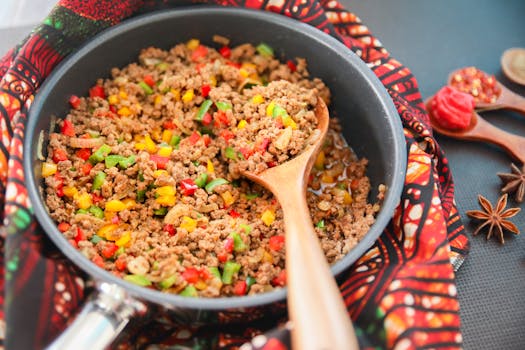
Photo: Keesha's Kitchen / Pexels
Latin-American
Picadillo
The diets react (see scores below)
Common Ingredients
- ground beef
- onion
- green bell pepper
- tomato sauce
- olives
- raisins
- capers
- cumin
Specific recipes may vary.
Incompatible with 4 of 11 diets
Diet Ratings
Traditional Picadillo contains several keto-friendly ingredients — ground beef (high fat, zero carb protein), olives, capers, cumin, and moderate amounts of onion and bell pepper. However, raisins are the primary disqualifier: even a small amount (2-3 tbsp per serving) can add 15-25g of net carbs from sugar. Tomato sauce also contributes additional net carbs (4-6g per half cup). Together, a standard serving likely pushes 20-30g net carbs, threatening ketosis. The dish is salvageable with modifications — omitting raisins entirely and using crushed whole tomatoes in smaller quantities — which is why it lands in 'caution' rather than 'avoid'. As served traditionally, it is borderline to incompatible with strict keto targets.
Lazy keto practitioners who track only raisin quantity might argue that a very small pinch of raisins (under 10g) keeps the dish workable within a 50g daily carb ceiling, especially paired with a low-carb day. Strict/clinical keto advocates, however, would reject any added dried fruit categorically, as raisins are essentially concentrated sugar with no place in therapeutic ketosis.
Picadillo contains ground beef as its primary protein, which is an animal product and therefore strictly incompatible with a vegan diet. There is no ambiguity here — beef is animal flesh and is excluded under all definitions of veganism. The remaining ingredients (onion, green bell pepper, tomato sauce, olives, raisins, capers, cumin) are all plant-based, but the dish as described cannot be considered vegan due to the ground beef.
Picadillo is largely paleo-compatible at its core — ground beef, onion, green bell pepper, and cumin are all clearly approved paleo ingredients. However, several components introduce concern. Tomato sauce is commonly store-bought and may contain added sugar, salt, and preservatives, making it a processed food risk; even homemade tomato sauce is fine, but the default assumption leans processed. Olives and capers are generally paleo-accepted whole foods, though jarred versions often contain added salt. Raisins are a natural, concentrated fruit sugar source — whole paleo in origin, but the high sugar density and typical commercial processing (often with added oils or sulfur dioxide) push them toward the caution zone. Taken together, the dish sits in a gray area: the base protein and vegetables are solid paleo, but the combination of likely-processed tomato sauce, salt-brined olives and capers, and commercially dried raisins makes this a 'caution' rather than a clean approve.
Strict Cordain-school paleo would flag the added salt in olives and capers and the processed tomato sauce outright, potentially rating this dish as 'avoid' in its typical restaurant or packaged form. Conversely, paleo practitioners following Mark Sisson or the Whole30 framework would likely approve a homemade version using fresh tomatoes, naturally cured olives, and organic unsulfured raisins.
Picadillo is centered on ground beef as its primary protein, which is a red meat that the Mediterranean diet restricts to only a few times per month. While the dish does contain some beneficial ingredients — onion, green bell pepper, tomatoes, olives, and capers are all Mediterranean-friendly components — the foundational ingredient directly contradicts core Mediterranean principles. Ground beef is typically higher in saturated fat than the lean fish, legumes, and plant proteins that form the backbone of Mediterranean eating. The sweet-savory profile from raisins adds sugar, and the overall dish lacks the whole grains, olive oil as primary fat, or plant-forward protein base that would make it compatible. Occasional consumption is not impossible, but as a regular main dish it conflicts with Mediterranean dietary patterns.
Picadillo is fundamentally incompatible with the carnivore diet. While it does contain ground beef as its protein base, the dish is heavily loaded with plant-derived ingredients that are all excluded on carnivore: onion, green bell pepper, tomato sauce, olives, raisins, capers, and cumin. Raisins are particularly problematic as a concentrated sugar source. Tomato sauce, bell peppers, and onions are all vegetables/fruits. Capers and olives are plant-based. Cumin is a plant-derived spice. The ground beef itself would be approved, but it represents only one of eight ingredients — the dish as prepared cannot be considered carnivore-compatible in any tier of the diet.
Picadillo's core ingredients — ground beef, onion, green bell pepper, cumin, olives, capers, and raisins — are all individually Whole30-compliant. Raisins are dried fruit with no added sugar (when plain), which is allowed. The main concern is tomato sauce: most commercial tomato sauces contain added sugar, citric acid stabilizers, or other non-compliant additives. A label-verified or homemade tomato sauce with no added sugar is required. Olives and capers are also typically fine but can be packed in brine that occasionally contains sulfites — though sulfites are no longer excluded per the 2024 rule change, so that's not a barrier. The dish itself is a whole-food savory meal, not a recreation of a baked good or junk food, so the spirit of the program is honored.
Some Whole30 practitioners flag raisins in savory dishes as 'SWYPO-adjacent' (using sweet elements to satisfy sugar cravings), though official Whole30 guidelines do not restrict fruit or dried fruit in savory recipes. The main practical concern is commercial tomato sauce requiring careful label-reading.
Picadillo contains multiple high-FODMAP ingredients that make it unsuitable during the elimination phase. Onion is one of the highest-fructan foods tested by Monash and is high-FODMAP at any culinary amount — even 1/4 of a medium onion exceeds safe thresholds. Raisins are high in fructose and fructans; Monash rates them high-FODMAP at just 1 tablespoon (13g), and traditional picadillo uses a meaningful handful. Green bell pepper is low-FODMAP, ground beef is low-FODMAP, cumin is low-FODMAP in spice quantities, capers are generally considered low-FODMAP in small amounts, and olives are low-FODMAP. Tomato sauce requires scrutiny — plain tomato passata is low-FODMAP at 100g but many canned tomato sauces contain garlic and/or onion as ingredients, adding further fructan load. The combination of onion (unavoidable in this dish) and raisins (traditional and used in meaningful quantity) makes this dish high-FODMAP regardless of portion size. Substituting scallion greens for onion and omitting raisins could make a modified version more compliant, but the traditional recipe as described is not suitable for elimination phase.
Picadillo presents a mixed DASH diet profile. The positive elements include onion, green bell pepper, and tomato sauce (vegetables rich in potassium and fiber), raisins (natural sweetness with potassium and fiber), and cumin (a sodium-free spice). However, ground beef is a red meat high in saturated fat, which DASH explicitly limits — the fat content depends heavily on the lean percentage (80/20 vs. 93/7 makes a significant difference). The more problematic elements are olives and capers, which are both very high in sodium; a typical serving of picadillo can easily contain 600–1,000mg of sodium from these two ingredients alone, making sodium management the central DASH concern. Tomato sauce also often contains added sodium. The dish is not categorically off-limits if prepared with extra-lean ground beef (≥93% lean), low-sodium tomato sauce, reduced quantities of olives and capers, and portion-controlled serving size, but as traditionally prepared it conflicts with key DASH principles around sodium and saturated fat.
NIH DASH guidelines clearly limit both red meat and high-sodium ingredients like olives and capers, placing traditional picadillo in caution or avoid territory. However, some DASH-oriented registered dietitians note that the dish's substantial vegetable base, use of anti-inflammatory spices, and cultural significance warrant a modified 'caution' rather than 'avoid' — suggesting substitutions like lean turkey, low-sodium canned tomatoes, and minimal olives/capers can make it DASH-compatible without abandoning the dish entirely.
Picadillo sits squarely in Zone 'caution' territory. The protein base (ground beef) is workable but depends heavily on fat content — lean ground beef (90%+ lean) fits Zone protein guidelines reasonably well, while standard ground beef carries excess saturated fat that competes with the fat block allowance. The vegetables (onion, green bell pepper) and tomato sauce are favorable low-glycemic Zone carbs. However, raisins are a recognized 'unfavorable' carb in Zone methodology — high glycemic index and sugar-dense — and can spike insulin response. Olives contribute monounsaturated fat (Zone-favorable), while capers are negligible macro-wise. Cumin is a polyphenol-rich spice Sears would approve. The main Zone challenges are: (1) the fat profile of typical ground beef pushes saturated fat higher than ideal, (2) raisins are an 'unfavorable' carb that require strict portion control to avoid glycemic disruption, and (3) the dish as traditionally prepared skews toward a higher carb-to-protein ratio when raisins and tomato sauce are used generously. With lean ground beef and minimized raisins, this dish can be portioned into acceptable Zone blocks alongside additional low-glycemic vegetables.
Some Zone practitioners would rate this more favorably, noting that the raisin quantity in picadillo is typically small (a few tablespoons across multiple servings), making the per-serving glycemic impact modest. Dr. Sears' later anti-inflammatory work in 'The Zone Diet' also places more emphasis on overall inflammatory load than strict GI categorization — and picadillo's olive and spice components provide polyphenols and monounsaturated fats that score well on that axis. With 90% lean beef, the dish could be argued as a moderate Zone-friendly main.
Picadillo is a mixed dish from an anti-inflammatory perspective. The primary concern is ground beef, which is a red meat high in saturated fat and arachidonic acid — a precursor to pro-inflammatory eicosanoids. Anti-inflammatory guidelines recommend limiting red meat, particularly ground beef which often has higher fat content. However, the dish has several redeeming elements: onion and green bell pepper provide quercetin, flavonoids, and vitamin C; tomatoes (via tomato sauce) supply lycopene, a well-studied antioxidant that reduces CRP; olives contribute monounsaturated fats and polyphenols similar to olive oil; capers are rich in quercetin and rutin; and cumin has anti-inflammatory properties including antioxidant volatile compounds. Raisins add natural sugars but also resveratrol and polyphenols. The vegetable and spice components are genuinely anti-inflammatory, but the ground beef base pulls the overall profile into 'caution' territory. Using lean ground beef (≤10% fat) or substituting with turkey or plant-based protein would significantly improve the anti-inflammatory profile. As prepared with standard ground beef, this is acceptable occasionally but not a dish to eat regularly on an anti-inflammatory protocol.
Some anti-inflammatory practitioners, particularly those following Mediterranean-adjacent frameworks like Dr. Weil's pyramid, would note that the tomato sauce, olives, and polyphenol-rich vegetables substantially offset the beef's drawbacks when consumed in moderate portions — especially if lean beef is used. Conversely, strict anti-inflammatory and autoimmune protocol (AIP) adherents would rate this lower, citing red meat's arachidonic acid load and the nightshade content of tomatoes as potentially problematic for inflammation-sensitive individuals.
Picadillo provides meaningful protein from ground beef, but the fat content depends heavily on the beef's fat percentage — standard 80/20 ground beef is high in saturated fat, which can worsen GLP-1 side effects like nausea, bloating, and reflux due to slowed gastric emptying. Raisins and olives add sugar and fat respectively, though in modest amounts. The tomato sauce, onion, and bell pepper contribute some fiber and micronutrients, improving nutrient density. Overall, this dish sits in the caution zone: good protein potential but fat content needs to be managed. Using 90/10 or 93/7 lean ground beef, or substituting ground turkey or chicken, would move this dish into approve territory. Portion size matters significantly here.
Some GLP-1-focused dietitians accept lean-version picadillo as a solid high-protein Latin staple worth encouraging, particularly given its cultural relevance and the vegetable and legume additions common in some regional recipes. Others flag even lean ground beef as a caution due to its saturated fat content relative to white meat alternatives, and note that olives and raisins add fat and sugar that reduce the dish's overall nutrient density per calorie for patients eating very small portions.
*See how scores were generated at our methodology page.
Nutritional profile
Six traits that cut across every diet.
Fiber & Plants
How much whole-plant food and fiber it delivers.
Healthy Fats
The quality of its fats (unsaturated, omega-3).
Whole / Unprocessed
How close it is to its natural, unprocessed form.
Gut Gentle
How easy it is on digestion (low FODMAP, few irritants).
Low Glycemic
How little it spikes your blood sugar.
Protein Density
How much protein it packs per calorie.
Controversy Index
Higher controversy = more disagreement between diets.
Diet-Specific Tips
 Keto — 4/10
View tips
- Raisins are high in sugar and net carbs — the primary keto disqualifier in this dish
- Tomato sauce adds moderate net carbs and must be portioned carefully
- Ground beef and olives are strongly keto-friendly components
- Onion and green bell pepper contribute minor but non-trivial carbs
- Dish is easily modified by omitting raisins to improve keto compatibility
- Standard traditional serving likely exceeds 20g net carbs making it risky for strict keto
 Paleo — 5/10
View tips
- Ground beef is a core paleo protein — approved
- Onion, green bell pepper, and cumin are fully paleo-compliant
- Tomato sauce is frequently processed with added sugar, salt, or preservatives
- Olives and capers are paleo in origin but typically jarred with added salt
- Raisins are a whole-food fruit but concentrated in sugar and often commercially treated
- Homemade version with clean ingredients would score closer to 7-8; typical prepared version scores lower
 Whole30 — 6/10
View tips
- Ground beef, onion, green bell pepper, cumin, olives, capers, and raisins are all Whole30-compliant
- Tomato sauce must be label-checked — most commercial versions contain added sugar
- Raisins (plain, unsweetened dried fruit) are allowed per official Whole30 rules
- Olives and capers in brine are generally compliant; sulfites no longer excluded per 2024 rule change
- Dish is a legitimate savory meal, not a banned food recreation
- A homemade or compliant-labeled tomato sauce makes this fully approvable
 DASH — 4/10
View tips
- Ground beef is red meat high in saturated fat — DASH recommends limiting red meat; lean percentage critically affects rating
- Olives and capers are high-sodium ingredients that can push a single serving well above DASH sodium targets
- Tomato sauce often contains significant added sodium — low-sodium versions are preferred
- Onion, green bell pepper, and tomato base contribute beneficial potassium, fiber, and phytonutrients
- Raisins add natural sweetness and potassium without added sodium
- No added sugars or tropical oils, which is favorable
- Preparation modifications (extra-lean beef, low-sodium tomato sauce, reduced olives/capers) can meaningfully improve DASH compatibility
 Zone — 5/10
View tips
- Ground beef fat content is variable — lean (90%+) is necessary to stay within Zone fat block limits and reduce saturated fat
- Raisins are an 'unfavorable' Zone carb — high glycemic index; portion must be minimized
- Olives provide Zone-favorable monounsaturated fat
- Green bell pepper and onion are favorable low-glycemic Zone carbs
- Tomato sauce contributes acceptable carb blocks if unsweetened
- Cumin and capers add polyphenols with negligible macro impact
- Traditional preparation often served over white rice, which would push this to avoid — evaluate dish in isolation
 Anti-Inflammatory — 4/10
View tips
- Ground beef is a red meat high in saturated fat and arachidonic acid — flagged for limiting on anti-inflammatory diets
- Olives provide monounsaturated fats and anti-inflammatory polyphenols
- Tomato sauce supplies lycopene, an antioxidant associated with reduced inflammatory markers
- Onion and green bell pepper contribute quercetin and vitamin C
- Capers are rich in quercetin and rutin — strongly anti-inflammatory
- Cumin has antioxidant and anti-inflammatory phytochemicals
- Raisins add sugar load but also resveratrol and polyphenols
- Overall profile is mixed: pro-inflammatory protein base offset by genuinely anti-inflammatory supporting ingredients
 GLP-1 Friendly — 5/10
View tips
- Ground beef fat content is the primary concern — 80/20 significantly raises saturated fat per serving
- High saturated fat worsens GLP-1 GI side effects including nausea, bloating, and reflux
- Protein is adequate but not maximized — lean swaps would improve protein-to-fat ratio
- Raisins add simple sugars, a minor drawback for blood sugar stability
- Olives add unsaturated fat, which is preferable but still calorie-dense in small-appetite context
- Tomato sauce, bell pepper, and onion add fiber and micronutrients — a positive
- Capers contribute negligible macronutrient impact but add flavor without significant downside
- Dish is portion-sensitive — a small serving of a lean version is acceptable; a large serving of fatty beef version is problematic