Eastern-European
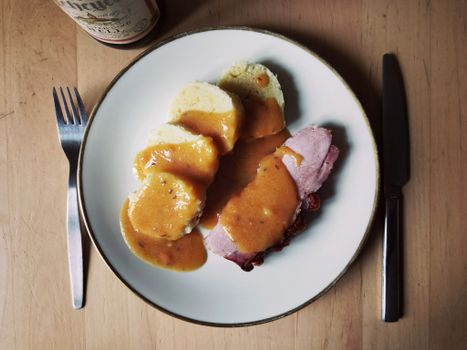
Svíčková
The diets react (see scores below)
Common Ingredients
- beef sirloin
- carrots
- parsnips
- celery root
- cream
- mustard
- cranberry
- bread dumplings
Specific recipes may vary.
Incompatible with 9 of 11 diets
Diet Ratings
Svíčková is a traditional Czech beef sirloin dish served with a creamy root vegetable sauce and bread dumplings (knedlíky). While the beef sirloin and cream components are keto-friendly, the dish is fundamentally incompatible with ketogenic eating due to two major disqualifying elements: (1) bread dumplings are made from flour or stale bread and represent a very high net-carb load, easily contributing 40-60g of carbs per standard serving on their own; (2) the sauce typically includes carrots, parsnips, and celery root — all moderate-to-high carb root vegetables — plus cranberry sauce which adds significant sugar. The combination makes it essentially impossible to consume this dish in its traditional form without decisively breaking ketosis. The dish is defined by its dumplings; without them, it would be a different dish entirely.
Svíčková is a traditional Czech/Slovak braised beef dish that is fundamentally incompatible with a vegan diet. It contains multiple animal products: beef sirloin as the primary protein, and cream as a key component of the characteristic sauce. Bread dumplings (houskové knedlíky) also typically contain eggs and milk. There is no ambiguity here — this dish is built around animal-derived ingredients at its core and cannot be considered vegan in its traditional form.
Svíčková is a traditional Czech braised beef dish that contains multiple non-paleo ingredients. While the beef sirloin, carrots, parsnips, celery root, and cranberry are all paleo-approved, two ingredients make this dish clearly non-compliant: cream (dairy) and bread dumplings (grain-based, typically made from wheat flour or white bread). These are not minor or debated additions — they are structural components of the dish. The cream-based sauce is the defining element of Svíčková, and bread dumplings are its essential accompaniment. Without them, the dish ceases to be Svíčková. Mustard is a minor caution depending on preparation (added salt, vinegar, or preservatives are common), but is not the primary disqualifier. The dish as traditionally prepared is firmly in avoid territory.
Svíčková is a traditional Czech dish that conflicts with Mediterranean diet principles on multiple fronts. The primary protein is beef sirloin, which the Mediterranean diet limits to only a few times per month. The sauce is cream-based, adding saturated fat from dairy in a way that goes far beyond moderate dairy consumption. Bread dumplings (knedlíky) are made from refined white flour, representing refined grains that the Mediterranean diet discourages. The dish lacks olive oil, is not plant-forward, and represents a pattern of eating — heavy red meat with rich cream sauce and refined starch — that is essentially the opposite of Mediterranean dietary principles. The only positive elements are the root vegetables (carrots, parsnips, celery root) and cranberry, but these are minor components in an otherwise incompatible dish.
Svíčková is a Czech braised beef dish that is almost entirely incompatible with the carnivore diet. While the base protein — beef sirloin — is carnivore-approved, virtually every other component violates carnivore principles. The dish is braised with root vegetables (carrots, parsnips, celery root), all of which are excluded plant foods. The sauce is thickened and flavored with mustard (plant-derived condiment). It is traditionally served with cranberry sauce (fruit) and bread dumplings (wheat-based, a grain product). Even the cream component, while animal-derived, is embedded in a sauce built on plant ingredients. This dish is fundamentally a plant-heavy preparation that uses beef as a secondary component within a vegetable braise — the opposite of carnivore eating.
Svíčková is a traditional Czech braised beef dish served with a cream sauce and bread dumplings (knedlíky). It contains two clear Whole30-excluded ingredients: dairy cream (excluded dairy product) and bread dumplings (made from wheat flour/bread, an excluded grain). Even setting aside the dumplings, the cream-based sauce is non-compliant. The dish as traditionally prepared cannot be made Whole30-compatible without fundamentally changing its character.
Svíčková contains multiple high-FODMAP ingredients that make it unsuitable during the elimination phase. The most problematic component is the bread dumplings (houskové knedlíky), which are made from wheat flour and are high in fructans — a core FODMAP trigger. Celery root (celeriac) is high-FODMAP even at moderate servings (Monash rates it as high-FODMAP due to fructans and mannitol). Cream is high in lactose and high-FODMAP at typical serving quantities used in this sauce. Cranberry sauce/cranberries can contain excess fructose or polyols depending on preparation, and commercial versions often contain high-fructose corn syrup or large amounts of sugar adding fructose load. Carrots and parsnips are low-FODMAP, and beef sirloin is protein with no FODMAPs, but the combination of wheat dumplings, celeriac, and cream sauce makes the dish as traditionally prepared a clear avoid during elimination.
Svíčková is a traditional Czech braised beef sirloin dish served with a rich cream-based sauce and bread dumplings. While it contains DASH-friendly vegetables (carrots, parsnips, celery root) and lean-ish beef sirloin, the dish is problematic for DASH in several ways: (1) The heavy cream sauce is high in saturated fat and calories, directly conflicting with DASH's emphasis on limiting saturated fat and full-fat dairy. (2) Bread dumplings (knedlíky) are made from refined white flour, offering little fiber and representing empty refined carbohydrates rather than the whole grains DASH recommends. (3) The overall sodium content from braising and seasoning is typically high. (4) Red meat (beef) is a protein DASH advises limiting. The combination of full-fat cream sauce, red meat, and refined-grain dumplings makes this dish fundamentally misaligned with DASH principles, even though the vegetable components are beneficial.
NIH DASH guidelines explicitly limit red meat and full-fat dairy (cream), placing this dish in the avoid category. However, some updated clinical DASH interpretations note that beef sirloin is a relatively lean cut and that the vegetable-rich braising base provides potassium and fiber; a modified version using reduced-fat cream or a cream substitute and whole-grain dumplings could shift this to 'caution.'
Svíčková is a Czech braised beef sirloin dish served with root vegetable cream sauce and bread dumplings (knedlíky). While it contains some Zone-friendly elements — beef sirloin provides lean protein, and root vegetables like carrots, parsnips, and celery root offer low-to-moderate glycemic carbohydrates with fiber and polyphenols — the dish has several Zone challenges. The bread dumplings (knedlíky) are the biggest problem: made from white flour or bread, they are high-glycemic refined carbohydrates that Sears classifies as 'unfavorable.' The cream-based sauce adds significant saturated fat, which Zone discourages in favor of monounsaturated sources. Cranberry sauce often contains added sugar, pushing glycemic load higher. The overall macro ratio skews toward high-GI carbs and saturated fat rather than the ideal 40/30/30 with low-glycemic carbs and monounsaturated fat. A Zone-adapted version would substitute the bread dumplings with steamed vegetables or a small portion of whole grain, reduce or modify the cream sauce, and ensure the cranberry component is unsweetened. As traditionally served, it can technically be portioned into Zone blocks but requires significant modification or very careful portion management to achieve favorable ratios.
Some Zone practitioners would note that the root vegetables (carrots, parsnips, celery root) are moderately favorable Zone carbs, and beef sirloin is a reasonable lean protein source. In Sears' later writings on anti-inflammatory nutrition, small amounts of saturated fat are more tolerated. A disciplined Zone follower could eat a small portion of the beef with sauce and minimal dumplings, treating the dumplings as a single unfavorable carb block within an otherwise balanced meal. This interpretation pushes the score closer to 5-6.
Svíčková is a traditional Czech braised beef dish with a creamy root vegetable sauce. From an anti-inflammatory standpoint, it presents a mixed but largely problematic profile. On the positive side, the root vegetables (carrots, parsnips, celery root) provide meaningful antioxidants, fiber, and polyphenols. Cranberry adds flavonoids and vitamin C. Mustard contains anti-inflammatory glucosinolates. However, the dish has several significant anti-inflammatory liabilities: (1) Beef sirloin is red meat, which falls in the 'limit' category due to saturated fat content and association with elevated inflammatory markers like CRP and IL-6 in research. (2) Cream is full-fat dairy, also in the 'limit' category due to saturated fat content — and cream-heavy sauces represent a substantial load. (3) Bread dumplings (knedlíky) are made from refined white flour, a refined carbohydrate that can spike blood glucose and promote inflammatory signaling. The combination of red meat + full-fat cream + refined carbs in one dish stacks multiple 'limit' ingredients simultaneously, pushing this into the lower caution range rather than neutral caution. The vegetable and cranberry components provide some offset but are insufficient to counterbalance the inflammatory burden. Scored at 3 — technically within 'caution' but at the boundary toward 'avoid' due to the cumulative pro-inflammatory load.
A strict anti-inflammatory framework (e.g., Dr. Weil's pyramid) would point to the red meat and heavy cream as meaningful concerns given their saturated fat content. However, some anti-inflammatory practitioners note that unprocessed beef in moderate portions from quality sources (grass-fed) contains conjugated linoleic acid (CLA) and zinc which may have anti-inflammatory roles, and that full-fat dairy's inflammatory status is more debated than once thought, with some recent research suggesting neutral or even protective effects from fermented or whole dairy forms.
Svíčková is a traditional Czech braised beef sirloin dish served with a rich cream-based sauce and bread dumplings. While beef sirloin provides meaningful protein, the overall profile is poorly suited for GLP-1 patients. The cream sauce is high in saturated fat, which worsens GLP-1 side effects including nausea, bloating, and reflux — especially problematic given slowed gastric emptying. Bread dumplings are made from refined white flour, offering high glycemic load, minimal fiber, and empty calories. The dish is inherently heavy and slow to digest, working directly against GLP-1 tolerability. The cranberry garnish and root vegetables (carrots, parsnips, celery root) add some micronutrients and modest fiber, but not enough to offset the high-fat cream sauce and refined carbohydrate base. Portion sizes for this dish are traditionally large. Overall, this is a high-fat, low-fiber, refined-carb-heavy meal that is likely to cause significant GI discomfort on GLP-1 medications.
Some GLP-1-aware dietitians might allow a heavily modified version — for example, a very small portion of the beef with vegetables only, cream sauce omitted or replaced, and dumplings skipped entirely — arguing that the beef sirloin itself is a reasonable protein source. However, as the dish is traditionally prepared and served, there is little clinical disagreement that the cream sauce and bread dumplings make it inappropriate for GLP-1 patients.
*See how scores were generated at our methodology page.
Nutritional profile
Six traits that cut across every diet.
Fiber & Plants
How much whole-plant food and fiber it delivers.
Healthy Fats
The quality of its fats (unsaturated, omega-3).
Whole / Unprocessed
How close it is to its natural, unprocessed form.
Gut Gentle
How easy it is on digestion (low FODMAP, few irritants).
Low Glycemic
How little it spikes your blood sugar.
Protein Density
How much protein it packs per calorie.
Controversy Index
Higher controversy = more disagreement between diets.
Diet-Specific Tips
 Zone — 4/10
View tips
- Bread dumplings (knedlíky) are high-glycemic refined carbohydrate — unfavorable Zone carb
- Cream-based sauce is high in saturated fat, not the preferred monounsaturated fat
- Cranberry component likely contains added sugar, increasing glycemic load
- Beef sirloin is a reasonable Zone protein source (lean cut)
- Root vegetables (carrots, parsnips, celery root) are moderate Zone carbs with fiber
- Overall macro ratio skews away from 40/30/30 as traditionally served
- Dish is salvageable with portion control but requires significant modification
 Anti-Inflammatory — 5/10
View tips
- Red meat (beef sirloin) — 'limit' category; associated with elevated CRP and IL-6
- Heavy cream — full-fat dairy high in saturated fat, 'limit' category
- Bread dumplings (knedlíky) — refined carbohydrates, pro-inflammatory glycemic load
- Root vegetables (carrots, parsnips, celery root) — beneficial antioxidants and fiber, partial offset
- Cranberry — flavonoids and vitamin C, anti-inflammatory benefit
- Mustard — contains glucosinolates with mild anti-inflammatory properties
- Cumulative stacking of multiple 'limit' ingredients in a single dish