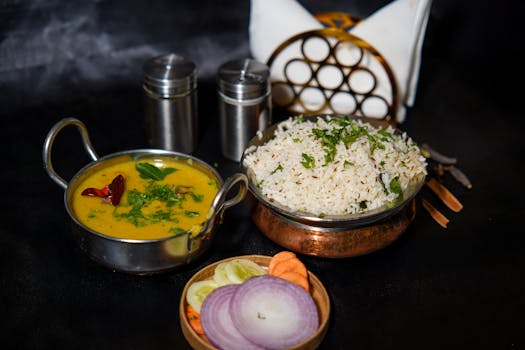
Photo: Karan Mridha / Pexels
The diets react (see scores below)
Common Ingredients
- toor dal
- ghee
- cumin seeds
- garlic
- green chilies
- turmeric
- tomato
- cilantro
Specific recipes may vary.
Incompatible with 6 of 11 diets
Diet Ratings
Dal Tadka is built on toor dal (split pigeon peas), a legume with roughly 18-20g of net carbs per 100g cooked serving. A standard serving (200-250g) delivers approximately 30-40g of net carbs on its own, making it extremely difficult to fit within the 20-50g daily keto limit. Lentils and legumes are categorically incompatible with ketogenic eating due to their high starch content. While the tadka (tempering) uses keto-friendly ingredients — ghee, cumin, garlic, green chilies, turmeric — and tomato and cilantro add only marginal carbs, the primary ingredient completely disqualifies the dish. The protein source is also plant-based and comes packaged with a heavy carbohydrate load, unlike animal proteins. There is no realistic portion size of Dal Tadka that would preserve ketosis for most individuals.
Dal Tadka as listed contains ghee, which is clarified butter — a dairy product derived from cows and therefore a clear animal-derived ingredient excluded by all vegan standards. While toor dal, cumin seeds, garlic, green chilies, turmeric, tomato, and cilantro are all fully plant-based, the ghee used in the tadka (tempering) makes this dish non-vegan. A simple substitution of ghee with a neutral plant-based oil (coconut, sunflower, or mustard oil) would make this dish fully vegan-compliant and it would score 9/10 as a whole-food, legume-based dish.
Dal Tadka is centered on toor dal (split pigeon peas), a legume that is explicitly excluded from the paleo diet. Legumes contain lectins, phytates, and antinutrients that paleo authorities like Loren Cordain and Robb Wolf consistently flag as problematic. The remaining ingredients — ghee, cumin seeds, garlic, green chilies, turmeric, tomato, and cilantro — are largely paleo-compatible (ghee being a minor debate), but the foundational ingredient, lentils, is a non-negotiable exclusion. No amount of preparation or cooking makes legumes paleo-approved under mainstream paleo guidelines. The dish cannot be considered paleo in any form as long as lentils remain the primary ingredient.
Dal Tadka is built around toor dal (split pigeon peas), a legume that is a cornerstone of the Mediterranean diet. Legumes are strongly encouraged as a daily plant-based protein and fiber source. The supporting ingredients — tomato, garlic, green chilies, turmeric, and cilantro — are all whole, plant-based foods fully aligned with Mediterranean principles. The one notable departure is ghee (clarified butter) as the cooking fat rather than extra virgin olive oil. Ghee is a saturated animal fat, whereas EVOO is the canonical Mediterranean fat. However, the quantity of ghee used in a tadka (tempering) is typically small, and the overall dish profile — legume-based, vegetable-rich, minimally processed — is strongly Mediterranean-compatible. This dish earns a solid approval with a modest score reduction due to the non-traditional fat source.
Some Mediterranean diet purists would flag ghee as an animal-derived saturated fat inconsistent with the diet's emphasis on olive oil as the primary fat. Traditional Mediterranean cooking uses EVOO for tempering aromatics; substituting olive oil for ghee would make this dish an unambiguous 9-10 staple. Modern clinical guidelines (e.g., Willett et al., 1995 Mediterranean Diet Pyramid) place butter and clarified fats in the 'use sparingly' tier.
Dal Tadka is fundamentally incompatible with the carnivore diet. The primary protein source is toor dal (split pigeon peas), a legume — one of the most strictly excluded food categories on carnivore. The dish is built almost entirely from plant-derived ingredients: lentils, tomato, green chilies, turmeric, cumin seeds, garlic, and cilantro. The only animal-derived ingredient is ghee, which is a minor component used as a cooking fat. There is universal consensus across all carnivore frameworks — strict Lion Diet, Baker's approach, and even Saladino's more permissive 'animal-based' model — that legumes and plant-based dishes of this nature are completely off the table. No amount of ghee rescues a dish whose primary macronutrient and structural base is plant protein from legumes.
Dal Tadka's primary ingredient is toor dal (split pigeon peas), which is a legume. Legumes are explicitly excluded from the Whole30 program for the full 30 days. While the other ingredients — ghee (the one allowed dairy exception), cumin seeds, garlic, green chilies, turmeric, tomato, and cilantro — are all individually Whole30-compliant, the foundational ingredient of this dish is a prohibited legume. There is no exception for lentils or pigeon peas, making this dish incompatible with Whole30 regardless of how it is prepared.
Dal Tadka contains multiple high-FODMAP ingredients that make it unsuitable during the elimination phase. Toor dal (split pigeon peas) is a legume high in GOS (galacto-oligosaccharides), which is a significant FODMAP trigger — even a small serving of lentils/legumes contains enough GOS to be problematic during elimination. Garlic is one of the highest-FODMAP foods tested by Monash University, rich in fructans, and is a core flavoring ingredient in this dish. Tomato in larger quantities can contribute excess fructose. The combination of toor dal and garlic alone makes this dish a clear avoid during the elimination phase.
Dal Tadka is largely DASH-compatible: toor dal (split pigeon peas) is an excellent source of plant-based protein, fiber, potassium, and magnesium — all core DASH nutrients. Tomatoes, garlic, turmeric, green chilies, and cilantro are DASH-friendly whole-food ingredients. The primary concern is ghee, a clarified butter high in saturated fat, which DASH guidelines explicitly limit. The tadka (tempering) technique uses ghee as the fat base, and the amount used can vary considerably — a light tadka (1–2 tsp ghee for a 4-serving pot) stays within moderate limits, while restaurant-style preparations often use significantly more. The dish is naturally very low in sodium as prepared at home, which is a strong DASH positive. Overall, a home-prepared version with minimal ghee earns a solid 'caution' leaning toward approval; restaurant versions with liberal ghee use warrant more caution.
NIH DASH guidelines recommend limiting saturated fat and specify vegetable oils over animal-derived fats like ghee. However, updated clinical interpretations note that ghee in small culinary amounts (especially in an otherwise nutrient-dense, high-fiber, low-sodium legume dish) may not meaningfully impact cardiovascular risk — some DASH-oriented dietitians allow traditional preparations like dal tadka without modification, particularly given the strong fiber and potassium profile of lentils.
Dal Tadka is a nutritious Indian lentil dish with a moderate Zone compatibility profile. Toor dal (split pigeon peas) is the primary carbohydrate and protein source — lentils provide vegetarian protein (~9g protein per 100g cooked) and complex carbohydrates (~20g net carbs per 100g cooked), placing them in Zone's 'unfavorable' carb category due to their relatively higher glycemic load, though their fiber content moderates glycemic impact. The protein-to-carb ratio in lentils is skewed heavily toward carbs, making it difficult to hit Zone's 40/30/30 without careful supplementation. Ghee (clarified butter) is a saturated fat, which early Zone strictly limited, though Sears' later anti-inflammatory work is somewhat more permissive. The tadka includes anti-inflammatory spices (turmeric, cumin, garlic, green chilies) and tomatoes, which align well with Zone's polyphenol emphasis. To Zone-balance this meal, a practitioner would need to: reduce portion size of dal significantly, add a lean protein source (e.g., egg whites, low-fat paneer, or chicken) to correct the protein deficit, and substitute or minimize the ghee in favor of olive oil or limit to a very small quantity. As a standalone main dish, Dal Tadka over-delivers on carbs and under-delivers on lean protein relative to Zone blocks, but it is highly nutritious and workable with adjustments.
Some Zone practitioners, particularly those following Sears' later writings emphasizing polyphenols and anti-inflammatory eating, may rate Dal Tadka more favorably. Lentils appear in Zone-friendly recipe collections as a 'favorable' protein-carb combination due to their low glycemic index relative to other legumes, their high fiber content reducing net carbs, and their polyphenol content. Additionally, turmeric and other spices make this dish a strong anti-inflammatory candidate aligned with Sears' Zone dietary philosophy. The ghee concern is also contested — while early Zone avoided saturated fat strictly, Sears has acknowledged that traditional dairy fats are not equivalent to processed trans fats.
Dal Tadka is built on a strongly anti-inflammatory foundation. Toor dal (split pigeon peas) is a legume rich in fiber, plant protein, and polyphenols — all emphasized in anti-inflammatory frameworks. Turmeric provides curcumin, one of the most well-researched anti-inflammatory compounds. Garlic contains allicin and organosulfur compounds with demonstrated anti-inflammatory and immune-modulating effects. Green chilies contribute capsaicin, which reduces NF-κB-mediated inflammation. Tomatoes add lycopene and vitamin C. Cilantro provides antioxidants and quercetin. Cumin has been shown to reduce CRP and oxidative stress markers. The one notable consideration is ghee: while traditional Ayurvedic practice reveres ghee and some emerging research suggests its butyrate content may support gut health and reduce intestinal inflammation, conventional anti-inflammatory guidelines flag its saturated fat content as a concern. Used in the moderate quantities typical of a tadka (tempered spice mixture), ghee is unlikely to be problematic for most people, but it prevents a score of 9–10. Overall, this dish is a strong anti-inflammatory choice.
Ghee is the primary point of debate: Dr. Weil's framework and mainstream anti-inflammatory guidelines recommend limiting saturated fats, which would place ghee in the 'use sparingly' category. However, Ayurvedic nutrition and a growing number of functional medicine practitioners (e.g., Dr. Mark Hyman) argue that ghee's short-chain butyrate and conjugated linoleic acid content make it pro-gut, anti-inflammatory in practice — particularly when sourced from grass-fed dairy. The dish scores lower than it would if ghee were replaced with extra virgin olive oil.
Dal Tadka is a nutritionally solid dish for GLP-1 patients in several respects: toor dal provides meaningful plant-based protein (~8-9g per 100g cooked) and is high in fiber (~4-5g per serving), supporting two of the top priorities. Tomato and turmeric add antioxidants and nutrient density per calorie. However, two factors push this into caution territory. First, ghee is a saturated fat — the tadka (tempering) step typically uses 1-2 teaspoons per serving, which is moderate saturated fat that can worsen nausea, bloating, or reflux in GLP-1 patients. Second, green chilies may trigger GI irritation in patients already dealing with GLP-1-related nausea or reflux, particularly at higher doses of medication. The protein per serving (~10-12g for a standard bowl) is meaningful but falls short of the 15-30g per meal target without a complementary protein source. Portion size also matters — a small serving is easily digestible, but a large portion of legumes can cause gas and bloating due to the fermentable fiber content, which compounds GLP-1-related GI side effects. Overall a good foundational dish that benefits from ghee reduction and chili moderation.
Some GLP-1-focused RDs view dal as a near-ideal food given its protein-fiber combination and low glycemic impact, and consider small amounts of ghee acceptable for palatability and fat-soluble nutrient absorption. Others flag the saturated fat content of ghee and fermentable fiber load as meaningful triggers for GI side effects, particularly in the early weeks of GLP-1 treatment when GI tolerance is lowest.
*See how scores were generated at our methodology page.
Nutritional profile
Six traits that cut across every diet.
Fiber & Plants
How much whole-plant food and fiber it delivers.
Healthy Fats
The quality of its fats (unsaturated, omega-3).
Whole / Unprocessed
How close it is to its natural, unprocessed form.
Gut Gentle
How easy it is on digestion (low FODMAP, few irritants).
Low Glycemic
How little it spikes your blood sugar.
Protein Density
How much protein it packs per calorie.
Controversy Index
Higher controversy = more disagreement between diets.
Diet-Specific Tips
 Mediterranean — 8/10
View tips
- Toor dal (legumes) is a Mediterranean diet staple — high plant protein and fiber
- Tomato, garlic, and spices are whole plant foods fully aligned with Mediterranean principles
- Ghee is a saturated animal fat, diverging from olive oil as the recommended primary fat
- Tadka uses a small quantity of ghee, limiting the overall saturated fat impact
- No refined grains, added sugars, or processed ingredients
- Dish is minimally processed and nutrient-dense
 DASH — 6/10
View tips
- Toor dal is high in fiber, potassium, magnesium, and plant protein — core DASH nutrients
- Ghee is high in saturated fat, which DASH guidelines explicitly limit
- No added sodium in home preparation — strong DASH positive
- Portion of ghee used is variable; light home cooking vs. heavier restaurant use significantly affects saturated fat load
- Tomatoes, garlic, and spices are DASH-friendly whole food ingredients
- Substituting ghee with canola or olive oil would raise the score to 8–9
 Zone — 5/10
View tips
- Toor dal is high in carbohydrates relative to protein, making 40/30/30 ratio difficult to achieve without supplemental lean protein
- Lentils are 'unfavorable' Zone carbs due to moderate glycemic load, but high fiber content lowers net carbs and moderates glycemic response
- Ghee is a saturated fat source — limited in classic Zone protocol, though more accepted in Sears' later anti-inflammatory framework
- Strong polyphenol and anti-inflammatory profile from turmeric, cumin, garlic, and tomato aligns with Zone's anti-inflammatory focus
- Vegetarian protein source requires using the higher fat block calculation (3g fat per block instead of 1.5g) in Zone's block system
- Portion control is critical — a typical serving of dal is carb-heavy and would need to be paired with additional lean protein to Zone-balance the meal
 Anti-Inflammatory — 8/10
View tips
- Toor dal: high-fiber legume with anti-inflammatory polyphenols, emphasized in anti-inflammatory diets
- Turmeric: curcumin is one of the most researched anti-inflammatory compounds
- Garlic: allicin and organosulfur compounds reduce inflammatory markers
- Green chilies: capsaicin inhibits pro-inflammatory NF-κB pathway
- Tomato: lycopene and vitamin C provide antioxidant protection
- Cumin: associated with reduced CRP and oxidative stress in studies
- Cilantro: quercetin and antioxidants add modest anti-inflammatory benefit
- Ghee: saturated fat raises caution under conventional anti-inflammatory guidelines, though butyrate content may offer gut-anti-inflammatory benefit
 GLP-1 Friendly — 6/10
View tips
- Good plant protein source (~10-12g per serving) but below 15-30g per meal target without pairing
- High fiber from toor dal supports digestion and satiety
- Ghee introduces saturated fat that may worsen nausea, bloating, or reflux
- Green chilies are a potential GI irritant for GLP-1 patients with nausea or reflux
- Fermentable fiber in lentils can cause gas and bloating, compounding GLP-1 GI side effects
- Nutrient-dense per calorie — turmeric, tomato, garlic add antioxidant and anti-inflammatory value
- Easy to reduce ghee quantity or substitute with a small amount of olive oil to improve the profile
- Small portions are well-tolerated; large servings increase bloating risk