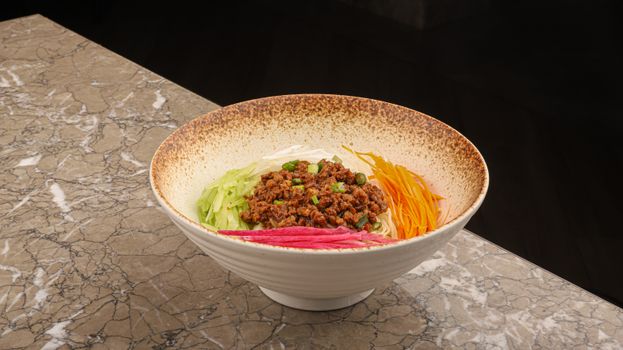
Photo: Change C.C / Pexels
Chinese
Dan Dan Noodles
The diets react (see scores below)
Common Ingredients
- Chinese wheat noodles
- ground pork
- Sichuan chili oil
- Sichuan peppercorns
- preserved mustard
- sesame paste
- soy sauce
- scallions
Specific recipes may vary.
Incompatible with 9 of 11 diets
Diet Ratings
Dan Dan Noodles are built on a foundation of Chinese wheat noodles, which are a high-carb grain product. A standard serving (roughly 200g cooked noodles) delivers approximately 40-60g of net carbs from the noodles alone, instantly exceeding or maxing out the entire daily keto carb budget. While several other ingredients — ground pork, Sichuan chili oil, sesame paste, soy sauce, and Sichuan peppercorns — are keto-compatible or low-carb, the noodles make this dish fundamentally incompatible with ketosis. Preserved mustard greens may also contain added sugar depending on preparation. The dish cannot be made keto-compliant without replacing the noodles entirely with a keto substitute (e.g., shirataki or zucchini noodles), which would make it a different dish altogether.
Dan Dan Noodles as prepared here contains ground pork, a direct animal product, making it incompatible with a vegan diet. This is a clear-cut exclusion with no ambiguity. The remaining ingredients — wheat noodles, Sichuan chili oil, Sichuan peppercorns, preserved mustard greens, sesame paste, soy sauce, and scallions — are all plant-based, meaning a vegan adaptation is entirely possible by substituting the pork with a plant-based protein such as crumbled tofu, tempeh, or mushrooms.
Dan Dan Noodles contains multiple core paleo violations with no ambiguity. Chinese wheat noodles are a grain-based product — wheat is explicitly excluded from the paleo diet. Soy sauce is derived from fermented soybeans, a legume, and also contains wheat. Sesame paste is made from sesame seeds pressed into an oil-rich paste, and sesame falls into the excluded seed oil category. Preserved mustard greens typically contain added salt and preservatives, making them a processed food. The dish's entire flavor base — noodles, soy sauce, sesame paste — is built on non-paleo foundations. The only paleo-compliant elements are the ground pork, Sichuan peppercorns, scallions, and arguably the chili oil (depending on the oil base). This dish is structurally incompatible with paleo eating and cannot be made paleo-compliant without replacing its defining ingredients entirely.
Dan Dan Noodles conflicts with Mediterranean diet principles on multiple fronts. The primary protein is ground pork, a red/processed meat that should be limited to only a few times per month. The noodles are refined wheat noodles rather than whole grain. Sesame paste (tahini-like) and chili oil provide some acceptable fats, but the overall dish is built around ingredients and a flavor profile far outside Mediterranean tradition. The combination of red meat, refined grains, and absence of vegetables, legumes, or olive oil makes this a poor fit.
Dan Dan Noodles is almost entirely plant-based in composition and is incompatible with the carnivore diet. The dish is built on Chinese wheat noodles (grain), which alone disqualifies it. Beyond the noodles, virtually every other ingredient is plant-derived or plant-processed: Sichuan chili oil (plant oil with plant spices), Sichuan peppercorns (plant spice), preserved mustard greens (plant vegetable), sesame paste (plant seed), soy sauce (fermented legume/grain), and scallions (plant vegetable). The only carnivore-compatible ingredient is the ground pork, which represents a small fraction of the dish. This is a classic plant-forward noodle dish with no meaningful animal-product foundation.
Dan Dan Noodles contains multiple excluded ingredients that make it clearly non-compliant with Whole30. Chinese wheat noodles are a grain-based food (wheat is explicitly excluded). Soy sauce contains soy (an excluded legume) and typically wheat as well. Sesame paste, while made from seeds, is fine on its own, but the dish as a whole is a noodle dish, which falls squarely into the 'no pasta or noodles' rule even if grain-free substitutes were used. The combination of wheat noodles and soy sauce alone makes this dish a definitive avoid.
Dan Dan Noodles as traditionally prepared contains multiple high-FODMAP ingredients that make it unsuitable during the elimination phase. The primary offender is Chinese wheat noodles, which are made from wheat flour and are high in fructans — a major FODMAP category. There is no realistic low-FODMAP serving size for a full portion of wheat noodles. Additionally, scallion bulbs (white parts) are high in fructans, though the green tops are low-FODMAP. Preserved mustard greens (ya cai or sui mi ya cai) are a traditional ingredient that often contains garlic or onion in the pickling process, adding further fructan load. Sesame paste (tahini) is low-FODMAP in small amounts but can accumulate. Soy sauce is generally considered low-FODMAP in typical serving quantities. Ground pork itself is protein and fat — inherently FODMAP-free. Sichuan chili oil and peppercorns are also low-FODMAP. However, the wheat noodle base alone is disqualifying for the elimination phase, and the preserved mustard greens add a second high-FODMAP ingredient. This dish cannot be made low-FODMAP without fundamental substitutions (e.g., rice noodles, certified GF noodles, omitting preserved mustard or using a low-FODMAP substitute, and using only scallion greens).
Dan Dan Noodles is highly problematic for the DASH diet across multiple dimensions. The dish combines several high-sodium ingredients — soy sauce, preserved mustard greens (ya cai), and sesame paste — that together can easily deliver 1,500–2,500mg of sodium per serving, potentially exceeding the entire daily allowance for the low-sodium DASH target in a single meal. Ground pork is a red meat that DASH explicitly limits due to its saturated fat content, and the Sichuan chili oil adds significant additional fat. Refined Chinese wheat noodles provide minimal fiber compared to DASH-recommended whole grains. There are no vegetables of substance to contribute the potassium, magnesium, or fiber that DASH emphasizes. The overall nutrient profile — high sodium, saturated fat from pork, refined carbohydrates, and calorie-dense chili oil — runs contrary to nearly every core DASH principle.
Dan Dan Noodles presents multiple Zone Diet challenges that push it toward the lower end of the caution range. The primary carbohydrate source — Chinese wheat noodles — is a high-glycemic refined grain, which Zone explicitly classifies as 'unfavorable.' A typical serving delivers a large carb load with minimal fiber, making block balancing very difficult. The ground pork provides protein but is fattier than Zone-preferred lean proteins like skinless chicken or fish, contributing excess saturated fat. Sesame paste and Sichuan chili oil add significant fat, but sesame paste is omega-6 heavy (sesame oil is predominantly polyunsaturated/omega-6, not monounsaturated), which conflicts with Zone's anti-inflammatory focus on monounsaturated fats and omega-3s. The dish also contains no meaningful vegetables, leaving the Zone's recommended colorful vegetable base entirely absent. To fit Zone ratios, one would need to dramatically reduce the noodle portion, substitute leaner protein, and add substantial low-GI vegetables — essentially deconstructing the dish. As served in a restaurant or traditional preparation, it is very difficult to incorporate into a Zone-balanced meal without major modification. The score of 3 reflects that it is technically a food (not pure sugar/candy) but is genuinely hard to Zone-balance in any practical sense.
Dan Dan Noodles presents a mixed anti-inflammatory profile. On the positive side, several ingredients offer meaningful anti-inflammatory benefits: Sichuan peppercorns contain hydroxy-alpha sanshool and antioxidant compounds; chili oil provides capsaicin, a known anti-inflammatory agent; sesame paste contributes sesamin and sesamolin (lignans with antioxidant properties) plus calcium and healthy fats; scallions offer quercetin and other flavonoids; soy sauce in small amounts is benign and fermented versions may offer modest benefits. The dish also has a culinary heritage of using spice-forward, plant-based condiments. However, the dish has notable inflammatory liabilities: ground pork is a red/processed-adjacent meat that falls in the 'limit' category due to saturated fat content; refined Chinese wheat noodles are a refined carbohydrate with a high glycemic index and minimal fiber; Sichuan chili oil is typically made with a seed oil base (often soybean or rapeseed oil), which raises omega-6 concerns depending on type and quantity; preserved mustard greens may contain high sodium and sometimes additives. The overall dish is calorie-dense, sodium-heavy, and built around refined carbs and pork — ingredients that collectively push it away from anti-inflammatory ideals. Substituting whole-grain or buckwheat noodles, using a smaller amount of pork, and choosing a high-quality chili oil would significantly improve the profile.
The chili oil base is the key contested element here. Most anti-inflammatory protocols (Dr. Weil, IF Rating system) caution against regular seed oil use due to omega-6 load and oxidation risk during high-heat processing. However, mainstream nutrition science and the AHA consider soybean and rapeseed oils acceptable sources of unsaturated fat, and some anti-inflammatory researchers argue that traditional-style chili oils used in small, flavoring quantities pose minimal inflammatory risk in context of an otherwise varied diet.
Dan Dan Noodles present multiple significant concerns for GLP-1 patients. The Sichuan chili oil and Sichuan peppercorns make this a very spicy, high-fat dish that can trigger or worsen nausea, reflux, and GI distress — side effects already common on GLP-1 medications. Sesame paste (tahini-style) adds substantial saturated and unsaturated fat per serving, further slowing already-delayed gastric emptying and increasing bloating risk. The base is refined wheat noodles, offering minimal fiber and low nutrient density per calorie. Ground pork, while providing some protein, is a fatty meat with significant saturated fat content. The sodium load from soy sauce and preserved mustard greens is high, which can contribute to water retention and GI discomfort. Overall, this dish is high fat, high sodium, very spicy, built on refined carbohydrates, and uses a fatty protein source — hitting nearly every 'avoid' flag simultaneously.
*See how scores were generated at our methodology page.
Nutritional profile
Six traits that cut across every diet.
Fiber & Plants
How much whole-plant food and fiber it delivers.
Healthy Fats
The quality of its fats (unsaturated, omega-3).
Whole / Unprocessed
How close it is to its natural, unprocessed form.
Gut Gentle
How easy it is on digestion (low FODMAP, few irritants).
Low Glycemic
How little it spikes your blood sugar.
Protein Density
How much protein it packs per calorie.
Controversy Index
Higher controversy = more disagreement between diets.
Diet-Specific Tips
 Zone — 5/10
View tips
- Refined wheat noodles are high-glycemic and classified as 'unfavorable' carbs in Zone methodology
- Ground pork is higher in saturated fat than Zone-preferred lean proteins
- Sesame paste is omega-6 dominant, conflicting with Zone's anti-inflammatory monounsaturated fat preference
- Sichuan chili oil adds additional omega-6 fat load
- No vegetables present — Zone requires 8 servings of low-GI vegetables daily
- Macro ratio heavily skewed toward carbohydrates and fat, far from 40/30/30 target
- Preserved mustard greens are a minor favorable element but insufficient to offset other issues
 Anti-Inflammatory — 4/10
View tips
- Ground pork is a red meat categorized as 'limit' due to saturated fat content
- Refined wheat noodles are high-glycemic refined carbohydrates with minimal fiber
- Sichuan peppercorns and chili oil provide capsaicin and antioxidant compounds
- Sesame paste contributes beneficial lignans and healthy unsaturated fats
- Chili oil base is typically a seed oil (soybean/rapeseed), raising omega-6 concerns
- High sodium content from soy sauce and preserved mustard greens
- Scallions contribute quercetin and flavonoids with anti-inflammatory properties
- Dish can be improved by substituting whole-grain noodles and reducing pork portion