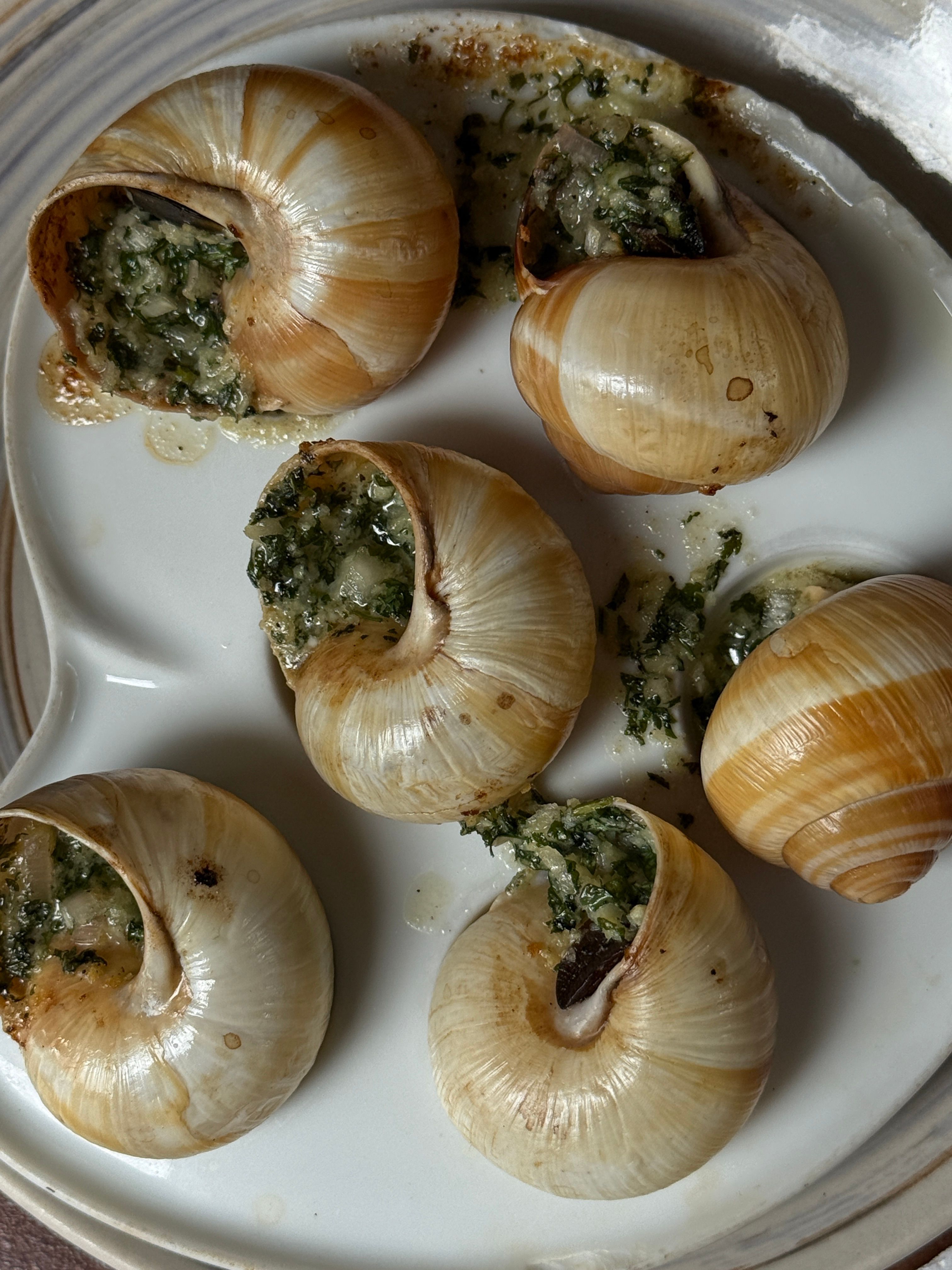
Photo: Eugenia Remark / Pexels
French
Escargots à la Bourguignonne
The diets react (see scores below)
Common Ingredients
- snails
- butter
- garlic
- parsley
- shallots
- white wine
- salt
- black pepper
Specific recipes may vary.
Incompatible with 5 of 11 diets
Diet Ratings
Escargots à la Bourguignonne is largely keto-compatible, anchored by snails (lean, low-carb protein) and a generous amount of butter (high-fat, zero carbs). Garlic, parsley, and shallots add minimal net carbs in typical serving quantities. The main concern is white wine, which contributes residual sugars and carbohydrates — though much of the alcohol and some sugars cook off during preparation, a non-trivial amount remains. Shallots, while low in carbs, are slightly higher than onion alternatives. A standard serving of 6-12 snails with garlic butter is manageable within daily carb limits, but the white wine in the recipe introduces enough ambiguity to warrant caution rather than a full approval.
Strict keto practitioners argue that any white wine in cooking — even reduced — introduces unnecessary carbs and sugars that could disrupt ketosis in sensitive individuals, and would recommend omitting the wine entirely or substituting with a small amount of dry vermouth or broth for a clean approval rating.
Escargots à la Bourguignonne contains multiple animal-derived ingredients that are entirely incompatible with a vegan diet. Snails are animals (mollusks), and their consumption directly violates the core vegan principle of excluding all animal products. Additionally, the dish is prepared with butter, a dairy product derived from cow's milk. Both the primary protein and a key preparation ingredient are animal-derived, making this dish doubly non-vegan with no ambiguity.
Escargots à la Bourguignonne contains several non-paleo ingredients that disqualify it despite the protein source being acceptable. Snails themselves are a legitimate paleo food — mollusks were consumed by Paleolithic humans and are nutrient-dense. However, the classic preparation introduces multiple problematic ingredients: butter is a dairy product excluded in strict paleo, white wine is an alcoholic/processed ingredient that falls in a gray area, and added salt is explicitly excluded. The combination of these violations, particularly the butter which is central to the dish's identity, pushes this into 'avoid' territory.
Some modern paleo practitioners following Mark Sisson's Primal Blueprint or similar frameworks would accept butter and even ghee, and might tolerate a small amount of wine used in cooking. Under a more relaxed primal interpretation, this dish could be modified to caution-level by substituting ghee for butter and omitting salt, as the snails themselves are an ancestrally appropriate protein.
Escargots à la Bourguignonne presents a genuinely complex case for Mediterranean diet evaluation. Snails themselves are actually consumed in traditional Mediterranean cuisines — particularly in Spain (cargols), Italy (lumache), Greece, and North Africa — and are a lean, high-protein, low-fat food with nutritional qualities comparable to shellfish. However, the classic French Bourguignonne preparation is heavily reliant on butter as the primary fat, which directly conflicts with extra virgin olive oil as the canonical Mediterranean fat source. The garlic, parsley, shallots, and white wine are all Mediterranean-friendly aromatics. The dish is a snack portion, limiting total butter intake. The snail itself could be 'approved,' but the butter-based preparation pulls the verdict toward caution.
Traditional Mediterranean practice in Spain, Catalonia, and parts of Italy does include snails prepared with olive oil, tomatoes, and herbs — making snails themselves a legitimate Mediterranean ingredient. Some Mediterranean diet authorities might approve this dish if the butter were substituted with olive oil, and argue that the snail protein source is more aligned with the diet's seafood and shellfish-adjacent foods than with red meat. Conversely, strict modern clinical interpretations of the Mediterranean diet flag butter as a food to minimize due to its saturated fat content, which would push this dish further toward avoidance.
Escargots à la Bourguignonne is heavily problematic for the carnivore diet despite snails being an animal product. The dish is dominated by plant-based ingredients: garlic, parsley, shallots, white wine, and black pepper are all excluded on a carnivore diet. The compound butter (beurre d'escargot) is defined by these plant additions. Even setting aside the plant ingredients, snails themselves occupy a debated grey area — they are invertebrate mollusks, not the ruminant or vertebrate animal proteins that form the core of carnivore eating. The white wine adds fermented plant-derived sugar and compounds. As prepared, this dish is fundamentally incompatible with carnivore principles due to the extensive plant-based herb, allium, and alcohol components.
Some flexible carnivore practitioners (aligned with Saladino's 'animal-based' approach) might tolerate snails as an animal-derived protein source and accept small amounts of seasoning like salt and pepper, but the garlic, shallots, parsley, and white wine make even a lenient carnivore practitioner reject this preparation as written.
Escargots à la Bourguignonne contains regular butter, which is a dairy product explicitly excluded from the Whole30 program. The only dairy exception the program allows is ghee or clarified butter. The classic recipe's defining feature — the herb butter (beurre à l'escargot) — cannot be substituted without fundamentally changing the dish. All other ingredients (snails, garlic, parsley, shallots, white wine, salt, black pepper) are Whole30-compliant. The white wine used in cooking is also acceptable under Whole30 rules (alcohol cooks off and wine vinegar/wine in recipes is allowed). However, the butter alone makes this dish non-compliant as prepared.
Escargots à la Bourguignonne contains multiple high-FODMAP ingredients that make it unsuitable during the elimination phase. Garlic is one of the highest-FODMAP foods tested by Monash University, rich in fructans, and is a core ingredient in this dish. Shallots are also high-FODMAP due to fructans and are present in meaningful quantities. While snails themselves are a plain protein and low-FODMAP, butter is low-FODMAP, parsley is low-FODMAP in normal amounts, white wine is low-FODMAP in small servings, and salt/black pepper are fine — the combination of both garlic and shallots makes this dish definitively high-FODMAP with no realistic way to consume a standard serving safely during elimination. These alliums are not optional garnishes; they are foundational to the dish's identity and flavor.
Escargots à la Bourguignonne presents a mixed DASH profile. Snails themselves are a lean, low-fat protein source with reasonable mineral content (iron, magnesium), which aligns well with DASH principles. However, the traditional preparation relies heavily on a compound butter (beurre persillé) — butter being high in saturated fat, which DASH explicitly limits. A typical restaurant serving of 6 snails can contain 10–15g of saturated fat from the butter alone, exceeding a significant portion of the DASH daily saturated fat budget. Added salt and the sodium naturally present in the preparation further elevate sodium content. On the positive side, garlic, parsley, and shallots are DASH-friendly aromatics, and white wine contributes minimally to the nutritional profile. The dish is not inherently 'avoid' territory — the snail protein is lean and portions are typically small — but the butter-dominant sauce makes it a 'caution' item requiring portion control and infrequent consumption.
NIH DASH guidelines clearly limit saturated fat and butter, placing this dish in caution territory. However, some updated clinical interpretations note that the typical snack-sized serving (6 snails) and the lean protein quality of snails mean that moderate, occasional consumption within an otherwise adherent DASH diet may be acceptable — a position supported by some cardiovascular dietitians who focus on overall dietary pattern rather than individual food restriction.
Escargots à la Bourguignonne presents an interesting Zone Diet profile. Snails themselves are an excellent lean protein source — very low in fat, high in protein, and comparable to shellfish in macro terms, making them a favorable Zone protein block. The garlic, parsley, and shallots are low-glycemic, polyphenol-rich vegetables that align well with Zone principles. However, the classic preparation is heavily butter-based, which introduces significant saturated fat rather than the preferred monounsaturated fats (olive oil, avocado, almonds) championed by Dr. Sears. The butter disrupts the ideal fat profile, even though saturated fat is not categorically excluded from the Zone. As a snack, the dish could be portioned reasonably — 6 snails provide roughly 1-2 protein blocks — but the butter quantity typically used (often 50-100g for a standard preparation) would wildly overweight the fat blocks and skew heavily toward saturated fat. White wine contributes minimal carbohydrate in cooking. This dish can fit Zone ratios with strict butter reduction or substitution with olive oil, but in its classic form it requires significant modification.
Dr. Sears' later works, particularly 'The Anti-Inflammation Zone' and 'Toxic Fat,' softened his stance on saturated fat somewhat, acknowledging that not all saturated fatty acids are equally inflammatory. Some Zone practitioners would argue that a small, carefully portioned serving of escargot with moderate butter is acceptable within a balanced Zone meal, especially given snails' exceptional lean protein profile and the dish's polyphenol contributions from garlic and parsley. The key concern shifts from saturated fat per se to overall AA/EPA eicosanoid balance.
Escargots à la Bourguignonne presents a genuinely mixed anti-inflammatory profile. Snails themselves are a noteworthy protein source with a favorable nutritional profile: low in fat, high in lean protein, and notably rich in omega-3 fatty acids, magnesium, and selenium — all of which support anti-inflammatory pathways. Snails also contain choline and zinc. The dish's aromatics — garlic, shallots, and parsley — are strongly anti-inflammatory, with garlic's allicin and parsley's flavonoids (apigenin, luteolin) and vitamin C being well-documented anti-inflammatory compounds. White wine contributes minimal polyphenols. However, the classic Bourguignonne preparation calls for a generous amount of butter as the primary delivery vehicle, which is high in saturated fat. The anti-inflammatory framework consistently recommends limiting saturated fat and butter. This is the key tension: excellent anti-inflammatory proteins and aromatics are offset by a significant butter load. The dish is not processed, contains no trans fats or refined sugars, and the overall ingredient list is relatively clean — which keeps it out of 'avoid' territory. As an occasional dish, the snail + garlic + parsley combination has genuine merit; the butter content is the primary concern.
Some anti-inflammatory practitioners, including those aligned with Dr. Weil's broader Mediterranean-adjacent approach, may view the saturated fat concern as overstated given the whole-food context and the anti-inflammatory potency of the garlic and parsley — arguing that modest butter consumption in a nutrient-dense dish is acceptable. Conversely, stricter anti-inflammatory protocols would flag the butter as a consistent 'limit' item and suggest preparation modifications (e.g., olive oil substitution) to make the dish more compliant.
Escargots à la Bourguignonne presents a genuinely mixed nutritional profile for GLP-1 patients. The snails themselves are an excellent lean protein source — roughly 15-17g of protein per 100g with very low fat — which strongly supports muscle preservation during GLP-1-driven weight loss. However, the classic preparation is butter-heavy, with each serving (typically 6-12 snails) carrying a substantial saturated fat load from the compound butter (beurre d'escargot), which can worsen GLP-1 side effects including nausea, bloating, and reflux. The garlic and shallots add minor fiber and beneficial phytonutrients. The white wine contributes minimal calories at cooking quantities but alcohol is generally flagged for GLP-1 patients. Portion size is naturally small (a standard appetizer serving), which aligns well with reduced appetite. The dish is easy to digest in small quantities. The primary issue is the butter volume — a restaurant preparation may use 30-50g of butter per serving, tipping this into high saturated fat territory that conflicts with GLP-1 dietary rules. A home-prepared lighter version with reduced butter would score higher (6-7). Rated as caution rather than avoid because the protein source itself is genuinely excellent and the serving is inherently small.
Some GLP-1-focused RDs would rate this more favorably, arguing the portion is small enough that total fat intake remains moderate and the lean protein quality of snails outweighs the butter concern. Others would flag the high butter content as a near-automatic avoid given how reliably high-fat preparations trigger nausea and delayed gastric emptying in GLP-1 patients, particularly in the first months of treatment.
*See how scores were generated at our methodology page.
Nutritional profile
Six traits that cut across every diet.
Fiber & Plants
How much whole-plant food and fiber it delivers.
Healthy Fats
The quality of its fats (unsaturated, omega-3).
Whole / Unprocessed
How close it is to its natural, unprocessed form.
Gut Gentle
How easy it is on digestion (low FODMAP, few irritants).
Low Glycemic
How little it spikes your blood sugar.
Protein Density
How much protein it packs per calorie.
Controversy Index
Higher controversy = more disagreement between diets.
Diet-Specific Tips
 Keto — 6/10
View tips
- Snails are low-carb, moderate-protein — keto-neutral
- Butter is the dominant fat source — strongly keto-positive
- White wine adds residual sugars/carbs after cooking — main concern
- Garlic and shallots contribute minor net carbs; portion-dependent
- Parsley is negligible in carb contribution
- Overall net carbs per serving are manageable but not zero
- Best consumed in standard 6-snail portions to stay within daily carb budget
 Mediterranean — 5/10
View tips
- Snails are consumed in traditional Mediterranean cuisines (Spain, Italy, Greece, North Africa) and are lean and protein-rich
- Butter is the primary fat, conflicting with the Mediterranean principle of extra virgin olive oil as the main fat source
- Garlic, parsley, shallots, and white wine are all Mediterranean-compatible ingredients
- French Bourguignonne preparation is not a Mediterranean regional tradition
- Snack-sized portion limits overall butter consumption impact
- No refined grains, added sugars, or highly processed ingredients present
 DASH — 4/10
View tips
- Snails are a lean, low-fat protein source — DASH-compatible protein
- High saturated fat content from compound butter (primary concern)
- Added salt increases sodium load beyond what snails contribute naturally
- Small typical portion size (6 snails) partially mitigates overall impact
- Garlic, shallots, and parsley are DASH-positive aromatics
- Prepared with butter rather than DASH-preferred vegetable oils
- Occasional consumption in small portions within an overall DASH pattern may be tolerable
 Zone — 5/10
View tips
- Snails are an excellent lean protein source with a favorable Zone protein block profile (comparable to shellfish)
- Classic preparation uses substantial butter, introducing high saturated fat that conflicts with Zone's preference for monounsaturated fats
- Garlic, shallots, and parsley are low-glycemic, polyphenol-rich vegetables aligned with Zone anti-inflammatory principles
- As a snack category, portion control is critical — butter quantity must be sharply reduced to maintain 40/30/30 ratios
- White wine contributes negligible carbohydrate after cooking
- No high-glycemic carbohydrates present, but no favorable carb block is included either, making Zone balance incomplete as a standalone snack
- Substituting butter with olive oil would significantly improve Zone compatibility
 Anti-Inflammatory — 5/10
View tips
- Snails are lean, high-protein, and contain omega-3 fatty acids, selenium, and magnesium — anti-inflammatory nutrients
- Garlic and shallots provide allicin and quercetin with strong anti-inflammatory and antioxidant activity
- Parsley is rich in anti-inflammatory flavonoids (apigenin, luteolin) and vitamin C
- Butter is the primary fat source — high in saturated fat, consistently flagged as a 'limit' item in anti-inflammatory frameworks
- No processed ingredients, trans fats, refined sugars, or artificial additives — clean ingredient list
- White wine contributes negligible polyphenols at typical cooking quantities
- Overall dish is nutritionally mixed: anti-inflammatory protein and aromatics undercut by saturated fat vehicle
 GLP-1 Friendly — 5/10
View tips
- Snails are a high-quality lean protein (~15-17g per 100g) with low intrinsic fat — excellent for GLP-1 muscle preservation goals
- Compound butter preparation significantly increases saturated fat content per serving, a known GLP-1 side effect trigger
- Naturally small portion size aligns well with reduced appetite on GLP-1 medications
- Garlic and shallots contribute minor fiber and anti-inflammatory phytonutrients
- White wine in cooking reduces to negligible alcohol content but is worth noting
- No fiber-rich ingredients — does not support the fiber target of 25-30g daily
- Restaurant versions likely use more butter than home preparation — real-world fat load may be higher than ingredient list suggests
- Easy to digest in small quantities when not overwhelmed by fat