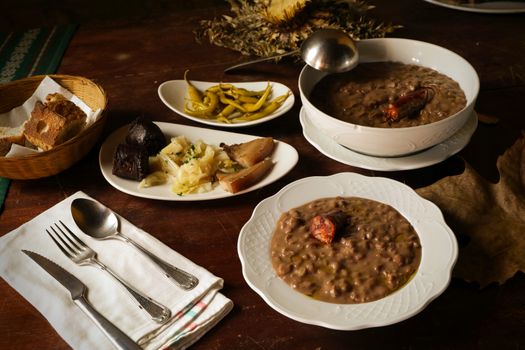
Photo: José Antonio Otegui Auzmendi / Pexels
Spanish
Fabada Asturiana
The diets react (see scores below)
Common Ingredients
- fabes beans
- Spanish chorizo
- morcilla
- pork shoulder
- saffron
- paprika
- onion
- garlic
Specific recipes may vary.
Incompatible with 9 of 11 diets
Diet Ratings
Fabada Asturiana is built around fabes (large white beans), which are extremely high in net carbohydrates. A single serving of this stew contains approximately 30-45g of net carbs from the beans alone, easily exceeding the entire daily keto limit in one bowl. While the accompanying meats (chorizo, morcilla, pork shoulder) are keto-friendly and contribute healthy fats and protein, the foundational ingredient makes this dish fundamentally incompatible with ketosis. There is no practical way to adapt this dish while retaining its identity — the beans are the defining ingredient, not a minor component.
Fabada Asturiana is a traditional Spanish bean stew built entirely around multiple animal products. The dish contains Spanish chorizo (pork sausage), morcilla (blood sausage — made from pig's blood), and pork shoulder as its primary proteins. All three are direct animal-derived ingredients, making this dish unambiguously non-vegan. While the fabes beans, saffron, paprika, onion, and garlic are all plant-based, the animal ingredients are not incidental — they are the defining, structural components of the dish. There is no meaningful debate within the vegan community about this assessment.
Fabada Asturiana is fundamentally incompatible with the paleo diet. The dish is built around fabes beans (large white beans), which are legumes — one of the most clearly excluded food groups in paleo due to their lectin and phytate content. Beyond the beans, Spanish chorizo and morcilla (blood sausage) are processed meats containing added salt, preservatives, and often fillers, making them non-paleo even if pork itself is approved. The paleo-compliant components — pork shoulder, saffron, paprika, onion, and garlic — are acceptable, but they are supporting ingredients in a dish whose identity and bulk depend entirely on a prohibited legume base.
Fabada Asturiana is a hearty Spanish bean stew that centers on fabes (large white beans), which are Mediterranean-friendly, but the dish is dominated by cured and processed pork products — Spanish chorizo, morcilla (blood sausage), and pork shoulder. These represent multiple servings of red and processed meat in a single dish, directly contradicting Mediterranean diet principles that limit red meat to a few times per month and discourage processed meats almost entirely. The high saturated fat and sodium content from the cured meats override the nutritional benefit of the legumes. Aromatics like onion, garlic, paprika, and saffron are positive elements, but they are incidental to the dish's character.
Some Mediterranean diet scholars acknowledge that traditional Iberian cuisine, including Asturian and broader Spanish regional cooking, incorporates cured pork products as part of a deeply rooted food culture. A small-portion or modified version of this dish — emphasizing the beans with only a small amount of chorizo as flavoring rather than a primary ingredient — could align with the spirit of traditional Mediterranean eating patterns, similar to how Italian ribollita uses pancetta sparingly for depth.
Fabada Asturiana is fundamentally incompatible with the carnivore diet. The dish is built around fabes beans as its primary ingredient — a legume, which is entirely plant-derived and strictly excluded from all tiers of carnivore eating. Beyond the beans, the recipe contains multiple plant-based ingredients: onion, garlic, saffron, and paprika are all plant foods or spices. While the dish does contain carnivore-approved animal proteins (pork shoulder, morcilla, and Spanish chorizo), these are minority components in a bean-dominated stew. There is no version of this dish that could be made carnivore-compliant without completely deconstructing it — at which point it would no longer be Fabada Asturiana.
Fabada Asturiana is built around fabes beans (large white beans), which are legumes — a categorically excluded food group on Whole30. Unlike green beans, sugar snap peas, or snow peas (the explicit legume exceptions), fabes are a starchy dried bean with no exception granted. Additionally, Spanish chorizo and morcilla (blood sausage) are cured/processed meats that typically contain added sugars and other non-compliant additives, making them further disqualifiers in their standard commercial forms. The dish is fundamentally incompatible with Whole30 due to the legume base alone.
Fabada Asturiana is essentially a FODMAP minefield. The dish is built around fabes (large white beans), which are high in GOS (galactooligosaccharides) — a major FODMAP category. Monash University rates legumes like butter beans and cannellini beans as high-FODMAP at typical serving sizes. Fabes are a large Spanish white bean virtually identical in FODMAP profile to these high-GOS legumes. On top of this, the recipe explicitly includes both onion and garlic, which are among the highest-fructan foods tested by Monash — both are flagged as 'avoid' at any reasonable serving. Spanish chorizo and morcilla (blood sausage) may also contain garlic and onion as core ingredients in their seasoning, compounding the fructan load. Pork shoulder and saffron and paprika are low-FODMAP, but they cannot redeem a dish whose base ingredients are multiple high-FODMAP foods. There is no realistic way to make a traditional Fabada Asturiana low-FODMAP, as the beans, onion, and garlic are fundamental to its identity.
Fabada Asturiana is a traditional Spanish bean stew that contains multiple high-sodium, high-saturated-fat processed meats — Spanish chorizo, morcilla (blood sausage), and pork shoulder — which are directly at odds with DASH diet principles. While the fabes beans are an excellent DASH food (high in fiber, potassium, magnesium, and plant protein), they are outweighed by the problematic ingredients. Chorizo and morcilla are cured, high-sodium meats that also carry significant saturated fat loads. Pork shoulder adds additional saturated fat. The combination of multiple processed and cured pork products in a single dish creates a very high sodium profile (easily exceeding 1,500–2,000mg per serving) and high saturated fat content. DASH guidelines explicitly limit processed meats, cured meats, and high-fat red meat, and recommend lean proteins instead. The aromatic vegetables (onion, garlic) and spices (saffron, paprika) are DASH-friendly, but they cannot compensate for the primary protein sources in this dish.
Fabada Asturiana is a traditional Spanish bean stew that presents a mixed Zone Diet profile. The fabes (large white beans) are the primary carbohydrate source — legumes are generally 'favorable' Zone carbs due to their low-to-moderate glycemic index, high fiber content (reducing net carbs), and slow digestion. However, a typical serving of this dish is very bean-heavy, pushing carbohydrate blocks well above a Zone-balanced meal without careful portioning. The protein sources — chorizo, morcilla (blood sausage), and pork shoulder — are all fatty, processed, or cured meats with significant saturated fat content. Zone Diet strongly favors lean proteins, and none of these qualify as lean. Chorizo and morcilla in particular are high in saturated fat and are processed, which conflicts with the anti-inflammatory principles Sears emphasizes in later works. Pork shoulder is moderately lean but still fattier than ideal Zone proteins. The fat macros from this dish will be dominated by saturated fat rather than the preferred monounsaturated fats. On the positive side, onion, garlic, saffron, and paprika are excellent Zone-friendly anti-inflammatory polyphenol sources. The dish can technically be incorporated into a Zone framework if served in small portions (limiting bean quantity) and balanced with a lean protein addition, but as traditionally prepared, it skews toward high carbs and unfavorable saturated fats.
Some Zone practitioners note that Sears' later writings (The OmegaRx Zone, The Mediterranean Zone) soften the strict anti-saturated fat stance and acknowledge that traditional Mediterranean dietary patterns — including legume-heavy stews with small amounts of cured pork — are consistent with anti-inflammatory eating when overall omega-6 intake is controlled. From this perspective, a small portion of Fabada could fit as part of a broader Zone-Mediterranean meal pattern, with the beans providing good polyphenols and fiber and the cured meats serving as flavor components rather than primary protein sources.
Fabada Asturiana presents a genuinely mixed anti-inflammatory profile. On the positive side, fabes beans are an excellent source of fiber, plant protein, and polyphenols — legumes are explicitly emphasized in anti-inflammatory frameworks. Garlic, onion, saffron, and paprika all carry meaningful anti-inflammatory compounds (allicin, quercetin, crocin, capsanthin). However, the dish is dominated by processed pork products: Spanish chorizo and morcilla (blood sausage) are cured, high-fat, high-sodium processed meats — a category anti-inflammatory guidelines consistently recommend limiting or avoiding. Pork shoulder adds saturated fat load. The combination of multiple processed meats in a single dish pushes the overall profile toward the 'limit' category, even though the bean base is commendable. This is a classic case where a nutritionally beneficial staple ingredient (legumes) is paired with ingredients that work against anti-inflammatory goals. Occasional consumption by generally healthy individuals is unlikely to cause harm, but it cannot be recommended as an anti-inflammatory dish.
Some anti-inflammatory practitioners take a more permissive view of traditionally prepared, minimally processed cured meats in the context of Mediterranean and Iberian dietary patterns, noting that overall dietary pattern matters more than individual foods. Dr. Weil's framework does allow moderate red meat and acknowledges traditional food cultures; in this context, a small portion of chorizo in a largely bean-based dish might be considered acceptable. However, mainstream anti-inflammatory guidance (including the IF Rating system) consistently scores processed meats low due to saturated fat, nitrates/nitrites, and pro-inflammatory arachidonic acid content.
Fabada Asturiana is a rich, heavy Spanish bean stew built around high-fat processed pork products — Spanish chorizo, morcilla (blood sausage), and pork shoulder. While the fabes beans provide meaningful fiber and some plant protein, and the overall dish is protein-containing, the fat profile is the primary disqualifier for GLP-1 patients. Chorizo and morcilla are high in saturated fat and are calorie-dense processed meats; pork shoulder adds additional saturated fat. The combination of high fat content, slow gastric emptying caused by GLP-1 medications, and the richness of the broth creates significant risk of nausea, bloating, reflux, and general GI distress. The dish is also traditionally served in large, hearty portions, which conflicts with small-portion-friendly eating. The paprika and saffron are benign, and the onion and garlic are fine, but they cannot offset the core fat and processing concerns. The beans are genuinely valuable nutritionally, but the same fiber and plant protein benefit can be achieved from bean-based dishes without the fatty processed meats.
Some GLP-1-focused dietitians may argue that a small, carefully portioned serving of Fabada — emphasizing the beans and minimizing the chorizo and morcilla — could be acceptable given the high fiber content of fabes beans and the dish's protein density. However, the practical challenge is that the fat from the processed meats leaches into the broth throughout cooking, making it difficult to reduce fat exposure simply by limiting the meat portions.
*See how scores were generated at our methodology page.
Nutritional profile
Six traits that cut across every diet.
Fiber & Plants
How much whole-plant food and fiber it delivers.
Healthy Fats
The quality of its fats (unsaturated, omega-3).
Whole / Unprocessed
How close it is to its natural, unprocessed form.
Gut Gentle
How easy it is on digestion (low FODMAP, few irritants).
Low Glycemic
How little it spikes your blood sugar.
Protein Density
How much protein it packs per calorie.
Controversy Index
Higher controversy = more disagreement between diets.
Diet-Specific Tips
 Zone — 4/10
View tips
- Fabes beans are low-to-moderate glycemic index legumes — favorable Zone carb source, but portion size easily exceeds Zone carb block limits
- Chorizo and morcilla are processed, high-saturated-fat meats — unfavorable Zone proteins conflicting with lean protein guidelines
- Pork shoulder has moderate fat content — acceptable in small amounts but not ideal lean Zone protein
- No monounsaturated fat sources present; fat profile is saturated-fat dominant
- Garlic, onion, saffron, and paprika are anti-inflammatory polyphenol sources — positive for Zone anti-inflammatory goals
- As traditionally prepared, macronutrient ratio skews toward excess carbohydrate and unfavorable fat, making Zone balancing difficult without significant modification
- Dish lacks lean protein or monounsaturated fat components to easily balance the Zone block ratio
 Anti-Inflammatory — 4/10
View tips
- Fabes beans are a strong anti-inflammatory positive — high fiber, polyphenols, plant protein (legumes are emphasized)
- Chorizo and morcilla are processed meats: high in saturated fat, sodium, and potentially nitrates — consistently flagged as pro-inflammatory
- Pork shoulder adds additional saturated fat load
- Garlic and onion contribute allicin and quercetin — meaningful anti-inflammatory compounds
- Saffron contains crocin and safranal with documented anti-inflammatory and antioxidant activity
- Paprika provides capsanthin and carotenoids — anti-inflammatory antioxidants
- Multiple processed pork components in one dish amplify the inflammatory burden beyond what a single moderate portion of red meat would represent
- Traditional preparation without refined carbohydrates or seed oils is a mild positive