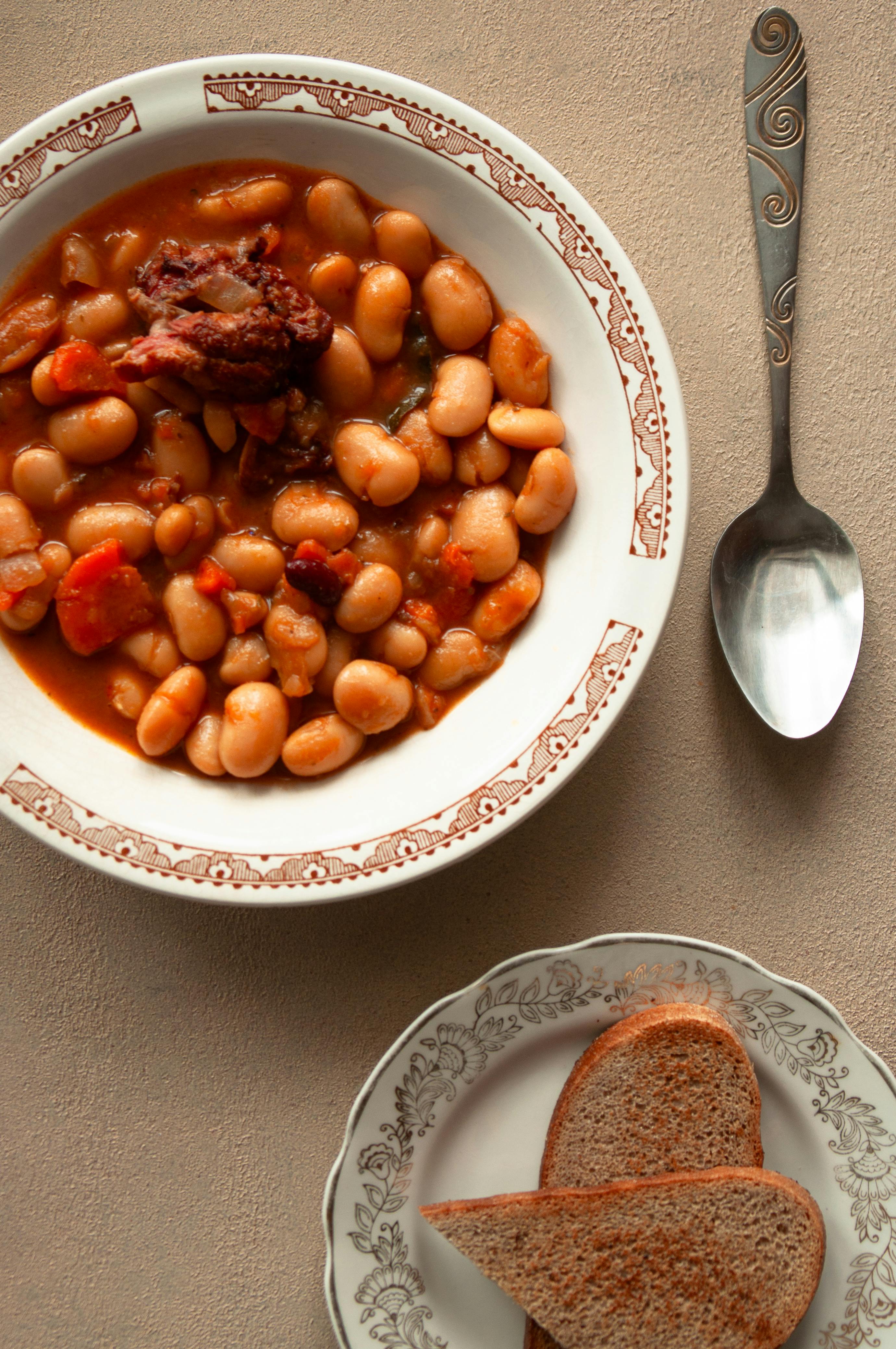
Photo: Boryslav Shoot / Pexels
Mediterranean
Fasolada (Greek Bean Soup)
The diets react (see scores below)
Common Ingredients
- cannellini beans
- tomatoes
- carrots
- celery
- onion
- olive oil
- bay leaf
- oregano
Specific recipes may vary.
Incompatible with 5 of 11 diets
Diet Ratings
Fasolada is fundamentally incompatible with a ketogenic diet. Cannellini beans are the primary ingredient and the central problem: a single cup of cooked cannellini beans contains approximately 40g of net carbs, which alone exceeds or nearly exhausts the entire daily keto carb budget. Beans are a legume high in starch and cannot be made keto-friendly through portion control in any meaningful way — a portion small enough to stay within keto limits would essentially remove the dish entirely. The remaining vegetables (carrots, onion, tomatoes) add additional net carbs on top. While olive oil is keto-friendly and the herbs are fine, they cannot redeem a dish built around high-carb legumes. This is a traditional Mediterranean peasant staple celebrated for its complex carbohydrates and fiber — qualities that directly conflict with ketosis.
Fasolada is a traditional Greek white bean soup made entirely from whole plant foods. Every ingredient — cannellini beans, tomatoes, carrots, celery, onion, olive oil, bay leaf, and oregano — is fully plant-based with no animal products or animal-derived ingredients present. The dish is nutritionally excellent, providing high-fiber legumes, antioxidant-rich vegetables, and heart-healthy olive oil. It earns a top-tier score within the approve range due to its whole-food composition with minimal processing. The only minor consideration is olive oil, which is a refined fat rather than a whole food, but it is a standard and uncontroversial ingredient in vegan cooking.
Fasolada is disqualified from paleo by its primary and defining ingredient: cannellini beans. Legumes are one of the most consistently excluded food groups in paleo across all major authorities, including Loren Cordain, Mark Sisson, and Robb Wolf. Beans contain lectins, phytates, and other anti-nutrients that paleo proponents argue cause gut irritation and impair nutrient absorption — anti-nutrients that Paleolithic humans would have lacked the agricultural tools and cooking traditions to regularly neutralize. All remaining ingredients (tomatoes, carrots, celery, onion, olive oil, bay leaf, oregano) are fully paleo-compliant, but the cannellini beans are not a minor or optional component — they are the dish itself. This is not a gray-area case; legume exclusion is one of the clearest, most unified positions in paleo nutritional philosophy.
Fasolada is considered the national dish of Greece and is a quintessential Mediterranean diet staple. Every ingredient aligns perfectly with Mediterranean diet principles: cannellini beans provide plant-based protein and fiber, tomatoes and vegetables deliver micronutrients and antioxidants, and extra virgin olive oil serves as the primary fat source. The dish is entirely plant-based, minimally processed, and built around legumes — one of the most emphasized food groups in the Mediterranean dietary pattern. It is precisely the kind of dish Mediterranean diet researchers and practitioners hold up as a model meal.
Fasolada is entirely plant-based and contains zero animal products. Every single ingredient — cannellini beans, tomatoes, carrots, celery, onion, olive oil, bay leaf, and oregano — is explicitly excluded on the carnivore diet. Beans are legumes, one of the most anti-carnivore foods due to their antinutrients (lectins, phytates). Olive oil is a plant oil. All vegetables and spices are plant-derived. This dish is the antithesis of carnivore eating in every respect.
Fasolada is a traditional Greek white bean soup made with cannellini beans as its primary ingredient. Cannellini beans are legumes, and legumes are explicitly excluded on the Whole30 program. Unlike green beans, sugar snap peas, and snow peas — which are specific legume exceptions carved out by the official Whole30 rules — cannellini beans (and all other dried/cooked beans) remain fully off-limits. All other ingredients in this dish (tomatoes, carrots, celery, onion, olive oil, bay leaf, oregano) are individually Whole30-compliant, but the cannellini beans are a non-negotiable disqualifier. There is no compliant substitution that would preserve the identity of this dish.
Fasolada is fundamentally incompatible with the low-FODMAP elimination phase due to multiple high-FODMAP ingredients. Cannellini beans are very high in GOS (galacto-oligosaccharides) and are rated high-FODMAP by Monash University — beans are one of the most significant FODMAP sources in any diet. Onion contains high levels of fructans and is among the most problematic foods on the low-FODMAP diet, with no safe serving size. Celery becomes high-FODMAP at standard soup quantities (Monash rates it as moderate-to-high in typical portions). Together, these three ingredients make this dish unsuitable for the elimination phase regardless of portion size, as the dish cannot be made without its defining components.
Fasolada is an exemplary DASH-compatible dish. Cannellini beans are a DASH-recommended legume providing excellent plant-based protein, fiber, potassium, and magnesium. The vegetable base (tomatoes, carrots, celery, onion) directly aligns with DASH's emphasis on 4-5 servings of vegetables daily, contributing potassium, magnesium, and fiber. Olive oil is a DASH-approved unsaturated fat. Oregano and bay leaf add flavor without sodium. The dish is naturally low in saturated fat, contains no added sugar, and is cholesterol-free. If made with fresh or low-sodium canned beans and tomatoes, sodium remains well within DASH targets. Canned versions of beans or tomatoes can elevate sodium — rinsing canned beans and choosing no-salt-added tomatoes keeps this dish firmly in the approve category.
Fasolada is a nutritious, whole-food Mediterranean soup that aligns well with Zone principles in many respects, but requires careful portioning due to the dual role of beans as both protein and carbohydrate. Cannellini beans are the primary protein source here, which means they fall under the vegetarian protein fat-block rule (1 fat block = 3g fat rather than 1.5g). The beans provide moderate protein (~7g per 1/2 cup cooked) alongside a substantial carbohydrate load (~20g net carbs per 1/2 cup), making them an 'unfavorable' Zone carbohydrate — dense and moderately high-glycemic compared to non-starchy vegetables. The vegetable base (tomatoes, carrots, celery, onion) contributes favorable low-glycemic carbs and polyphenols. Olive oil is an ideal Zone fat source (monounsaturated). Oregano adds anti-inflammatory polyphenols. The challenge is that a typical serving of fasolada will be carbohydrate-heavy relative to protein, skewing the 40/30/30 ratio unless portions are tightly controlled — roughly 1 cup of soup would provide far more carb blocks than protein blocks. To Zone-balance this dish, one would need to reduce bean quantity, add a lean protein side (e.g., grilled fish or chicken), and use olive oil as the fat block. As written, it's a solid Zone-friendly framework but is not a complete Zone meal on its own.
Some Zone practitioners, particularly those following Sears' later anti-inflammatory protocols emphasizing plant-based eating, would treat beans more favorably given their fiber content (which reduces net carbs), low glycemic load per serving, and polyphenol content. In Sears' later work (The Mediterranean Zone), legumes are elevated as preferred protein/carb sources in a Mediterranean-style Zone approach, which could push this dish closer to a 7 or 'approve' verdict if portioned thoughtfully.
Fasolada is a quintessential anti-inflammatory dish. Cannellini beans provide soluble fiber and plant protein, both associated with reduced inflammatory markers (CRP, IL-6) and improved gut microbiome diversity. Tomatoes contribute lycopene and other carotenoids, particularly potent when cooked. Carrots and celery add beta-carotene, flavonoids, and additional fiber. Onions are rich in quercetin, a well-studied anti-inflammatory flavonoid. Extra virgin olive oil is a cornerstone of anti-inflammatory eating due to oleocanthal, which mimics ibuprofen in inhibiting COX-1 and COX-2 enzymes. Oregano and bay leaf contribute polyphenols and have demonstrated antimicrobial and antioxidant properties. The dish is entirely plant-based, contains no refined carbohydrates, no saturated fat, no added sugar, and no processed ingredients. It aligns squarely with Dr. Weil's Anti-Inflammatory Food Pyramid — emphasizing legumes, colorful vegetables, herbs, and olive oil — and with the broader Mediterranean dietary pattern, which is one of the most evidence-backed dietary patterns for reducing systemic inflammation. This is essentially an anti-inflammatory diet meal by design.
Fasolada is an excellent GLP-1 companion dish. Cannellini beans provide a strong dual benefit of protein and fiber — roughly 15g protein and 11g fiber per cup — making this soup highly aligned with the two top priorities for GLP-1 patients. The vegetable base (tomatoes, carrots, celery, onion) adds micronutrients, additional fiber, and water content, directly supporting hydration and digestion. Olive oil is a moderate amount of unsaturated fat, consistent with guidance. The soup format is easy to digest, warm, and gentle on a slowed GI tract. It works well in small portions, making it suitable for the reduced appetite and small-meal eating pattern typical on GLP-1 medications. The primary limitation is that beans, while protein-rich, are not as protein-dense per calorie as animal proteins, and the overall protein per serving may fall short of the 15-30g per-meal target depending on portion size and preparation. A standard bowl (~1.5 cups) would yield approximately 20-22g protein, which is adequate. Overall this is a nutrient-dense, fiber-forward, easily digestible dish with healthy fats and high water content — a near-ideal GLP-1 meal.
*See how scores were generated at our methodology page.
Nutritional profile
Six traits that cut across every diet.
Fiber & Plants
How much whole-plant food and fiber it delivers.
Healthy Fats
The quality of its fats (unsaturated, omega-3).
Whole / Unprocessed
How close it is to its natural, unprocessed form.
Gut Gentle
How easy it is on digestion (low FODMAP, few irritants).
Low Glycemic
How little it spikes your blood sugar.
Protein Density
How much protein it packs per calorie.
Controversy Index
Higher controversy = more disagreement between diets.
Diet-Specific Tips
 Vegan — 9/10
View tips
- Cannellini beans provide complete plant-based protein and fiber
- All vegetables (tomatoes, carrots, celery, onion) are unambiguously plant-based
- Olive oil is plant-derived and vegan-compliant
- Herbs (bay leaf, oregano) are whole plant ingredients
- No animal products, dairy, eggs, or animal-derived additives present
- Whole-food composition elevates score within the approve range
 Mediterranean — 10/10
View tips
- Cannellini beans are a core Mediterranean legume providing plant-based protein and dietary fiber
- All ingredients are whole, unprocessed plant foods
- Extra virgin olive oil as the primary fat is canonical Mediterranean diet practice
- Tomatoes, carrots, celery, and onion contribute vitamins, minerals, and antioxidants
- Aromatic herbs (oregano, bay leaf) add flavor without sodium or processed additives
- Zero red meat, refined grains, added sugars, or processed ingredients
- Directly originates from traditional Greek cuisine, a foundational Mediterranean diet culture
 DASH — 9/10
View tips
- Cannellini beans are a DASH-recommended legume rich in fiber, potassium, and magnesium
- Vegetable-dense base aligns directly with DASH vegetable serving goals
- Olive oil provides heart-healthy monounsaturated fats approved by DASH
- No saturated fat, trans fat, added sugar, or cholesterol
- Naturally low sodium when prepared with fresh or no-salt-added canned ingredients
- Sodium caution: canned beans and canned tomatoes can add significant sodium — rinsing beans and using no-salt-added products is recommended
- Excellent source of plant protein consistent with DASH lean protein guidelines
 Zone — 6/10
View tips
- Cannellini beans serve dual role as protein and carbohydrate, complicating Zone block balancing
- Bean carbohydrate density makes the dish carb-heavy; net carbs per serving likely exceed Zone targets without careful portioning
- Olive oil is an ideal monounsaturated Zone fat source
- Vegetable base (tomatoes, carrots, celery, onion) provides favorable low-glycemic carbs and polyphenols
- Oregano and tomatoes contribute anti-inflammatory polyphenols consistent with Sears' anti-inflammatory focus
- Dish lacks a complete lean protein complement to achieve 30% protein by calories without modification
- Well-suited as a Zone meal component alongside a lean protein, rather than a standalone Zone meal
 Anti-Inflammatory — 9/10
View tips
- Cannellini beans: high fiber, plant protein, associated with reduced CRP and IL-6
- Extra virgin olive oil: oleocanthal inhibits COX-1/COX-2 inflammatory pathways
- Tomatoes: lycopene and carotenoids enhanced by cooking
- Onion: quercetin, a potent anti-inflammatory flavonoid
- Oregano and bay leaf: polyphenols with antioxidant and anti-inflammatory activity
- Carrots: beta-carotene and fiber
- No refined carbohydrates, added sugars, trans fats, or processed ingredients
- Fully plant-based; aligns with Mediterranean dietary pattern and Dr. Weil's Anti-Inflammatory Pyramid
 GLP-1 Friendly — 8/10
View tips
- High fiber from cannellini beans (~11g per cup) supports digestion and prevents constipation
- Dual protein-and-fiber source from beans aligns with top two GLP-1 dietary priorities
- High water content from soup base supports hydration, counteracting reduced thirst on GLP-1s
- Olive oil provides unsaturated fat in moderate amounts — appropriate and beneficial
- Easy to digest in soup form; gentle on slowed gastric emptying
- Vegetable base adds micronutrient density with minimal calories
- Protein per serving is adequate (~20g per standard bowl) but portion-dependent
- Beans are less protein-dense per calorie than lean animal proteins — not a limitation unique to this dish but worth noting for patients struggling to hit daily protein targets