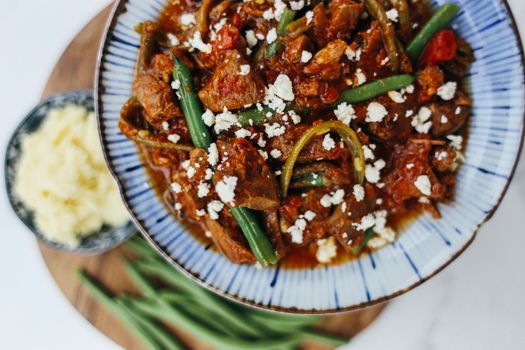
Photo: Rachel Claire / Pexels
Mediterranean
Fasolakia (Green Bean Stew)
The diets react (see scores below)
Common Ingredients
- green beans
- potatoes
- tomatoes
- onion
- olive oil
- garlic
- parsley
- oregano
Specific recipes may vary.
Incompatible with 4 of 11 diets
Diet Ratings
Fasolakia contains potatoes as a primary ingredient, which are a high-starch vegetable with roughly 15-17g net carbs per 100g. A typical serving of this stew would easily deliver 30-50g+ of net carbs from potatoes alone, blowing the daily keto limit. Tomatoes and onions also contribute additional net carbs. While the olive oil base and green beans are keto-friendly, the potatoes make this dish fundamentally incompatible with ketosis in any standard portion size.
Fasolakia is a traditional Greek green bean stew made entirely from whole plant foods. Every ingredient — green beans, potatoes, tomatoes, onion, olive oil, garlic, parsley, and oregano — is fully plant-based with no animal products or animal-derived ingredients. The dish is built around vegetables and legumes cooked in olive oil with aromatics, making it an excellent example of a whole-food, minimally processed vegan meal. It scores very high on both vegan compliance and nutritional quality.
Fasolakia contains two significant paleo violations. Green beans are legumes, which are explicitly excluded from the paleo diet due to their lectin and phytate content — this is a core, non-negotiable exclusion across virtually all paleo frameworks. Potatoes are also problematic; while white potatoes occupy a debated space in paleo, they remain discouraged by strict paleo authorities including Cordain's original framework. The combination of a definitive avoid ingredient (green beans) with a debated ingredient (potatoes) makes this dish incompatible with paleo. The remaining ingredients — tomatoes, onion, olive oil, garlic, parsley, oregano — are all paleo-approved, but they cannot offset the fundamental violations. The dish's identity is built around green beans as the primary ingredient, making substitution impractical.
Fasolakia is a quintessential Mediterranean dish and a staple of Greek cuisine. It is built entirely on plant-based whole foods — green beans, potatoes, tomatoes, onions, and garlic — cooked in generous amounts of extra virgin olive oil and seasoned with fresh herbs. Every ingredient aligns perfectly with Mediterranean diet principles: abundant vegetables, olive oil as the primary fat, no refined grains, no added sugars, and no animal products. This is exactly the kind of plant-forward, olive-oil-rich meal that the Mediterranean diet emphasizes eating multiple times daily.
Fasolakia is an entirely plant-based dish with zero animal-derived ingredients. Every single component — green beans, potatoes, tomatoes, onion, olive oil, garlic, parsley, and oregano — is explicitly excluded from the carnivore diet. There is no animal protein, no animal fat, and no animal product of any kind. This dish is the antithesis of carnivore eating: it is a vegetable stew cooked in a plant oil with plant aromatics and herbs. It scores the minimum possible rating.
Fasolakia is a traditional Greek green bean stew made entirely from Whole30-compliant ingredients. Green beans are explicitly excepted from the legume exclusion by the official Whole30 program. All other ingredients — potatoes, tomatoes, onion, olive oil, garlic, parsley, and oregano — are whole, unprocessed vegetables, a natural fat, and herbs, all fully permitted. There are no excluded ingredients in this dish.
Fasolakia contains two major high-FODMAP ingredients that make it unsuitable during the elimination phase: onion and garlic. Both are among the highest-fructan foods in the Monash system and are problematic at any cooking quantity. Onion is high-FODMAP even in small amounts (Monash rates it as avoid), and garlic is one of the most concentrated sources of fructans — both are used as foundational flavoring ingredients in this stew, meaning their FODMAPs will permeate the entire dish including the cooking liquid. Green beans are low-FODMAP at a standard serve (75g per Monash). Potatoes are low-FODMAP. Tomatoes are low-FODMAP at standard serves (up to 75g canned or one medium fresh). Olive oil is low-FODMAP. Parsley and oregano are low-FODMAP as herbs. However, the presence of whole onion and garlic as key structural ingredients — not incidental trace amounts — makes this dish a clear avoid. Even if onion and garlic were removed, FODMAPs from these aromatics leach into the stew liquid during cooking, which compounds the problem. This dish cannot be made compliant without a fundamental recipe overhaul substituting garlic-infused oil and omitting onion entirely.
Fasolakia is an excellent fit for the DASH diet. The dish is composed almost entirely of DASH-core vegetables — green beans, tomatoes, onion, garlic — along with potatoes, which contribute potassium, and olive oil, a heart-healthy unsaturated fat explicitly recommended in DASH. Fresh herbs (parsley, oregano) add flavor without sodium, making this a naturally low-sodium preparation. The dish is rich in potassium, magnesium, fiber, and antioxidants, all nutrients DASH emphasizes. There is no red meat, processed ingredients, saturated fat, added sugar, or high-sodium components. The olive oil content is moderate and aligned with DASH's allowance for vegetable oils. The only minor consideration is that potatoes are a starchy vegetable and should be portion-controlled within daily grain/starchy vegetable allowances, but they are not prohibited. Overall, this dish exemplifies the DASH dietary pattern.
Fasolakia is a traditional Greek vegetarian stew that has real Zone strengths but a notable weakness. The green beans are an excellent Zone-favorable vegetable — low glycemic, high fiber, and nutrient-dense. Tomatoes, onions, garlic, and herbs (parsley, oregano) are all Zone-approved polyphenol-rich, low-glycemic ingredients. Olive oil is the ideal Zone fat — monounsaturated and anti-inflammatory. However, potatoes are explicitly listed as 'unfavorable' (high-glycemic) carbohydrates in Dr. Sears' Zone framework and are generally discouraged alongside corn, bananas, and raisins. As a main dish with no dedicated protein source, this meal also fails the Zone's requirement for approximately 25g of lean protein per meal, creating a significant macronutrient imbalance. The dish is carbohydrate-heavy and protein-deficient, making the 40/30/30 ratio very difficult to achieve as presented. To make it Zone-compliant, potatoes should be minimized or eliminated, portion size of the stew should be reduced, and a lean protein (e.g., grilled chicken, fish, or tofu) must be added alongside. As a side dish rather than a main, it scores better. The olive oil and vegetable base are Zone assets, but the potato inclusion and absent protein are real liabilities.
Some Zone practitioners argue that potatoes in small quantities can be incorporated as an 'unfavorable' carb block without derailing the diet, especially when the portion is modest and balanced with sufficient protein and fat. In Sears' later writings emphasizing anti-inflammatory eating and Mediterranean diet alignment, the overall polyphenol density of this dish (tomatoes, olive oil, garlic, herbs) is genuinely favorable. A small serving of fasolakia as a vegetable side — not a protein-less main — could be reasonably accommodated within Zone blocks.
Fasolakia is a classic Mediterranean plant-based stew with an exceptionally strong anti-inflammatory profile. Extra virgin olive oil is the cooking fat, providing oleocanthal and oleic acid with well-documented anti-inflammatory effects. Garlic and onion supply quercetin, allicin, and organosulfur compounds that suppress NF-κB inflammatory pathways. Tomatoes contribute lycopene and vitamin C; cooking in olive oil enhances lycopene bioavailability. Green beans provide fiber, flavonoids, and carotenoids. Herbs oregano and parsley are rich in polyphenols, rosmarinic acid, and apigenin. Potatoes add resistant starch and potassium, though they are nightshades and a starchy carbohydrate. The dish is entirely whole-food, plant-based, low in saturated fat, free of refined carbohydrates and additives, and aligns closely with Dr. Weil's Anti-Inflammatory Food Pyramid and the traditional Mediterranean dietary pattern — one of the most anti-inflammatory dietary frameworks supported by research.
Tomatoes and potatoes are nightshades; while mainstream anti-inflammatory authorities like Dr. Weil consider them beneficial due to antioxidant content (lycopene, vitamin C), Autoimmune Protocol (AIP) practitioners and researchers like Dr. Tom O'Bryan argue that solanine and lectins in nightshades can trigger inflammatory responses in individuals with autoimmune conditions or gut permeability issues. Potatoes also carry a moderate glycemic load, which some anti-inflammatory practitioners flag for blood sugar management.
Fasolakia is a nutrient-dense, fiber-rich Mediterranean vegetable stew with genuinely positive qualities for GLP-1 patients — green beans, tomatoes, and onion provide meaningful fiber, micronutrients, and high water content that supports digestion and hydration. Olive oil contributes heart-healthy unsaturated fats in moderate amounts, and the dish is easy to digest, low in saturated fat, and unlikely to worsen GLP-1 side effects. However, it has no meaningful protein source, which is the #1 priority for GLP-1 patients. Potatoes add starchy carbohydrates with limited protein payoff, and the dish as a standalone main cannot support the 15–30g protein-per-meal target that protects against muscle loss during rapid weight loss. As a side dish paired with a lean protein (grilled chicken, white fish, eggs, or legumes), it would score higher. As a primary main, it falls short of GLP-1 dietary needs.
Some GLP-1-focused dietitians accept plant-forward, protein-light meals like this when patients are struggling with nausea or appetite suppression, arguing that caloric intake and digestibility take temporary priority over protein targets on difficult days. Others maintain that protein targets should be non-negotiable at every meal to prevent lean mass loss, and would always require a protein addition before calling this dish meal-complete.
*See how scores were generated at our methodology page.
Nutritional profile
Six traits that cut across every diet.
Fiber & Plants
How much whole-plant food and fiber it delivers.
Healthy Fats
The quality of its fats (unsaturated, omega-3).
Whole / Unprocessed
How close it is to its natural, unprocessed form.
Gut Gentle
How easy it is on digestion (low FODMAP, few irritants).
Low Glycemic
How little it spikes your blood sugar.
Protein Density
How much protein it packs per calorie.
Controversy Index
Higher controversy = more disagreement between diets.
Diet-Specific Tips
 Vegan — 9/10
View tips
- All ingredients are whole plant foods
- No animal products or animal-derived ingredients
- Green beans provide plant-based protein and fiber
- Olive oil is plant-derived (pressed from olives)
- Traditional preparation contains no dairy, eggs, or meat
- Nutritionally balanced with vegetables, legumes, and healthy fats
 Mediterranean — 9/10
View tips
- All ingredients are whole, unprocessed plant foods
- Extra virgin olive oil is the primary and only fat source
- Rich in vegetables providing fiber, vitamins, and antioxidants
- No animal products, refined grains, or added sugars
- Authentic traditional Greek dish representing core Mediterranean eating patterns
- Potatoes are a whole food carbohydrate consistent with traditional Mediterranean diets
- Tomatoes, garlic, and herbs provide anti-inflammatory phytonutrients
 Whole30 — 9/10
View tips
- Green beans are explicitly allowed on Whole30 despite being legumes
- Potatoes are a compliant vegetable on Whole30
- Olive oil is a compliant natural fat
- Tomatoes, onion, garlic, parsley, and oregano are all compliant whole foods
- No grains, dairy, added sugars, or other excluded ingredients present
- Dish is a whole-food stew, not a recreated junk food or baked good
 DASH — 9/10
View tips
- Green beans and tomatoes are DASH-core vegetables high in potassium, magnesium, and fiber
- Olive oil provides heart-healthy monounsaturated fats aligned with DASH guidelines
- Naturally very low sodium — no processed or high-salt ingredients
- Potatoes contribute potassium and satiety but add starchy calories; portion control advised
- No saturated fat, red meat, added sugar, or processed ingredients
- Garlic, onion, parsley, and oregano enhance flavor without sodium
- Excellent source of dietary fiber supporting cardiovascular health
 Zone — 5/10
View tips
- Potatoes are explicitly 'unfavorable' high-glycemic carbs in Zone methodology
- No protein source present — fails Zone's ~25g lean protein per meal requirement
- Green beans are an excellent Zone-favorable low-glycemic vegetable
- Olive oil is ideal Zone fat — monounsaturated and anti-inflammatory
- Tomatoes, garlic, onion, and herbs contribute Zone-friendly polyphenols
- As a main dish, macronutrient ratio is heavily skewed toward carbohydrates
- Could work as a side dish paired with a lean protein source
- Mediterranean ingredient profile aligns with Sears' anti-inflammatory emphasis
 Anti-Inflammatory — 9/10
View tips
- Extra virgin olive oil as the sole fat — rich in oleocanthal and monounsaturated fats
- Garlic and onion provide allicin, quercetin, and organosulfur anti-inflammatory compounds
- Tomatoes supply lycopene (enhanced by heat and EVOO) and vitamin C
- Green beans contribute fiber, flavonoids, and carotenoids
- Oregano and parsley are potent polyphenol-rich anti-inflammatory herbs
- Entirely whole-food, plant-based — no processed ingredients, refined carbs, or additives
- Nightshade vegetables (tomatoes, potatoes) may be a concern for autoimmune-sensitive individuals
- Potatoes add moderate glycemic load — consider portion size
 GLP-1 Friendly — 5/10
View tips
- No protein source — cannot meet 15–30g per meal target as served
- High fiber from green beans, tomatoes, and onion — supports digestion and GLP-1 constipation prevention
- Olive oil provides unsaturated fat — acceptable in moderate amounts, not a side-effect risk
- High water content from tomatoes and green beans — supports hydration
- Potatoes add starchy carbs with limited nutritional trade-off at small portions
- Easy to digest — well-cooked vegetables tolerated well with slowed gastric emptying
- Scores higher as a side dish paired with lean protein than as a standalone main