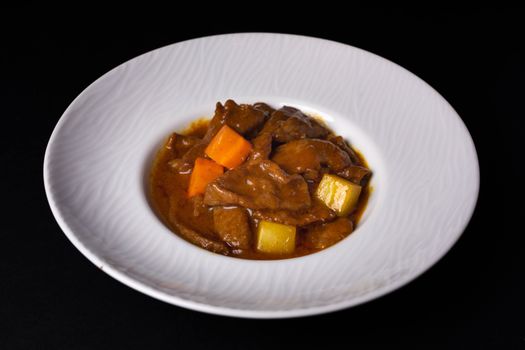
The diets react (see scores below)
Common Ingredients
- beef
- tomato sauce
- potatoes
- carrots
- onion
- garlic
- bay leaves
- soy sauce
Specific recipes may vary.
Incompatible with 7 of 11 diets
Diet Ratings
Mechado is fundamentally incompatible with a ketogenic diet in its traditional form. The dish contains two major high-carb starchy vegetables — potatoes and carrots — which alone can easily push a single serving well past the 20-50g daily net carb limit. Potatoes are one of the most carb-dense whole foods (~15-17g net carbs per 100g), and even a modest portion in a stew contributes significantly. Carrots add additional net carbs (~7g per 100g). Tomato sauce also contributes moderate carbs and often contains added sugars. While the beef is keto-friendly and garlic/onion in small amounts are manageable, the overall carbohydrate load from the starchy vegetables makes this dish a clear avoid for anyone maintaining ketosis.
Mechado is a Filipino beef stew with beef as its primary protein — a direct animal product that immediately disqualifies it from any vegan diet. There is no ambiguity here: beef is animal flesh and is categorically excluded under all definitions of veganism. While the supporting ingredients (tomato sauce, potatoes, carrots, onion, garlic, bay leaves, soy sauce) are all plant-based, the dish cannot be considered vegan in its traditional form.
Mechado contains two clear paleo violations that disqualify the dish outright. Soy sauce is a soy-based, grain-fermented condiment containing both legumes and wheat — both are strictly excluded from the paleo diet. It also typically contains added salt and preservatives, making it a processed food by paleo standards. White potatoes are a debated ingredient in the paleo community, but even setting that debate aside, soy sauce alone is a hard disqualifier. The remaining ingredients — beef, tomatoes, carrots, onion, garlic, and bay leaves — are fully paleo-compliant, but the dish as traditionally prepared cannot be approved or even placed in a caution category due to the definitive exclusion of soy sauce.
Mechado is a Filipino beef stew that fundamentally conflicts with Mediterranean diet principles. Red meat (beef) is the primary protein, which the Mediterranean diet limits to only a few times per month. The dish also contains soy sauce, a processed, high-sodium condiment not part of the Mediterranean tradition. While some ingredients are Mediterranean-friendly — tomatoes, potatoes, carrots, onion, and garlic are all wholesome plant foods — the dish is anchored by a large portion of red meat as the main protein source, and soy sauce adds processed sodium. The overall dietary pattern this dish represents (red meat-centric, soy-based seasoning) is contrary to Mediterranean guidelines, pushing it firmly into the 'avoid' category.
Mechado is a Filipino beef stew that is fundamentally incompatible with the carnivore diet. While beef is the primary protein and an excellent carnivore food, the dish is loaded with multiple plant-based ingredients: tomato sauce, potatoes, carrots, onion, garlic, bay leaves, and soy sauce. Soy sauce is derived from fermented soybeans (a legume) and wheat (a grain), making it doubly problematic. Potatoes and carrots are starchy root vegetables, onion and garlic are alliums, and tomato sauce is a plant-based condiment. The entire flavor profile and structure of this dish depends on plant ingredients, meaning it cannot be made carnivore-compliant without being fundamentally reconstructed into a completely different dish. Only the beef itself is carnivore-approved.
Mechado as traditionally made contains soy sauce, which is a soy-based product and therefore excluded on Whole30. Soy in any form (including soy sauce, tamari, and similar condiments) is a legume derivative and explicitly banned under Whole30 rules. All other ingredients — beef, tomato sauce (if no added sugar or non-compliant additives), potatoes, carrots, onion, garlic, and bay leaves — are otherwise Whole30-compatible. The dish could be made compliant by substituting coconut aminos for the soy sauce and verifying the tomato sauce has no added sugar or excluded ingredients.
Mechado contains two major high-FODMAP ingredients that make it unsuitable during the elimination phase: garlic (high in fructans even in very small amounts) and onion (one of the highest-FODMAP foods, also high in fructans). These two ingredients are foundational to the dish's flavor base and cannot simply be omitted without fundamentally changing the recipe. Soy sauce contains wheat and contributes fructans, adding another FODMAP source. While beef, potatoes, carrots, bay leaves, and tomato sauce (in moderate servings) are generally low-FODMAP, the presence of garlic and onion as core ingredients makes this dish a clear avoid during the FODMAP elimination phase. There is no realistic serving size at which a standard preparation of Mechado would be low-FODMAP.
Mechado contains several DASH-friendly components — tomatoes, potatoes, carrots, onion, and garlic are all vegetables encouraged on the DASH plan, providing potassium, fiber, and magnesium. However, two significant concerns bring this dish into 'caution' territory. First, beef is a red meat, which DASH limits due to saturated fat and cholesterol content; traditional mechado often uses fattier cuts like chuck or brisket. Second, soy sauce is a high-sodium ingredient — a single tablespoon contains approximately 900–1,000mg sodium, and combined with tomato sauce, total sodium per serving can easily exceed 600–900mg, consuming a substantial portion of the DASH daily limit (1,500–2,300mg). The dish is not inherently disqualifying if prepared with lean beef cuts, reduced-sodium soy sauce, and no-salt-added tomato sauce, but as commonly prepared in Filipino households, the sodium and saturated fat load make it a food to consume occasionally and in controlled portions rather than regularly.
NIH DASH guidelines explicitly limit red meat and high-sodium condiments like soy sauce; however, some updated clinical interpretations note that lean beef in moderate portions (3 oz) fits within the DASH protein allowance, and that the vegetable-heavy composition of mechado contributes meaningful potassium that can partially offset sodium's blood pressure effects — suggesting that a modified, lower-sodium version could score closer to a 6.
Mechado is a Filipino beef stew that presents several Zone Diet challenges. The primary protein (beef) can work in the Zone but is typically a fattier cut (chuck or brisket), making it less ideal than lean proteins like chicken breast or fish. More significantly, potatoes are explicitly listed as an 'unfavorable' high-glycemic carbohydrate in Dr. Sears' Zone framework — they spike blood sugar rapidly and are categorized alongside white bread and rice as foods to minimize. Carrots and onions are moderate-glycemic but acceptable in portions. Tomato sauce and garlic are favorable polyphenol-rich ingredients that Sears would appreciate. The dish as traditionally prepared would be carb-heavy (potatoes dominate), protein-moderate, and potentially higher in saturated fat depending on the beef cut. To bring Mechado into Zone compliance, one would need to: (1) swap potatoes for lower-GI vegetables (zucchini, green beans, bell peppers), (2) use a leaner beef cut or reduce portion size significantly, and (3) ensure the fat macro is balanced with monounsaturated sources. The sodium from soy sauce is a minor nutritional concern but not a Zone-specific issue. As traditionally prepared, the potato content is the primary disqualifier from a higher score.
Some Zone practitioners argue that the 40/30/30 ratio can still be achieved with unfavorable carbs like potatoes if portions are tightly controlled — a small amount of potato alongside lean beef and fibrous vegetables could still fit within the block framework. Additionally, Sears' later writings emphasize anti-inflammatory polyphenols, and the tomato sauce, garlic, and onion in Mechado provide meaningful polyphenol content that partially offsets concerns.
Mechado is a Filipino beef stew with a mixed anti-inflammatory profile. On the positive side, it contains several beneficial ingredients: garlic and onions provide quercetin and allicin with anti-inflammatory properties; tomatoes (via tomato sauce) supply lycopene and antioxidants; carrots contribute beta-carotene; and bay leaves offer modest anti-inflammatory phytochemicals. However, the dish is centered on beef, which is a red meat flagged under anti-inflammatory guidelines for its saturated fat content and arachidonic acid, both of which can promote inflammatory signaling when consumed regularly. Soy sauce adds significant sodium, which at high intake may contribute to vascular inflammation. Potatoes are a starchy, moderate-glycemic ingredient that are nutritionally neutral in this context. The dish is not inherently harmful and reflects a whole-foods cooking tradition, but the red meat base places it in the 'limit' category per anti-inflammatory principles. Occasional consumption is acceptable; it is not recommended as a regular staple. Choosing leaner cuts (e.g., round or sirloin), using low-sodium soy sauce, and keeping portions moderate would improve its anti-inflammatory profile.
Most anti-inflammatory protocols (Dr. Weil, IF Rating) recommend limiting red meat due to saturated fat and pro-inflammatory fatty acid profile, placing beef-centered dishes like Mechado in a caution tier. However, some researchers argue that minimally processed, grass-fed beef has a more favorable omega-3 to omega-6 ratio and that the overall dish context — with its antioxidant-rich vegetables, garlic, and tomatoes — partially offsets the beef's inflammatory potential, particularly in modest serving sizes.
Mechado is a Filipino beef stew featuring tomato sauce, potatoes, carrots, onion, and garlic. It has meaningful nutritional strengths: beef provides substantial protein, and the vegetable mix (carrots, potatoes, onion, tomato sauce) adds fiber, vitamins, and micronutrients. The tomato-based broth is relatively low in fat compared to cream- or coconut milk-based stews, and the dish is slow-cooked, making it easier to digest than fried or grilled beef. However, the primary protein source is beef, which typically includes cuts with moderate-to-high saturated fat content (chuck, brisket, or round are common in mechado). Soy sauce adds significant sodium, which can contribute to water retention and is worth monitoring. Potatoes are starchy and moderate on the glycemic index, and while they add volume and some fiber, they are less nutrient-dense per calorie than non-starchy vegetables. The fat content is highly cut-dependent: a leaner cut like beef round brings this closer to an approve, while fattier cuts like chuck in large portions push it toward the lower end of caution. Portion sensitivity is important here — a small serving with lean beef, focused on the broth and vegetables, is a reasonable GLP-1-compatible meal; a large, fatty portion is not.
Some GLP-1-focused dietitians caution against beef-based stews broadly due to saturated fat content and slower gastric emptying compounding the medication's own delayed motility effect, recommending chicken or fish as the protein base instead. Others consider lean-cut mechado an acceptable protein-and-vegetable meal provided portions are controlled and visible fat is trimmed, citing the tomato-based broth and vegetable fiber as genuine nutritional advantages.
*See how scores were generated at our methodology page.
Nutritional profile
Six traits that cut across every diet.
Fiber & Plants
How much whole-plant food and fiber it delivers.
Healthy Fats
The quality of its fats (unsaturated, omega-3).
Whole / Unprocessed
How close it is to its natural, unprocessed form.
Gut Gentle
How easy it is on digestion (low FODMAP, few irritants).
Low Glycemic
How little it spikes your blood sugar.
Protein Density
How much protein it packs per calorie.
Controversy Index
Higher controversy = more disagreement between diets.
Diet-Specific Tips
 DASH — 4/10
View tips
- Red meat (beef) is limited on DASH due to saturated fat content
- Soy sauce is high in sodium (~900–1,000mg per tablespoon), a major DASH concern
- Tomato sauce adds additional sodium unless no-salt-added variety is used
- Potatoes, carrots, onion, and garlic are DASH-positive vegetables providing potassium and fiber
- Dish can be improved significantly by using lean beef cuts, low-sodium soy sauce, and no-salt-added tomato sauce
- As commonly prepared, sodium per serving likely exceeds 700–1,000mg
 Zone — 4/10
View tips
- Potatoes are a high-glycemic 'unfavorable' carbohydrate explicitly discouraged in Zone Diet
- Beef is acceptable protein but fattier cuts common in Mechado increase saturated fat
- Tomato sauce, garlic, onion, and carrots contribute favorable polyphenols and low-GI carbs
- Dish can be Zone-adapted by replacing potatoes with low-GI vegetables
- Traditional portion sizes are likely carb-heavy relative to Zone's 40/30/30 target
- Soy sauce adds sodium but is not a Zone-specific concern
- Bay leaves are nutritionally negligible but contribute anti-inflammatory compounds
 Anti-Inflammatory — 4/10
View tips
- Beef (red meat) is the primary protein — flagged as 'limit' due to saturated fat and arachidonic acid content
- Garlic and onions provide anti-inflammatory quercetin and allicin
- Tomato sauce supplies lycopene and antioxidants
- Carrots contribute beta-carotene
- Bay leaves offer minor phytochemical anti-inflammatory benefit
- Soy sauce introduces high sodium, potentially problematic in large quantities
- No added oils or processed fats noted — a neutral factor
- Whole-food, minimally processed cooking base is a modest positive
 GLP-1 Friendly — 5/10
View tips
- Beef protein supports daily protein targets but cut selection critically determines saturated fat load
- Tomato-based broth is preferable to cream or coconut milk bases — easier to digest and lower in fat
- Potatoes add starchy carbohydrates and moderate glycemic load; portion sensitivity applies
- Carrots, onion, garlic, and tomato sauce contribute fiber, antioxidants, and micronutrients
- High sodium from soy sauce warrants monitoring, especially with hydration already a concern on GLP-1s
- Slow-cooked texture improves digestibility relative to grilled or fried beef
- Recommend lean cuts (round, sirloin) and trimming visible fat to optimize for GLP-1 compatibility
- Small-to-moderate portions recommended; large servings of fatty beef may worsen GI side effects