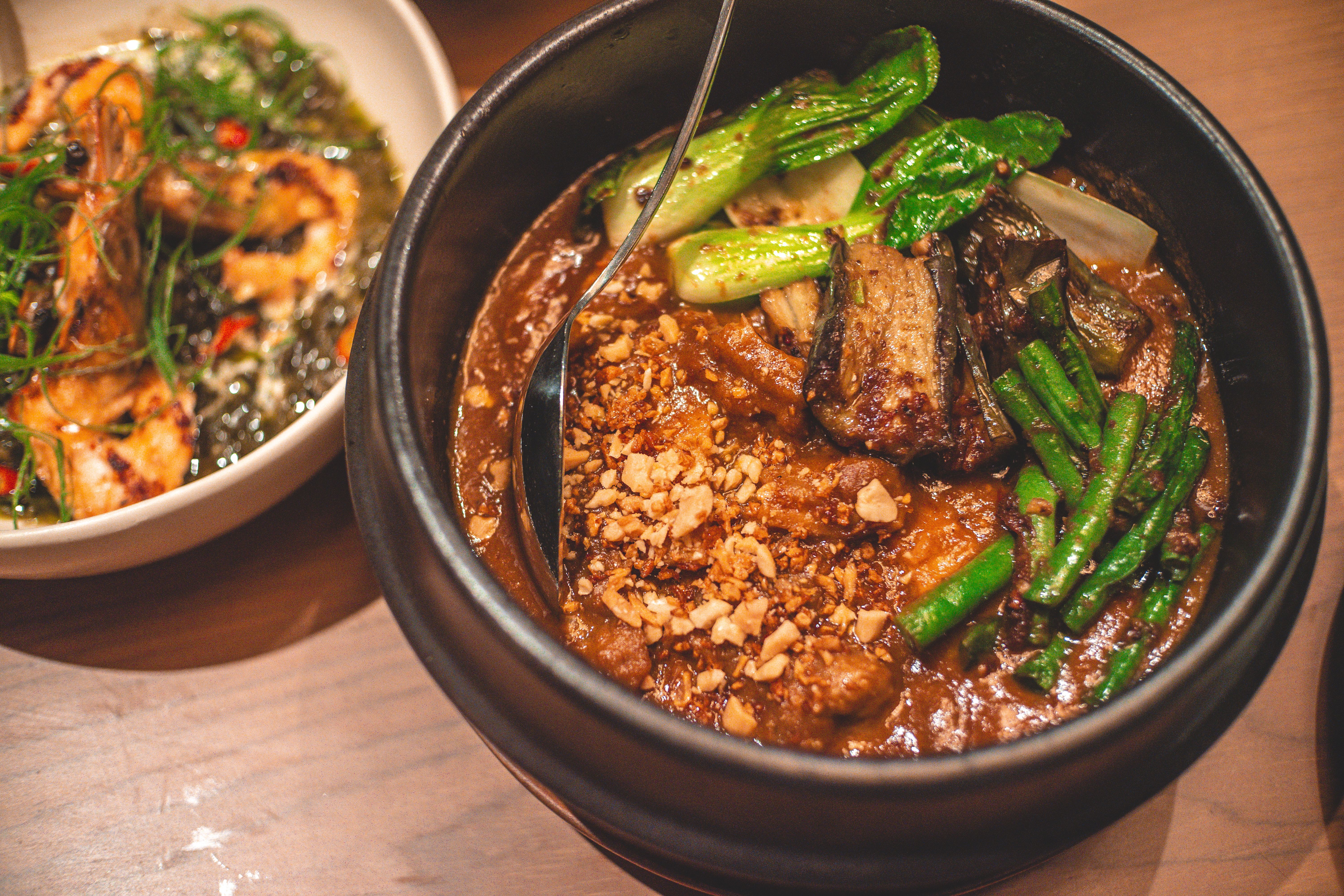
Photo: Josh Eleazar / Pexels
The diets react (see scores below)
Common Ingredients
- oxtail
- tripe
- peanut butter
- annatto
- eggplant
- bok choy
- string beans
- bagoong
Specific recipes may vary.
Incompatible with 8 of 11 diets
Diet Ratings
Kare-Kare is a Filipino stew built around oxtail and tripe, both of which are excellent keto proteins with high fat content. However, the dish's primary thickening agent — peanut butter — adds a notable carbohydrate load (roughly 6-8g net carbs per 2 tablespoons, and traditional recipes use a substantial amount). The vegetable additions (eggplant, bok choy, string beans) are relatively low-carb individually, but string beans are borderline and portions matter. Annatto (atsuete) is used in small amounts for color and contributes negligible carbs. The fermented shrimp paste (bagoong) served alongside is low-carb and keto-friendly. The main concern is the cumulative carb load from peanut butter in a full serving — a generous restaurant portion could push 15-25g net carbs, which may still fit within a 50g daily limit but leaves little room. With careful portioning and reducing peanut butter quantity, this dish can be worked into a keto day, but it is not a freely consumable keto staple.
Stricter keto practitioners flag peanut butter itself as problematic — not just for carb content, but because peanuts are legumes with an inflammatory omega-6 fatty acid profile; this camp recommends avoiding the dish entirely and substituting almond-based or macadamia-based thickeners if attempting a keto adaptation.
Kare-Kare contains multiple animal-derived ingredients that are unambiguously non-vegan. Oxtail and tripe are both bovine animal products — oxtail is the tail of a cow and tripe is the stomach lining. Bagoong, the traditional fermented shrimp or fish paste served alongside Kare-Kare, is an animal-derived condiment. While the sauce base (peanut butter, annatto) and vegetables (eggplant, bok choy, string beans) are fully plant-based, the primary protein components and the essential condiment make this dish incompatible with a vegan diet. There is no ambiguity here.
Kare-Kare is a traditional Filipino stew built around a peanut butter-thickened sauce, which immediately disqualifies it under strict paleo rules. Peanut butter is derived from peanuts, which are legumes — a clear avoid category. The dish is also traditionally served with bagoong (fermented shrimp paste), a heavily salted and processed condiment that contains added salt and preservatives, making it non-paleo. String beans (green beans) are also legumes, adding a second legume violation. While several individual ingredients are paleo-friendly — oxtail and tripe are excellent nose-to-tail paleo proteins, annatto is a natural seed-derived coloring, eggplant and bok choy are approved vegetables — the foundational elements of this dish (peanut butter sauce and bagoong) are incompatible with paleo principles. The dish cannot be considered paleo in its traditional form.
Kare-Kare is fundamentally incompatible with Mediterranean diet principles. The primary proteins are oxtail and tripe — both red meat offal cuts high in saturated fat, which the Mediterranean diet restricts to a few times per month at most. While the dish does include several approved vegetables (eggplant, bok choy, string beans), these positives are outweighed by the heavy use of peanut butter as the base sauce (adding significant calorie density and is not a traditional Mediterranean fat source), and bagoong (fermented shrimp paste), which is a highly processed, extremely high-sodium condiment that contradicts the diet's emphasis on minimally processed foods. The absence of olive oil, whole grains, or legumes as primary components, combined with the red meat-centric protein base, places this dish firmly outside Mediterranean dietary guidelines.
Kare-Kare is fundamentally incompatible with the carnivore diet despite containing excellent carnivore-friendly proteins (oxtail and tripe are prized organ/ruminant cuts). The dish is defined by its peanut butter base — a plant-derived legume product that is explicitly excluded from carnivore. Annatto is a plant-derived seed used as a colorant. The vegetable load is extensive: eggplant, bok choy, and string beans are all plant foods. Bagoong (fermented shrimp paste) is actually an animal-derived condiment and would be the one carnivore-acceptable component. The dish cannot be adapted without fundamentally ceasing to be Kare-Kare — the peanut sauce IS the dish. There is no debate within the carnivore community about peanut butter or vegetables; these are universally excluded.
Kare-Kare is disqualified primarily by two ingredients: peanut butter (peanuts are legumes, explicitly excluded on Whole30) and bagoong (fermented shrimp paste that almost universally contains added sugar and is often made with non-compliant additives). The remaining ingredients — oxtail, tripe, annatto, eggplant, bok choy, and string beans — are all Whole30-compliant. However, peanut butter is a core, structural component of this dish (it forms the sauce base), not a minor or easily-omitted ingredient. Bagoong is the traditional condiment served alongside and integral to the authentic experience of Kare-Kare. Because peanuts are explicitly prohibited as legumes under the official Whole30 program, this dish cannot be considered compliant in its traditional form.
Kare-Kare is a Filipino stew that presents multiple FODMAP concerns. The most significant issue is peanut butter, which is high-FODMAP at typical serving sizes due to GOS content — Monash rates peanut butter as low-FODMAP only at a very small 2 tablespoon (32g) serve, but in a rich stew like Kare-Kare, peanut butter forms the base of the sauce and is used in quantities far exceeding this threshold. String beans (also called green beans) are high-FODMAP at larger serves due to GOS — Monash considers them low-FODMAP only at 75g or less, but the cumulative load in a full serving of this stew is a concern. Bagoong (fermented shrimp paste), the traditional condiment served with Kare-Kare, is not well-tested by Monash, but its fermented, concentrated nature and typical use alongside other ingredients raises concern. Eggplant is low-FODMAP at standard serves (75g). Bok choy is low-FODMAP. Oxtail and tripe are protein sources with no FODMAPs. Annatto is used in small amounts and is considered low-FODMAP. The primary FODMAP problems are the peanut butter base (GOS in large quantities) and string beans, making this dish high-FODMAP at realistic serving sizes during elimination.
Monash rates peanut butter as low-FODMAP at exactly 2 tablespoons, so some practitioners may argue that a carefully portioned Kare-Kare with measured peanut butter could be tolerated; however, most clinical FODMAP dietitians would advise avoiding this dish during elimination given that peanut butter is the defining base ingredient and realistic portions far exceed the safe threshold. Bagoong's FODMAP status also lacks clear Monash testing data, adding further uncertainty.
Kare-Kare presents multiple significant conflicts with DASH diet principles. The dish is built on oxtail and tripe — high-fat, high-cholesterol cuts that are far from the lean proteins DASH emphasizes. Oxtail in particular is extremely high in saturated fat, which DASH explicitly limits. Peanut butter adds further saturated fat and calories, though it also contributes some beneficial unsaturated fats and protein. The most critical DASH violation is bagoong (fermented shrimp paste), which is one of the saltiest condiments in Filipino cuisine, containing well over 1,000mg of sodium per tablespoon — a single serving can easily push sodium intake beyond the entire daily DASH sodium ceiling (1,500–2,300mg). Bagoong is not a minor garnish in this dish; it is a defining and essential accompaniment. The vegetables (eggplant, bok choy, string beans) are genuinely DASH-positive, contributing potassium, fiber, and magnesium, but they cannot offset the saturated fat load of oxtail and tripe or the extreme sodium burden of bagoong. Annatto is neutral. Overall, the combination of high saturated fat from fatty cuts and extremely high sodium from bagoong places this dish firmly in the 'avoid' category.
Kare-Kare is a rich Filipino stew that presents a mixed Zone Diet profile. On the positive side, it contains excellent low-glycemic vegetables (eggplant, bok choy, string beans) that align well with Zone carbohydrate guidelines, and the peanut butter provides monounsaturated fats that fit the Zone fat profile. However, several challenges exist: oxtail and tripe are fatty cuts of beef with significant saturated fat content, which Zone discourages in favor of lean proteins. Peanut butter, while providing monounsaturated fat, also contributes carbohydrates and some omega-6 fats, making precise block balancing tricky. The annatto is nutritionally negligible. The fermented shrimp paste (bagoong), served as a condiment, adds sodium but minimal macros. The overall dish can be portioned to approximate Zone ratios — emphasizing the vegetable components, using a modest portion of the oxtail/tripe, and counting the peanut butter carefully as both a fat and partial carb block — but the fatty protein cuts and the richness of the peanut sauce make it difficult to hit the 30% lean protein target without deliberate adjustment. This is a 'use with caution and careful portioning' food rather than an avoid, as the vegetable base and monounsaturated fat from peanuts provide real Zone-friendly elements.
Some Zone practitioners, particularly those following Sears' later anti-inflammatory framework, might rate this more favorably, noting that oxtail collagen and the polyphenol content in annatto and vegetables partially offset the saturated fat concern. Others might rate it lower, arguing the peanut-heavy sauce makes precise block balancing nearly impossible in a restaurant or traditional preparation context.
Kare-Kare is a traditional Filipino stew with a mixed anti-inflammatory profile. On the positive side, it features an impressive array of anti-inflammatory vegetables — eggplant (nasunin antioxidant), bok choy (glucosinolates, vitamin C), string beans (flavonoids, fiber), and annatto (bixin, a carotenoid with antioxidant properties). Peanut butter contributes monounsaturated fats, resveratrol, and some anti-inflammatory polyphenols, though it is also relatively high in omega-6 fatty acids. The problematic elements are the primary proteins: oxtail is a fatty cut of beef rich in saturated fat and arachidonic acid, both of which are associated with pro-inflammatory signaling. Tripe (beef stomach) is a processed organ meat that is high in saturated fat and cholesterol. The fermented shrimp paste condiment bagoong, while probiotic in nature, is extremely high in sodium, which can promote systemic inflammation at excessive intake levels. The dish is a classic case of anti-inflammatory vegetables embedded in a pro-inflammatory protein-and-fat base. Consumed occasionally as part of a mostly plant-forward diet, it is acceptable; consumed regularly, the saturated fat and omega-6 load from the beef cuts and peanut butter tip it toward a pro-inflammatory direction.
Some anti-inflammatory practitioners, drawing on Dr. Weil's more flexible pyramid, would note that traditional whole-food preparations like Kare-Kare — rich in diverse vegetables and minimally processed ingredients — compare favorably to ultra-processed Western foods, and that the collagen from oxtail may have gut-lining benefits. Critics aligned with stricter anti-inflammatory protocols (e.g., the Ornish or Esselstyn frameworks) would flag the saturated fat content from oxtail and tripe as clearly pro-inflammatory and cardiovascular-risk-elevating.
Kare-Kare is a poor fit for GLP-1 patients in its traditional form. Oxtail and tripe are both high in saturated fat and collagen-heavy connective tissue, making them slow to digest and heavy on a stomach that already has delayed gastric emptying. The peanut butter-based sauce is calorie-dense and high in fat per serving — while peanut butter contains unsaturated fats and some protein, the volume used in kare-kare is substantial and contributes significant fat load per typical serving. The vegetables (eggplant, bok choy, string beans) are genuinely beneficial — high fiber, nutrient-dense, easy to digest — but they are outweighed by the problematic protein and sauce components. Bagoong (fermented shrimp paste served as condiment) is extremely high in sodium, which is a concern for fluid retention and blood pressure, and its intense fermented flavor can trigger nausea or reflux in patients already sensitive to strong smells and tastes. The overall dish is high in saturated fat, high in sodium, low in lean protein density relative to calories, and heavy enough to worsen GLP-1 GI side effects including nausea, bloating, and reflux. The small-portion-friendliness is also poor — a small serving of this dish delivers more fat than protein benefit.
*See how scores were generated at our methodology page.
Nutritional profile
Six traits that cut across every diet.
Fiber & Plants
How much whole-plant food and fiber it delivers.
Healthy Fats
The quality of its fats (unsaturated, omega-3).
Whole / Unprocessed
How close it is to its natural, unprocessed form.
Gut Gentle
How easy it is on digestion (low FODMAP, few irritants).
Low Glycemic
How little it spikes your blood sugar.
Protein Density
How much protein it packs per calorie.
Controversy Index
Higher controversy = more disagreement between diets.
Diet-Specific Tips
 Keto — 4/10
View tips
- Peanut butter is the primary carb source and thickener — net carbs scale directly with quantity used
- Oxtail and tripe are high-fat, zero-carb proteins well-suited to keto
- String beans contribute moderate carbs (~4-5g net per half-cup) and should be limited
- Eggplant and bok choy are relatively low net-carb vegetables in reasonable portions
- Bagoong (fermented shrimp paste) is keto-compatible and adds negligible carbs
- Full restaurant servings may approach or exceed 20g net carbs from peanut butter alone
- Dish is keto-adaptable by reducing peanut butter volume or substituting with lower-carb nut butter
 Zone — 5/10
View tips
- Oxtail and tripe are high-saturated-fat proteins, misaligning with Zone lean protein guidelines
- Peanut butter sauce provides monounsaturated fat but also adds carbs and omega-6 fatty acids, complicating block calculations
- Excellent vegetable lineup (eggplant, bok choy, string beans) strongly supports Zone low-glycemic carbohydrate goals
- Bagoong condiment adds sodium but negligible macro impact
- Dish can approximate Zone ratios with careful portioning: small protein portion, generous vegetables, measured peanut sauce
- Traditional preparation tends toward fat-heavy ratios that exceed Zone's 30% fat target
 Anti-Inflammatory — 4/10
View tips
- Oxtail and tripe are fatty red meat cuts high in saturated fat and arachidonic acid — pro-inflammatory
- Peanut butter provides monounsaturated fats and polyphenols but also contributes omega-6 fatty acids
- Eggplant, bok choy, and string beans are anti-inflammatory vegetables with antioxidants and fiber
- Annatto (bixin/norbixin) is a carotenoid with documented antioxidant and anti-inflammatory activity
- Bagoong (fermented shrimp paste) is very high in sodium, which can promote inflammation at high intake
- Dish is a whole-food, traditionally prepared recipe with no refined carbohydrates or artificial additives
- Overall saturated fat load from the protein base outweighs the vegetable benefits for regular consumption